

Subscribe to receive new articles by e-mail. It’s free, but if you like, you can pledge a donation:
Join the Telegram group if you would like to join the live lessons. This course is maintained with your donations. Click here to donate.
💬 Text of the lesson
What is beyond Lokāloka
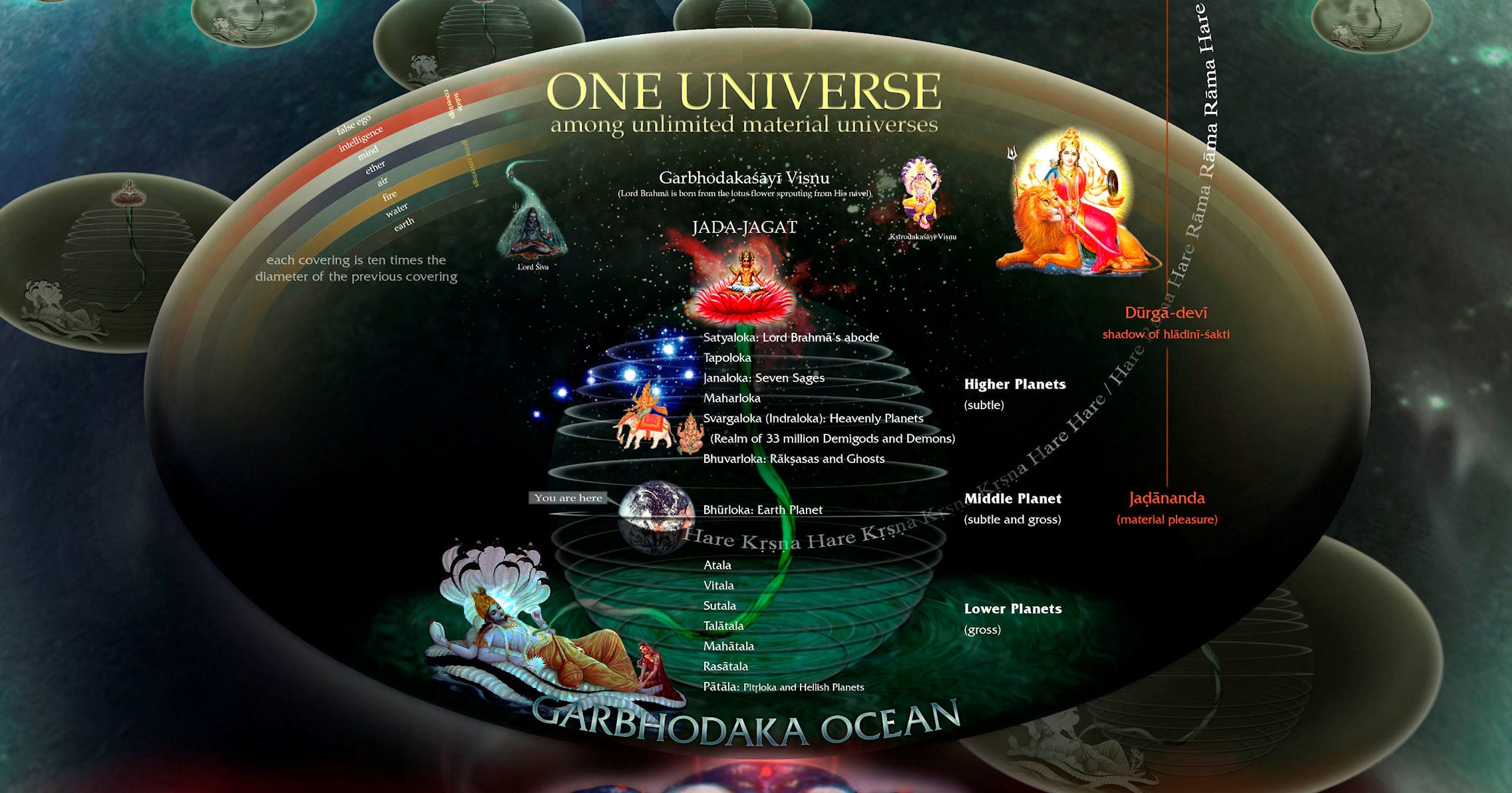
Lokāloka is described in the text as loka-traya-ante: situated at the end of Bhūrloka, Bhuvarloka and Svargaloka, the physical realm that includes the lower, intermediate and celestial planetary systems, extending up to Dhruvaloka, the polestar. From the description, these appear to comprise what in modern cosmology is understood as our galaxy.
Beyond that, higher in the subtle vertical dimension, are the very subtle planetary systems of Maharloka, Janaloka, Tapoloka, and Satyaloka that are the abode of great sages. These abodes extend much beyond Dhruvaloka and are exponentially larger than Svargaloka and the rest. It appears that they form the rest of the observable universe, beyond our galaxy and including everything else that exists inside of our universe. Beyond them there are the seven coverings of the universe (each one exponentially larger than the previous) and beyond that, the impersonal Brahmajyoti and the Causal ocean (in which all the other universes float), and beyond that, the spiritual planets. The whole creation is thus many orders of magnitude larger than believed in modern cosmology, spreading much beyond the barriers of space and time.
“On the top of Lokāloka Mountain are the four gaja-patis, the best of elephants, which were established in the four directions by Lord Brahmā, the supreme spiritual master of the entire universe. The names of those elephants are Ṛṣabha, Puṣkaracūḍa, Vāmana and Aparājita. They are responsible for maintaining the planetary systems of the universe.
The Supreme Personality of Godhead is the master of all transcendental opulences and the master of the spiritual sky. He is the Supreme Person, Bhagavān, the Supersoul of everyone. The demigods, led by Indra, the King of heaven, are entrusted with seeing to the affairs of the material world. To benefit all living beings in all the varied planets and to increase the power of those elephants and of the demigods, the Lord manifests Himself on top of that mountain in a spiritual body, uncontaminated by the modes of material nature. Surrounded by His personal expansions and assistants like Viṣvaksena, He exhibits all His perfect opulences, such as religion and knowledge, and His mystic powers such as aṇimā, laghimā and mahimā. He is beautifully situated, and He is decorated by the different weapons in His four hands.
The various forms of the Supreme Personality of Godhead, such as Nārāyaṇa and Viṣṇu, are beautifully decorated with different weapons. The Lord exhibits those forms to maintain all the varied planets created by His personal potency, yoga-māyā.
My dear King, outside Lokāloka Mountain is the tract of land known as Aloka-varṣa, which extends for the same breadth as the area within the mountain — in other words, 125,000,000 yojanas [one billion miles]. Beyond Aloka-varṣa is the destination of those who aspire for liberation from the material world. It is beyond the jurisdiction of the material modes of nature, and therefore it is completely pure. Lord Kṛṣṇa took Arjuna through this place to bring back the sons of the brāhmaṇa.” (SB 5.20.39-42)
It is described that Lokāloka is supported on four sides by four great elephants. However, just as Lokāloka is not an ordinary mountain, these are not ordinary elephants, nor do they serve as just ordinary weights on the sides of the structure.
Just as Brahmā creates the demigods as predominating deities of the different forces that govern the cosmos, he creates also these four elephant-deities to embody the forces that maintain the whole universal structure. The names of these divine elephants give us some clues about these potencies. Ṛṣabha means “the foremost” or chief, giving the idea of strength and power. Puṣkaracūḍa means “lotus-crested” which indicates purity. Vāmana means “small” or “short”, giving the idea of fine control, or restraint, while Aparājita means “unconquered” or “invincible” indicating control that can’t be challenged or overthrown.
We can see that after describing these four gaja-patis, the text describes the Supreme Lord, indicating that He is the real maintainer and overseer. He manifests in His spiritual form above the whole structure of the universe, surrounded by His personal expansions, assistants, opulences, mystic potencies, etc. This again indicates that He is the power behind all material creation, and that everything works under His control. These four gaja-patis are thus just manifestations of His power, just like the demigods and other powerful beings who maintain the universe.
“The sun is situated [vertically] in the middle of the universe, in the area between Bhūrloka and Bhuvarloka, which is called antarikṣa, outer space. The distance between the sun and the circumference of the universe is twenty-five koṭi yojanas [two billion miles].
The sun-god is also known as Vairāja, the total material body for all living entities. Because he entered this dull egg of the universe at the time of creation, he is also called Mārtaṇḍa. He is also known as Hiraṇyagarbha because he received his material body from Hiraṇyagarbha [Lord Brahmā].
O King, the sun-god and the sun planet divide all the directions of the universe. It is only because of the presence of the sun that we can understand what the sky, the higher planets, this world and the lower planets are. It is also only because of the sun that we can understand which places are for material enjoyment, which are for liberation, which are hellish and subterranean.
All living entities, including demigods, human beings, animals, birds, insects, reptiles, creepers and trees, depend upon the heat and light given by the sun-god from the sun planet. Furthermore, it is because of the sun’s presence that all living entities can see, and therefore he is called dṛg-īśvara, the Personality of Godhead presiding over sight.” (SB 5.20.43-46)
The next two chapters will describe in more detail the orbit of the sun. The sun is situated slight over Bhū-mandala, close to the vertical middle of the universe.
According to the description, the sun travels in the middle of the space between Mount Sumeru and Mānasottara Mountain, over the ocean of yogurt. However, because the breadth of the islands increase exponentially, this is actually very close to the horizontal center of the universe. It is described thus that the sun is 250 million yojanas from the covering of the universe, which is half of the circumference. This is just a rounded number.
The universe is called a “dull egg” because it is composed of material elements that are originally inert. It starts working only when the Supreme Lord enters into it through His potencies, accompanied by all the jīvas.
The mysterious commentary by Śrīla Viśvanātha Cakravartī Ṭhākura
Is his purport to text 5.20.38, Śrila Prabhupāda quotes a long Sanskrit commentary by Śrīla Viśvanātha Cakravartī Ṭhākura, without including a translation for it. This long, mysterious block of untranslated Sanskrit text adds to the mystique of the Fifth Canto.
This commentary by Śrīla Viśvanātha Cakravartī Ṭhākura details the formula for calculating the breadth of Jambūdvīpa and gives a few extra details about the structure. It also raises a small detail not mentioned in the main text of Śrīmad Bhāgavatam: the existence of a small gap between the borders of Bhū-mandala and the coverings of the universe.
This text is very technical, and the numbers appear to not add up at first. However, when the text is studied keeping in mind the conclusions Prabhupāda gives in his translations and purports of the verses of the 20th chapter, the text becomes understandable.
Here is a translation and a short commentary on how the numbers add up and how it matches the explanations of Śrila Prabhupāda:
sa tu lokālokas tu bhū-golakasya bhū-sambandhāṇḍa-golakasyety arthaḥ; sūryasy eva bhuvo ’py aṇḍa-golakayor madhya-vartitvāt kha-golam iva bhū-golam api pañcāśat-koṭi-yojana-pramāṇaṁ tasya turīya-bhāgaḥ sārdha-dvādaśa-koṭi-yojana-vistārocchrāya ity arthaḥ bhūs tu catus-triṁśal-lakṣonapañcāśat-koṭi-pramāṇā jñeyā;
“Here, Lokāloka is related to the bhū-golaka and the aṇḍa-golaka. Because both the sun and the earth are situated in the vertical middle of the universe, the area occupied by Bhū-mandala, just like the celestial domain (kha-gola) spreads for 50 koṭi yojanas (500,000,000 yojanas). One quarter of this is twelve-and-a-half koṭi yojanas (125,000,000 yojanas). However, the whole Bhū-mandala should be known as having the measure of 50 koṭi minus 34 lakṣa yojanas (496,600,000 yojanas).”
The word bhū-golaka indicates Bhū-mandala, and aṇḍa-golaka refers to cosmic egg-sphere, or the inner boundary of the universal covering, that functions as the barrier-limit of the universe. The Lokāloka mountains are the border between the inhabited areas of the universe and the uninhabited part. Kha-gola means the celestial domain, or Svargaloka, which is positioned just above Bhū-mandala.
The value of 500,000,000 yojanas is given in the Śrīmad Bhāgavatam as the total breadth of the internal area of the universe. Śrīla Viśvanātha Cakravartī Ṭhākura, however, argues that Bhū-mandala is slightly smaller than that, as he will explain.
If taken literally, the term “bhū-golaka” can be translated as “the earth-globe”. However, in the context, it doesn’t mean Earth in the sense of our planet, but Bhū-mandala, the extended earth described in the Śrīmad Bhāgavatam. This understanding is reinforced by the term “gola” being used to also describe Svargaloka, which is a planetary system, rather than a single globe. In SB 5.20.38, Prabhupāda translates “bhū-golasya” as “of the planetary system known as Bhūgolaka,” reinforcing the meaning of the term as a planetary system composed of multiple globes, and not as a single globe. Logic shows that this is the correct interpretation, since Viśvanātha’s text describes that bhū-golaka is situated in the vertical middle of the universe, under Svargaloka, and has a diameter of 496.6 million yojanas. Taken bhū-golaka as a globe, the description makes no sense.
It is also important to emphasize that “gola” can also be translated as “round” or “circle”, which appears more appropriate in the context. Bhū-golaka can be thus translated as “the earthly circle” or as “the earthly domain”, describing Bhū-mandala, and kha-gola as “the celestial circle” or celestial domain, describing Svargaloka. Aṇḍa-golaka thus describes the circumference of the internal boundary of the coverings of the universe around both.
yathā meru-madhyān mānasottara-madhya-paryantaṁ sārdha-sapta-pañcāśal-lakṣottara-koṭi-yojana-pramāṇam; mānasottara-madhyāt svādūdaka-samudra-paryantaṁ ṣaṇ-ṇavati-lakṣa-yojana-pramāṇaṁ tataḥ kāñcanī-bhūmiḥ sārdha-sapta-pañcāśal-lakṣottara-koṭi-yojana-pramāṇā evam ekato meru-lokālokayor antarālam ekādaśa-śal-lakṣādhika-catuṣ-koṭi-parimitam anyato ’pi tatha
“The individual distances are as follows: The distance from the middle of Meru up to the middle of Mānasottara is 1 koṭi plus 57½ lakṣas (15,750,000 yojanas). Then, the distance from the middle of Mānasottara to the ocean of sweet-water is 96 lakṣas (9,600,000 yojanas). Then, the breadth of the golden land is again 1 koṭi plus 57½ lakṣas (15,750,000 yojanas). Thus, the total distance comes to 4 koṭis plus 11 lakṣas (41,100,000 yojanas) and the measure of the opposite side is the same.”
The distance from the middle of Mānasottara mountain up to the end of the ocean of sweet water is 9,600,000 yojanas, which is followed by the inhabited tract of land beyond it (mentioned in ŚB 5.20.35), which measures 15,750,000 yojanas more. In this way, the total distance between Meru and the end of the inhabited part of the universe comes to 41,100,000 yojanas (15,750,000 + 9,600,000 + 15,750,000).
In his translation of SB 5.20.35, Prabhupāda mentions: “
Beyond the ocean of sweet water is a tract of land as broad as the area between the middle of Mount Sumeru and the boundary of Mānasottara Mountain. In that tract of land there are many living beings. Beyond it, extending to Lokāloka Mountain, is another land, which is made of gold. Because of its golden surface, it reflects light like the surface of a mirror, and any physical article that falls on that land can never be perceived again. All living entities, therefore, have abandoned that golden land.”
Here, Prabhupāda concludes that the last of the seven islands of Bhū-mandala is divided into two parts: one inhabited, and another, uninhabited. The description of Prabhupāda of the inhabited land beyond the ocean of sweet water matches the golden land of 15,750,000 yojanas mentioned here by Viśvanātha Cakravartī.
tyeto lokālokāl loka-paryantaṁ sthānaṁ dvāviṁśati-lakṣottarāṣṭa-koṭi-parimitaṁ lokālokād bahir apy ekataḥ etāvad eva anyato ’py etāvad eva yad vakṣyate, yo ’ntar-vistāra etena hy aloka-parimāṇaṁ ca vyākhyātaṁ yad-bahir lokālokācalād
“The next expanse of land, reaching as far as Lokāloka, has a measure of 8 koṭis plus 22 lakṣas (82,200,000 yojanas). The land beyond Lokāloka, extends for exactly the same as on the other side, and on the opposite side, again we have the same amount. Thus, since the measurement of the inner size is given, the breadth of Aloka-varṣa, which lies outside the Lokāloka mountain, can also be understood.”
Prabhupāda mentions in SB 5.20.35 that beyond the ocean of sweet water, there is a large tract of inhabited land, as broad as the area between Mount Sumeru and Mānasottara Mountain. Beyond it, there is a golden land, extending to Lokāloka Mountain.
The land with a breadth of 15,750,000 yojanas mentioned in the previous passage matches the inhabited area, and the larger land of 82,200,000 yojanas extending up to the Lokāloka mountains matches the uninhabited land mentioned by Prabhupāda. There is some apparent divergence centered on the interpretation of the words bhūmiḥ kāñcanī in SB 5.20.35 (Viśvanātha appears to attribute it to the inhabited area, and Prabhupāda to the uninhabited area around it), but it is clear that the two explanations describe the same model.
As previously stated, the inhabited part goes for 15,750,000 yojanas, and then there are 82,200,000 yojanas more of the uninhabited land that extends up to the Lokāloka mountains. The total, thus, comes to 123,300,000 yojanas in the calculation given.
With this, we have 41,100,000 yojanas for the inhabited part of the universe, plus 82,200,000 yojanas for the breadth of uninhabited golden land, a total of 123,300,000 yojanas. After the boundary of Lokāloka, we have another area of the same breadth, which corresponds to Aloka-varṣa, the dark, uninhabited area of the universe that extends up to the border of Bhū-mandala.
On the other side of Mount Sumeru, we have the same distance to the opposite side, multiplying this total by two.
ity ekato lokālokaḥ sārdha-dvādaśa-koṭi-yojana-parimāṇaḥ anyato ’pi sa tathety evaṁ catus-triṁśal-lakṣonapañcāśat-koṭi-pramāṇā bhūḥ sābdhi-dvīpa-parvatā jñeyā
“Thus, twelve-and-a-half koṭi (125,000,000 yojanas) is the total measure up to Lokāloka, and from the other side also the same. In this way, the total measure of Bhū-mandala, with all its oceans, islands, and mountains, should be understood as measuring 50 koṭi minus 34 lakṣas yojanas (496,600,000 yojanas).”
Twelve-and-a-half koṭi (125,000,000 yojanas) is the value mentioned in the Śrīmad Bhāgavatam for a quarter of the total diameter of the universe. The total diameter is thus 500,000,000 yojanas. Śrila Viśvanātha Cakravartī’s thesis, however, is that Bhū-mandala is slightly smaller than the total diameter of the universe, extending for 496,600,000 yojanas. This leaves a small portion of empty space between the border of Bhū-mandala and the covering of the universe, which he explains later on.
One valid question at this point is that, following the previous calculation, we come to a total of 123,300,000 yojanas from Sumeru to the end of the uninhabited land. If we add the same for the other side of Lokāloka, and then multiply the total by two (adding the other side from Mount Sumeru), we come to 493,200,000 yojanas, which is different from the value of 496,600,000 yojanas given in Viśvanātha’s commentary.
From where does this difference come? The text does not explicitly explain, but we can infer it from the details mentioned.
The commentary mentions that 123,300,000 yojanas is the distance up to Lokāloka (lokāloka-paryantam sthānam); it does not include the mountain itself.
What is then the breadth of this cosmic barrier? Some interpret the words as meaning that Lokāloka mountain in itself has a breadth of 123,300,000 yojanas, going all the way to the border of Bhū-mandala. However, the text mentions “lokālokāt bahiḥ” which means outside Lokāloka, or beyond the boundary, and not within the mountain. This is reinforced by SB 5.20.36:
lokāloka iti samākhyā yad anenācalena lokālokasyāntarvar-tināvasthāpyate
“Between the lands inhabited by living entities and those that are uninhabited stands the great mountain which separates the two and which is therefore celebrated as Lokāloka.”
Therefore, according to the text, we have 123,300,000 yojanas before Lokāloka and 123,300,000 yojanas after it, and then the same on the other side of Sumeru. Considering that after mentioning this, the verse states that the total diameter is 496,600,000 yojanas, the logical conclusion is that the difference corresponds to the breadth of the Lokāloka barrier in itself.
We thus have 123,300,000 yojanas from Sumeru to Lokāloka, then 1,700,000 yojanas of the barrier itself, and 123,300,000 yojanas more on the other side (aloka-varṣa), bringing the total to 248,300,000 yojanas. We then have the same on the other side of Sumeru, bringing the final total to 496,600,000 yojanas, which is the same number he gives.
What about the figure of 125,000,000 yojanas? Viśvanātha’s commentary mentions that “twelve-and-a-half koṭi (125,000,000 yojanas) is the total measure up to Lokāloka, and from the other side also the same.” How does it connect to the numbers given?
125,000,000 yojanas is the total distance from Sumeru up to the end of Lokāloka (123,300,000 + 1,700,000). If we start from the border of Bhū-mandala and go to the other side of Lokāloka, we have again the same. This kind of beautiful symmetry again proves that the universe didn’t appear by chance.
ata evāṇḍa-golakāt sarvato dikṣu sapta-daśa-lakṣa-yojanāvakāśe vartamāne sati pṛthivyāḥ śeṣa-nāgena dhāraṇaṁ dig-gajaiś ca niścalī-karaṇaṁ sārthakaṁ bhaved anyathā tu vyākhyāntare pañcāśat-koṭi-pramāṇatvād aṇḍa-golaka-lagnatve tat tat sarvam akiñcit-karaṁ syāt cākṣuṣe manvantare cākasmāt majjanaṁ śrī-varāha-devenotthāpanaṁ ca durghaṭaṁ syād ity adikaṁ vivecanīyam.
“Therefore, there is an open space of 17 lakṣas (1,700,000 yojanas) within the aṇḍa-golaka on all sides. Understanding that, the description of Bhū-mandala being held by Śeṣanāga and balanced by the directional elephants becomes meaningful. Otherwise, if we take the measure as exactly fifty koṭis (500,000,000 yojanas) with Bhū-mandala being fixed to the covering, this description would be pointless. Another point is that the account of Bhū-mandala sinking and being lifted by Śrī Varāhadeva would be difficult to explain without this being considered.”
Aṇḍa-golaka means the cover of the universe. He argues that Bhū-mandala doesn’t extend all the way to the covering, leaving a narrow gap. This gap explains how Bhū-mandala can submerge into the causal ocean and be rescued by Varāhadeva, and the necessity of the four universal elephant-deities balancing it. As he argues, without this gap, these descriptions would not make sense. This gap is of the same breadth as Lokāloka, again proving that the universe didn’t appear by chance.
1,700,000 yojanas on all sides means we have 1,700,000 yojanas on one side of Bhū-mandala and 1,700,000 more on the other side. 496,600,000 yojanas plus two times 1,700,000 amounts to exactly 500,000,000, the number given in the Śrīmad Bhāgavatam for the total diameter of the universe.
Here are two tables that make it easy to follow the calculations given by him:
The breadth of the different islands and oceans:
Jambūdvīpa: 100,000 yojanas (same for the saltwater ocean)
Plakṣadvīpa: 200,000 yojanas (same for the sugarcane-juice ocean)
Śālmalīdvīpa: 400,000 yojanas (same for the liquor ocean)
Kuśadvīpa: 800,000 yojanas (same for the oil ocean)
Krauñcadvīpa: 1,600,000 yojanas (same for the milk ocean)
Śākadvīpa: 3,200,000 yojanas (same for the yogurt ocean)
Puṣkaradvīpa: 6,400,000 yojanas (same for the sweet-water ocean)
Inhabited land beyond the sweet water ocean: 15,750,000 yojanas
The uninhabited land extending to Lokāloka: 82,200,000 yojanas
Aloka-varṣa: 123,300,000 yojanas
Cumulative distances from Mount Sumeru to the outer edge of the different lands and oceans:
Sumeru > Jambūdvīpa: 50,000 yojanas (half of the diameter of the island, since Sumeru is in the middle)
Sumeru > Saltwater ocean: 150,000 yojanas
Sumeru > Plakṣadvīpa: 350,000 yojanas
Sumeru > Sugarcane-juice ocean: 550,000 yojanas
Sumeru > Śālmalīdvīpa: 950,000 yojanas
Sumeru > Liquor ocean: 1,350,000 yojanas
Sumeru > Kuśadvīpa: 2,150,000 yojanas
Sumeru > Oil ocean: 2,950,000 yojanas
Sumeru > Krauñcadvīpa: 4,550,000 yojanas
Sumeru > Milk ocean: 6,150,000 yojanas
Sumeru > Śākadvīpa: 9,350,000 yojanas
Sumeru > Yogurt ocean: 12,550,000 yojanas
Sumeru > Puṣkaradvīpa: 18,950,000 yojanas
Sumeru > Sweet-water ocean: 25,350,000 yojanas
Sumeru > Inhabited land beyond the sweet water ocean: 41,100,000 yojanas
Sumeru > Uninhabited land: 123,300,000 yojanas
Sumeru > Lokāloka: 125,000,000 yojanas
Sumeru > Aloka-varṣa: 248,300,000 yojanas
Sumeru > Border of the universe: 250,000,000 yojanas
Total diameter of Bhū-mandala: 496,600,000 yojanas
Open space: 1,700,000 yojanas on both sides
Total diameter of the universe: 500,000,000 yojanas.
This is a publication for thoughtful readers who want to go deeper into Kṛṣṇa consciousness. I publish daily, and all posts are available to free subscribers. If you wish, you can also choose a paid subscription to support this work. By subscribing, you also gain access to the manuscripts of the books I’m currently working on.
If you would like to contribute further, you can find the donation links here.
Hare krishna Prabhuji. Why don't u make virtual AI movie of the universe keeping all the dimensions in mind.