

You can receive new articles directly in your inbox. Subscription is free; donations are welcome.
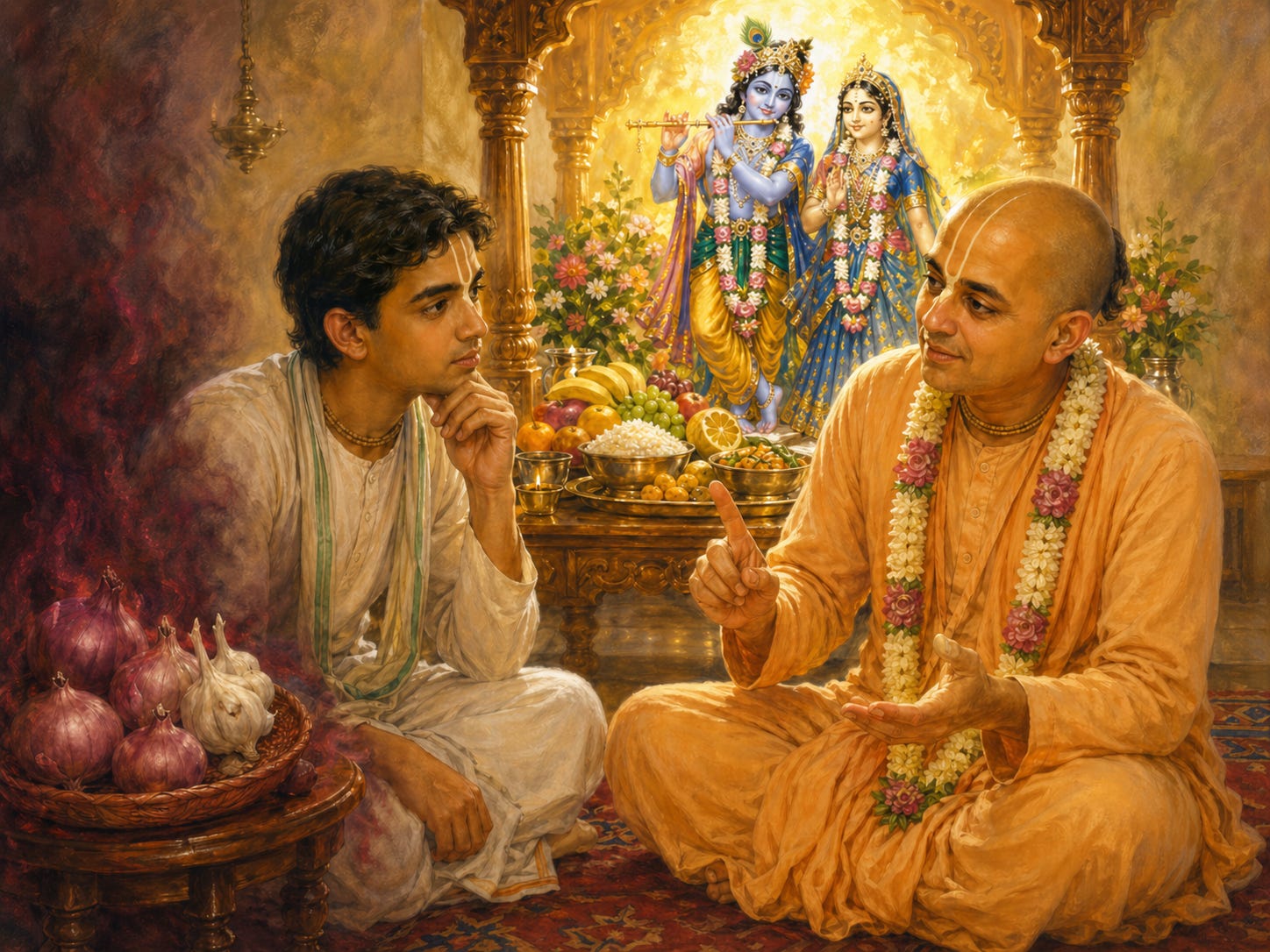
“Recently a young man started visiting our center and chanting, and even coming to maṅgala-ārati. He keeps asking me about onions and garlic. I gave him the basic answers, but he is still not satisfied. What more can be mentioned?”
One point that we can consider is that in Vaiṣnava philosophy, we don’t take food simply as nutrition but as something that affects our consciousness. The highest principle is to always remember Kṛṣṇa and never forget Him. Practically everything we do, or don’t, is connected with that. The ultimate reason why we don’t eat meat or gamble, for example, is that these things make us more entangled in material existence and push us away from Him. If eating garlic and onions would give us love of godhead, all our ācāryas would be doing it. Unfortunately, it gets in the way, and that’s why it is avoided.
As long as our mind is influenced by passion and ignorance, it is very difficult to be fixed in spiritual practice. That’s a mistake many of us make. We think that spiritual practice is just a matter of determination, of trying harder, but it has a lot to do with changing our habits. We can see that in the Gītā, Kṛṣṇa spends several chapters explaining the three material modes, so we can recognize the symptoms, habits, actions, etc., connected with each. This is not just theoretical knowledge; it is possibly the most practical part of the book.
It is further explained in the Śrīmad-Bhāgavatam:
“When the mode of goodness, which is luminous, pure and auspicious, predominates over passion and ignorance, a man becomes endowed with happiness, virtue, knowledge and other good qualities. When the mode of passion, which causes attachment, separatism and activity, conquers ignorance and goodness, a man begins to work hard to acquire prestige and fortune. Thus in the mode of passion he experiences anxiety and struggle. When the mode of ignorance conquers passion and goodness, it covers one’s consciousness and makes one foolish and dull. Falling into lamentation and illusion, a person in the mode of ignorance sleeps excessively, indulges in false hopes, and displays violence toward others.
When consciousness becomes clear and the senses are detached from matter, one experiences fearlessness within the material body and detachment from the material mind. You should understand this situation to be the predominance of the mode of goodness, in which one has the opportunity to realize Me.
You should discern the mode of passion by its symptoms — the distortion of the intelligence because of too much activity, the inability of the perceiving senses to disentangle themselves from mundane objects, an unhealthy condition of the working physical organs, and the unsteady perplexity of the mind. When one’s higher awareness fails and finally disappears and one is thus unable to concentrate his attention, his mind is ruined and manifests ignorance and depression. You should understand this situation to be the predominance of the mode of ignorance.” (SB 11.25.13-18)
To become fixed on the spiritual platform, we first need to situate ourselves in the mode of goodness. That’s the platform where the mind becomes peaceful, and we can fix our thoughts on Kṛṣṇa. The problem with garlic and onions is that they send us back, influencing us in the opposite direction. This is something recognized not just by Vaiṣnavas, but by other groups of spiritualists; it is not a matter of dogma, but of the study of practical effects. They push us towards passion and ignorance, making us more restless and prone to material activities, more impulsive, more prone to lust and anger, and less thoughtful in our actions. It makes us more dull or gross, less sensitive to subtle devotional feelings. It pushes our consciousness more in the direction of doing and achieving in the material platform and less in the direction of internal peace and clarity.
They are, of course, not in the same category of meat, which comes from violence or alcohol that directly affects our consciousness, but they also affect us in a noticeable way. This is one point that can make them more dangerous instead of less, because it tends to make us less careful. It is easy to understand that meat is something that has to be avoided, but garlic may seem innocent. It is indeed much less serious, but the problem is that by consuming it regularly, our consciousness becomes lower, and we tend to go to more negative things later. If one wants to just chant Hare Kṛṣṇa for now and continue in the next life, it may be ok, but if one wants to be serious in the spiritual process, that’s something to avoid.
There is also another important point that is often overlooked: foods with garlic and onions can’t be offered to Kṛṣṇa, just as industrialized foods and other impure items. In the Gītā (3.13), Kṛṣṇa mentions, “The devotees of the Lord are released from all kinds of sins because they eat food which is offered first for sacrifice. Others, who prepare food for personal sense enjoyment, verily eat only sin.”
We can chant the mantras, of course, but Kṛṣṇa will not really accept them, because they are fundamentally impure. This will deprive us of eating prasāda, which is another important factor in spiritual practice.
One could question this point of Kṛṣṇa not accepting food that contains garlic and onions, arguing that in another passage, He mentions that He eats what is offered with devotion. The point is, however, that devotion means offering things that are pleasant. If he mentions he doesn’t like something, and we deliberately put it in His food, is that really devotion?
If we want to invite a guest to our house, we need to feed him. Feeding a guest means offering what he likes to eat. If we know about his preferences, but we keep offering something he doesn’t like, that’s not good hospitality. Maybe he will not want to stay. Kṛṣṇa is the most exalted guest, and he explains His preferences in the Gītā and other books. He doesn’t demand much: even a leaf or flower will do. He can eat the same things we eat, but they have to be pure; that’s the point. As soon as we make our eating pure, we can offer everything to Kṛṣṇa, and everything works perfectly.
One could argue that garlic and onions are not directly mentioned in the Gītā, but the same applies to many other items. Nowhere in the Gītā does Kṛṣṇa say we should not smoke or drink beer, but we learn that these things are negative through paramparā. Kṛṣṇa gives the guidelines, and our ācāryas help us to apply these guidelines in practice.
The guideline for foods is given in Bg 17.8-10. The direct word is not there, but the description is clear enough:
“Foods dear to those in the mode of goodness increase the duration of life, purify one’s existence and give strength, health, happiness and satisfaction. Such foods are juicy, fatty, wholesome, and pleasing to the heart. Foods that are too bitter, too sour, salty, hot, pungent, dry and burning are dear to those in the mode of passion. Such foods cause distress, misery and disease. Food prepared more than three hours before being eaten, food that is tasteless, decomposed and putrid, and food consisting of remnants and untouchable things is dear to those in the mode of darkness.”
Once, in the very early days of our movement, Śyāmasundara Prabhu was appointed to carve the first deities of Jagannātha, Baladeva, and Subhadrā for ISKCON San Francisco. Once, when Śrīla Prabhupāda visited his workshop, he saw a pack of cigarettes on the floor. He knocked it out with his cane and told him, “Don’t let a small thing like cigarettes stand between you and Kṛṣṇa.” This summarizes the point. If something gets in the way, why continue doing it? It’s not about condemnation but about making our lives easier.
One could also bring up the point of using it as medicine. This is accepted. Practically anything can be used medicinally when needed, because in this case, we work from the principle of the greater good. Prabhupāda himself once prescribed garlic tea as a medicine for a lady disciple who was constantly sick. The point is about using it when there is no necessity.
This is a publication for thoughtful readers who want to go deeper into Kṛṣṇa consciousness. I publish daily, trying to offer high-quality spiritual content, and all posts are available to free subscribers. If you wish, you can also choose a paid subscription to support this work.
You can also receive the updates on WhatsApp or Telegram.
If you would like to contribute further, you can find the donation links here.
Wonderful article - Thank you so very much dear Chaitanaya Chandra Prabhu
There are some wonderful Shlokas in the Manu-Samhita, why we should not eat Onion Garlic Mushrooms etc?
(Manusmriti 5.5)
लशुनं गृञ्जनं चैव पलाण्डुं कवकानि च ।
अभक्ष्याणि द्विजातीनाम् अमेध्यप्रभवानि च ॥५॥
Transliteration:
laśunaṃ gṛñjanaṃ caiva palāṇḍuṃ kavakāni ca |
abhakṣyāṇi dvijātīnām amedhya-prabhavāni ca || 5 ||
English Translation:
“Garlic, leeks (or certain root vegetables), onions, and mushroom
and all things produced from impure substances are unfit to be eaten by the twice-born (dvijas).”
Chapter 5 of Manusmriti deals largely with dietary rules and purity for the dvija (twice-born classes). Several verses in this section list foods considered “abhakṣya” (not fit to eat) for ritual purity.
Hare Krishna