

Subscribe to receive new articles by e-mail. It’s free, but if you like, you can pledge a donation:
Generally, we think about fruitive activity (karma) as being influenced by passion, and philosophic inquiry (jñana) by goodness, but there is a tinge of ignorance in both, coming from the lack of positive spiritual knowledge about our eternal position of service to the Lord. This ignorance keeps us bound to this material world. Even if one eventually attains the impersonal brahmajyoti, as impersonalists do, one falls back again if there is not at least a tinge of devotional service.
To become situated in the platform of devotional service, we need to come in contact with a self-realized soul, offering some service and asking questions. Without this process, we continue bound to the mistake of identifying the body with the self, and the cycle of selfish action that keeps us bound to the material energy. Just as the work of a karmī wanting to improve his material condition or being elevated to the celestial planets, the efforts of a jñani trying to attain impersonal liberation with the goal of extinguishing suffering are self-motivated. Freedom comes from reviving the original nature of the soul, acting for the satisfaction of Krsna.
The difficulty is that it is not very easy to complete separate devotional service from material hankering and philosophical speculation. We tend to mix, and this can undermine our progress.
See this purport by Śrīla Prabhupāda to SB 5.5.7, for example:
“In the lowest stage of devotional life, one is not an unalloyed devotee. Anyābhilāṣitā-śūnyaṁ jñāna-karmādy-anāvṛtam: to be an unalloyed devotee, one must be freed from all material desires and untouched by fruitive activity and speculative knowledge. On the lower platform, one may sometimes be interested in philosophical speculation with a tinge of devotion. However, at that stage one is still interested in sense gratification and is contaminated by the modes of material nature. The influence of māyā is so strong that even a person advanced in knowledge actually forgets that he is Kṛṣṇa’s eternal servant. Therefore he remains satisfied in his householder life, which is centered around sexual intercourse. Conceding to a life of sex, he agrees to suffer all kinds of material miseries. Due to ignorance, one is thus bound by the chain of material laws.”
Śrīla Prabhupāda sets the bar quite high on this purport, classifying anyone who is not a pure devotee as being in the “lowest stage of devotional life”. We should, however, take it with humility and not be discouraged. The point is that attaining the highest goal of life in a single, short human life demands serious commitment, and Śrīla Prabhupāda is trying to shake us out of the comfortable platform of karma-miśra-bhakti or jñāna-miśra-bhakti and become serious in reestablishing our original, pure consciousness.
Prabhupāda uses the term “pure devotee” in different ways in his writings. Sometimes, “pure devotee” is used in the sense of uttama-adhikārī, a devotee who achieved perfection, but he uses it more commonly in the sense of an unalloyed devotee, someone who is not mixing his practice of bhakti with karma and jñana (kevala–bhakti). This makes it easier to understand the progression he is describing here.
In the lowest stage, we have the devotee who is intentionally mixing his practice with material progress and philosophical speculation. At this stage, one is mainly doing material activities or mental speculation, with just a tinge of devotion. This practice is not sufficient to free one from the influence of the material modes, and thus one will remain full of material desires. Prabhupāda urges us to go beyond that.
The next stage is when we understand the goal of life, and we are striving to attain it, seriously practicing the devotional process and trying to gradually get rid of our material attachments and impurities. At this stage, one may not be perfect yet, but he may be called a pure devotee in the sense that he is not mixing his bhakti with karma and jñana. By practicing and associating with other pure devotees, we can gradually develop and attain the platform of purity.
This process is detailed in a sequence of verses in the same chapter of this purport, starting with SB 5.5.10. These verses are part of the instructions of Lord Ṛṣabhadeva to his sons:
“O My sons, you should accept a highly elevated paramahaṁsa, a spiritually advanced spiritual master. In this way, you should place your faith and love in Me, the Supreme Personality of Godhead. You should detest sense gratification and tolerate the duality of pleasure and pain, which are like the seasonal changes of summer and winter. Try to realize the miserable condition of living entities, who are miserable even in the higher planetary systems. Philosophically inquire about the truth. Then undergo all kinds of austerities and penances for the sake of devotional service. Give up the endeavor for sense enjoyment and engage in the service of the Lord. Listen to discussions about the Supreme Personality of Godhead, and always associate with devotees. Chant about and glorify the Supreme Lord, and look upon everyone equally on the spiritual platform. Give up enmity and subdue anger and lamentation. Abandon identifying the self with the body and the home, and practice reading the revealed scriptures. Live in a secluded place and practice the process by which you can completely control your life air, mind and senses. Have full faith in the revealed scriptures, the Vedic literatures, and always observe celibacy. Perform your prescribed duties and avoid unnecessary talks. Always thinking of the Supreme Personality of Godhead, acquire knowledge from the right source. Thus practicing bhakti-yoga, you will patiently and enthusiastically be elevated in knowledge and will be able to give up the false ego.” (SB 5.5.10-13)
This can be broken into several points:
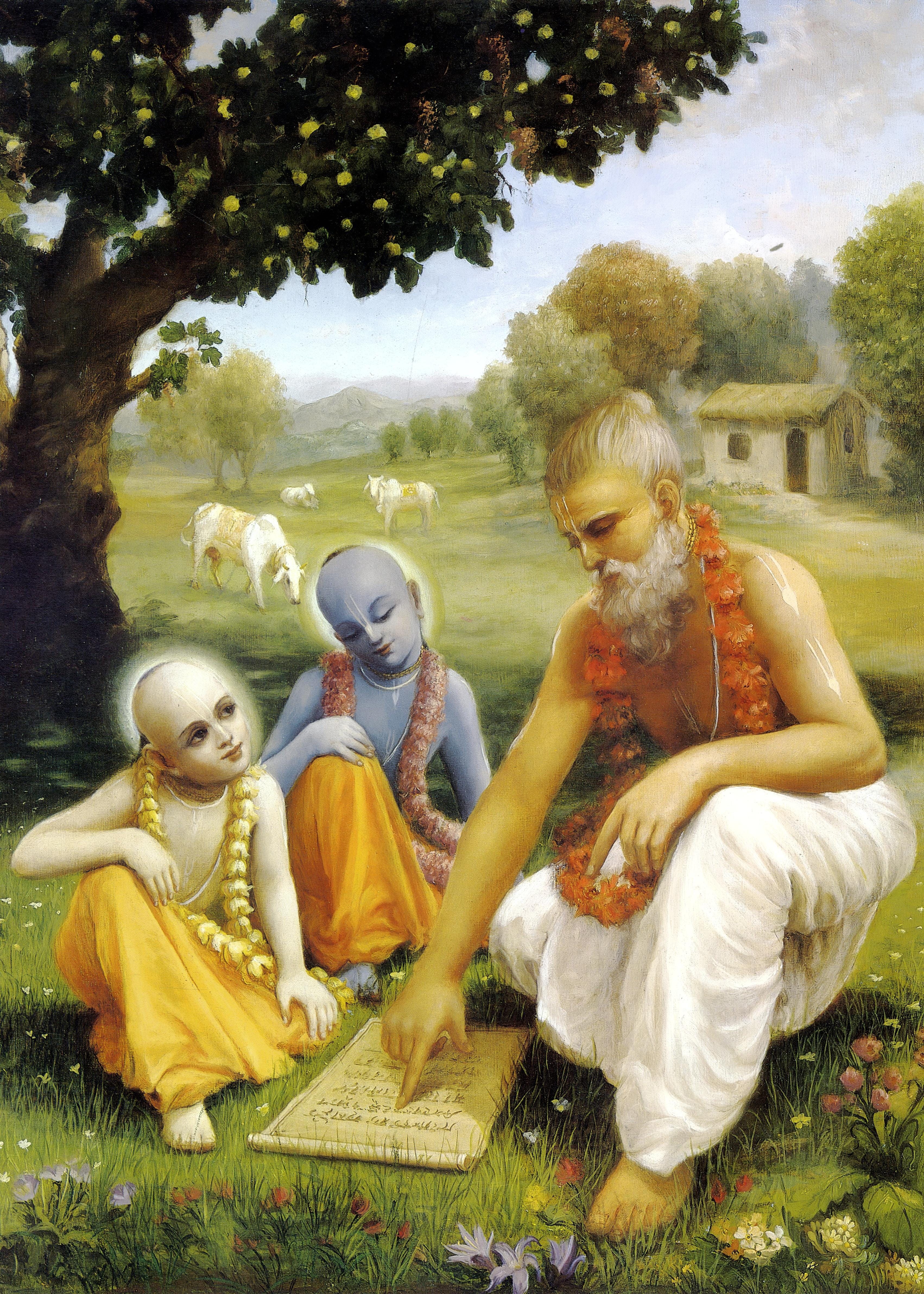
a) The first principle described by Lord Ṛṣabhadeva is to accept a spiritual master, who should be a highly elevated paramahaṃsa. Acceptance of a spiritual master is the most basic principle in spiritual life, valid for all processes of realization, and especially for bhakti. Just as we can’t become doctors or engineers without studying in a university under the guidance of qualified teachers, we can’t properly understand the spiritual science without studying it under the guidance of someone who has perfected it. Prabhupāda sustains this with two famous quotes: “śrī-guru-pādāśrayaḥ. To be freed from the entanglement of the material world, one has to approach a spiritual master. Tad-vijñānārthaṁ sa gurum evābhigacchet. By questioning the spiritual master and by serving him, one can advance in spiritual life.”
b) By hearing from the spiritual master and developing faith in his personal example, we learn to place our faith and love in the Supreme Lord and realize that this material world is a place of misery, where we all live in very precarious situations. This leads to the process of brahma-jijñāsā, inquiring about the Absolute truth, and developing a profound philosophical understanding.
c) Being trained by the spiritual master means following a system of spiritual discipline, which helps us learning to tolerate the material duality of pain and pleasure, understanding that they come and go in cycles that are beyond our control, just like the seasons of the year. Instead of trying to fix a situation that can’t be fixed, we learn to focus on solving the underlying problem by developing our Krsna Consciousness. By doing that, we acquire a higher taste, and sense gratification automatically becomes distasteful.
d) After becoming fixed in the process, we should undergo austerities for developing our devotional service. This means accepting inconveniences for performing activities that are pleasing to Krsna, especially spreading Krsna Consciousness. We can see how much of their lives and energy many disciples of Śrīla Prabhupāda sacrificed, especially in the early days of our movement. This is the fastest way to attract the mercy of the Lord.
e) Even while spreading Krsna Consciousness or any other important task, we should not forget about the basics. We should always listen to lectures and discussions about the Lord, associate with devotees, chant the holy names, etc. We should also work on our internal qualities, looking upon others equally, controlling the impulses of the mind, including anger and lamentation, avoiding unnecessary talks, etc.
f) Prabhupāda explains that there are two types of celibacy. One is a brahmacārī or sannyāsi who has no connection with the opposite sex, and the other is a householder who has relations only with his wife, according to religious principles. We can follow celibacy by observing either of the two methods, according to what is more suitable in our circumstances.
g) By following this process, we can gradually develop spiritual taste and always think of Krsna. By this constant contact with the Lord, we can develop perfect, realized spiritual knowledge, which frees us from the false ego, which is the root cause of our material conditioning.
In his purport, Prabhupāda summarizes: “As Śrī Madhvācārya points out, the sum and substance of these four ślokas is that one should refrain from acting out of a desire for sense gratification and should instead always engage in the Lord’s loving service. In other words, bhakti-yoga is the acknowledged path of liberation.”
This process of rules and regulations recommended by Ṛṣabhadeva is not directly bhakti per see, but it is a process that gradually elevates us to the platform of pure devotion, and in this sense it becomes an integral part of the process, just as the process of yoga starting with yama and niyama taught by Lord Kapila in the third canto.
In general, it is not possible for a conditioned soul to be immediately elevated to a platform of pure devotion; we need to shed our material contaminations first. In this sense, rules and regulations performed under the guidance of the spiritual master are an essential and integral part of the process. Sahajiyās reject this process, aiming to jump directly into a stage of spontaneous devotional service, but it doesn’t work. Instead of cleaning the heart, they conserve their material addictions and try to impose them on the lila.
You can also donate using Buy Me a Coffee, PayPal, Wise, Revolut, or bank transfers. There is a separate page with all the links. This helps me enormously to have time to write instead of doing other things to make a living. Thanks!