

Subscribe to receive all new articles directly by e-mail. It’s free, but if you like, you can pledge a monthly or annual donation to support my work:
Throughout the history of mankind, countless books, movies, songs, poetry, etc. have been composed on the subject of love. People desire and cherish it, but not many can obtain it, and even fewer can maintain it. Therefore, love often results in a broken heart. Just like this material world is temporary, love here is also temporary, subject to change, and ultimately to forgetfulness.
However, there is another reality, the spiritual world. How does love exist there?
The first concept to understand when we speak about the spiritual realm is that it is the opposite of this material world. Not in the sense of not having forms or activities, but in terms of quality. In the Bhagavad-gītā, Krsna compares the material world to a tree reflected in a lake, observed by someone who is on the opposite shore.
The reflection of the tree in the lake looks exactly like the real tree, with leaves, branches, a trunk, and roots. However, there is a crucial difference: the reflection is inverted. While the real tree has its roots downward and the leaves upward, the reflection has the roots upward and the leaves downward. As He mentions:
“It is said that there is an imperishable banyan tree that has its roots upward and its branches down and whose leaves are the Vedic hymns. One who knows this tree is the knower of the Vedas. The branches of this tree extend downward and upward, nourished by the three modes of material nature. The twigs are the objects of the senses. This tree also has roots going down, and these are bound to the fruitive actions of human society. The real form of this tree cannot be perceived in this world. No one can understand where it ends, where it begins, or where its foundation is.” (Bg 15.1-4)
In this analogy, the real tree represents the spiritual world, while the reflected tree represents the material cosmos. Just like in a reflection, everything that exists in the spiritual universes is also present in the material side, but in a corrupted or inverted way. For example, there are forms in the spiritual world; therefore, we also have forms here. The difference is that forms in the spiritual universe are eternal and perfect, while here they are imperfect and temporary.
Similarly, love is present in the spiritual world, but there it is manifested in its pure and perfect form, while here in the material universes it’s subjected to the imperfections of this world.
In the spiritual world, souls cultivate eternal relationships with Kṛṣṇa, who manifests Himself in different forms, according to the aspirations of His different devotees. For some, he appears as an all-powerful, opulent Supreme Personality of Godhead; for others, as a loyal friend, as a beloved son, or as a husband or paramour. These different relationships are divided into five categories:
The first level is śānta-rasa, or neutrality. In this platform, souls observe and admire, but there is no direct impetus to serve. They are satisfied in assuming immovable forms, such as rocks or trees, and simply observing the pastimes of the Lord and chanting His glories.
The next relationship is dāsya-rasa. Souls in this platform develop a taste for directly serving Kṛṣṇa in any of His unlimited forms. Now, there is a propensity for service, but the relationship is very formal, and this formality limits its intensity.
Souls who can surpass this fear and formality can enter into sakhya-rasa, where the servitude becomes friendship. In this platform, Kṛṣṇa appears as a loyal friend, and the relationship becomes much deeper. One example of a soul who cultivates a friendly relationship with Kṛṣṇa is Arjuna. Every time Kṛṣṇa comes to a material universe, Arjuna comes with Him, and they have many adventures together.
The next level is vātsalya-rasa. At this level, the love becomes so intense that one develops a taste for taking care of Kṛṣṇa and protecting Him from any danger. Friendship is based on seeing Kṛṣṇa as an equal who can defend Himself, while vātsalya-rasa means developing such a strong desire to serve and protect Kṛṣṇa that one starts seeing Him as a subordinate, someone who needs protection. How can this happen? Due to the cover of yoga-māyā, the divine potency of the Lord. One has full knowledge of the opulences of Kṛṣṇa, but because the devotional sentiment is so strong, yoga-māyā covers this knowledge, and one starts seeing Kṛṣṇa as a defenseless child that one has to protect. In this level, formality completely disappears, and Kṛṣṇa becomes the beloved son, just like in the case of mother Yaśodā and Nanda Maharaja.
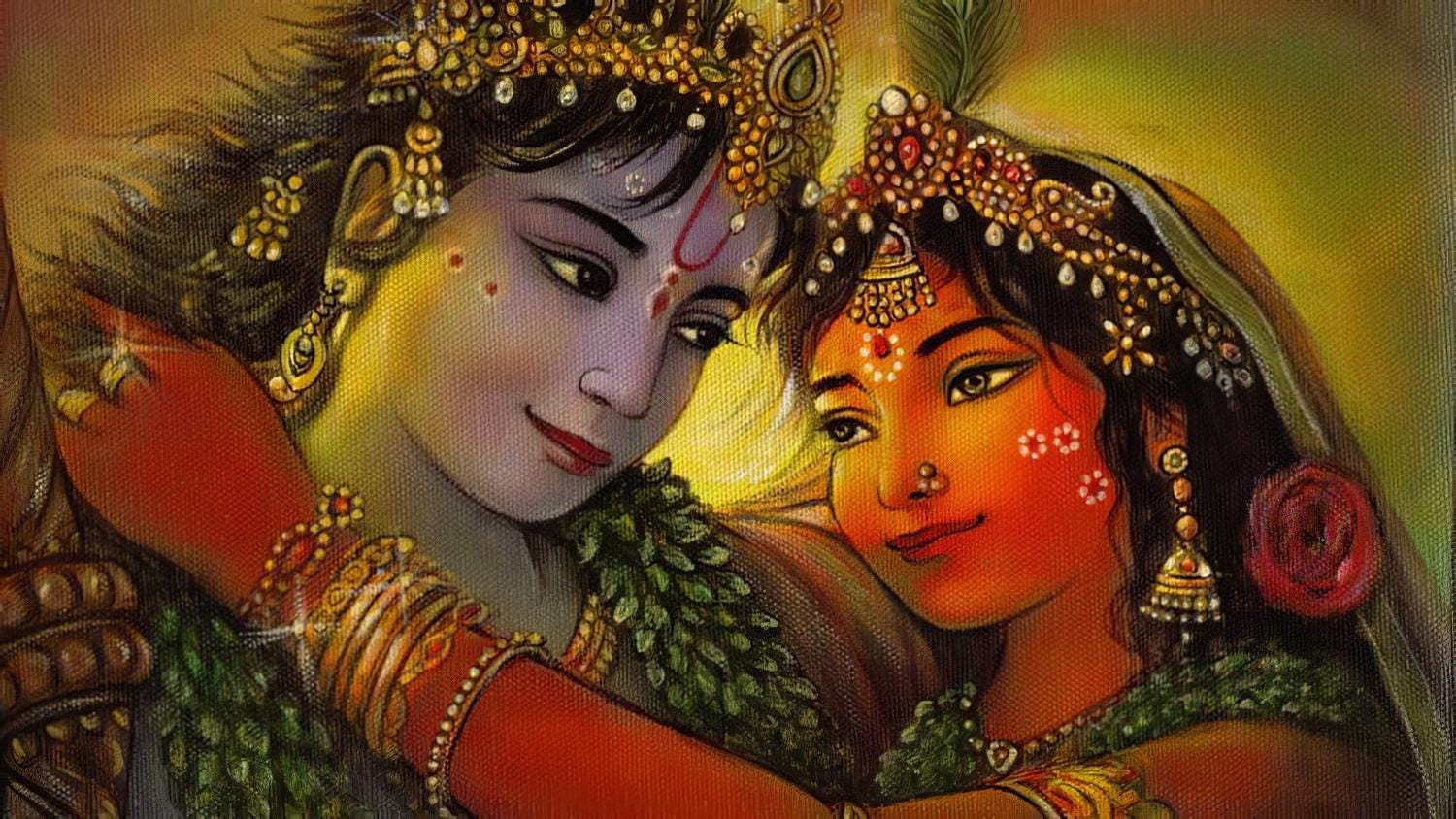
The most intense of the five relationships is mādhurya-rasa. Souls who attain this level of perfection desire to cultivate a loving relationship with Kṛṣṇa, like the queens of Dvaraka and the cowherd girls of Vṛndāvana. This is the most intense of the five relationships and involves the highest level of love and purity.
These five levels of relationships are reflected in this world, and therefore, we also have lovers, friends, sons, and masters. The problem is that in the material sphere, these relationships are not as pure as in the spiritual world. One may serve a master, but he expects a salary; one may take care of a son, but expects that he will eventually grow up and take care of him or her in his older age. One may love a boyfriend, but this love will continue only as long as the boyfriend continues to act in a certain way. When one’s expectations are not fulfilled, this love can be easily converted into hate.
In the spiritual world, these five relationships are classified only according to the intensity of the relationship. They are all completely pure, and in this sense non-different, but śānta-rasa, neutrality, is distant and therefore is considered the least exalted, while mādhurya-rasa, conjugal relationship, is the most intense, and thus considered the highest.
When these five relationships are reflected in the material realm, they become affected by the material modes, and thus the order is inverted, as the relationships become contaminated by lust.
Conjugal relationship, which is the highest in the spiritual realm, being the relationship that involves the most intense love, becomes the lowest in the material world, involving the most lust. On the other hand, neutrality, which is the least intense in the spiritual platform, when reflected, becomes the highest, because it is the one that involves the least lust. In the material world, neutrality means indifference to material objects and material lust, which is actually a good platform, leading one to gradually ascend to the platform of liberation and, from there, to a platform of pure devotional service.
Lust is actually the opposite of love. Love means to give, while lust means to take. Lust means that we desire something that a person has, and we do what is necessary to obtain it. A man who lusts after the body of a woman may do anything necessary to attract her, not out of love, but just because of interest. As soon as his purposes are fulfilled, he can dump her in the coldest ways. Similarly, a woman may cultivate a relationship out of some interest and reject a man when he is not useful anymore. Many of us experienced this on one side or the other.
Among all the relationships in this material world, this type of exploitative relationship based on lust is the lowest and most degraded. Therefore, we all need to curb this propensity to gradually elevate ourselves from the platform of lust to the platform of love.
True love is based on giving and caring. Real love is unconditional and does not depend on a particular purpose being fulfilled. Lust means to use another to achieve satisfaction, while love means to desire to make another happy without imposing any conditions.
The first step is to convert this exploitative tendency into a nourishing propensity. This is done by entering family life. Different from a mere affair, which can be dumped at any time, a relationship between husband and wife is based on commitment, “until death do them part,” as they used to say. It means to care for a person even when things don’t go our way, “in health and in sickness.”
This stable relationship leads one to the next stage of this gradual progression: to love one’s children. The love for one’s children is much purer because it involves caring and nourishing without the expectancy of any immediate return. A mother does not serve her children because she expects some payment; she serves them out of love. The children do not always behave well: they may misbehave or even reject the mother’s love, but the mother still loves them. There is still some material contamination in the sense that one expects the children to develop in certain ways, to take care of him or her in old age, etc., but it is purer than other types of relationships.
As one goes through this experience and learns this unconditional love, he or she can expand it to others who are not related to him or her by blood. One enters them into the realm of pure friendship and service without interest, where one simply serves and cares for others without expectation of return. When one achieves this platform, he or she is ready to understand what true love is and to understand these different relationships in the spiritual platform. This is the progression that leads us to the spiritual platform.
This unconditional love is the essence of the process of devotional service, but it is something very difficult to understand while we are still in the conditioned stage, conditioned by lust. By going through these different stages, we can eventually start to understand it.
You can also donate using Buy Me a Coffee, PayPal, Wise, Revolut, or bank transfers. There is a separate page with all the links. If you prefer, you can also receive the updates on Telegram.