

Subscribe to receive new articles by e-mail. It’s free, but if you like, you can pledge a donation:
In the Bhagavad-gītā, Kṛṣṇa mentions that “What is night for all beings is the time of awakening for the self-controlled; and the time of awakening for all beings is night for the introspective sage.”
This does not simply mean that a self-realized person lives in a different time zone; it indicates a complete change in activities and life priorities. A regular person is interested in improving his or her material condition, getting a better job, more money, new experiences, followers on Instagram, etc., while a self-realized person understands the futility of it and instead focuses his or her time on pursuing spiritual progress. This leads to significant changes in one’s practical actions and the way he or she perceives life. One will dismiss what others see as opportunities and instead spend time on what they perceive as eccentric or useless activities, such as chanting, going to the temple, studying scriptures, etc. The eating habits will change, the dress may change, and so on.
To the new devotee, these changes may feel natural and positive, and usually they are. Even by material standards, we can’t deny that avoiding meat, alcohol, promiscuous sex, etc. is a positive step. By practicing these sāttvic habits, combined with spiritual practice, we discover a new understanding of life and become enthusiastic about practicing it. We change, sometimes very quickly.
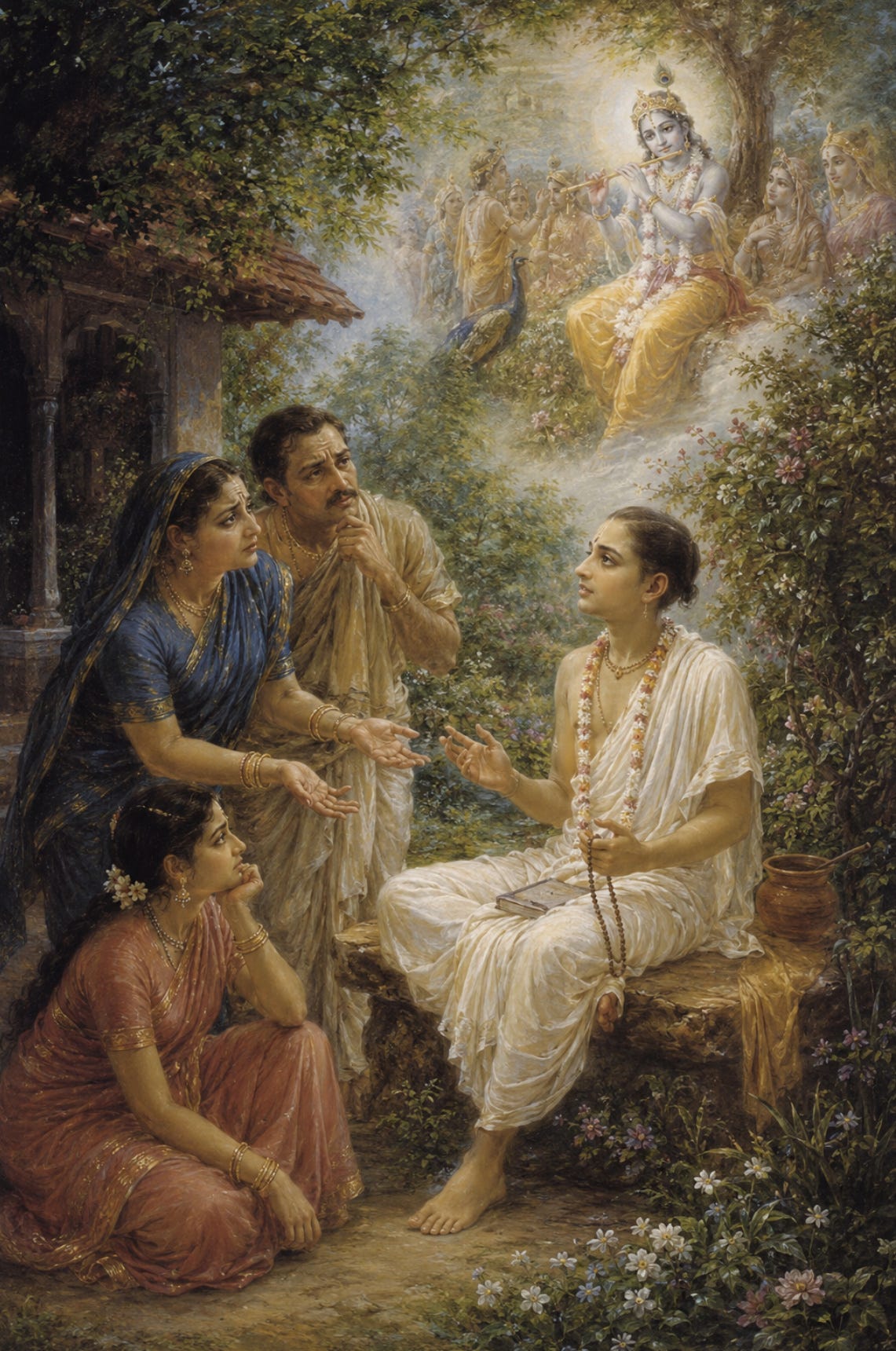
All of this, however, can be unsettling to family members, because familiarity is usually based on similarity. We remain close to people because they share similar values. When the values become too different, we feel that a dear person is slipping away. If it were just some distant friend, one would not take it very seriously, but when it is a son, a daughter, or another close family member, the change can be unsettling. One will then try to rationalize it in different ways, and the explanation that one’s son or daughter joined a cult may sound attractive.
Why? Because it avoids having to question one’s direction in life (and often his whole concept of identity). If I accept that my son or daughter changed so much because he or she found a better path in life, I then have to admit that my own path, which I have been pursuing for decades, is not the best. For most people, this is very difficult to admit. The cult explanation changes the blame. The problem is not me or my family, we are the victims. The reaction then frequently becomes, “Who are these people influencing my son?” “Has this religion become more important than the family?”
Other relatives may fear that the person will give away his money, abandon his studies or profession, move into a temple, give up his autonomy, start accepting everything a guru says without thinking, or cut off contact with everyone outside the group. Some of them may then get some of our books to read and take passages out of context to reinforce their fears.
How should we react to that?
Here it is important to understand how the material modes work. Regular people are mostly influenced by passion and ignorance. That’s what moves them in material life. If a person is predominantly influenced by goodness, he or she will not want to spend 48 hours per week in an office; therefore, as goodness increases, changes in one’s priorities and behavior will be visible. However, others will struggle to understand these changes, especially if they are too quick.
The influence of passion and ignorance also often makes relatives react in terms of fear, instead of knowledge. Our first reaction may then be to become defensive. We may think that they are ignorant, envious, etc., and also react negatively. The two negative reactions then compound, bringing escalation. It can quickly become a fratricidal war. Instead of reacting to fear with fear or to aggression with more aggression, it’s usually much more effective to defuse it with a mature reaction (goodness). The best answer to fear is kindness.
Here is where spiritual practice, even in the earlier stages, can be valuable. We can stop and consider the situation. There are surely situations in which family members can be envious of each other, but apart from such cases, people from our family usually wish us well. We can then understand that their reaction, even if misguided, does not come from genuine enmity, but from a misapplied sense of care.
The word “cult” is often used loosely to describe any unfamiliar group. A person may be called a cult member simply because he or she develops different habits and believes things outside the mainstream. Nowadays this problem is smaller than it was a few decades ago, because in most societies people have become culturally more flexible. We have vegans, far-right and far-left political groups, LGBT, etc., and often people go from one group to the other, changing radically in the process. Becoming a Vaiṣnava may be at first dismissed as just one of these changes. However, in societies that are still more closed, the reaction may still be very strong.
Here is a point to consider, however: unhealthy Vaiṣnava groups do exist. There are many places where I, even after practicing for 34 years, would be deeply concerned to see a close person joining. There are charismatic leaders who demand absolute obedience, groups that isolate followers and manipulate them emotionally, manipulate their finances, discourage questions, etc. These are places where Kṛṣṇa consciousness is heavily covered by the material faults and ambitions of the members, and where the spiritual path can take a darker turn. Therefore, often the family may not be completely irrational. The sweeping reaction may include some part that may be justified, and we may take this into consideration.
Here we come to a part of the process that can blunt much of this reaction and can also make our own spiritual experience more progressive. Contrary to popular belief, the scriptures do not recommend that anyone surrender blindly. We can observe that Kṛṣṇa tells Arjuna to “abandon all varieties of religion and just surrender unto Me” after explaining the whole Bhagavad-gītā to him. In chapter four, He tells us to approach a self-realized spiritual master as the essential part in the process of obtaining transcendental knowledge, but in other passages we learn that one is supposed to observe the spiritual master carefully for one year before becoming a disciple, not only to remove any doubt about his or her character but also to complete the internal process of removing doubt. If during this time we focus on learning and developing our chanting and meditation and gradually changing our habits, instead of just accepting external symbols and dress, we can develop a good spiritual foundation without shocking anyone.
This also helps in another direction: changes in behavior are better accepted when they are explained in a logical way. If we start lecturing our parents about them being demons for slaughtering cows when they question why we have become vegetarian, they will probably not take it very positively. If instead we just explain that it is healthier not to eat meat, and that this makes us feel more peaceful, etc., the reaction will probably be much better. Health and peace are values people can usually relate to. Similarly, when they question why we spend so much time chanting on beads, we can answer that this is a process of meditation we learned that helps a lot to focus the mind and avoid stress, which makes a huge difference in our daily routine, and so on. If we can explain in ways they can relate to, emphasizing positive changes, and these come together with positive changes in our behavior, this can not only defuse most of the tension but gradually make them positive about, or even interested in, Kṛṣṇa consciousness themselves.
A good exercise is to run a check periodically, asking ourselves:
Am I becoming more honest?
Am I becoming more patient with others?
Am I fulfilling my responsibilities better?
Am I learning to control my anger?
Am I becoming less selfish?
Or, conversely, am I becoming more proud, argumentative, and difficult to live with?
Honest answers to these questions can help us to identify many detours in our spiritual practice before they become unrecoverable.
Usually, people who are inclined to quickly adopt the process of Kṛṣṇa consciousness are the ones who were already practicing in previous lives. If that’s our case, we usually have a strong sense of suddenly finding the right path as soon as we come again into contact with it. This confirmation comes from Paramātmā inside the heart. This leads us to trust the process even before getting knowledge. Most people, however, adopt it very slowly, as they see that it brings answers to practical questions and positive changes. If we become visible evidence of it, chances are they will become gradually interested, or at least favorable.
Here is yet another point you may consider: Most of the negative effects we see in devotees who suddenly become too fanatical about Kṛṣṇa consciousness do not come from following the guidance of a genuine spiritual master but from fanatically surrendering to charismatic leaders who haven’t yet freed themselves from the influence of the material modes. This is then often compounded by our own unresolved emotional problems, need for identity, black-and-white thinking, desire to become prominent in a group, etc., creating a dangerous combination.
By developing our foundations first, we can skip this whole phase and go directly to the stage of finding a self-realized spiritual master, or at least an experienced mentor who can genuinely guide us in the right direction.
If you would like to go deeper, check out the book. Free for everyone:

You can also donate using Buy Me a Coffee, PayPal, Wise, Revolut, or bank transfers. There is a separate page with all the links. This helps me enormously to have time to write instead of doing other things to make a living. Thanks!