

👆 I’m testing a new feature: an audio version of the article you can listen to. This is not an AI voice; it’s me reading the article and sometimes adding something. If you find it useful and would like to see it in other articles, leave a comment sharing your experience. Thanks! 🕉
You can receive new articles directly in your inbox. Subscription is free; donations are welcome.
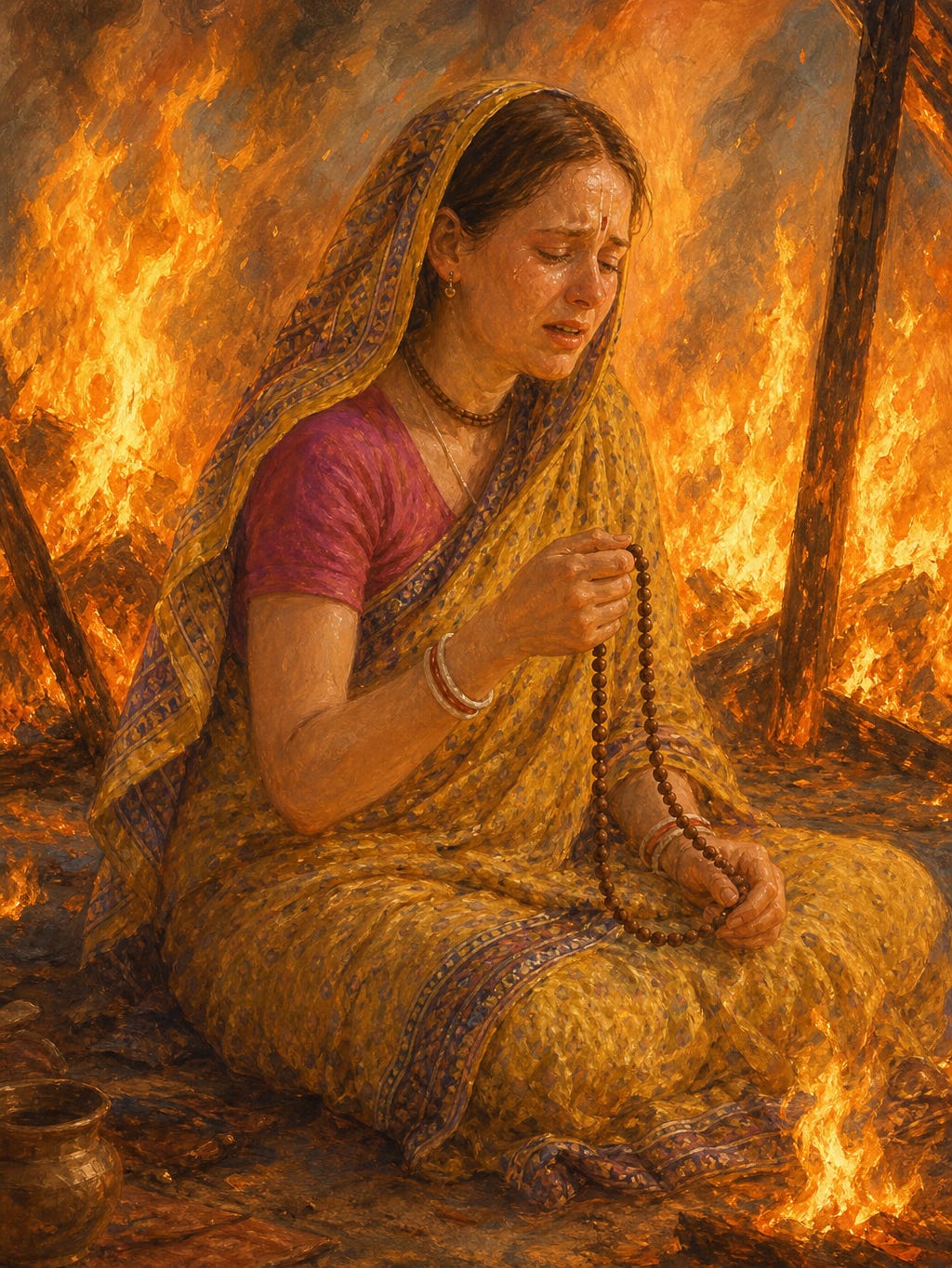
Burnout is a problem that affects many devotees. It can lead to many negative symptoms, like irritation and impatience, headaches and other physical discomfort, depression, low self-esteem, and a feeling of impotence against what appear to be mounting and insurmountable difficulties. This physical and mental exhaustion leads to mechanical hearing and chanting, which can undermine the very foundation of our spiritual practice. It doesn’t really count when the body is there, but the mind is somewhere else.
Once the foundation is impacted, other symptoms can appear, such as irritation, harsh speech, fault-finding, cynicism, and so on. Eventually, all of this combined can lead a devotee to conclude that he or she simply can’t continue, and that’s where many end up leaving the association of devotees or even spiritual practice altogether.
It’s not difficult to understand why: in this case, instead of bringing bliss, spiritual practice registers in the mind as a painful experience, and even if one is very determined in the beginning, time makes the mind reject it. Once one stops, it is difficult to go back.
Interestingly enough, devotees are, in general, more susceptible to burnout than regular people because we frequently have to combine our regular material obligations with work and family with our spiritual practice and service. It is easy to tell others that we need to be attentive while hearing and chanting, that we should be present, and so on. We all understand that. The question is that all of this demands energy, and it may be difficult to muster it after a journey of 16 hours of work, commuting, family problems, and other forms of pressure. Often, the pressure for being present, which is generally good advice, just adds to the problem.
Ironically, the more a devotee is serious and determined to do more in spiritual life, the more he or she becomes susceptible to developing burnout. A devotee who wants to be serious in his spiritual practice frequently has to add 20 or even 30 hours of practice and service on top of responsibilities with work and family. This includes japa, listening to classes, online meetings with devotees, temple activities, book distribution, etc.
For example, many devotees participate in weekend warrior programs, distributing books on weekends, often on both Saturday and Sunday. All included (commuting, organization, the distribution itself, and some meeting afterward), this may equal 16 hours of extra service per week. If one is the organizer, it can be more. Add this to 21 hours of weekly spiritual practice (japa, classes, etc.), 10 hours of temple and home programs, plus 40 hours of a regular job, 12 hours of commuting to work, 14 hours spent with family, etc. All of this under the pressure of being present and doing everything attentively.
Is it even humanly possible? That’s exactly the point. Many devotees are not exactly “human” in the ordinary sense. They are in the stage of bhāva (if not beyond), impervious to the limitations of the material body and mind. One who is on such a high platform may effectively be able to maintain such a rhythm. The problem starts when it comes to regular mortals like us.
In the Gītā (6.16-17), Kṛṣṇa directly alerts:
“There is no possibility of one’s becoming a yogī, O Arjuna, if one eats too much or eats too little, sleeps too much or does not sleep enough. He who is regulated in his habits of eating, sleeping, recreation and work can mitigate all material pains by practicing the yoga system.”
Spiritual practice is not a sprint. If we could obtain love of Godhead as we collapse after a year working 20 hours per day, this would surely be a tempting option, but unfortunately, that’s not how it works. Love of Godhead can be achieved only after a lifetime of service, performed with care and attention. The question then is how to maintain our physical and mental strength to be able to continue performing our spiritual practice with stability. How to hold enough back to be able to remain present during our hearing, chanting, and associating without being lazy. This is an art we must master to achieve success.
We know philosophically that austerity is good for spiritual advancement. We hear many stories of great devotees who achieved perfection by performing great austerities, such as Dhruva Maharaja and the Six Goswamis, and thus the natural conclusion for many is that since austerity is good, the more austerity we can do, the more we will be able to advance. Although this simple logic sounds attractive, the reality is a little more complicated.
The level of austerity we can perform, as well as the types of austerity that are more effective for our specific situation, are connected not just with our level of spiritual advancement but also with the constitution of our body and mind. The important point to understand is that everyone has their limits. We can’t perform austerities like Raghunātha Dāsa Goswami (or any other of the six Goswamis!) To perform more austerities, we can maintain is actually dangerous, because it makes us too exhausted, which can increase the influence of the mode of ignorance, leading to all kinds of problems.
Too little austerity leads one to lenience and tama-guna, but interestingly enough, too much austerity can also increase the influence of the mode of ignorance because this is the natural result of becoming overly-tired when we are still in the material platform.
That’s precisely the difference between pure devotees and ordinary mortals. Pure devotees don’t identify with the body and mind, and therefore they remain stable even under extraordinary loads. They can thus accept superhuman austerities or remain engaged in service much beyond any human limit, without any negative effect on their spiritual meditation. They remain perfectly connected with Kṛṣṇa regardless of the situation.
The question is that we can’t imitate them without being on the same platform. If we are not transcendental to body and mind, we need to follow the rule of regulation that Kṛṣṇa gives in the Gītā, being regulated in our habits of eating, sleeping, recreation, and work, not being lazy but also not over-endeavoring.
There is also another point we should be attentive to. In the Upadeśāmṛta (2), Śrīla Rūpa Gosvāmī explains:
“One’s devotional service is spoiled when he becomes too entangled in the following six activities: (1) eating more than necessary or collecting more funds than required; (2) over-endeavoring for mundane things that are very difficult to obtain; (3) talking unnecessarily about mundane subject matters; (4) practicing the scriptural rules and regulations only for the sake of following them and not for the sake of spiritual advancement, or rejecting the rules and regulations of the scriptures and working independently or whimsically; (5) associating with worldly-minded persons who are not interested in Kṛṣṇa consciousness; and (6) being greedy for mundane achievements.”
The critical point here is number two: over-endeavoring for mundane things that are very difficult to obtain.
Not all service is transcendental. Often, we become attracted to performing different types of services as a form of material achievement, as a way to nourish our ego, or to impress others and achieve some form of prestige in the group. To become a great person in the world is very difficult, but to become prominent in the society of devotees, materially speaking, is not very difficult, and the mind can easily become attracted to the idea. This, however, leads to the most dangerous type of burnout.
In the end, we need to be balanced enough to differentiate tolerance from self-harm. In the Gītā (2.14), Kṛṣṇa urges us to develop tolerance, getting out of lethargy: “O son of Kuntī, the nonpermanent appearance of happiness and distress, and their disappearance in due course, are like the appearance and disappearance of winter and summer seasons. They arise from sense perception, O scion of Bharata, and one must learn to tolerate them without being disturbed.”
... On the other hand, He also urges restraint, like on 6.16-17, as already mentioned, and on 12.13-14: “One who is not envious but is a kind friend to all living entities, who does not think himself a proprietor and is free from false ego, who is equal in both happiness and distress, who is tolerant, always satisfied, self-controlled, and engaged in devotional service with determination, his mind and intelligence fixed on Me – such a devotee of Mine is very dear to Me.”
We can see that in this and other passages, Kṛṣṇa gives the image of a balanced devotee who is kind to others and performs his services with determination, while at the same time being wise enough to avoid over-endeavoring and not being a workaholic.
We must, thus, find his golden middle, a situation where we can perform all the important activities without, however, going beyond our limit.
a) Basic spiritual practice, including japa and hearing, must be non-negotiable. There may be a day when we may have to sacrifice it because of some emergency, but this must be a one-time thing. If an emergency becomes a daily occurrence, it is not an emergency anymore; it is routine.
b) There may also be some months when things become intense; this is part of life. The point is that after this, there should be a more peaceful period when we can recover.
c) We are not kamikazes. We don’t defeat Māyā by performing banzai charges. We need to be able to honestly estimate how many hours of service per day or week we can do without sacrificing non-negotiable aspects, such as sādhana and family, avoiding suicide service.
d) We should be able to watch for warning lights, such as irritation, sleep deprivation, resentment, depression, etc., and reduce the load before reaching a point of collapse.
e) Isolation makes things worse. Reaching out to other devotees and finding non-judgmental support is also crucial. Both other devotees who can be supportive friends and seniors who can mentor us are valuable. The point, however, is to avoid judgmental people, or devotees who simply lack the proper realization to understand our situation. These can easily make things worse.
In conclusion, spiritual life is not a sprint, but a marathon. It’s not about going on the fast line until we become exhausted and then collapse, but about keeping a steady pace of advancement during all our lives. For this, we need a lot of common sense and good guidance.
If this post was useful for you, you may also be interested in the book that discusses our challenges in spiritual life more thoroughly:

This is a publication for thoughtful readers who want to go deeper into Kṛṣṇa consciousness. I publish daily, trying to offer high-quality spiritual content, and all posts are available to free subscribers. If you wish, you can also choose a paid subscription to support this work.
You can also receive the updates on WhatsApp or Telegram.
If you would like to contribute further, you can find the donation links here.
Hare Krishna! An audio version is truly wonderful, and the article as well. You listed many very important and instructive points with a great compassion. Thank you for always addressing such important topics. 😊