

You can receive new articles directly in your inbox. Subscription is free; donations are welcome.
Bipin Bihari Goswami, the initiating spiritual master of Śrila Bhaktivinoda Thakura, is a personality very difficult to understand based on historical facts alone. Self-realized souls who can see in the spiritual platform probably can understand him, but one who tries to understand based solely on historical facts will certainly become bewildered. Some sources associated with the Gaudiya Matha depict Bipin Bihari Goswami in a highly negative light, whereas others do the opposite. Like in other cases, the truth is probably somewhere in the middle.
Bipin Bihari was born into a family of caste Goswamis in the line of Jahnavi mātā. He was a scholar of Vaiṣnava philosophy and wrote many books and articles. Śrila Bhaktivinoda Thakura took initiation from him after three years of correspondence. Up to this point, the story is clear, since we have a first-hand account of it in the letter Śrila Bhaktivinoda Thakura wrote to his son Lalita Prasada in 1896:
“I had been searching for a suitable guru for a long time, but had not found one, so I was feeling disturbed. Whenever I met someone in whom I could have a little faith, when I studied his teachings and character, I would lose whatever little faith I had. I was quite worried, but Prabhu eradicated these worries in a dream. In that dream, I had a hint of what would happen and when morning came, I felt joyful. A day or two later, Gurudeva wrote me a letter saying, “I will come soon and give you initiation.”
When he came and performed the initiation rituals, I became cheerful. From that day on the sin of meat eating vanished from my heart and I began to feel a little compassion toward all beings.”
We can also notice that Śrila Bhaktivinoda Thakura used to treat his initiating guru with great respect and that Śrila Bhaktisiddhanta Sarasvati Thākura also refrained from any public criticism of him (with the possible exception of one particular incident when he was very small). On the other hand, he philosophically disagreed with him on quite a few points.
However, this is the point where sources begin to differ. In the famous debate of Śrila Bhaktisiddhanta Saraswati Thakura against the caste Brahmanas in 1911, some sources claim that Bipin Bihari took the side of the caste Brahmanas, while others say that he supported the arguments given by Śrila Bhaktisiddhanta Sarasvati Thākura.
Some sources say he took the side of the caste goswamis and was against Śrila Bhaktivinoda Thakura when he discovered that the birthplace of Mahaprabhu was on the other side of the river and started building the Yoga-Pitha, while others claim he was cordial to Bhaktivinoda and was present at the inauguration of the Yoga-Pitha. Some sources claim he was smoking tobacco and cultivating some other bad habits, while others give a different description.
There is some later evidence of some dispute between Śrila Bhaktisiddhanta Saraswati Thakura (or at least some of his disciples) and Bipin Bihari Goswami in 1919, again surrounding the birthsite of Mahaprabhu, but at this time, Śrila Bhaktivinoda Thakura had already passed away, and again, there is contradictory information available.
Old stories like these are very difficult to sort out and almost impossible to prove, so it’s improbable that we will ever have a clear picture. What is clear, however, is that shortly afterward, Śrila Bhaktivinoda Thakura met the Vaiṣnava-Sarvabhauma, Śrila Jagannatha Dasa Babaji, and he had a profound impact on his life. Jagannatha Dasa became his revered siksa-guru, and he followed his teachings until the end of his life. It’s clear that among the two, Śrila Jagannatha Dasa Babaji was a more prominent figure in his life.
One point to be made here is that in the Gaudiya Vaiṣnava Tradition, and especially at the time Śrila Bhaktivinoda Thakura was living, the diksa and sika guru would play complementary roles. Sometimes one would receive diksa and siksa from the same person, but in other cases, one would receive diksa from one guru and then receive siksa from another, and the siksa would become more prominent. Therefore, the attitude of Bhaktivinoda Thakura was not out of general etiquette.
Śrila Bhativinoda passed the siddha-pranali diksa he received from Bipin Bihari to his son Lalita Prasada. He, in turn, had a few disciples. His disciples and grand-disciples identify with the caste Goswami line, and some of them are offensive to Śrila Bhaktisiddhanta Saraswati Thakura and Śrila Prabhupada.
On the other hand, he passed the Bhagavata line he inherited from his siksa guru, Śrila Jagannatha Dasa Babaji Maharaja, to his other son, Śrila Bhaktisiddhanta Saraswati Thakura, who took diksa initiation from Śrila Gaurakishora Dasa Babaji. This Bhagavata line was passed to Śrila Prabhupada, and from him it reached all of us.
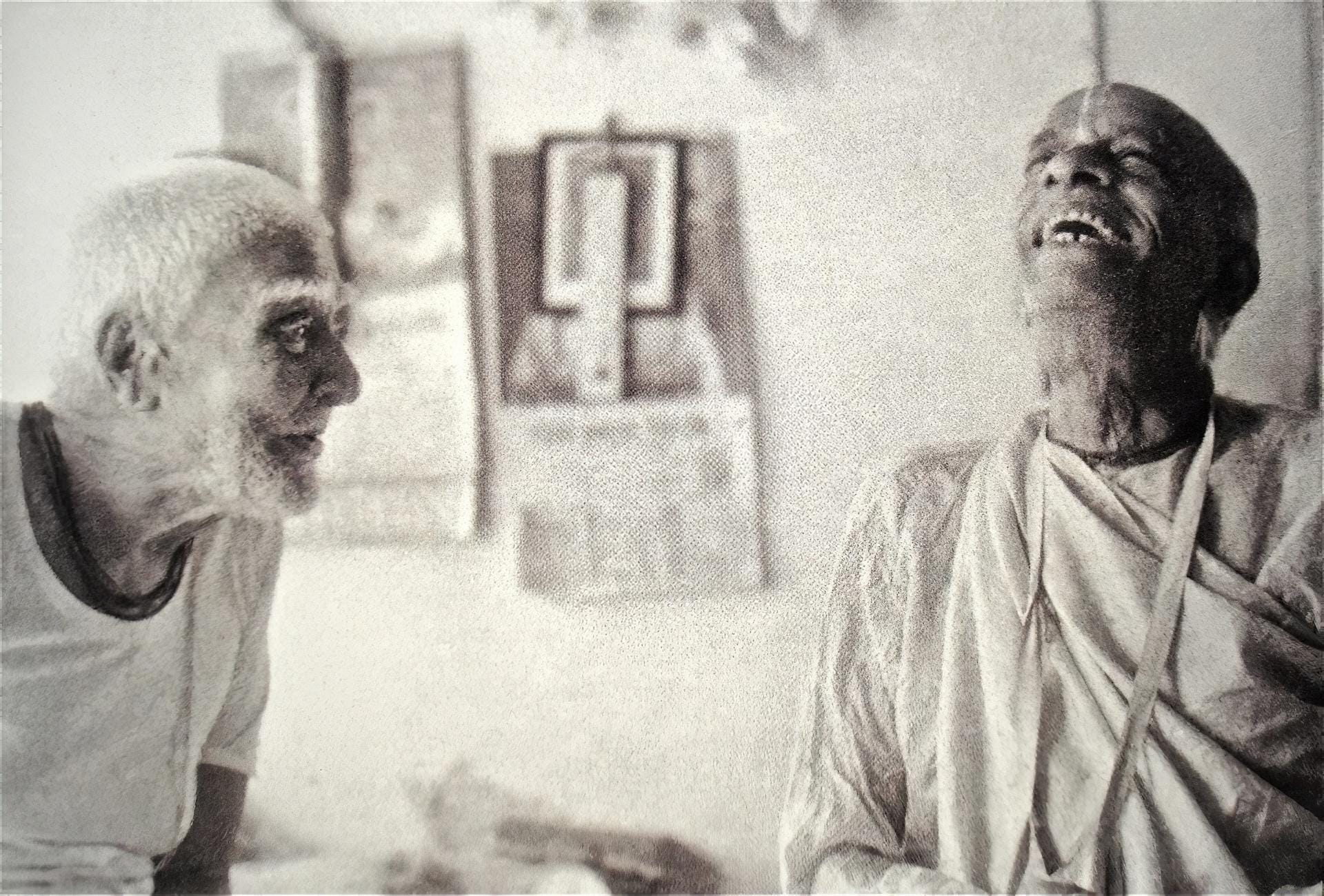
By the time Śrila Prabhupada went back to India with his first Western disciples, Śrila Lalita Prasada was still present on the planet, and they had some cordial encounters (photo). Śrila Prabhupada even allowed his disciples to hear from him occasionally (although he objected to the Siddha-Pranali process he was following), and Lalita Prasada decided to donate the place of Bhaktivinoda’s bhajana in Nadiya to ISKCON (although it was apparently never realized). Later, however, things became a little tense after a few disciples of Śrila Prabhupada rejected him and were re-initiated by Lalita Prasada. This is considered a very serious offense, equal to publicly stating that one is not a bona fide guru. We can observe that the same was done by several godbrothers of Śrīla Prabhupāda; such was the opposition he faced in trying to fulfill his mission.
What we can learn from all of this is that Śrila Prabhupada was not publicly criticizing his God-uncle Lalita Prasada, although he philosophically disagreed with him, and similarly, Śrila Bhaktisiddhanta Saraswati Takura refrained from public criticism of the diksa guru of his exalted father, although he was at odds with him philosophically. This is something we should follow for our spiritual well-being. We can see how exalted Vaiṣnavas can keep cordial relationships with senior Vaiṣnavas even when they philosophically disagree with them or are directly offended by them. If we consider ourselves followers of the above-mentioned ācāryas, we should also follow this example.
Śrila Bhāktivinoda Thakura was seriously attacked and offended in the course of his preaching work, and the same happened with Śrila Bhaktisiddhanta Sarasvati Thākura and Śrila Prabhupada. Therefore, if we are trying to spread Kṛṣṇa Consciousness and others act inimically to us, this just shows we are in good company.
One should, however, be intelligent enough to avoid fellows who don’t show proper behavior or who are offensive to our ācāryas. Certain groups try to lure devotees from both ISKCON and different Gaudiya Mathas with spurious accusations against Śrila Bhaktisiddhanta Saraswati Thakura by using the name of Bipin Bihari Goswami, and similarly, members of the Gaudiya Mathas and ISKCON may feel the necessity of attacking Bipin Bihari as a way to protect Śrila Bhaktisiddhanta Sarasvati Thakura. However, one has little to gain (and much to lose) by participating in this arms race. It's better to stay away from such partisan disputes and focus on positive aspects.
This is a publication for thoughtful readers who want to go deeper into Kṛṣṇa consciousness. I publish daily, and all posts are available to free subscribers. If you wish, you can also choose a paid subscription to support this work. By subscribing, you also gain access to the PDFs of all my books and drafts of books I’m working on.
If you would like to contribute further, you can find the donation links here.