

Subscribe to receive new articles by e-mail. It’s free, but if you like, you can pledge a donation:
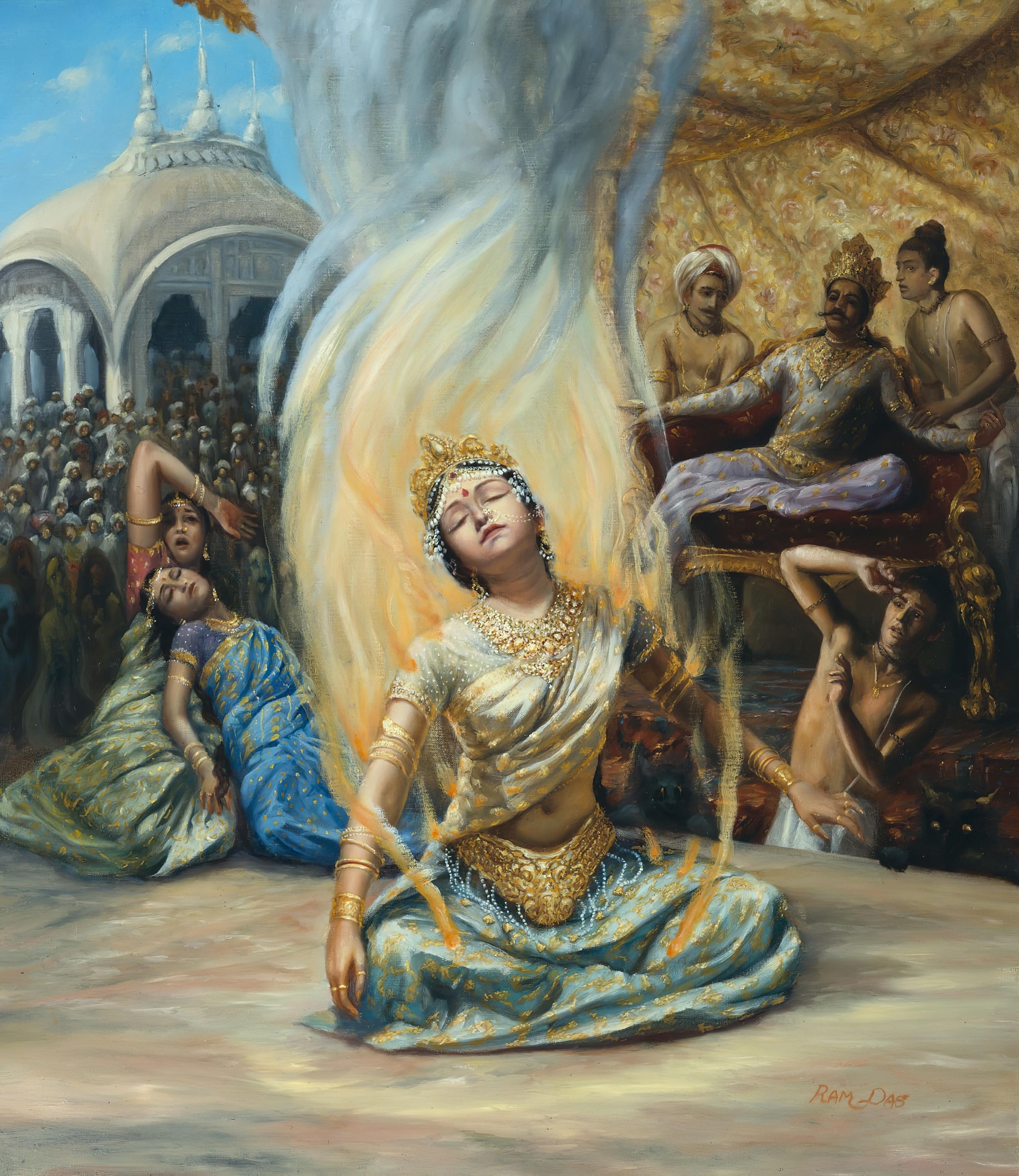
Satī and Lord Śiva formed an ideal couple: Lord Śiva is the greatest Vaiṣnava, completely devoted to the Lord, while Satī was an extremely dedicated and qualified wife. Being so, why did she decide to quit her body, burning it in the fire of mystic yoga, abandoning both her life and her qualified husband?
It came down to the difficult relationship between her father, Daksa, and Lord Śiva.
Satī is the eternal wife of Lord Śiva, the incarnation of material nature. Brahma knew about that and ordered Daksa to give her in marriage to Lord Śiva at a young age. Daksa did it, but he resented their marriage, considering Lord Śiva to be unqualified to be the husband of his daughter and his son-in-law.
The last drop was when he performed a great sacrifice, and Lord Śiva did not rise from his seat when he entered the arena. Being one of the three principal demigods, Lord Śiva was much higher in position than Daksa and did not have to rise from his seat to offer him respects, but seeing Lord Śiva as his son-in-law, and therefore a subordinate, he took it as a challenge.
Losing his composure, he sharply criticized Śiva in front of all demigods and exalted personalities, and cursed him to be deprived of his share in the performance of sacrifices. After this, he cut relations with both Śiva and his daughter.
Later, when he performed another great sacrifice, Satī desired to go and meet her father, friends, and other relatives, as well as take part in the social function. Lord Śiva, however, told her not to go, foreseeing that nothing good would come from it.
Having such a qualified husband, Satī was supposed to accept his judgment, understanding that he was operating under higher reasoning. The real reason Satī wanted to go to the sacrifice was to confront her father about not honoring her husband, but externally she behaved like a regular woman, appearing to want to go due to family attachment. In this way, the story gives us the example of a woman who has a highly qualified husband disagreeing with him and the negative consequences of doing so.
Having already given all his arguments, Lord Śiva didn’t say anything more when Satī decided to disregard his instructions and go alone, but his followers accompanied her, understanding that this was Lord Śiva’s desire. They organized a procession for Satī, so she could travel comfortably. This also tells us something about a qualified disciple being able to understand the intentions of the spiritual master without having to be directly ordered at each step.
However, when Satī reached the opulent arena of the sacrifice, no one received her apart from her mother and sisters. All the brāhmanas and demigods present wanted in their minds to receive Satī and honor her, but they knew Daksa would be displeased by that. Since Daksa was their superior, they were afraid of him. Only the mother and sisters of Satī were more softhearted and received her with affection.
However, understanding Daksa’s offensive mentality towards her husband, Satī didn’t reply to them or accept their presents. She was focused on her father and the arrangements made by him to neglect her husband. She saw that the Brahmanas were skipping the mantras for offering oblations to Lord Śiva, and that Daksa was so envious of him to the point of refusing to receive his youngest daughter just because she was married to him.
Not only Satī, but all the followers of Lord Śiva who accompanied her were enraged by these offenses, and they were prepared to attack and, if possible, kill Daksa. Satī, however, stopped them. She wanted to deal with the situation herself, using words and not physical violence. She was not sorry for herself, but because her husband was insulted.
There were many brāhmanas present in the assembly, but they were not envious of Lord Śiva. The whole situation was caused by Daksa, who was misusing his authority, forcing all the others to neglect him. This Satī accused Daksa of being the only one envious. She also contrasted it with the attitude of Lord Śiva, in seeing only the good qualities of others, with Daksa, who was envious of even completely faultless persons.
The speech of Satī goes from verse 4.4.11 to 16. This passage is important because it describes the glories of Lord Śiva, not as a demigod, but as the greatest of Vaiṣnavas. Lord Śiva has many worshipers, but very few of them understand his real position. As Vaiṣnavas, we should be very careful not to offend Lord Śiva, since he is senior to all of us. Just as Daksa fell for offending Lord Śiva, anyone who does the same may face the same end. Followers of Lord Śiva often have nasty habits due to their tamasic nature, but Lord Śiva is completely different from them.
Demons and ghosts worship Lord Śiva for material benefits, seeing him as a separate deity from Lord Viṣṇu. For them, Lord Śiva acts as a demigod, granting them material blessings. Vaiṣnavas, however, are the true followers of Lord Shiva, because they understand his real position and glorify him as a devotee of the Lord. Lord Śiva’s position is fully transcendental, and his external behavior just confirms that. No one could associate with the most degraded classes of beings as he does without becoming contaminated, and he does so not out of personal desire, but out of compassion for them, giving shelter for the most degraded creatures, who would otherwise have no means of deliverance.
Satī came to talk to her father, even against the desire of her husband, because the situation was intolerable for her. Because she had a familial relationship with Daksa, having accepted him as her father, his attitude deeply pained her. She came to the arena with the idea that she might be able to convince her father with good arguments. Daksa, however, ignored her pleas. Seeing that it would be impossible to change Daksa’s mentality, she decided to break the relationship with him. In other words, she decided she didn’t want to be his daughter anymore. Since a familial relationship is established based on the body, she decided to cut the problem at the root by destroying her body.
Satī is the incarnation of the external potency of the Lord. Just as Lord Śiva appears as the son of Lord Brahma, although he exists eternally outside the material universe, his wife, the material potency, appeared first as Satī, and then as Parvati, accompanying him. Daksa had the good fortune of playing the role of a father for such an exalted personality, but unfortunately, he wasted the opportunity.
Perfect yogis can leave the body whenever they desire. Normally, they do that by controlling the vital airs and thus elevating the vital airs through the ṣaṭ-chakra, the six circles of air circulation. The subtle body floats in the five types of vital air inside the heart, and thus, by moving the vital air, they can move the subtle body to the top of the head, and from there leave the body by the cerebral passage. Satī, however, decided to also incinerate her body using her mystic power, completely destroying the root cause of her relationship with Daksa.
She was feeling very sorry that her body was produced by him, and she felt morose due to this relationship. She desired to obtain another, uncontaminated body to associate with her husband, free from the contaminating relationship with such an offender.
The passing away of Satī was a dramatic event for everyone present. It is described that there was a tumultuous roar all over the universe. Everyone was questioning how such an elevated person, the wife of the respected Lord Śiva, could abandon her body in such a manner, and how Daksa could be so neglectful to the point of causing it.
You can also donate using Buy Me a Coffee, PayPal, Wise, Revolut, or bank transfers. There is a separate page with all the links. This helps me enormously to have time to write instead of doing other things to make a living. Thanks!