

Subscribe to receive new articles by e-mail. It’s free, but if you like, you can pledge a donation:
The first chapter of the Bhagavad-gītā starts with the words of Dhṛtarāṣṭra, which are followed by the words of Duryodhana, two of the great villains of the Mahabharata. Sañjaya describes the situation on the battlefield, and then Arjuna reveals his hesitancy in fighting, speaking in terms of moral arguments that are later dismissed by Kṛṣṇa.
One could thus question what the value of this first chapter is. Why do we study it? Would it not be better to just skip it and start in the second chapter, where Kṛṣṇa starts his instructions, instead of repeating the words of Dhṛtarāṣṭra and Duryodhana?
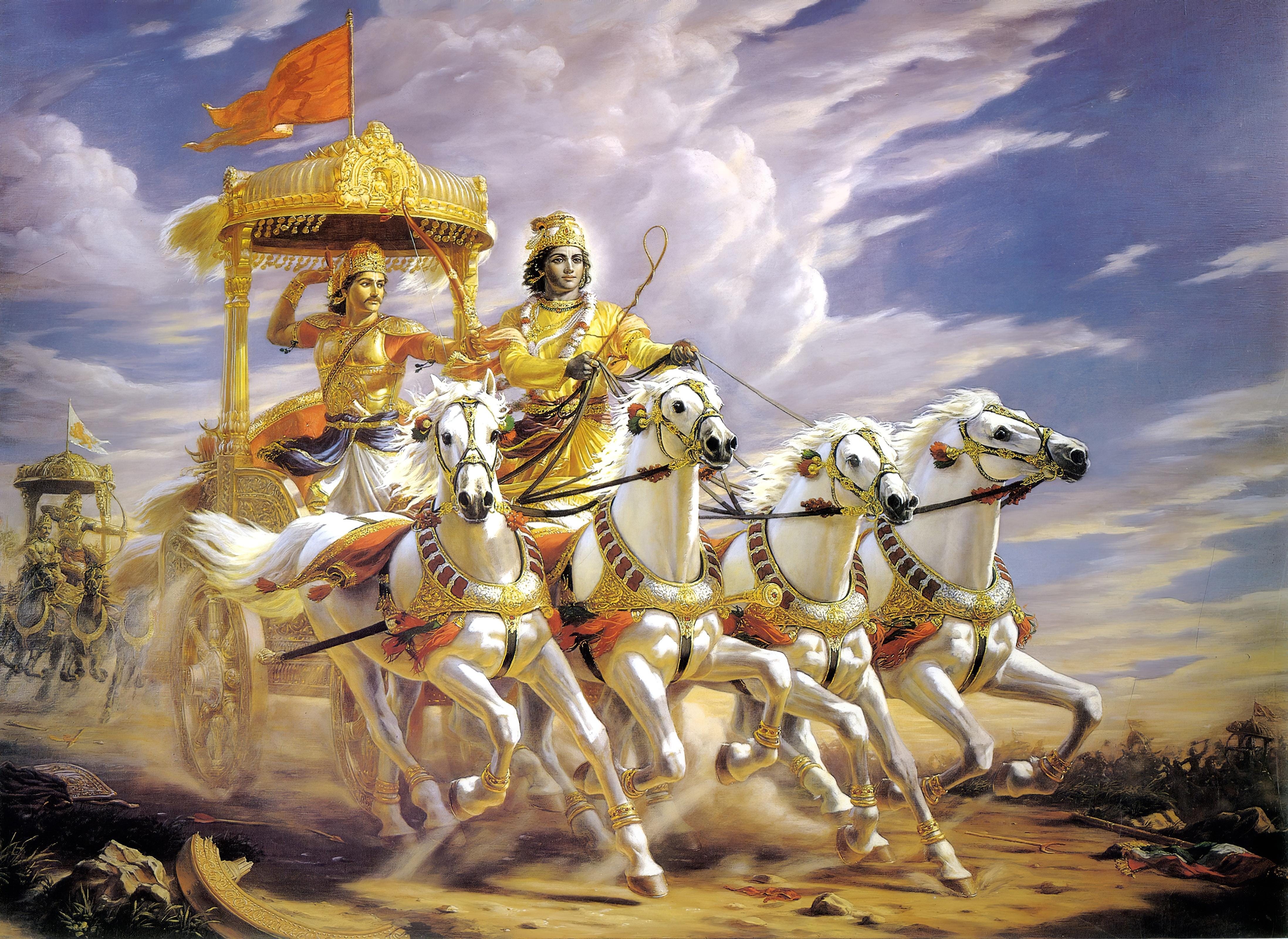
A possible answer is that the first chapter of the Bhagavad-gītā describes the scenario of the discussion between Arjuna and Kṛṣṇa and helps us to understand the severity of the situation Arjuna was in. If examined from this angle, the first chapter is quite fascinating and can be explained in many different ways.
However, there is an even deeper philosophical significance in the first chapter: it teaches us a very essential point that is essential to understand the rest of the Bhagavad-gītā: the way we should approach transcendental knowledge and the role of the spiritual master.
We can see that in the first chapter, Duryodhana approaches Droṇācārya, his guru, but he does it with a completely inappropriate attitude. He indirectly chastises him for teaching Dhṛṣṭadyumna (who became a commander in the army of the Pandavas), tries to instruct him instead of asking for instruction, and acts in a diplomatic, arrogant way. This illustrates a common attitude in many students, in trying to show their brilliance to the guru, trying to surpass or control him, instead of asking for instructions and learning from him, which demands humility. The attitude of Droṇācārya in response is also illustrative: he remains in silence, simply observing the insolence of his disciple. As a result, no knowledge is transmitted. Duryodhana is not alerted to his mistakes, not chastised, not corrected, nothing.
On the other side, we can see that Arjuna also initially approaches Kṛṣṇa in an inappropriate way, first giving him orders and then arguing with him about the morality of the fight. Arjuna had decided not to fight, and he was making arguments to try to convince Kṛṣṇa of his decision. We can see that Kṛṣṇa also remained silent, and thus Arjuna concludes the first chapter with his mind overwhelmed with grief.
These are actually two important examples. This shows us how to not approach the spiritual master. Duryodhana was simply too arrogant and insolent. Arjuna was not arrogant, but instead of asking Kṛṣṇa, he had a conclusion and was just trying to justify it in front of Kṛṣṇa. We can see that in both cases, there was no transmission of transcendental knowledge. Duryodhana ended the first chapter a fool, and Arjuna was still confused about what to do. Thus, the first chapter makes it clear that this will be the result when we approach transcendental knowledge by either of the two ways.
At the beginning of the second chapter, however, Arjuna shows us the proper approach. Admitting his incapacity to solve the situation on his own, he humbly submits to Kṛṣṇa, accepting Him as his spiritual master. From this point, seeing the proper mentality of Arjuna, Kṛṣṇa instructs him on transcendental knowledge, and his doubts are destroyed. By the end of the Bhagavad-gītā, Arjuna knew perfectly what to do.
Arjuna is a pure devotee, an eternal associate of the Lord, who appears together with Him repeatedly to play all kinds of lilas. There is no question of a devotee of this caliber being affected by material illusion. However, because Kṛṣṇa wants to use Arjuna to speak the Bhagavad-gītā, Arjuna agrees to be covered by yoga-maya and go through these different stages as a way to instruct us.
Similarly, even when we accept a spiritual master, we frequently commit the same mistakes as Duryodhana and Arjuna in the first chapter, and thus, the spiritual knowledge remains locked for us. We may think we understand something, but when problems appear, we become completely perplexed.
Of course, many read the Bhagavad-gītā without formally accepting a spiritual master, or without directly being instructed by him. In this case, the role of the instructing spiritual master is played by Śrila Prabhupāda through his purports. Still, however, the basic process is the same: Only when we learn how to approach this knowledge with an open mind and a humble heart is it finally revealed to us.
You can also donate using Buy Me a Coffee, PayPal, Wise, Revolut, or bank transfers. There is a separate page with all the links. This helps me enormously to have time to write instead of doing other things to make a living. Thanks!