

Subscribe to receive new articles by e-mail. It’s free, but if you like, you can pledge a donation:
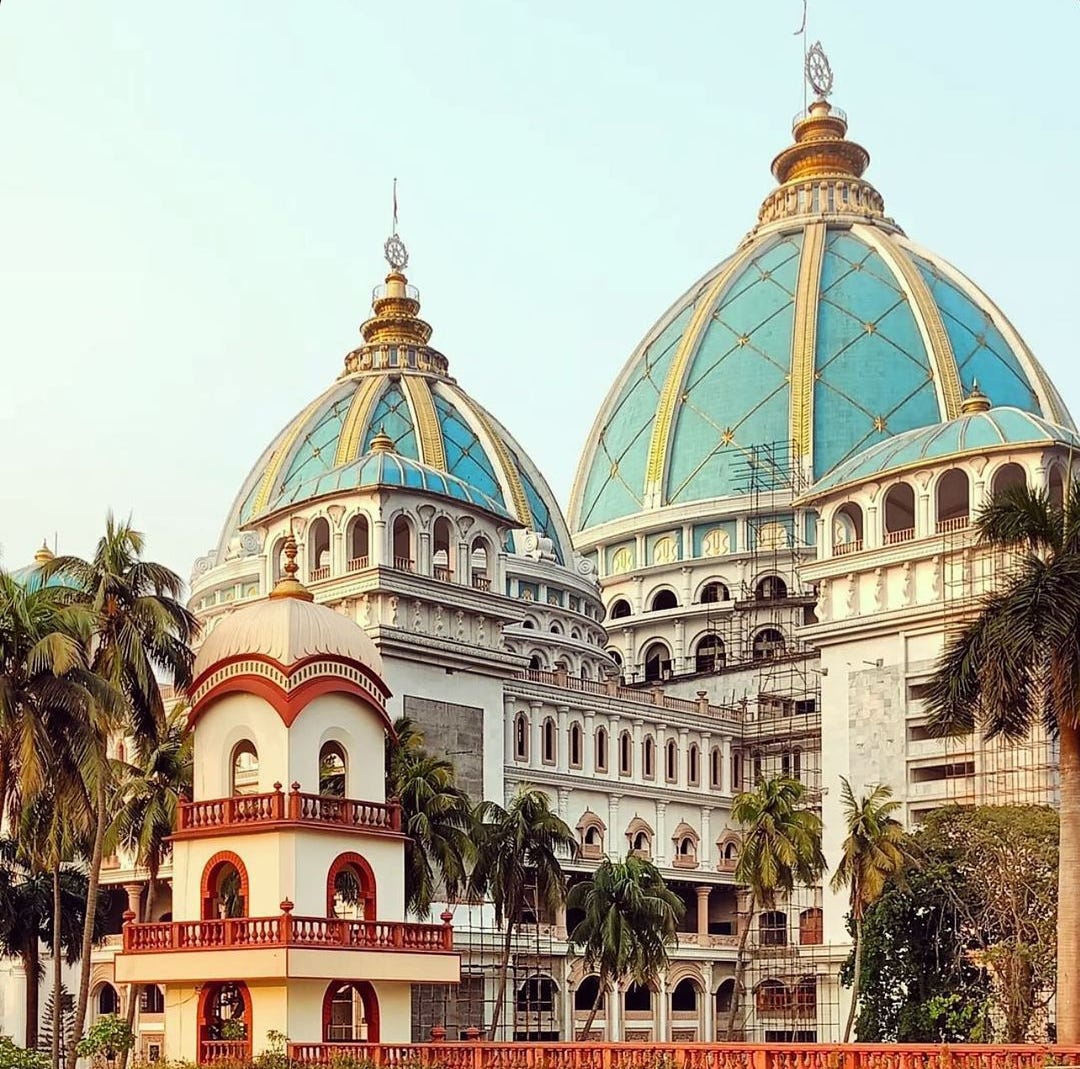
During his time with us, Prabhupāda put a lot of emphasis on the construction of the temple of Vedic Planetarium. What is the pressing need for a planetarium, one could ask. If the idea is to attract the public, there could be more popular ideas. However, when we think like that, we fail to consider another aspect of the question.
Why is Vedic cosmology explained in the Śrīmad Bhāgavatam after all? The main purpose of the Śrīmad-Bhāgavatam is to discuss spiritual topics, so what’s the point in discussing the structure of Bhū-mandala, the orbit of the sun, the heavenly and hellish planets, and so on? The truth is that this description is far more important than it may look at first.
The view we have of the universe around us is very influential in our concept of identity. If I believe the universe is an empty wasteland governed by mechanical physical laws, where things happen by chance, I will be much more inclined to believe that there is no God, life comes from matter, and life serves no purpose apart from immediate gratification.
Kṛṣṇa describes this mentality in the Bhagavad-gītā (16.8-9):
“They say that this world is unreal, with no foundation, no God in control. They say it is produced of sex desire and has no cause other than lust. Following such conclusions, the demoniac, who are lost to themselves and who have no intelligence, engage in unbeneficial, horrible works meant to destroy the world.”
Because nowadays, atheists are in control of most of the educational system, they teach a view of the universe that fosters atheism. The Vedas, on the other hand, offer a model of the universe that nurtures our self-realization.
The main purpose of the cosmological model described in the Śrīmad Bhāgavatam is to help us see the universe and everything that exists around us as a manifestation of Kṛṣṇa’s potencies, a wonderful creation that sprouts from just a small fraction of His power. When we see the universe as Kṛṣṇa’s creation, and a place where He performs His pastimes, instead of a place for our enjoyment, we start seeing the spiritual nature behind the material illusion.
Because everything comes from Kṛṣṇa, ultimately, nothing is material. When we see everything in connection with Kṛṣṇa, and we use everything in His service, this hidden spiritual nature is manifested to our eyes.
The difficulty in the description of the universe given in the Śrīmad Bhāgavatam is that it is very difficult to understand. At first, it appears to be a primitive description of a flat earth, with surreal lands inhabited by mythic creatures. However, when it is studied in detail, it reveals a complex model that gives us a much more complete view of the universe than what is described in modern science.
The Vedic cosmological model of the Puranas is centered on the description of Bhū-Mandala, a gigantic series of concentric islands and oceans, organized like a lotus flower and situated close to the vertical center of the universe. The difficulty with that model is that it doesn’t reflect what we see when we look to the sky. If our planet is part of a gigantic structure composed of massive islands surrounded by oceans, why can’t we detect it? Why do all the means we have to collect information about our cosmic surroundings show only a lonely planet, surrounded by the vastness of space?
The first point to understand about the structure of Bhū-Mandala is that it is the way demigods see the universe. Different beings, with different sets of senses, see reality in different ways. The concept of reality of an ant and that of a human being are radically different. Similarly, demigods can see reality on a much higher level than we do.
The universe described in the Vedas is multidimensional. Our perception of reality depends on our level of consciousness. Just as demigods can’t perceive great sages like the four Kumāras, unless they become visible to them, we can’t perceive the demigods, or their abodes, unless they become visible to us. Even the asuras are normally not visible to us, since they also possess subtle bodies, similar to the demigods in nature.
Somehow, the demigods see Bhū-Mandala as a continuous structure and have access to the different tracts of land that compose it, but in our gross reality, the different abodes that compose Bhū-Mandala appear as different planets, to which we don’t have access. We can’t even directly understand how these different planets appear in our gross reality, since in our age, we have access to only our own planet, which is part of the southern section of Jambūdvīpa, the central island.
In our gross reality, the universe appears to be almost empty, and everything is extremely far away. From the higher-dimensional perspective of the demigods, however, the different planets that compose the intermediate planetary system form a cosmic lotus, with the higher planetary systems orbiting around it like a giant chandelier. From the point of view of blind physical laws, it doesn’t make much sense, but from the perspective of an all-powerful God with an artistic sense, it’s perfectly plausible.
Another point in understanding this description is to help us to understand where we are and our options in where to go next in the karmic cycle.
The cycles of four eras, with Satya-yuga, Treta-yuga, Dvāpara-yuga, and Kali-yuga, happen only in Bhārata-varsa, accommodating souls of different levels of consciousness that need to take birth here. The other eight varṣas of Jambūdvīpa are places of enjoyment reserved for pious souls who are receiving the results of their past work. In all of these varṣas, they have a quality of life similar to Treta-yuga, living for 10,000 years with many opportunities for sense enjoyment. No one becomes old, and couples can enjoy sex life freely, with pregnancy happening only once close to the end of one’s life.
From this description, we can see that most of the population of the universe actually lives in quite comfortable situations by material standards. People in the higher planetary systems (starting from Maharloka), as well as in Svargaloka, obviously live comfortably, and even demons live comfortably in the Bila-svarga. As Prabhupāda mentions in his purport, even on this planet, people live most of the time comfortably. Only in Kali-yuga do people experience acute suffering:
“There are four yugas: Satya-yuga, Tretā-yuga, Dvāpara-yuga and Kali-yuga. During the first yuga, Satya-yuga, people were very pious. Everyone practiced the mystic yoga system for spiritual understanding and realization of God. Because everyone was always absorbed in samādhi, no one was interested in material sense enjoyment. During Tretā-yuga, people enjoyed sense pleasure without tribulations. Material miseries began in Dvāpara-yuga, but they were not very stringent. Stringent material miseries really began from the advent of Kali-yuga.”
We live now in difficult conditions because we exhausted the results of our past karma, and we are now in the test room preparing a new set of karma, which we will either enjoy in the heavenly realms or suffer in hell and in the animal species. Even if one has no desire to go back to Godhead in this life, it makes sense to at least live piously, so one can escape this difficult condition.
We can see that if people were properly educated in the cosmological model of the Vedas, understanding these different abodes and how our actions lead to one or another, they would undoubtedly become more inclined to practice Kṛṣṇa Consciousness, or at least live a pious life. It is thus not surprising that Prabhupāda put so much emphasis on the construction of the temple of the Vedic Planetarium, which can serve as a vehicle for the dissemination of this knowledge.
You can also donate using Buy Me a Coffee, PayPal, Wise, Revolut, or bank transfers. There is a separate page with all the links. This helps me enormously to have time to write instead of doing other things to make a living. Thanks!
Hari bol....