


You can receive new articles directly in your inbox. Subscription is free; donations are welcome.
The Pracetās were the ten sons of King Prācīnabarhi, descendants of Pṛthu Mahārāja. Their story is described in the Fourth Canto of the Śrīmad-Bhāgavatam. When they became sufficiently grown-up, their father instructed them to marry, produce qualified descendants, and eventually take responsibility for ruling the kingdom. Before doing that, however, he instructed them to perform austerities to become purified.
The Pracetās were very obedient and accepted this order seriously. This obedience to their father is compared to the obedience of a disciple to the spiritual master. We often like to over-analyze and end up following only the parts that fit our preferences, but the Pracetās simply accepted the instruction without arguing, and this brought them great blessings.
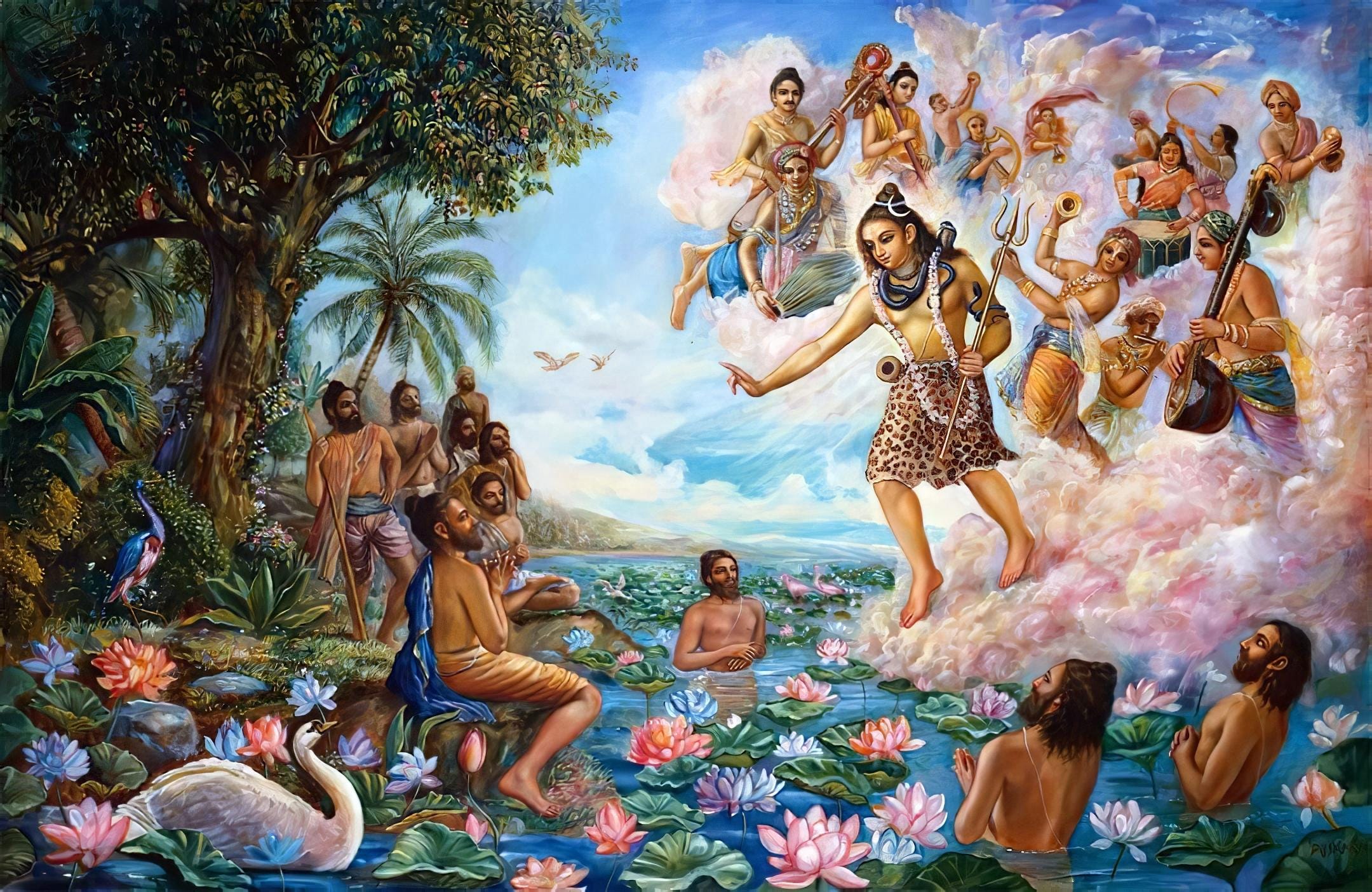
While traveling, they came across a great reservoir of water, a large bay or lake, close to the ocean. Different from the ocean, however, this reservoir of water was very calm and quiet, an ideal place to practice meditation. The waters of the lake were very clear, like the mind of a great soul, and it was adorned with lotus flowers, different types of auspicious birds, creepers, and so on. Great sages and devotees prefer this type of place to practice meditation, because the atmosphere fosters the mode of goodness in the mind. This lake, however, was not an ordinary lake: it was part of the abode of Lord Śiva, and as soon as they approached it, they got the audience of Lord Śiva, who was anxious to show them mercy because of their gentleness and other good qualities.
Lord Śiva didn’t appear alone: he came accompanied by his different associates who were playing different musical instruments. These were not the ghosts and spirits he associates with as Bhūtanātha, however, but denizens of the higher planets, such as Gandharvas and Kinnaras, who live with him in his abode in Mount Kailāsa. It appears that the Pracetās walked from Bhārata-varṣa, on the southern part of Jambūdvīpa, all the way to somewhere between Mount Kailāsa and the salt ocean, where they found this lake or bay. In other words, this is not a place situated on our planet, but in the higher-dimensional Bhū-mandala to which the Pracetās had access due to their elevated spiritual stature.
Lord Śiva is the protector of pious persons and people of gentle behavior, and he is especially inclined to devotees surrendered to Kṛṣṇa. Demons are not true devotees of Lord Śiva. He blesses them with material benefits just out of formality. In reality, Lord Śiva loves and blesses devotees of the Lord, just as demonstrated in the case of the Pracetās, and devotees show all respect to Lord Śiva as the greatest of the Vaiṣṇavas. To show the example, the Lord Himself, appearing as Lord Rama, sometimes worshiped Lord Śiva.
Prabhupāda explains this point: “It is said, vaiṣṇavānāṁ yathā śambhuḥ: Lord Śiva is the best of all devotees. Therefore all devotees of Lord Kṛṣṇa are also devotees of Lord Śiva. In Vṛndāvana there is Lord Śiva’s temple called Gopīśvara. The gopīs used to worship not only Lord Śiva but Kātyāyanī, or Durgā, as well, but their aim was to attain the favor of Lord Kṛṣṇa. A devotee of Lord Kṛṣṇa does not disrespect Lord Śiva, but worships Lord Śiva as the most exalted devotee of Lord Kṛṣṇa. Consequently whenever a devotee worships Lord Śiva, he prays to Lord Śiva to achieve the favor of Kṛṣṇa, and he does not request material profit.”
Lord Śiva understood what the Pracetās intended to do, and therefore, he became very pleased with them, observing that they were fully surrendered to the Supreme Lord. Later, the Lord Himself appeared to bless the Pracetas, mentioning their friendly relations between themselves as a reason for his satisfaction. All ten Pracetās were great souls, and their gentleness and non-enviousness were a visible proof of that. Because of these qualities, they could cooperate in great friendship (to the point of later sharing a wife) and together advance in their spiritual practice. From the example of the Pracetās, we can observe how a humble devotee can attract blessings without even seeking them.
The real purpose of Lord Śiva’s appearing before the Pracetās was to give them a prayer by which they could worship the Lord while practicing austerities inside the water. That’s the Rudra-gītā, which he utters from text 4.24.33 to text 68.
Just as the instructions of Sanat-kumāra, the Rudra-gītā is one of the important sets of instructions contained in the 4th canto. Just as the instructions of Sanat-kumāra revealed many details about the eternal position of the soul and his entanglement in the material world, as well as the process of becoming free, the prayers of Lord Śiva reveal more details about the potencies of the Lord and the position of Lord Śiva as the greatest Vaiṣnava.
Often, we focus on studying the pastimes while studying the Śrīmad-Bhāgavatam, and just skim through the prayers and philosophical discussions. In reality, however, these are the most significant parts of the text. Without studying these parts, our study of the Śrīmad-Bhāgavatam may remain superficial.
The verses of the Rudra-gītā can be divided into four parts:
a) Understanding the greatness of the Lord
From texts 4.24.33 to 43, Lord Śiva describes the Lord as the all-pervading Supersoul, and explains how He conducts the cosmic manifestation and how only by His mercy we can become free from it.
The principle is that although we see many different energies acting in the universe, all of them ultimately come from Kṛṣṇa. This understanding of the greatness of the Lord is important. Sometimes we want to immediately jump to the intimate pastimes without first understanding who Kṛṣṇa is. However, before properly appreciating His pastimes, we must understand His greatness; otherwise, there is the danger of taking Him cheaply. Kṛṣṇa may play like an ordinary cowherd boy, but He is the same Supreme Personality of Godhead from whom innumerable universes emanate.
b) The transcendental form of the Lord
From texts 44 to 52, he speaks about the transcendental form of the Lord, and understanding that is the foundation of the process of devotional service. Without becoming attracted to the personal form of the Lord, there is no question of transcendental service in transcendental love.
There is no question of developing transcendental service in divine love if we think that the Absolute Truth is ultimately impersonal or that His form is just a temporary manifestation, as believed by Māyāvādīs.
c) Developing devotional service
From 53 to 59, he speaks directly about devotional service to the Lord, which becomes natural after we get to know the Lord in His personal form.
In the beginning, Kṛṣṇa may appear very distant and inaccessible. He is there enjoying with His associates, and we are here. However, as we come to understand more about Him, we start seeing Him less as a distant concept and more as a person. As we understand His transcendental qualities, we become attracted to Him, and the next step is to serve Him. Devotional service is the natural activity of the soul; it has only to be uncovered.
d) Kṛṣṇa is the ultimate object of worship
The last part, which goes from text 60 to 68, reinforces that the Lord is the ultimate object of worship. Brahman and Paramātmā are aspects of the same Supreme Personality of Godhead whom Lord Śiva has been glorifying throughout the prayer. Kṛṣṇa is at the same time everything, and a blue boy who plays with His cowherd friends.
Everything material will eventually disappear. The universe itself will eventually be destroyed; what to say about everything else? The Lord, however, is eternal, and our relationship with Him is also eternal. Once we take shelter of this eternal relationship, there is no need to fear destruction or anything else.
Read more:

This is a publication for thoughtful readers who want to go deeper into Kṛṣṇa consciousness. I publish daily, trying to offer high-quality spiritual content, and all posts are available to free subscribers. If you wish, you can support this work with a monthly contribution. When you subscribe, you can choose between a free subscription and a monthly contribution, and you can switch from a free subscriber to a supporter at any time.
You can also receive updates on WhatsApp or Telegram.
If you would like to contribute further, you can find the donation links here.