

Subscribe to receive all new articles directly by e-mail. It’s free, but if you like, you can pledge a monthly or annual donation to support my work:
A detail we may not notice is that in Vedic culture, people follow three different calendars. As devotees, we have four since we end up also following the Gregorian calendar. How does it work?
These are the three Vedic calendars. We may not notice, but we also end up using all of them in devotional life for different purposes:
a) The Vedic cosmological calendar, which is divided into 12 months of 30 days each. This is the normative calendar for cosmic cycles. Kali-yuga is composed of 432,000 of these years of 360 days, for example. This Vedic calendar is anchored on the rotation of the kāla-cakra and is thus the same all over the cosmos. The length of the day varies from one planetary system to another (one day for the demigods is one year for us, one day for Brahmā is 8.64 billion years for us, etc.), but everywhere people use calendars of 12 months of 30 days, according to the length of their days.
The difficulty with this 360-day calendar, in our case, is that it does not precisely reflect the movements of the sun and the moon. As described, the astronomical bodies have their own independent counterclockwise movements and thus their own natural cycles. This leads to the other two calendars:
b) The solar year corresponds to the orbit of the sun. It has approximately 365¼ days. The solar year is important because it governs the seasons, climatic cycles, and so on. It is thus essential in agriculture, since the right time to plant and harvest is determined by the seasons, and not a normative calendar.
c) The lunar year has about 354 days. It is important because it governs religious dates, such as festivals, vratas (such as ekādaśī), the calculations of auspicious and inauspicious dates, and so on. The Vaiṣnava calendar we follow is an example of application of the lunar calendar.
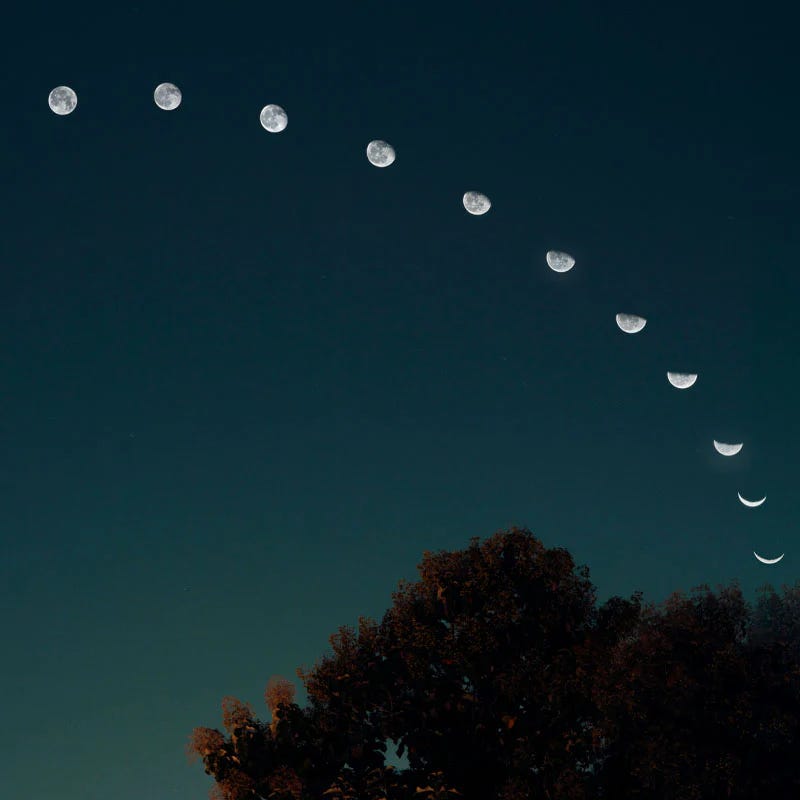
Each lunar month is divided into 30 tithis, divided into two halves. The Kṛṣṇa-pakṣa (the waning phase of the moon) starts after Pūrṇimā and ends at Amāvāsyā, while the Śukla-pakṣa (the waxing phase) begins after Amāvāsyā and ends at the next Pūrṇimā (you can see that these two are usually mentioned in the Vaiṣnava calendar). There are two ekādaśīs on a lunar month, at the 11th tithi of each phase. The difficulty is that the tithis don’t match the solar days. They are calculated based on the angular separation of the sun and moon, and range from 19 to 26 hours. A tithi can thus start at any time of the day or night. That’s why sometimes ekādaśīs and other dates often fall into different days in different parts of the world, due to the difference in the time of the local sunrise.
This discrepancy is mentioned by Prabhupāda in his purport to SB 5.22.7: “According to solar astronomical calculations, each year extends six days beyond the calendar year, and according to lunar calculations, each year is six days shorter. Therefore, because of the movements of the sun and moon, there is a difference of twelve days between the solar and lunar years. As the Saṁvatsara, Parivatsara, Iḍāvatsara, Anuvatsara and Vatsara pass by, two extra months are added within each five years. This makes a sixth saṁvatsara, but because that saṁvatsara is extra, the solar system is calculated according to the above five names.”
The lunar calendar has 6 days less than the Vedic normative calendar, and the solar calendar has about 6 days more. In this way, there is a difference of 12 days between the lunar and solar calendars.
In Vedic societies, people would usually follow the lunar calendar. To keep it in synchrony with the solar calendar, they would use the five-year saṁvatsara system, in which two extra months were added to the lunar calendar every five years, creating a functional sixth year to correct the accumulated lunar–solar discrepancy. Nowadays, it is more common to add an extra month every two or three years (the Pūruṣottama Māsa), but in any case, the underlying principle is the same.
You can also donate using Buy Me a Coffee, PayPal, Wise, Revolut, or bank transfers. There is a separate page with all the links. If you prefer, you can also receive the updates on Telegram.
https://dennisreganphd.substack.com/p/the-necessity-for-a-new-philosophy?r=7bumbm&utm_medium=ios