

Subscribe to receive new articles by e-mail. It’s free, but if you like, you can pledge a donation:
Some Christians believe that the Earth is flat because their scripture mentions “the four corners of the Earth”, “the pillars of the earth”, and so on. In fact, one could be killed until a few centuries ago for publicly claiming the Earth is a globe. Similarly, some Muslims believe similarly because of passages of the Qur’an that mention the earth being spread out, or flat like a bed. Considering the description of Bhū-mandala being composed of seven islands in the Śrīmad Bhāgavatam, it is not surprising that some Hare Kṛṣṇa devotees also believe so, with some coming to the point of believing (no joke) that we can find the rest of Bhū-mandala by sailing past the North Pole.
In reality, nowhere in the sastras is it described that the Earth, as the planet where we walk, is flat. In the Surya-siddhanta (1.59), which was commented on by Śrīla Bhaktisiddhānta Sarasvatī Thākura, it is mentioned:
yojanāni śatānyastau bhukarmo dviguṇānitu
tadvargato daśaguṇāt padam bhūparidhirbhavet“The earth’s diameter (bhukarna) is 1600 (2 X 800) yojanas. The square root of 10 times the square of earth’s diameter is earth’s circumference.”
There is no single fixed length for a yojana; different sources define it differently. In the Śrīmad Bhāgavatam, Prabhupāda takes the measure of the yojana as eight miles, which is consistent with the descriptions of the Puranas. It appears, however, that the Surya-siddhanta uses a different measure for the yojana, of about five miles. We can see that in this particular verse, the diameter of the Earth is given as 1600 yojanas. If we take the yojana as five miles, we have 8000 miles, which is extremely close to the 7,918 miles for the average diameter of the Earth in modern calculations. Similarly, the distances and circumference of the planets in the Surya-siddhanta match modern estimates closely when the yojana is taken as five miles. If we take it as slightly less, then the agreement becomes even closer. Similarly, the formula given for calculating the Earth’s circumference (the square root of 10 times the square of the Earth’s diameter) is very close to modern estimates.
The measure of the Earth’s diameter and circumference clearly indicates the Earth as a globe, which is consistently confirmed in other passages of the Surya-siddhanta and of the Puranas.
Śrīmad Bhāgavatam 5.21.9, for example, mentions:
yatrodeti tasya ha samāna-sūtra-nipāte nimlocati yatra kvacana syandenābhitapati tasya haiṣa samāna-sūtra-nipāte prasvāpayati tatra gataṁ na paśyanti ye taṁ samanupaśyeran.
“People living in countries at points diametrically opposite to where the sun is first seen rising will see the sun setting, and if a straight line were drawn from a point where the sun is at midday, the people in countries at the opposite end of the line would be experiencing midnight. Similarly, if people residing where the sun is setting were to go to countries diametrically opposite, they would not see the sun in the same condition.”
This describes our practical experience on Earth. When it is midday in Japan, it is midnight in Brazil, which is located on the diametrically opposite side of the globe. If the Earth were flat, the sun would circle overhead, just as it does at the north pole.
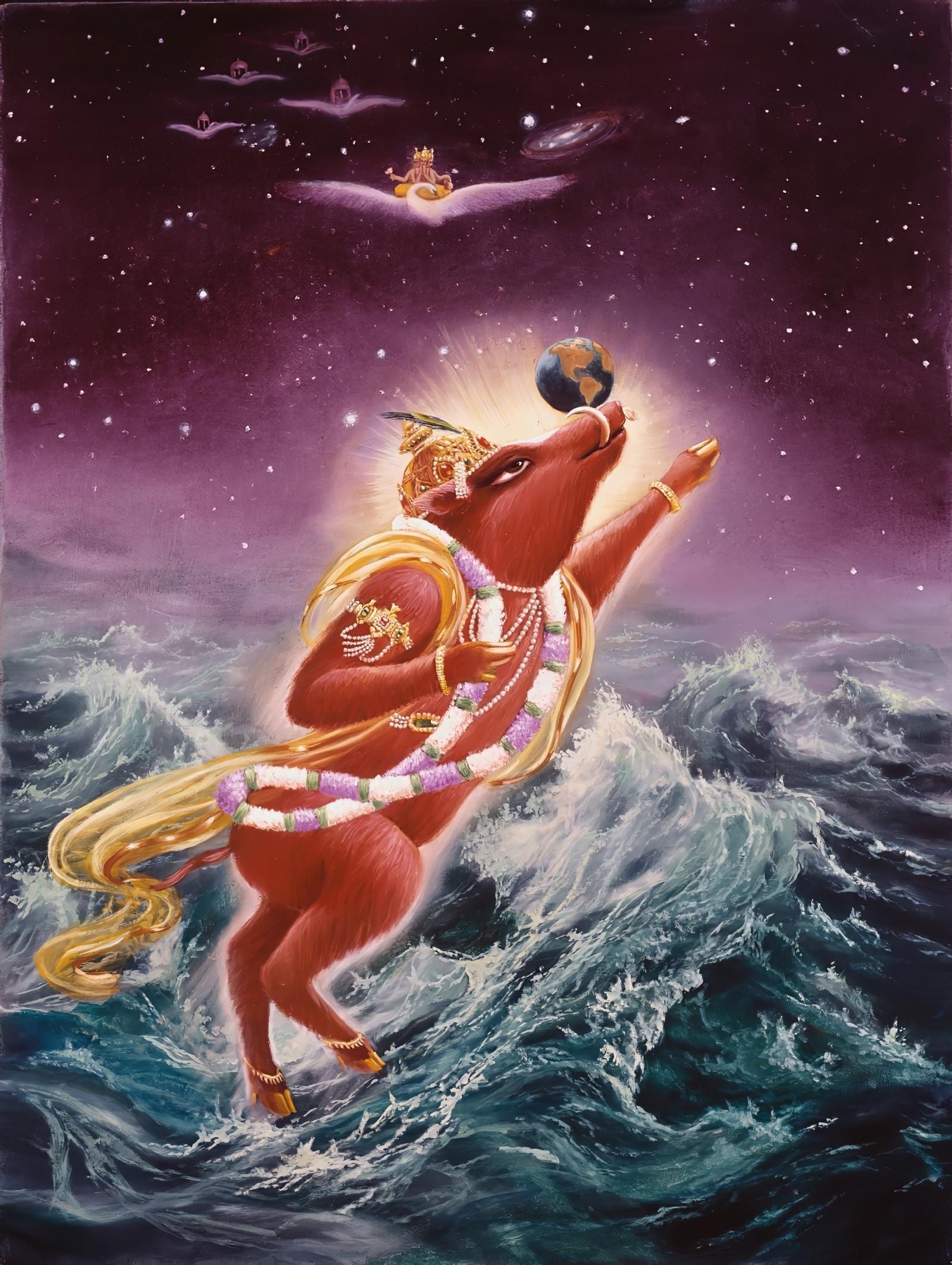
We can also see that Prabhupāda consistently identifies the Earth as a globe in his translations and commentaries of the Śrīmad Bhāgavatam. He even instructed his disciples to depict Varāhadeva lifting a spherical Earth from the ocean to illustrate the Śrīmad Bhāgavatam.
As Srila Prabhupada mentions in a morning walk (December 9, 1973, Los Angeles):
“In Vedic literature it is bhu-gola, jagad-anda. These words are there. We can see also it is round, jagad-anda. The universe is round. And Goloka. Or Bhu-gola. Bhū-gola, the earth is round. So in the Vedic literatures... Therefore their knowledge is also imperfect because they do not refer to the Vedic literatures. It is already there. Bhu-gola. Bhu means the earth; gola means round. It is already there. And the geography’s called, according to Sanskrit, it is called Bhu-gola. Long, long ago, before Galileo.”
At the same time, however, there is the description of an extended earth, formed by the collective of all the intermediate planetary systems, called Bhū-Mandala. This is a gigantic flat structure of which the planet Earth is part.
This is not dificult to understand when we take into consideration that the universe described in the Vedas is multidimensional. One can simultaneously live on a flat island, on a spherical planet, and on a flat solar system. In the same way, there is the round Bhu (Bhu-Gola) and the flat Bhu (Bhu-Mandala), and both exist simultaneously. As human beings, we have access only to the gross dimension, and thus we can see only the earthly globe where we live, but higher beings can see more, and their understanding of reality is different from ours. Their view of the Universe is conveyed in books like the Srimad Bhagavatam, and thus, such books of knowledge describe a reality that does not directly correspond to what we can observe using our human senses.
Thus, different levels of reality are described with the same words, and one can pick one or the other according to one’s level of understanding. This is simultaneously one of the most intriguing and one of the most difficult to understand aspects of the Vedic literature.
Another proof that the Earth is not flat is that the orbit of the sun is perceived very differently by the inhabitants of other parts of Bhū-mandala. See SB 5.21.8, for example:
tatratyānāṁ divasa-madhyaṅgata eva sadādityas tapati savyenācalaṁ dakṣiṇena karoti
“The living entities residing on Sumeru Mountain are always very warm, as at midday, because for them the sun is always overhead. Although the sun moves counterclockwise, facing the constellations, with Sumeru Mountain on its left, it also moves clockwise and appears to have the mountain on its right because it is influenced by the dakṣiṇāvarta wind.”
Different from us, the inhabitants of Sumeru Mountain always see the sun circling overhead and always feel its warmth. For them, there is no night, just as expected from a flat structure. If the Earth were flat, it would be the same for us.
It is described that inhabitants of previous ages somehow had access to other parts of Bhū-mandala, but this is not possible for us. As inhabitants of Kali-yuga, all we have access to is our small and blue planet. Just because we can’t see something, however, it does not mean it doesn’t exist. I may not be able to see Kṛṣṇa’s pastimes when I go to Vṛndāvana, but it doesn’t mean they are not happening.
There are thus two cosmological models described in the Vedas: the cosmos of our practical experience, centered around our small planet, and the higher-dimensional universe experienced by demigods and other higher beings, which is centered around Bhū-Mandala, the extended earth, of which our planet is part. Bhū-Mandala is composed of seven concentric islands, separated by concentric oceans. It appears that each of the seven islands is somehow formed by several different planets. Earth, or Bharata-varṣa, comprises the southern part of Jambūdvīpa, separated from the rest by the higher-dimensional Himalayas. Some interpret our planet as not even the whole Bharata-varṣa, but just part of it, since the dimensions given for Bharata-varṣa are much greater than our planet.
Recently, I published another article where I described how Prabhupāda gave us the keys to understand Vedic cosmology. You can read more on his views there.
You can also donate using Buy Me a Coffee, PayPal, Wise, Revolut, or bank transfers. There is a separate page with all the links. This helps me enormously to have time to write instead of doing other things to make a living. Thanks!