

Subscribe to receive all new articles directly by e-mail. It’s free, but if you like, you can pledge a monthly or annual donation to support my work. There is also Telegram.
To use milk or not is a complicated question that involves health, moral, and philosophical aspects. When we get information about how cows are treated in the modern dairy industry, our first reaction may be to decide to become vegan. However, there are a few points that you may want to consider.
First of all, there are a few questions that one should be aware of in terms of health aspects: there are a few essential nutrients for the human body that are difficult to get just from vegetables. We can see that there is no historical example of societies voluntarily abstaining from all animal sources. In Vedic societies, people would extensively use milk, and in most other societies, people would eat fish or meat. Śrila Prabhupāda mentions that uncivilized people kill animals and eat their flesh, while civilized societies get nutrition in the form of milk. Practically all historical examples we can find go in one direction or the other.
Three important factors are the ratio of omega-3 and omega-6 fats, the difficulty in getting some essential vitamins (A and B12, especially), and the absorption of essential minerals. A vegan who uses a lot of refined vegetable oils and doesn’t supplement omega-3 vitamins may end up with health problems.
Practically speaking, with the exception of algae, no plant-based source supplies any amount of omega-3. This is a particular type of fat that is found only in animals and specific types of algae. What plants have is alpha-linolenic acid (ALA), a precursor that can be converted into the active forms of omega-3 (EPA and DHA) by our body. The problem is that this conversion is very limited and inefficient; therefore, only very small quantities are effectively converted. As a result, a vegetarian will always have only small amounts of omega-3, even if he eats large amounts of chia seeds or walnuts. Although milk products offer a relatively small percentage of omega-3, it comes in the active form, serving as a good complement. This is also another reason to avoid refined vegetable oils: they are rich in omega-6, which competes with the omega-3 inside our bodies, exacerbating the problem.
The only way to consume more omega-6 without harm to our health is to simultaneously also consume more omega-3, something that is very difficult for vegetarians, and even more so for vegans, unless one supplements with good doses of algae supplements. The problem, though, is that they can be quite expensive.
A second problem is the lack of vitamins A and B12. Vegetable sources include only beta-carotene, which (although called “vitamin A”) is an inactive form that needs to be first converted by the body. The problem is that, again, this conversion is inefficient, and only small quantities are produced. Some are not able to convert any quantity at all. These usually struggle on a vegan diet unless they supplement with pills. Milk, on the other hand, contains vitamin A in its active form.
Next, we have the question of vitamin B12. This is a problem for both vegetarians and vegans since vegetables don’t offer this important nutrient. Milk offers small quantities of B12 that can be sufficient to allow one to go by without supplementation. For vegans, this point is more serious.
Milk and milk products are also an important source of essential amino acids, high-quality fats, minerals like magnesium and zinc (of which most of us are critically deficient), as well as most vitamins. In fact, good-quality milk is an almost complete food. Even if one has a bad diet, milk can allow him or her to get by. A vegan diet can also work, but it demands more attention.
Milk and milk products are also important sources of iodine. Nowadays, iodine is mixed in the commercial salt in most parts of the world; therefore, it stopped being a problem in the largest part, but traditionally iodine would be a serious problem for vegetarians, since the main sources of this mineral are fish and seafood. Unless one has the opportunity of eating seaweed frequently, iodine would be a problem. Again, milk offers good amounts of iodine (59 to 119% of the RDA per cup), serving as a reliable source for lacto-vegetarians.
In conclusion, a vegan can also be healthy; it’s just that it’s more difficult to fulfill all the body’s nutritional requirements without milk products. One that has time to research and maintain a proper diet, combined with the appropriate supplements, can do fine, but one that just takes out milk products from his or her diet, putting in its place things like refined vegetable oils and soy products, can end up worse than the meat-eaters. Another observation is that the need for supplements makes the vegan diet more entangled with the modern lifestyle of industry and supermarkets. It makes less sense as soon as one starts to think about retiring from modern civilization and going to live in a natural environment.
The other dimension
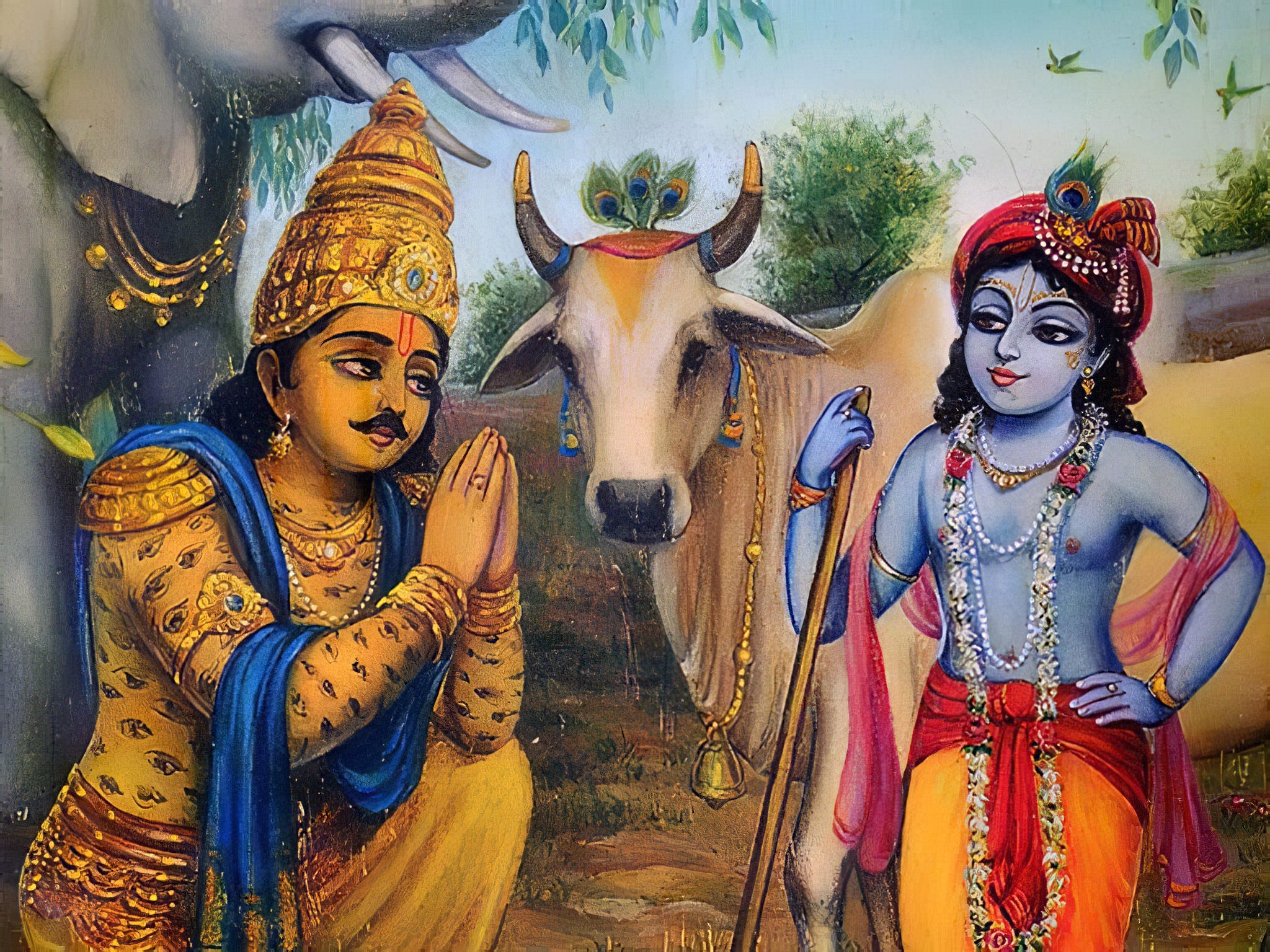
Next, we have the moral perspective. Milk is important from both a health and spiritual perspective. There is nothing wrong with maintaining a cow and taking milk from her. This is a beneficial relationship for both. In fact, humans and bovines have been living in a symbiotic relationship since the beginning of creation. There is no question of brāhminical culture without cows and milk.
The problem is not the milk but the way cows are treated. When one becomes aware of the fact that dairy cows are sold to the slaughterhouse after stopping giving milk, the first reaction is to want to stop completely and go on a vegan diet. However, this is ultimately not beneficial to the cows (which are still going to be slaughtered) nor for us, who lose the benefits of the milk. The positive solution is not to stop using milk, but to implement or support programs of cow protection so we can produce our own ahimsa milk.
What to do if this is not a viable option? A devotee who has been working with cows for a long time once shared an idea that seems like a reasonable middle ground for those who live in cities and don’t have the option of buying milk from protected cows. He explained that ahimsa milk costs about two times more than regular milk since one needs to keep taking care of the cow after she stops giving milk. That’s one of the reasons cow protection programs have a difficult time: they simply can’t compete financially with the dairy industry. To survive, they need funding. He suggested that any concerned person can set aside the same amount he pays for the milk products he buys and donate it to a cow protection program so they can take care of more cows. This is one way for one to try to repay his debt: maintaining a cow that can’t give milk, although not necessarily the same cow.
There is also the consideration of how the cows are treated. In some countries, most farms use an industrial system where the cows are kept in small spaces, fed only grains, and treated with antibiotics. This type of milk should be completely avoided. Not only is this treatment of the cows unacceptable, but the milk is also not very healthy. Cows that are fed only grains are essentially diseased, and the extensive use of antibiotics doesn’t help either. This type of milk is lower in nutrients, rich in omega-6, and contains various contaminants.
Another type is milk from pasture-raised cows, where the cows have the freedom to roam around a large area and feed on grass. The treatment of the cows is much better, fewer antibiotics are used, and the milk is much healthier. This is the type of milk that may be acceptable to consume (this is a personal decision) when there is no option of ahimsa milk available. One can find this information based on where the milk was produced. Some brands nowadays offer a QR code that allows one to see from which exact property the milk came. However, the best option is always to try to buy milk from people you know, and you can be sure to give the cows good treatment. There are small properties in the outskirts of practically any city where honest people take care of a few cows and sell the milk.
A realistic model of simple living
Finally, we have the philosophical perspective, which leads us to the goal of “simple living, high thinking.” One of the greatest difficulties for most of us is that we are trying to practice Krsna Consciousness in hostile territory, living in big cities, working in offices and factories, and living an artificial lifestyle. Such an environment fosters the influence of the modes of passion and ignorance, and the result is that our minds become very agitated, and spiritual practice becomes a struggle.
Śrila Bhaktivinoda Thākura was speaking about the importance of varnāśrama, but we frequently fail to understand what it means. We think that varnāśrama means ladies with covered heads, but this is just one of the external aspects. The essential aspect of the varnāśrama system is people living in a simple environment, in contact with the land and with the cows. Such an environment fosters the mode of goodness and allows one to easily progress in spiritual life. Śrila Prabhupāda captured the essence in his saying, “Simple living, high thinking.”
We can see that Śrila Prabhupāda emphasized the establishment of self-sustainable rural communities, and that’s a part of his instructions that we are largely not being able to follow. Only when we find a model of rural communities where people can live peacefully and quickly advance in spiritual life will our movement be well-established. That’s our future as a society. We can see that cows and milk are very much part of this future. A devotee may temporarily follow a vegan diet when ahimsa milk is unavailable, but it doesn’t work well as a collective, long-term solution for our movement.
One traditional problem with farm communities is that not many devotees are comfortable with completely unplugging from civilization and moving to a place without electricity or internet. This is, however, much simpler nowadays, with solar panels and Starlink. Devotees can now get together, buy some land, build a few houses there, and have electricity and internet, even in the most remote regions. Some devotees can work over the internet, and others can work taking care of cows and producing vegetables, and other services. This can create a small local economy, where one buys from the other, and everyone can live. Needed products and equipment can come from the outside, but the community can be at least financially self-sustainable. We can start with what works, and gradually try to implement other aspects.
You can also donate using Buy Me a Coffee, PayPal, Wise, Revolut, or bank transfers. There is a separate page with all the links.
Prabhuji few devotees offers milk powder of gir cow milk, A2 gir cow ghee. And they also offer other many good quality natural products. Their website is https://www.gomataseva.org/?srsltid=AfmBOorQBAKAwMYqj3-Jwwg645vSuvRwO--1upvXBfsYgyUzqZzwreMy
This website can be helpful for the devotees. And obviously purchasing it's product will also support the cow and devotees who are providing these services.