

Subscribe to receive new articles by e-mail. It’s free, but if you like, you can pledge a donation:
Prabhupāda wrote his commentary on the Bhagavad-gītā in the early days of our movement. At that time, there was no money to publish such a big book, nor the means to distribute it. Prabhupāda decided thus to get it published through some publishing company. He sent Brahmananda to visit a few publishing houses, but at first, he was received with little interest. However, this changed when he visited the Macmillan company:
“The next day, dressed in suit and tie, Brahmananda made his way up to the Macmillan skyscraper at 866 Third Avenue, just off 52nd Street. His expectations as large as the building itself, he was disappointed when he learned that the order for the album had come from a clerk in the mailroom.
“This really had nothing to do with the publishing company-it was just a simple worker who had some interest in mantras and meditation.”
So Brahmananda dutifully delivered the album and had pretty much given up hope that his teacher’s Gita would get published. Just then, in the midst of polite small talk with the clerk, a young executive happened to appear, hoping to collect his mail. The clerk introduced him to Brahmananda.
“This is James O’Shea Wade, our senior editor.”
Brahmananda seized the moment.
“I am a disciple of a guru from India,” he said, trying to repeat Prabhupada’s words verbatim. “He has translated the Bhagavad-gita.”
“What?” Wade responded, incredulously. “We’ve just published a full line of spiritual books, and we were looking for a Bhagavad-gita to fill out the set.”
Brahmananda’s mouth dropped open. Though at a loss for words himself, he contemplated the potency of Prabhupada’s: “They will publish it. Do not worry.”
Wade then broke the awkward silence.
“You bring in the manuscript tomorrow,” he offered, “and we’ll publish it, sight unseen.”
Brahmananda raced back down to the storefront and told Prabhupada the news. In his own inimitable way, Prabhupada was nonchalant, as though he knew what would transpire before it happened.”
The editor honored his word, and they published Prabhupāda’s Gītā. However, they wanted a book of fewer than 400 pages, and thus most of Prabhupāda’s purports were cut from this first edition, published in 1968.
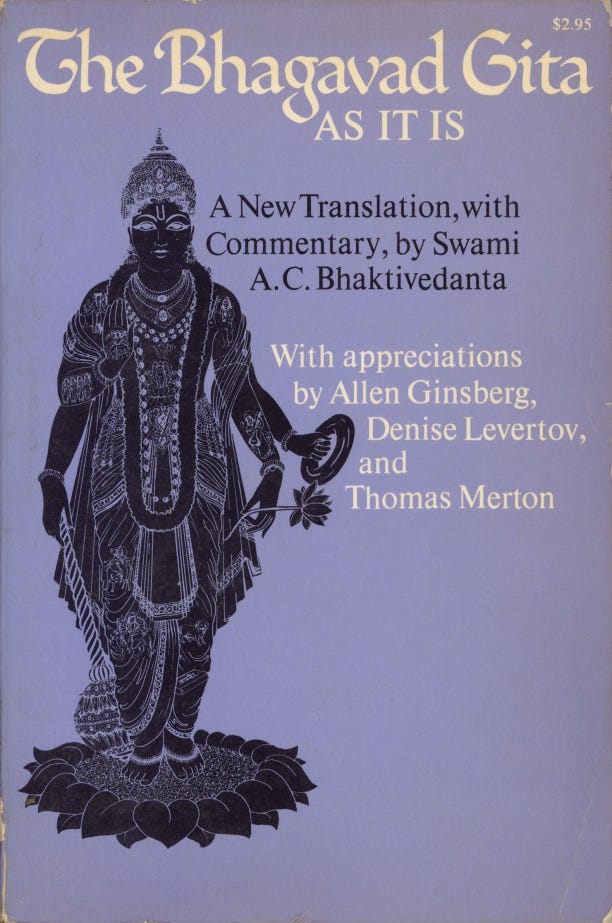
In case you are curious, you can read this edition here. You can see that most of the purports were butchered by the Macmillan editors, leaving only key points. Prabhupāda himself showed dissatisfaction with it.
However, because this first edition was received with a moderate success, Prabhupāda was able to convince them to publish the complete manuscript in a new edition, giving birth to the 1972 Bhagavad-Gita as It Is, which you can find here.
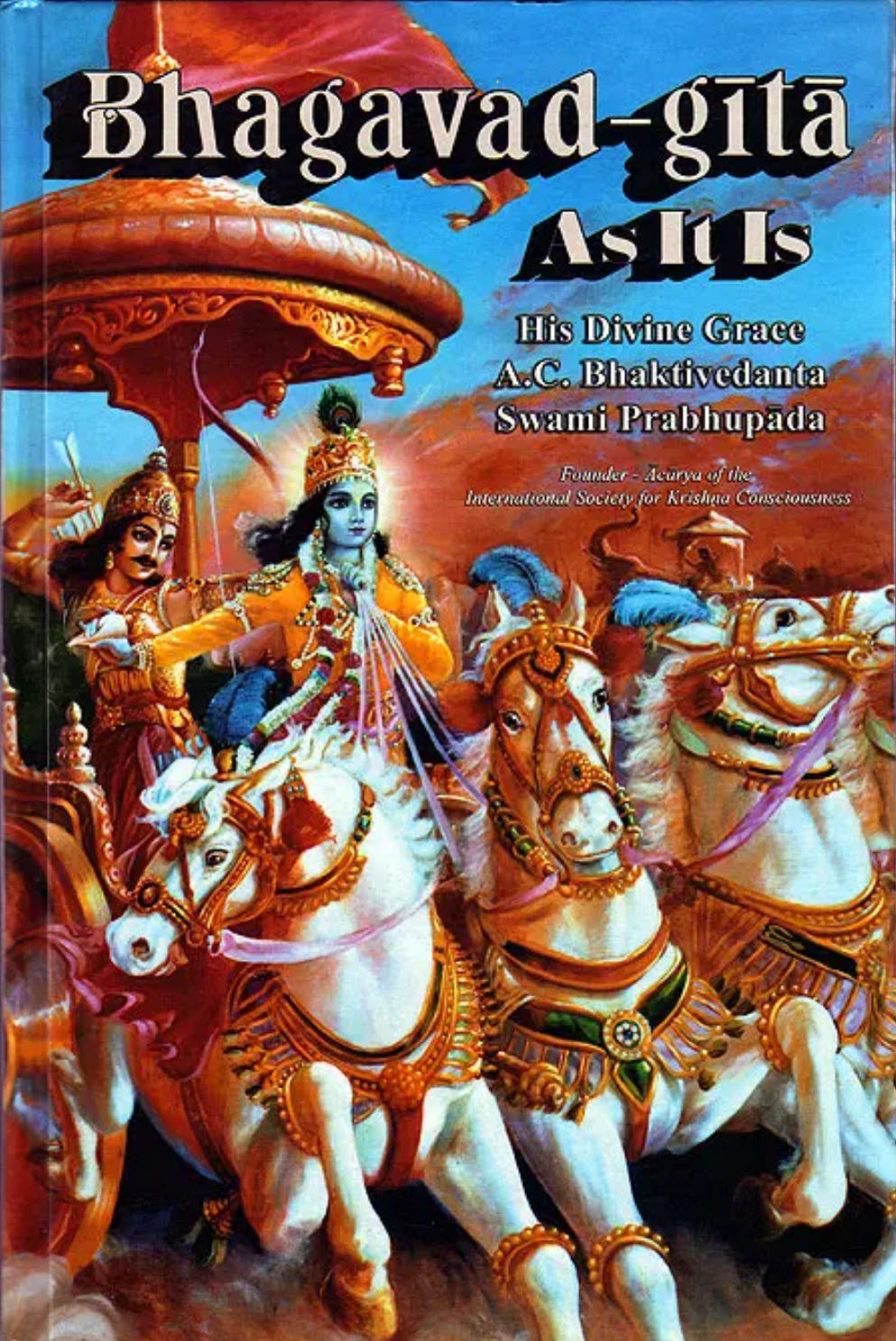
The edition of the book was done by very new devotees at the time, who were, at times, a little creative in their work on the book. In text 10.21, for example, they cut out a whole paragraph from Prabhupāda’s purport, where he says that according to the Vedic version, there is just one sun per material universe. 18.44 mentions “cattle raising” instead of “cow protection” and so on. Prabhupāda himself complained about a few of these mistakes in his lectures.
These few mistakes led devotees in the BBT to later publish a revised edition, the one we have currently in the Vedabase. I will not enter into details about whether this is justified or not, since most already have their opinion. My goal here is to just discuss one specific change: the title of chapter six.
In the 1972 edition, the chapter is called: “Sankhya-yoga”
In the later, edited editions, it is called “Dhyāna-yoga”
As we all know, chapter six is the chapter where Kṛṣṇa explains the process of eight-fold meditation, which is called aṣtānga-yoga (the eight-fold process) or dhyāna-yoga (meditation connected with the Lord). The term “sāṅkhya-yoga”, on the other hand, is often connected with chapter two, where Krsna gives Arjuna analytical knowledge.
Apparently, the editors thought it made more sense to call the chapter “Dhyāna-yoga” in the recent editions, but this creates a few contradictions with what Prabhupāda wrote in other passages. In the first chapter of ‘The Path of Perfection’, for example, he wrote: “One who can do this is the perfect sannyāsī and the perfect yogi. In the first verse of the sixth chapter of the Bhagavad-gītā, the chapter dealing with sāṅkhya-yoga, Bhagavān Śrī Kṛṣṇa states…”
Prabhupāda also refers to the sixth chapter as sāṅkhya-yoga in a number of lectures and a few other passages. This was no accident; he intentionally named the chapter in this way.
We can understand it better if we study the chapters of the 4th canto of Śrimad Bhāgavatam that describe the teachings of Lord Kapila (I wrote a book on that, in case you are interested). Lord Kapila is the preceptor of the devotional process of sāṅkhya-yoga, which includes both philosophy and meditation, practiced with the goal of realizing one’s eternal relationship with the Lord in devotional service.
In this way, the term “sāṅkhya-yoga”, as used by Prabhupāda, is much more loaded with meaning than the term “dhyāna-yoga”, which refers simply to meditation.
What about chapter two? Doesn’t it also speak about sāṅkhya? Yes, in a sense, but see the way Prabhupāda explains it in his purport to Bg 2.39:
“Thus the buddhi-yoga mentioned in this verse is the devotional service of the Lord, and the word sāṅkhya mentioned herein has nothing to do with the atheistic sāṅkhya-yoga enunciated by the impostor Kapila. One should not, therefore, misunderstand that the sāṅkhya-yoga mentioned herein has any connection with the atheistic sāṅkhya. Nor did that philosophy have any influence during that time; nor would Lord Kṛṣṇa care to mention such godless philosophical speculations. Real sāṅkhya philosophy is described by Lord Kapila in the Śrīmad-Bhāgavatam, but even that sāṅkhya has nothing to do with the current topics. Here, sāṅkhya means analytical description of the body and the soul. Lord Kṛṣṇa made an analytical description of the soul just to bring Arjuna to the point of buddhi-yoga, or bhakti-yoga. Therefore, Lord Kṛṣṇa’s sāṅkhya and Lord Kapila’s sāṅkhya, as described in the Bhāgavatam; are one and the same. They are all bhakti-yoga. He said, therefore, that only the less intelligent class of men make a distinction between sāṅkhya-yoga and bhakti-yoga.”
There are three different types of sāṅkhya:
a) The original sāṅkhya-yoga propounded by Lord Kapila and explained in the Srimad Bhagavatam.
b) The atheistic sāṅkhya of the impostor Kapila, which is not bona fide at all.
c) The analytical process described by Kṛṣṇa in the second chapter of the Gītā, which is also called sāṅkhya-yoga, but is different from the original sankiya of Lord Kapila.
In chapter six, however, Krsna goes much beyond mere description of meditation. He brings the reader to the real conclusion of the process, concluding it with:
“And of all yogīs, he who always abides in Me with great faith, worshiping Me in transcendental loving service, is most intimately united with Me in yoga and is the highest of all.” (Bg 6.47)
Prabhupāda concludes that what Krsna describes in chapter six is the same transcendental process of sāṅkhya-yoga described by Lord Kapila in the Srimad Bhagavatam, and thus decided to name the chapter as such, instead of naming it simply “dhyāna-yoga”, which has a more limited scope. Prabhupada gives a very deep and elaborate commentary on the process of sāṅkhya-yoga of Lord Kapila in the Srimad Bhagavatam, possibly seeing it as a natural progression of the description found in the Gītā.
It’s important to note that Rāmānujācārya names chapter six in his commentary “Dhyāna-yoga”; there is nothing wrong with the title. Madhvācārya, in his turn, named it “Ātma-saṁyama-yoga”. In short, each author has the authority to name chapters of their work in any way they consider fit; it’s not about “right” or “wrong”. Rāmānujācārya chose to name chapter six as “Dhyāna-yoga”, in his commentary, Madhvācārya named it “Ātma-saṁyama-yoga” and Prabhupāda chose to name it “Sankhya-yoga”.
What is more challenging is explaining why editors choose to change the titles selected by an author after their physical departure from this world. This is an example of why this topic generates such heated discussions.
You can also donate using Buy Me a Coffee, PayPal, Wise, Revolut, or bank transfers. There is a separate page with all the links. This helps me enormously to have time to write instead of doing other things to make a living. Thanks!
Hare Kṛṣṇa prabhuji
Jai Śrīla Prabhupāda
With all due respect, they are referred by Śrīla Prabhupāda as RASCAL EDITORS. They have become more than their guru n trying to surpass Him. Familiarity breeds contempt. In SB 2.5.16 p Śrīla Prabhupāda explains as below-:
In meditation, there are two systems of yoga, namely aṣṭāṅga-yoga and sāṅkhya-yoga. Aṣṭāṅga-yoga is practice in concentrating the mind, releasing oneself from all engagements by the regulative processes of meditation, concentration, sitting postures, blocking the movements of the internal circulation of air, etc. Sāṅkhya-yoga is meant to distinguish the truth from ephemerals. But ultimately both the systems are meant for realizing the impersonal Brahman, which is but a partial representation of Nārāyaṇa, the Personality of Godhead.