

Subscribe to receive new articles by e-mail. It’s free, but if you like, you can pledge a donation:
Sometimes, when we hear about the faults of a devotee—that someone displayed some pride, misunderstood something, or was chastised or corrected—we conclude that this person was not a real devotee and should not be respected. We then often mock and condemn without considering the qualities or the good such a devotee may have done.
One central problem is that we often think only in absolute categories, which is the result of our own conditioning. Under the influence of the mode of passion, we tend to see everything black and white. Either someone is perfect or completely useless, or completely pure or completely fallen, saint or sinner. The fact, however, is that there are many levels between these extremes. If someone has eight hundred million dollars, he may not be considered a billionaire, but he is not poor either. Similarly, a devotee may not possess the absolute purity of Rūpa Gosvāmī and still be a very advanced devotee empowered to perform important service.
Vallabha Bhaṭṭa, also known as Vallabhācārya, was not an ordinary person. He was a great Vaiṣṇava scholar, a powerful preacher, the author of several important works, and the leader of a Vaiṣṇava sampradāya. At the same time, however, we may hear this famous passage:
“The next day when he came to the assembly of Śrī Caitanya Mahāprabhu, he sat down after offering obeisances to the Lord and said something with great pride. “In my commentary on Śrīmad-Bhāgavatam,” he said, “I have refuted the explanations of Śrīdhara Svāmī. I cannot accept his explanations. “Whatever Śrīdhara Svāmī reads he explains according to the circumstances. Therefore he is inconsistent in his explanations and cannot be accepted as an authority.”
Śrī Caitanya Mahāprabhu smilingly replied, “One who does not accept the svāmī [husband] as an authority I consider a prostitute.” After saying this, Śrī Caitanya Mahāprabhu became very grave. All the devotees present derived great satisfaction from hearing this statement.” (CC Antya 7.112-116)
Hearing it, we may forget about the other side. If we go to the 19th chapter of the Madhya-lila, we can read about his affectionate dealings with Śrī Caitanya Mahāprabhu:
“At that time, Śrī Vallabha Bhaṭṭa was staying at Āḍāila-grāma, and when he heard that Śrī Caitanya Mahāprabhu had arrived, he went to His place to see Him. Vallabha Bhaṭṭācārya offered Śrī Caitanya Mahāprabhu his obeisances, and the Lord embraced him. After that, they discussed topics about Kṛṣṇa for some time.
Śrī Caitanya Mahāprabhu felt great ecstatic love when they began discussing Kṛṣṇa, but the Lord checked His feelings because He felt shy before Vallabha Bhaṭṭa. Although the Lord restrained Himself externally, ecstatic love raged within. There was no checking that. Vallabha Bhaṭṭa was astonished to detect this.” (CC Madhya 19.61-64)
So, who is the real Vallabha Bhaṭṭa? The humble devotee with whom Śrī Caitanya Mahāprabhu had such affectionate dealings, or the proud scholar who criticized Śrīdhara Svāmī, the original commentator of Śrīmad-Bhāgavatam? Both, but the pride was a temporary covering, while the devotion is the eternal nature.
This shows that a mistake does not disqualify one from being a devotee. It may suggest one is not an eternally perfect nitya-siddha, but does not mean one is not in a high devotional platform or that one may not reach perfection later.
In fact, the same Antya-lila clarifies that Śrī Caitanya Mahāprabhu acted in this way to correct Vallabha Bhaṭṭa, exactly because he was such a dear devotee, who was entrusted to do a valuable service, bringing Kṛṣṇa consciousness to a huge public in Gujarat, Rajasthan, and the area around Gokula. A devotee who is empowered to perform such a service cannot be considered ordinary.
“By various hints and refutations, Lord Caitanya, the Supreme Personality of Godhead, corrected Vallabha Bhaṭṭa exactly as Kṛṣṇa had cut down the false pride of Indra.” (CC Antya 7.118)
Indra committed a mistake by attacking Govardhana, but Kṛṣṇa did not reject Him. Instead, he used his anger as an opportunity for displaying His pastime of lifting Govardhana Hill. By displaying His power, he gave Indra the opportunity to understand his mistake and become repentant. Indra was then reinstalled in his position and resumed his service in managing the rains.
Similarly, it is described that Vallabha Bhaṭṭa went through a similar process:
“Returning home that night, Vallabha Bhaṭṭa thought, “Previously, at Prayāga, Lord Caitanya was very kind to me. “He accepted my invitation with His other devotees, and He was kind to me. Why has He now changed so much here at Jagannātha Purī?
“Being very proud of my learning, I am thinking, ‘Let me become victorious.’ Śrī Caitanya Mahāprabhu, however, is trying to purify me by nullifying this false pride, for a characteristic of the Supreme Personality of Godhead is that He acts for everyone’s welfare.
“I am falsely proud, advertising myself as a learned scholar. Therefore Śrī Caitanya Mahāprabhu insults me just to favor me by cutting down this false pride. (CC Antya 7.120-123)
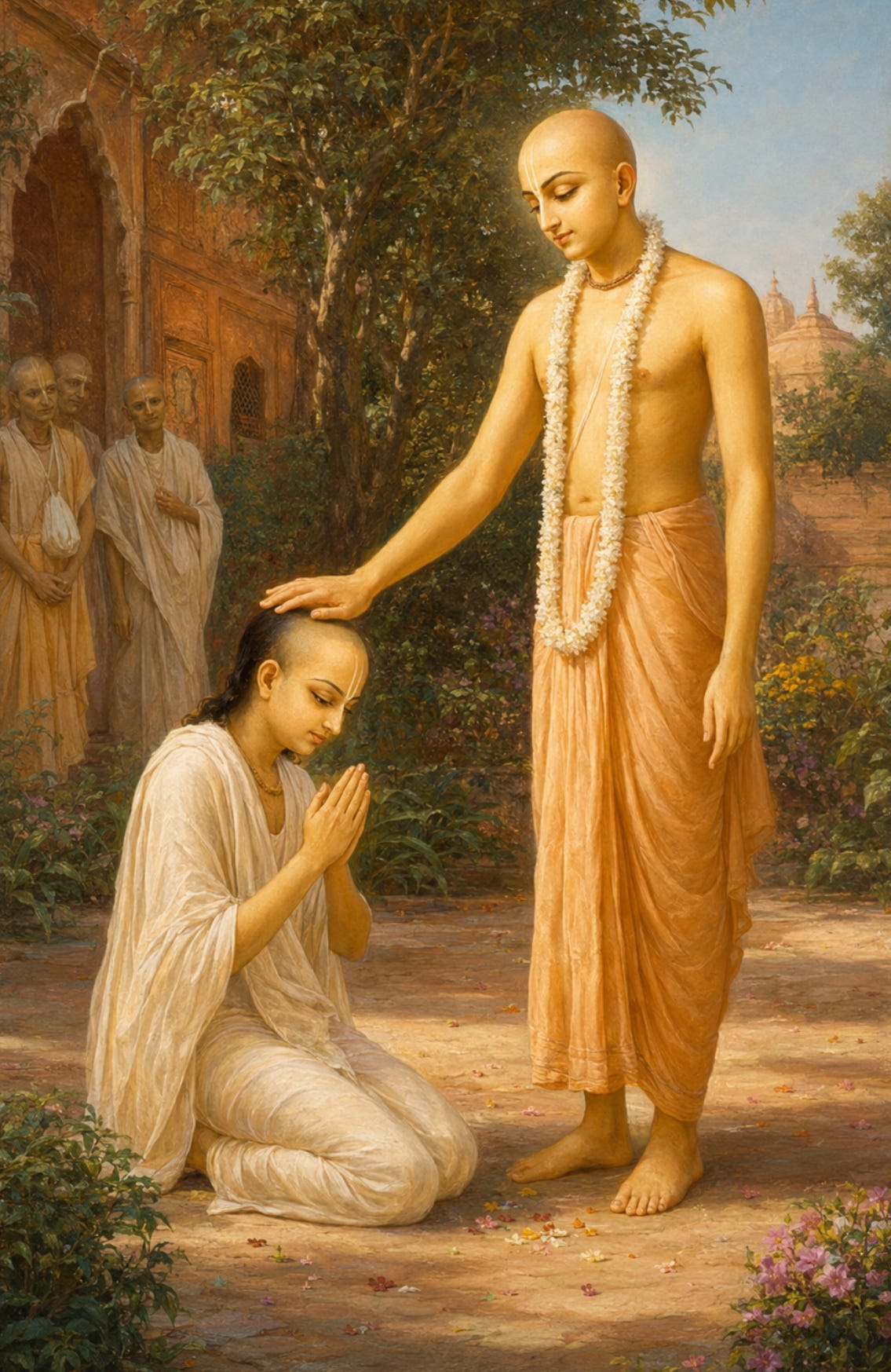
The next day, Vallabha Bhaṭṭa approached Śrī Caitanya Mahāprabhu again, lamenting his mistake, and was blessed by the Lord.
“Lord Śrī Caitanya Mahāprabhu said, “You are both a greatly learned scholar and a great devotee. Wherever there are two such attributes, there cannot be a mountain of false pride.
“You have dared criticize Śrīdhara Svāmī, and you have begun your own commentary on Śrīmad-Bhāgavatam, not accepting his authority. That is your false pride.
“Śrīdhara Svāmī is the spiritual master of the entire world because by his mercy we can understand Śrīmad-Bhāgavatam. I therefore accept him as a spiritual master. “Whatever you might write due to false pride, trying to surpass Śrīdhara Svāmī, would carry a contrary purport. Therefore no one would pay attention to it.
“One who comments on Śrīmad-Bhāgavatam following in the footsteps of Śrīdhara Svāmī will be honored and accepted by everyone. “Put forth your explanation of Śrīmad-Bhāgavatam following in the footsteps of Śrīdhara Svāmī. Giving up your false pride, worship the Supreme Personality of Godhead, Kṛṣṇa.” (CC Antya 7.131-136)
The point is that Śrī Caitanya Mahāprabhu corrected Vallabha Bhaṭṭa exactly because he was a great devotee, not the opposite. He recognized Vallabha Bhaṭṭa as a great devotee and scholar, but also saw that his pride had to be corrected so that it would not obstruct his devotional progress and service.
He thus took away the pride, so the good qualities could shine. Vallabha Bhaṭṭa later became celebrated as the principal ācārya of the Vallabha-sampradāya, connected with the Rudra-sampradāya of Viṣṇu Svāmī.
That’s how Kṛṣṇa acts. As He mentions in the Gītā (9.22), “But those who always worship Me with exclusive devotion, meditating on My transcendental form—to them I carry what they lack, and I preserve what they have.”
In other words, He preserves the qualities the devotee already has, and helps him to achieve the qualities that are still lacking. Later, in text 16.1-3, He describes the 26 divine qualities qualities: Fearlessness; purification of one’s existence; cultivation of spiritual knowledge; charity; self-control; performance of sacrifice; study of the Vedas; austerity; simplicity; nonviolence; truthfulness; freedom from anger; renunciation; tranquility; aversion to faultfinding; compassion for all living entities; freedom from covetousness; gentleness; modesty; steady determination; vigor; forgiveness; fortitude; cleanliness; and freedom from envy and from the passion for honor.
When we see a devotee worshiping Kṛṣṇa, but lacking any of them, we should understand that he or she is going through this process, and the qualities that are missing are going to gradually be revealed, as Kṛṣṇa does his magic.
This particular point is also confirmed in Śrīmad-Bhāgavatam 5.18.12, when it is said that “All the demigods and their exalted qualities reside in one who has unalloyed devotion to the Supreme Personality of Godhead.”
In this way, when we hear that a devotee was chastised by Kṛṣṇa or by His representative, we should see it as a symbol of Kṛṣṇa’s mercy upon him, and not of disqualification. It should also be taken as a lesson, so we can also identify the same mistake in ourselves and gradually become free from it. Certainly, Vallabha Bhaṭṭa was not the only devotee in history to show a degree of pride.
As Kṛṣṇadāsa Kavirāja concludes at the end of the chapter:
“The Lord purified Vallabha Bhaṭṭa by cleansing him of the mud of false pride. By such activities the Lord also instructed others. Śrī Caitanya Mahāprabhu was actually always merciful within His heart, but He was sometimes externally negligent of His devotees. We should not be preoccupied with His external feature, however, for if we do so we shall be vanquished. The pastimes of Śrī Caitanya Mahāprabhu are very deep. Who can understand them? Only one who has firm, deep devotion to His lotus feet can understand these pastimes.” (CC Antya 7.167-169)
Read more:

You can also donate using Buy Me a Coffee, PayPal, Wise, Revolut, or bank transfers. There is a separate page with all the links. This helps me enormously to have time to write instead of doing other things to make a living. Thanks!
I always had this question about Vallabhacharya. With this article you have corrected my Bhaav towards such an exalted associate of Gauranga Mahaprabhu.
thank you for article
Enligtening one
Hare krishna