

Subscribe to receive new articles by e-mail. It’s free, but if you like, you can pledge a donation:
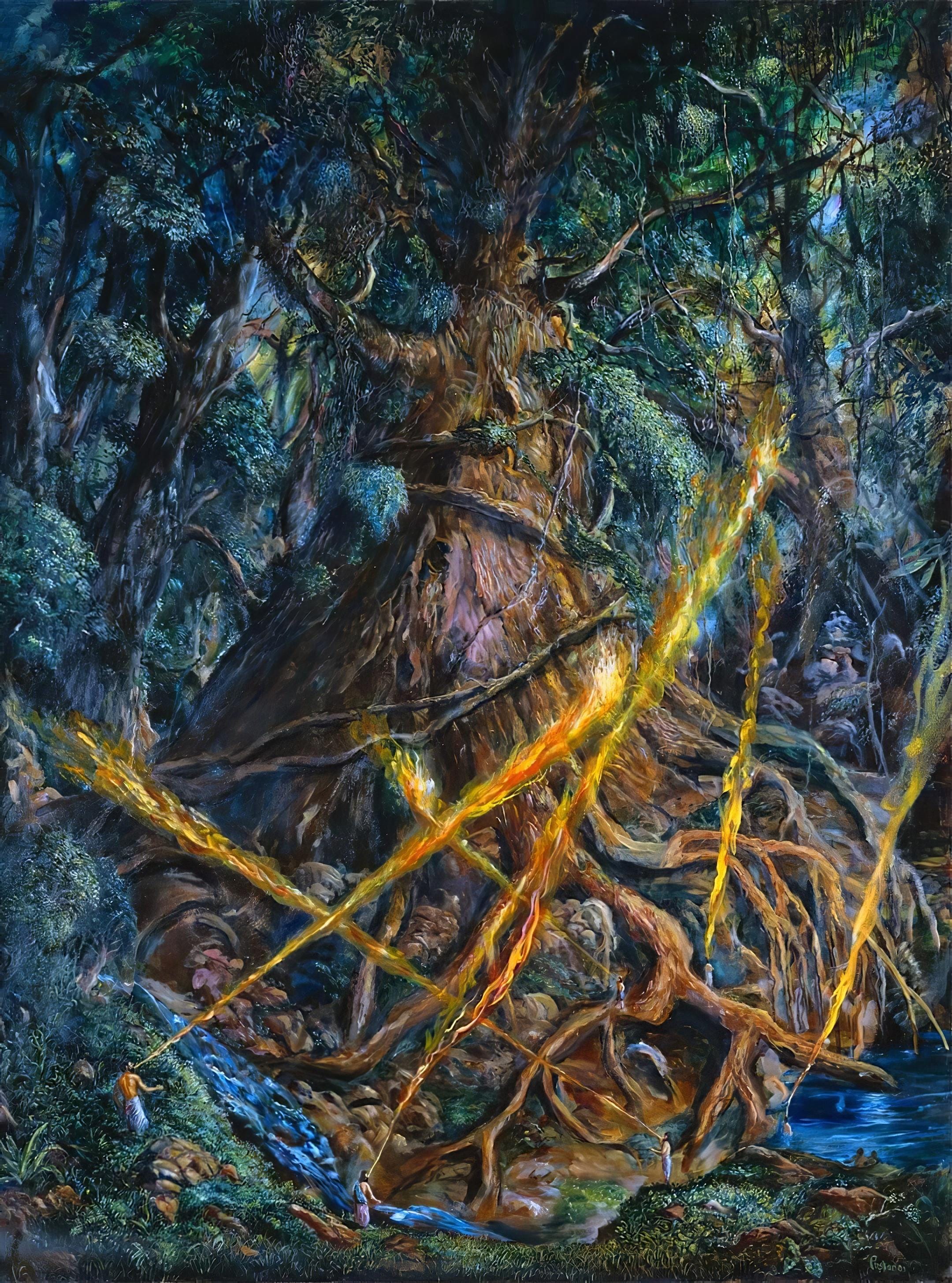
One mysterious pastime of the Śrīmad Bhāgavatam is the Pracetas becoming angry and burning most of the trees of the world, narrated in the Fourth Canto.
“Thereafter all the Pracetās emerged from the waters of the sea. They then saw that all the trees on land had grown very tall, as if to obstruct the path to the heavenly planets. These trees had covered the entire surface of the world. At this time the Pracetās became very angry.” (SB 4.30.44)
We know that cutting or burning trees is not a good thing. Not only are trees living beings who have the right to live, but they are also very important and useful, giving shade, fruits, and so on. We can’t even imagine how difficult life would be without trees.
How to explain then that pure devotees like the Pracetas could become angry and burn so many trees?
The point is that when the Pracetas finally emerged from the water after great austerities, they were ready to perform their service of maintaining the kingdom, but they were surprised when they saw that instead the planet was taken over by trees! Because their father Prācīnabarhi had left earlier for retired live, several thousands of years had passed, and without a king, everything was neglected. Agriculture stopped, population declined, and the world was taken over by very tall trees.
Although trees are auspicious and useful, there should be a balance between areas used by trees and areas cleared for agriculture and cities, creating the conditions for a growing population. The whole purpose of the creation of the material world is to offer the conditions for souls regaining their spiritual nature, and this is possible only in human life. The main duty of saintly kings is thus to create the conditions for the prosperity of a pious, growing human population. Trees are also living entities, but their existence is subordinate to this higher purpose.
Seeing the trees as an impediment to their service, the Pracetas became angry and started burning them using mystic fire coming from their mouths, planning to clear the land for agriculture, so food grains could again be produced and the human population could be increased.
Their anger was thus not destructive anger under the mode of ignorance, but the anger of Kṣatriya kings fighting adversity. Anger, therefore, was just used as a tool in the performance of their service, just as Hanumān burned Lanka and many other examples.
As Prabhupada explains in his purport to text 4.30.44: “King Prācīnabarhiṣat left his kingdom before his sons arrived after their execution of penance and austerity. The sons, the Pracetās, were ordered by the Supreme Personality of Godhead to come out of the water and go to the kingdom of their father in order to take care of that kingdom. However, when they came out they saw that everything had been neglected due to the King’s absence. They first observed that food grains were not being produced and that there were no agricultural activities. Indeed, the surface of the world was practically covered by very tall trees. It seemed as though the trees were determined to stop people from going into outer space to reach the heavenly kingdoms. The Pracetās became very angry when they saw the surface of the globe covered in this way. They desired that the land be cleared for crops.”
The burning of the trees by the Pracetas was thus not unjustified. However, everything has its right measure. They were not supposed to burn all the trees of the planet, since trees are also important for many other purposes. Therefore, to prevent them from crossing this line, Lord Brahma appeared to pacify them, just as he did in other important events.
After the Pracetas were thus pacified, the predominating deity of the trees offered Marīṣā in marriage to them, just as predicted to the Lord. Prabhupāda explains the details in his purport to text 47: “The daughter of the trees is referred to in text 13 of this chapter. This daughter was born of Kaṇḍu and Pramlocā. The society girl Pramlocā, after giving birth to the child, immediately left for the heavenly kingdom. While the child was crying, the king of the moon took compassion upon her and saved her by putting his finger into her mouth. This child was cared for by the trees, and when she grew up, by the order of Lord Brahmā, she was delivered to the Pracetās as their wife. The name of the girl was Māriṣā, as the next verse will explain. It was the predominating deity of the trees that delivered the daughter.”
As also predicted by the Lord, the Pracetas became the fathers of Daksa, who, having been purified from his offenses to Lord Śiva (described in the Third Canto), had the opportunity of taking his birth in an exalted family. He was reinstalled in his post as a prajāpati in the 6th Manvantara and finally had the opportunity of populating the universe as he desired.
“Following the order of Lord Brahmā, all the Pracetās accepted the girl as their wife. From the womb of this girl, the son of Lord Brahmā named Dakṣa took birth. Dakṣa had to take birth from the womb of Māriṣā due to his disobeying and disrespecting Lord Mahādeva [Śiva]. Consequently he had to give up his body twice. His previous body had been destroyed, but he, the same Dakṣa, inspired by the supreme will, created all the desired living entities in the Cākṣuṣa manvantara.” (SB 4.30.48-49)
The story of the Pracetas is also described in the Sixth Canto, chapter four. One can notice that the description is different from what we study in the Fourth Canto. In the Fourth Canto, the Pracetas are pacified by Brahma, while in the description in the Sixth Canto, they are approached by Soma. As normal in narrations by different speakers, the two descriptions focus on different events and should not be taken as contradictory. The Pracetas met Lord Viṣṇu, then came out of the water and became angry seeing the world taken by the trees. After they had burned most of the trees and cleared enough space for the production of grains, Soma appeared to restrain them from burning the remaining trees, offering them Marīṣā for marriage, which was confirmed by Brahma. In the narration of Vidura, the meeting with Brahma is emphasized, while in the description of the Sixth canto by Śukadeva Goswami (which is focused on the genealogical tree of the descendants of Daksa), the meeting with Soma and the marriage with Marīṣā are emphasized.
You can also donate using Buy Me a Coffee, PayPal, Wise, Revolut, or bank transfers. There is a separate page with all the links. This helps me enormously to have time to write instead of doing other things to make a living. Thanks!