

« Things I Wish Someone Had Taught Me When I Started Krishna Consciousness
Without education, varṇāśrama doesn’t work
We often hear about Varṇāśrama as a perfect system, but seeing the tone of some of the discussions centered around it, and the way some try to implement it, we may wonder if it is really a good idea. If you think so, you are not alone. Varṇāśrama is actually quite simple, but until we properly understand the system, it can be extraordinarily difficult and problematic to implement it in practice.
Just as the demigods, all human beings and other forms of life are parts of the universal form of the Lord; therefore, we are supposed to serve the whole. Animals automatically execute their functions according to their natures; therefore, there is no question of sin for them. Human beings, however, have free will. When this free will is properly applied, one becomes a pure devotee of the Lord, or at least performs his duties according to the Varṇāśrama system, playing his role as a teacher or intellectual dedicated to uplifting society; as an ethical politician, manager, or military man, organizing and protecting society; as an honest farmer or businessman; or simply as an honest worker. By accepting the supremacy of the Lord and executing our duties according to this divine system, we can gradually purify ourselves. The four orders are born from the Supreme Lord, and the ultimate goal of the system is to worship the Lord under the guidance of the spiritual master.
This division into four classes, with further ramifications, is a natural division that can be found in every society, from aboriginal tribes to modern countries. The reason is mentioned in the Bhagavad-gītā 4.13: “According to the three modes of material nature and the work associated with them, the four divisions of human society are created by Me.”
These divisions are present everywhere because they were created by Kṛṣṇa. Any functional society will naturally organize itself around these four basic divisions. Even communist countries (which are based on the idea of abolishing social classes) would develop this natural division over time. It is just not possible for a society to function without some form of it.
The point about the Varṇāśrama system is that it is based on the idea of training the members of society starting at an early age to properly perform their duties. Brāhmanas are thus trained to be enlightened spiritual teachers (instead of drunkards passing as professors), kṣatriyas are raised as saintly kings (instead of obnoxious politicians), the vaiśyas are educated as honest businessmen who share their wealth with the other sectors of society through proper wages, charity, taxes, etc., the śūdras are guided to be disciplined workers, and so on.
The soul of the Varṇāśrama system are the brāhmanas because these are the qualified educators who can train the other classes inside the gurukula system. Without proper gurukulas, maintained by qualified teachers, Varṇāśrama is just a pipe dream. We can see that at the beginning of our movement, Prabhupāda emphasized that he was trying to train some qualified brāhmanas who would guide society. We can see that it starts from there.
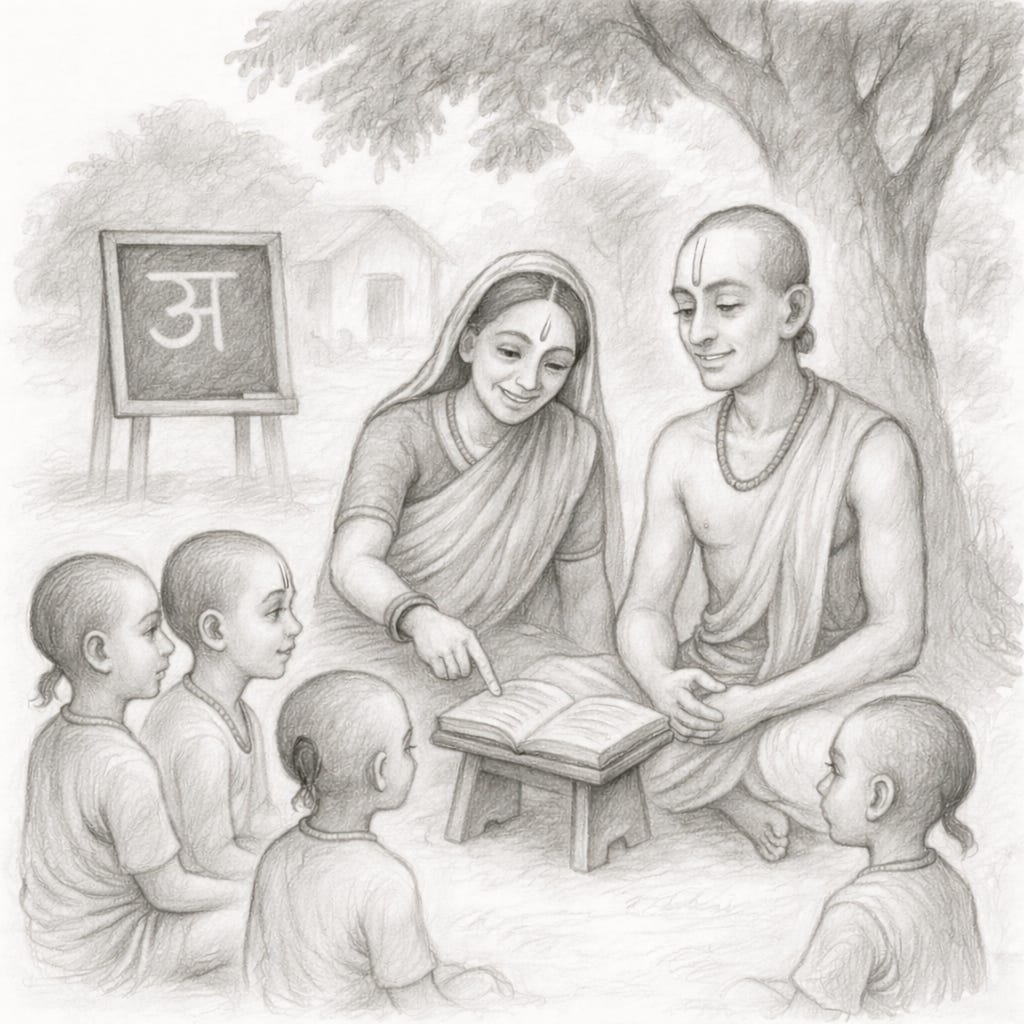
Traditionally, gurukulas are small schools maintained by a brāhmana family, where the children of nearby houses are educated in a protected family environment. A brāhmana, together with his wife, would accept the responsibility of educating a few children and teach each one according to their natures. The main characteristic of this system was that there was a bond of affection; the children were educated by the couple just like their own children.
The main reason gurukulas have largely failed in our movement up to now is that we often lack qualified teachers, and that’s something that is not produced very easily. As we get more qualified brāhmanas in our movement, and more of them start to perform their natural role as teachers, the training all members of our society can start taking place, and when somehow all the members of society are properly trained, the system can work properly, resulting in a prosperous and spiritually enlightened society. One stumbling block on this, however, is that brāhmanas need to be maintained by the other sectors of society; otherwise, they end up having to be engaged in other activities to make a living, and their potential to teach and perform other beneficial functions is lost. In general, devotees are prepared to pay for astrologers, psychologists, etc., but expect that teachers will work for free. The result is that in the end, we don’t have them. A society that is not willing to maintain its head will remain without one.
We often think of brāhmanas as devotees trained to perform fire sacrifices and other ceremonies, but this is just a very small subsection of what a brāhmana is. Brāhmanas are the natural teachers and spiritual masters of all other orders. The qualities of the brāhmanas are listed by the Lord (in the 17th chapter of the Eleventh Canto) as peacefulness, self-control, austerity, cleanliness, satisfaction, tolerance, simple straightforwardness, devotion to the Lord, mercy, and truthfulness.
Often, we relate being a kṣatriya with having power, influence, many wives, and so on, but this is again not what it means to be a kṣatriya. The main characteristic of kṣatriyas is their capacity and dedication to protect others, both in the material and spiritual sense. This characteristic, which comes from a positive influence of the mode of passion, makes them fit to rule society. The qualities of the kṣatriyas are described as dynamic power, bodily strength, determination, heroism, tolerance, generosity, great endeavor, steadiness, devotion to the brāhmaṇas, and leadership.
It’s said that the means of subsistence for all are generated from the thighs of the universal form of the Lord. The real means of subsistence are grains and other types of food, which should be distributed to all members of society. This power of maintenance is embodied by the vaiśyas, who take charge of producing food and wealth to maintain the whole society. The natural qualities of the vaiśyas are listed as faith in Vedic civilization, dedication to charity, freedom from hypocrisy, service to the brāhmaṇas, and perpetual desire to accumulate more money.
We can see that even greed can be used for Kṛṣṇa. Desire to accumulate money may be seen as an undesirable quality in other circumstances, but when combined with the other qualities of a vaiśya, it becomes positive, because the desire of a vaiśya to accumulate wealth supports his giving of charity, service to the brāhmanas, and protection of the workers, cows, and others under his jurisdiction. The desire to accumulate money on a brāhmana will lead him to sacrifice his religious principles; on a ksatriya, it may lead to wars and senseless disputes, on a sūdra can lead to thievery and other problems, but on a vaiśya, it fits just right. That’s why Kṛṣṇa teaches in the Gītā that one should work according to one’s nature, avoiding work destined to others.
From the legs of the universal form come the śūdras, who satisfy the Lord by menial service. The śūdras lack the special qualities and initiative of the other classes, but they support the whole society through their honest labor. Their qualities are listed as service without duplicity to the brāhmaṇas, cows, demigods, and other worshipable personalities, and complete satisfaction with whatever income is obtained through such service.
Śrila Bhaktivinoda Thākura mentions that most of us didn’t receive training in any of the four classes, therefore we should at first try to develop the positive qualities of a śūdra (such as honesty, simplicity, religiosity and submission to qualified authorities), and from there see if we have the natural inclination for developing the higher qualifications of any of the other three classes.
The Lord lists the qualities of persons who are not trained in the Varṇāśrama system as dirtiness, dishonesty, thievery, faithlessness, useless quarrel, lust, anger, and hankering, which are indeed very prominent in the modern world.
In contrast, the basic qualities for all members of the Varṇāśrama system (including śūdras and vaiśyas) are nonviolence, truthfulness, honesty, desire for the happiness and welfare of all others, as well as freedom from lust, anger, and greed.
The idea is that we need to first develop this basic set of qualities, then add the positive qualities of a śūdra, and from there see where we can go.
It is not possible to establish varṇāśrama as just a set of rules, as Muslims sometimes try to establish their sharia law. True varnāśrama is based on the opposite principle, on training people to live a religious and sāttvic life, instead of coercing them to do so. For this, it is necessary to somehow elevate the people to the necessary standard of consciousness.
It becomes possible only when we are first purified by hearing about the Lord and singing His glories. As mentioned in SB 5.18.12, one who develops firm devotion to the Lord manifests the qualities of the demigods, such as religion, knowledge, and renunciation. The process of hearing about Kṛṣṇa and chanting His name can thus help us to develop basic human qualities, and from there establish a proper society based on spiritual values. The process of establishing varṇāśrama thus passes through first becoming Kṛṣṇa conscious. Once we, as devotees, develop the saintly qualities that are expected from our spiritual practice, our communities can gradually evolve into places where devotees behave honestly and cooperate. From this, it may become possible to develop a functional varṇāśrama system based on qualified individuals.
« Things I Wish Someone Had Taught Me When I Started Krishna Consciousness
You can also donate using Buy Me a Coffee, PayPal, Wise, Revolut, or bank transfers. There is a separate page with all the links. This helps me enormously to have time to write instead of doing other things to make a living. Thanks!