

Subscribe to receive new articles by e-mail. It’s free, but if you like, you can pledge a donation:
Join the Telegram group if you would like to join the live lessons. This course is maintained with your donations. Click here to donate.
💬 Text of the lesson
Yamarāja instructs his servants: Do not touch Vaiṣnavas
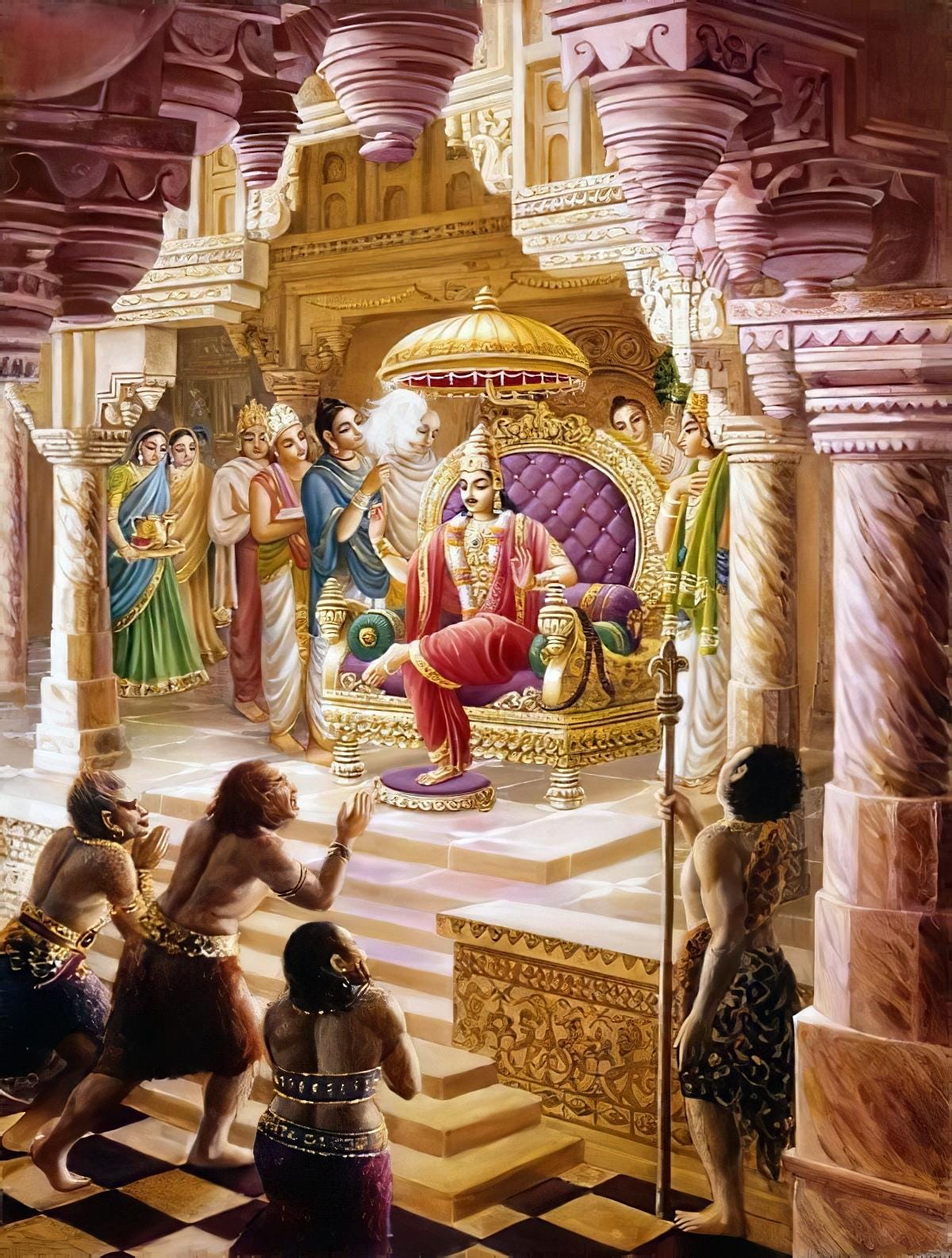
After being stopped by the Viṣṇudutas, the Yamadūtas returned to Yamarāja to describe what happened. They were instructed by him to drag all sinful persons to him to be judged, and in their understanding, Ajāmila was the classic example of a sinful person. However, when they tried to take him out of his body, they were stopped by these four effulgent personalities, who overpowered them both in terms of strength and in terms of philosophical understanding.
Such an event is unprecedented. Ordinarily, not even the demigods or great sages can challenge the authority of Yamarāja. Parīkṣit Mahārāja himself voiced his surprise:
“O great sage, never before has it been heard anywhere that an order from Yamarāja has been baffled. Therefore I think that people will have doubts about this that no one but you can eradicate. Since that is my firm conviction, kindly explain the reasons for these events.” (SB 6.3.2)
The Yamadūtas voice their question (SB 6.3.4-10)
The Yamadūtas had some vague notion of the worship of Lord Viṣnu as the ultimate goal of religious life, but in general they were under the impression that Yamarāja is the supreme authority, at least inside of the material universe. They were thus deeply surprised when confronted with a superior authority who could check them. They thus inquired:
“The Yamadūtas said: Our dear lord, how many controllers or rulers are there in this material world? How many causes are responsible for manifesting the various results of activities performed under the three modes of material nature [sattva-guṇa, rajo-guṇa and tamo-guṇa]? If in this universe there are many rulers and justices who disagree about punishment and reward, their contradictory actions will neutralize each other, and no one will be punished or rewarded. Otherwise, if their contradictory acts fail to neutralize each other, everyone will have to be both punished and rewarded.” (SB 6.2.4-5)
Although the Yamadūtas used polite words, Prabhupāda’s purport reveals that they were deeply disappointed in discovering that their master’s authority was not absolute. They were fully convinced that Ajāmila was supposed to be punished, based on his extensive history of sinful activities. However, the Viṣṇudutas not only disagreed with their judgment, but directly forced them to back down in fear for their lives.
This created a crisis of confidence. Normally, a servant is confident in performing his duty because he believes in the protection of his master. A policeman goes to perform his duty of arresting criminals because he believes he will have the means to do so and will receive backup if facing resistance. The Yamadūtas are no different. They returned thus to Yamarāja feeling disappointed and humiliated in their defeat.
There is also an important consideration between the verses and the commentary. Prabhupāda quotes Śrīla Viśvanātha Cakravartī in describing their internal mood, but the verse itself describes what they effectively said. This gives us a richer perspective. Yamadūtas are very angry by nature, which is appropriate for their service of punishing sinful souls. However, although they were boiling inside, they could still control themselves while addressing their master.
“The Yamadūtas continued: Since there are many different karmīs, or workers, there may be different judges or rulers to give them justice, but just as one central emperor controls different departmental rulers, there must be one supreme controller to guide all the judges.
The supreme judge must be one, not many. It was our understanding that you are that supreme judge and that you have jurisdiction even over the demigods. Our impression was that you are the master of all living entities, the supreme authority who discriminates between the pious and impious activities of all human beings. But now we see that the punishment ordained under your authority is no longer effective, since your order has been transgressed by four wonderful and perfect persons.
We were bringing the most sinful Ajāmila toward the hellish planets, following your order, when those beautiful persons from Siddhaloka forcibly cut the knots of the ropes with which we were arresting him.
As soon as the sinful Ajāmila uttered the name Nārāyaṇa, these four beautiful men immediately arrived and reassured him, saying, “Do not fear. Do not fear.” We wish to know about them from Your Lordship. If you think we are able to understand them, kindly describe who they are.” (SB 6.3.6-10)
The Yamadūtas argued about the contradiction of having different competing authorities. If different authorities were to disagree and pass different judgments, some could be wrongly punished or wrongly rewarded. Their fundamental misunderstanding was to believe that Yamarāja’s authority extended to everyone, without considering that devotional service puts a soul under a different sphere of authority, under the shelter of Lord Viṣnu Himself. Yamarāja has jurisdiction over all sinful souls who have turned their backs on Kṛṣṇa, punishing them according to their sins and then sending them into their next bodies or, conversely, rewarding them for their pious actions. Devotees, however, including the ones who simply chant the names of the Lord accidentally, like Ajāmila, are directly under the authority of the Supreme Lord. He Himself decides if they should be punished or not for their mistakes and how. He decides what will be their next destination and arranges for their deliverance through His own messengers. And if anyone threatens His devotees, as in the case of the Yamadūtas, His servants have authority to use lethal force if necessary.
Even in ordinary society, different authorities possess different levels of power. If a policeman goes against the army, for example, he will be outgunned.
Yamarāja is not powerless, nor are there multiple authorities passing contradictory judgments. Everything worked as it was supposed to be. The only mistake was that the Yamadūtas failed to properly understand Ajāmila’s situation. Now, Yamarāja will explain things to them, preventing the same mistake from being repeated in the future.
Yamarāja is pleased (SB 6.3.11-13)
“Śrī Śukadeva Gosvāmī said: Thus having been questioned, Lord Yamarāja, the supreme controller of the living entities, was very pleased with his order carriers because of hearing from them the holy name of Nārāyaṇa. He remembered the lotus feet of the Lord and began to reply.” (SB 6.3.11)
Yamarāja is described as “prajā-saṁyamanaḥ yamaḥ”, the supreme controller of the living entities. Lord Viṣnu is the final, supreme authority, and Yamarāja serves Him, assuming the role of a subordinate authority, the supreme authority within one of the departments of the creation. The Yamadūtas work under him, and therefore they have authority to punish any sinful person, but the Viṣṇudutas operate on a higher sphere. They have authority to punish anyone, including even Yamarāja himself.
Another point is the reaction of Yamarāja to being questioned. An ordinary mundane leader could be offended by being questioned by his subordinates, but we can see this didn’t happen in the case of Yamarāja. Instead, he was satisfied with His subordinates, because they uttered the name of Lord Nārāyaṇa and gave him the opportunity of talking about Him. He didn’t feel diminished in his authority; on the contrary, he was happy to explain to his subordinates that there is someone above him.
“Yamarāja said: My dear servants, you have accepted me as the Supreme, but factually I am not. Above me, and above all the other demigods, including Indra and Candra, is the one supreme master and controller. The partial manifestations of His personality are Brahmā, Viṣṇu and Śiva, who are in charge of the creation, maintenance and annihilation of this universe. He is like the two threads that form the length and breadth of a woven cloth. The entire world is controlled by Him just as a bull is controlled by a rope in its nose.
Just as the driver of a bullock cart ties ropes through the nostrils of his bulls to control them, the Supreme Personality of Godhead binds all men through the ropes of His words in the Vedas, which set forth the names and activities of the distinct orders of human society [brāhmaṇa, kṣatriya, vaiśya and śūdra]. In fear, the members of these orders all worship the Supreme Lord by offering Him presentations according to their respective activities.” (SB 6.3.12-13)
Prabhupāda explains that, in fact, Yamarāja has authority over just a subsection of the living entities. Animals, for example, are not under his jurisdiction. He has authority only over a subsection of human brings: the ones who are sinful. The same applies to all other demigods. Each one of them has his small sphere of authority, but above all of them is the Supreme Lord, who is the supreme authority.
The words “otaṁ protaṁ paṭavad” mentioned by Yamarāja are especially significant. Lord Viṣnu is the foundation of the whole creation. A quilt is made from horizontal and vertical threads. The threads are the foundation and ingredient of the quilt, since without the threads, there is no quilt. Similarly, the Supreme Lord is the very cause of the cosmic manifestation. The two are inseparable, since everything is made of His energies and without Him there is no cosmic manifestation.
To make it clear, he gives another example: A bullock-cart driver controls his bulls by passing ropes through holes made in their noses, and thus easily controlling them by the simple movement of his hand. Similarly, every conditioned soul is controlled by the laws of nature, which are, in turn, under the full control of the Lord.
Human beings are supposed to be guided by the Vedic injunctions, which prescribe different engagements according to one’s natural propensities, inside of the Varnāśrama system. People in Vedic societies follow these rules partly in fear of punishment by Yamarāja, but the ultimate purpose of these rules is to gradually elevate people to the platform of devotional service. Once a person becomes a devotee, he comes directly under Kṛṣṇa’s protection. This doesn’t mean a devotee is free to act in nonsensical ways, but it puts him under a different sphere of authority. Instead of being under ordinary dharmic codes and the laws of karma, a devotee puts himself under the higher principles of devotional service and the direct protection of the Lord.
Inconceivable (SB 6.3.14-18)
Once we consider the existence of an ultimate authority, Lord Viṣnu, who is above even Yamarāja, the next question is to try to understand His actions. That’s the part that is difficult to explain.
In the material world, everyone acts under the three material modes. Among all conditioned living entities, the best are the demigods, who operate under the mode of goodness. Yamarāja gives a long list of demigods, including himself, Varuṇa, Candra, Agni, etc. The list could be expanded to include all the millions of other demigods. The point is that even they cannot understand the activities of the Supreme Lord, even though He is very near, inside their own hearts.
The example given is that even though they are part of the body, the hands and legs cannot see the eyes. When we are walking, the feet can avoid obstacles due to the guidance of the eyes, but the feet themselves have no power to see the eyes. Similarly, we are dependent on the Supersoul for everything, even though we cannot see or understand Him.
How is then Yamarāja supposed to explain the topic of the redemption of Ajāmila? Bhaktyā mām abhijānāti: Kṛṣṇa can be understood by His devotees, and Yamarāja is a great devotee, one of the twelve great Mahājanas. Therefore, although he admits that he is not capable of explaining the glories of the Supreme Lord and His devotees based on his position as a demigod, he is more than qualified from his position as a great devotee of the Lord.
What is the position of the Supreme Lord? He is inconceivable to the material intelligence. As Yamarāja admits, “the living entities cannot see the Supreme Lord, who is situated as the Supersoul in everyone’s heart. Not by the senses, by the mind, by the life air, by thoughts within the heart, or by the vibration of words can the living entities ascertain the real situation of the Supreme Lord.”
Just as Lord Viṣnu is transcendental, His order carriers are also transcendental. They possess a transcendental nature and transcendental opulences almost as the Supreme Lord Himself. Just as Lord Viṣnu is above the jurisdiction of the demigods and even Yamarāja himself, the servants of Lord Viṣnu operate with full independence over them. They answer only to Lord Viṣnu Himself. With this, Yamarāja makes clear to the Yamadūtas the reason for their defeat. As Prabhupāda mentions, “Yamarāja informed the Yamadūtas that the Viṣṇudūtas are no less powerful than Lord Viṣṇu. Since Viṣṇu is above Yamarāja, the Viṣṇudūtas are above the Yamadūtas. Persons protected by the Viṣṇudūtas, therefore, cannot be touched by the Yamadūtas.”
The same Viṣṇudutas who are so transcendentally powerful protect all devotees. This explains the situation of Ajāmila. Although he was so sinful, because he took shelter of Lord Viṣnu’s name at the last moment, he was protected even from the servants of Yamarāja himself. Similarly, other Vaiṣnavas are protected from all kinds of material dangers, such as enemies, natural disturbances, etc. If even the Yamadūtas themselves cannot touch devotees, what to say about others?
Prabhupāda connect this point with the impending danger of a nuclear war: “Sometimes the members of the Kṛṣṇa Consciousness Society are afraid of the impending danger of world war and ask what would happen to them if a war should occur. In all kinds of danger, they should be confident of their protection by the Viṣṇudūtas or the Supreme Personality of Godhead, as confirmed in the Bhagavad-gītā: kaunteya pratijānīhi na me bhaktaḥ praṇaśyati. Material danger is not meant for devotees.”
This protection does not mean devotees don’t die. Everyone in the material world has to face death eventually. The point is that devotees are always protected by the Lord, who protects their devotional service in all circumstances, and arranges things in a way that they can ultimately return to Him.
One of the best examples of how this protection works is Maharaja Parīkṣit himself. When Aśvatthāmā attacked him with the brahmāstra while still in the womb, Kṛṣṇa personally intervened to save his life. Later, however, the same Parīkṣit was bitten by Takṣaka and his body was burned to ashes. We can see here the protection of the Lord acting in two different ways. In the womb, Kṛṣṇa protected his life, nullifying the weapon of Aśvatthāmā, while in the second case, He protected his devotional service, arranging for the king to meet death in the most auspicious conditions possible, hearing the Śrīmad-Bhāgavatam from Śūkadeva Gosvāmi and leaving his body under the auspicious blessings of all the great sages.
Kṛṣṇa’s lotus feet are compared to a boat. The promise is that a devotee who takes shelter of them can cross the material ocean and reach the spiritual world. Kṛṣṇa’s protection does not mean a devotee will never face difficulties—even great devotees like the Pandavas and Prahlāda Maharaja faced difficulties; this is the nature of this material world—the point is that devotees remain always under the protection of the Lord, who makes sure they attain victory in the end, overcoming birth and death.
This brings us back to Yamarāja’s point. Sometimes the Viṣṇudutas can intervene directly, as in the case of Ajāmila, and in other situations the Lord can intervene through other means, as in any situation the Pandavas faced. How the Lord protects a particular devotee is His decision, but the protection of the Lord is a constant for a surrendered devotee. Therefore, when Prabhupāda assures his disciples of Kṛṣṇa’s protection, the point is that they should continue their service with confidence. Even if a nuclear war takes a devotee’s life, his deliverance is already planned by Kṛṣṇa.
Bhāgavata-dharma, the true religion (SB 6.3.19-26)
In the previous verses, Yamarāja described the qualities of Lord Viṣnu. He is the master of everyone and everything, including the illusory energy herself. He has a form, qualities, and features, but these are fully spiritual. Similarly, His order carriers are endowed with transcendental qualities almost like Him. They are free to move as they please anywhere in both the material and spiritual worlds; they are worshiped even by the demigods and are rarely seen.
After describing the transcendental position of Lord Viṣnu and His messengers and how He protects His devotees, Yamarāja now answers to the Yamadūtas’ complaint that his order had been undermined by explaining what the real religious principles are:
“Real religious principles are enacted by the Supreme Personality of Godhead. Although fully situated in the mode of goodness, even the great ṛṣis who occupy the topmost planets cannot ascertain the real religious principles, nor can the demigods or the leaders of Siddhaloka, to say nothing of the asuras, ordinary human beings, Vidyādharas and Cāraṇas.” (SB 6.3.19)
Before, the Yamadūtas were under the impression that Yamarāja was the supreme authority and that they, as his servants, understood religious principles. Yamarāja explains that both assumptions were incorrect. Lord Viṣnu is the Supreme authority. He is the one who enacts religious principles. Fully understanding these religious principles is possible only for pure devotees, who are in the same transcendental platform.
The Vedas offer a gradual process for the elevation of conditioned souls, based especially on ritualistic ceremonies. However, these recommendations still operate under the material platform of sin and piety, under the three modes of material nature. Kṛṣṇa explains this point in the Gītā (2.42) when He mentions that, “Men of small knowledge are very much attached to the flowery words of the Vedas, which recommend various fruitive activities for elevation to heavenly planets, resultant good birth, power, and so forth. Being desirous of sense gratification and opulent life, they say that there is nothing more than this.”
Real religious principles are nistraiguṇya, above these three material modes. Kṛṣṇa also mentions this in the Gītā (2.45), when He mentions, “The Vedas deal mainly with the subject of the three modes of material nature. O Arjuna, become transcendental to these three modes.”
Just as a ladder, the fruitive path mentioned in the Vedas has the goal of gradually purifying the materialists. The real principle everyone should follow, however, is sarva-dharmān parityajya mām ekaṁ śaraṇaṁ vraja. Ultimately, everyone should give up all material pursuits, including the pious fruitive activities recommended in the Vedas, and surrender to Kṛṣṇa, adopting the path of bhakti-yoga.
A natural objection, however, is that if this path is not openly revealed in the Vedas, where from can we learn about it? This is answered by Yamarāja in the next two verses:
“Lord Brahmā, Bhagavān Nārada, Lord Śiva, the four Kumāras, Lord Kapila [the son of Devahūti], Svāyambhuva Manu, Prahlāda Mahārāja, Janaka Mahārāja, Grandfather Bhīṣma, Bali Mahārāja, Śukadeva Gosvāmī and I myself know the real religious principle. My dear servants, this transcendental religious principle, which is known as bhāgavata-dharma, or surrender unto the Supreme Lord and love for Him, is uncontaminated by the material modes of nature. It is very confidential and difficult for ordinary human beings to understand, but if by chance one fortunately understands it, he is immediately liberated, and thus he returns home, back to Godhead.” (SB 6.3.20-21)
Yamarāja identifies real dharma as bhāgavata-dharma: to surrender to the Supreme Lord and love Him. This is the most confidential religious principle, but it becomes understandable when we meet a pure devotee, connected to the paramparā system, the disciplic succession sprouting from Lord Brahmā, Lord Śiva, the four Kumāras, and the other great spiritual authorities. In the present moment, there are four Vaiṣnava sampradāyas: Brahma-sampradāya, Rudra-sampradāya, Śrī-sampradāya, and Kumāra-sampradāya.
We are part of a branch of the Brahma-sampradāya, the Brahma-Madhva-Gauḍīya-sampradāya, coming from Lord Brahmā through Nārada Muni, Vyāsadeva, Madhvācārya, and Śrī Caitanya Mahāprabhu. One must take shelter of a bona fide representative of one of these bona fide sampradāyas in order to understand Kṛṣṇa. Any school that is not properly connected to these spiritual authorities is an apa-sampradāya, an unbonafide school like the sahajiyās and caste brāhmanas.
Kṛṣṇa cannot be attained by material means. Only a pure devotee, or someone connected to a pure devotee, can help us to understand what devotional service is, and how to practice it. As Kṛṣṇa mentions in the Gītā (2.40), even a little advancement in this path can save one from the greatest danger. We can see this practically in the history of Ajāmila: just by chanting the name of Nārāyaṇa, he was saved from the Yamadūtas.
There is yet another point: Advancement on the devotional path is eternal. Whatever advancement we can make in this life stays with us. If we do one percent in this life, the next life we start from two percent, and this continues until we attain the ultimate result.
This is also illustrated in the history of Ajāmila, who had performed devotional service when young. Even though he stopped and performed sinful activities for many decades, when he chanted and was saved by the Viṣṇudutas, his devotional consciousness was immediately restored, and he was able to immediately abandon his sinful situation, take shelter in a temple of Viṣnu in Hardwar, and continue his practice of devotional service until attaining perfection.
The center of it is the chanting of the holy names, which Yamarāja personally endorses. When we chant, Kṛṣṇa is personally present with us. Therefore, the purifying potency is unlimited. It only depends on how sincerely and attentively we are able to chant. However, because the names are so powerful, even if we are not qualified in the beginning, the simple repetition brings us purification. Therefore, the advice given to a devotee who cannot chant without offenses is to simply continue chanting, if possible, twenty-four hours a day.
As indicated by the history of Ajāmila and the discourse of Yamarāja, the process of chanting the holy names of the Lord is eternal and equally effective in all ages. Śrī Caitanya Mahāprabhu didn’t inaugurate a new process; He simply revealed the eternal process that becomes often covered by lower forms of religion. The main difference is that in other ages there was some hope for people to attain perfection through other processes, such as meditation, but in Kali-yuga it is all or nothing: harer nāma harer nāma, harer nāmaiva kevalam, kalau nāsty eva nāsty eva, nāsty eva gatir anyathā: there is no other way, there is no other way, there is no other way.
“Devotional service, beginning with the chanting of the holy name of the Lord, is the ultimate religious principle for the living entity in human society.
My dear servants, who are as good as my sons, just see how glorious is the chanting of the holy name of the Lord. The greatly sinful Ajāmila chanted only to call his son, not knowing that he was chanting the Lord’s holy name. Nevertheless, by chanting the holy name of the Lord, he remembered Nārāyaṇa, and thus he was immediately saved from the ropes of death.
Therefore it should be understood that one is easily relieved from all sinful reactions by chanting the holy name of the Lord and chanting of His qualities and activities. This is the only process recommended for relief from sinful reactions. Even if one chants the holy name of the Lord with improper pronunciation, he will achieve relief from material bondage if he chants without offenses. Ajāmila, for example, was extremely sinful, but while dying he merely chanted the holy name, and although calling his son, he achieved complete liberation because he remembered the name of Nārāyaṇa.”(SB 6.3.22-24)
There is another point Yamarāja makes immediately afterward:
“Because they are bewildered by the illusory energy of the Supreme Personality of Godhead, Yājñavalkya and Jaimini and other compilers of the religious scriptures cannot know the secret, confidential religious system of the twelve mahājanas. They cannot understand the transcendental value of performing devotional service or chanting the Hare Kṛṣṇa mantra. Because their minds are attracted to the ritualistic ceremonies mentioned in the Vedas — especially the Yajur Veda, Sāma Veda and Ṛg Veda — their intelligence has become dull. Thus they are busy collecting the ingredients for ritualistic ceremonies that yield only temporary benefits, such as elevation to Svargaloka for material happiness. They are not attracted to the saṅkīrtana movement; instead, they are interested in dharma, artha, kāma and mokṣa.”(SB 6.3.25)
Jaimini is the founder of the Pūrva-mīmāṁsā school of philosophy, one of the ṣaḍ-darśanas, the six classical systems of Vedic philosophy, while Yājñavalkya is the preceptor of the Śukla Yajur Veda and other books within the Vedic literature. Both are great authorities, but even they cannot fully understand the path of devotional service. Instead, despite their great contribution, they remain absorbed in fruitive activities.
How is it possible? The point is that different material qualifications, such as being a scholar or even an authority in dharma, are still material. These qualities can be converted into spiritual assets when they are used for Kṛṣṇa, a process that He describes in the Gītā, but without this connection, they remain mere material assets that keep one entangled in this material world. In fact, even if one reaches the liberated platform, without coming to the association of devotees, one will remain clueless about the mysteries of devotional service.
In his purport to 6.2.25, Prabhupāda gives a striking example from his own experience on this point of how ordinary followers of the Vedas become absorbed in superficial rituals, and miss the real point of the scriptures:
“Since one may easily achieve the highest success by chanting the holy name of the Lord, one may ask why there are so many Vedic ritualistic ceremonies and why people are attracted to them. This verse answers that question. As stated in the Bhagavad-gītā (15.15), vedaiś ca sarvair aham eva vedyaḥ: the real purpose of studying the Vedas is to approach the lotus feet of Lord Kṛṣṇa. Unfortunately, unintelligent people bewildered by the grandeur of Vedic yajñas want to see gorgeous sacrifices performed. They want Vedic mantras chanted and huge amounts of money spent for such ceremonies. Sometimes we have to observe the Vedic ritualistic ceremonies to please such unintelligent men. Recently, when we established a large Kṛṣṇa-Balarāma temple in Vṛndāvana, we were obliged to have Vedic ceremonies enacted by brāhmaṇas because the inhabitants of Vṛndāvana, especially the smārta-brāhmaṇas, would not accept Europeans and Americans as bona fide brāhmaṇas. Thus we had to engage brāhmaṇas to perform costly yajñas. In spite of these yajñas, the members of our Society performed saṅkīrtana loudly with mṛdaṅgas, and I considered the saṅkīrtana more important than the Vedic ritualistic ceremonies. Both the ceremonies and the saṅkīrtana were going on simultaneously. The ceremonies were meant for persons interested in Vedic rituals for elevation to heavenly planets (jaḍī-kṛta-matir madhu-puṣpitāyām), whereas the saṅkīrtana was meant for pure devotees interested in pleasing the Supreme Personality of Godhead. We would simply have performed saṅkīrtana, but then the inhabitants of Vṛndāvana would not have taken the installation ceremony seriously. As explained here, the Vedic performances are meant for those whose intelligence has been dulled by the flowery language of the Vedas, which describe fruitive activities intended to elevate one to the higher planets.”
Yamarāja thus concludes:
“Considering all these points, therefore, intelligent men decide to solve all problems by adopting the devotional service of chanting the holy name of the Lord, who is situated in everyone’s heart and who is a mine of all auspicious qualities. Such persons are not within my jurisdiction for punishment. Generally they never commit sinful activities, but even if by mistake or because of bewilderment or illusion they sometimes commit sinful acts, they are protected from sinful reactions because they always chant the Hare Kṛṣṇa mantra.” (SB 6.3.26)
Normally, devotees do not commit sinful activities, because their activities are aligned with the desires of Kṛṣṇa. In material life, we try to satisfy our material desires, without realizing that these are actually the desires of the mind. The constitutional position of the soul is to always serve. In material life, we identify with the desires of the mind and thus work to serve our body and senses, as well as a material family, society, nation, etc. In Kṛṣṇa consciousness, a devotee identifies with the desires of Kṛṣṇa, and works to satisfy Him. He thus eats what Kṛṣṇa likes to eat, after offering the food to Him, and he performs spiritual activities connected with Kṛṣṇa, which are pure. However, as Yamarāja explains, even if by some accident, mistake, or weakness of heart or sheer illusion, a devotee commits some sinful activity, still, because he is continuously engaged in the devotional process, this sin is instantly destroyed. Therefore, a devotee never comes under his jurisdiction, as proved by the extreme case of Ajāmila.
Whom should be brought before Yamarāja? (SB 6.3.27-35)
Text 26 already established the conclusion that devotees remain outside the jurisdiction of Yamarāja. Now, text 27 turns this principle into a direct order. He warns the Yamadūtas that if they fail to follow this directive, they will face destruction, for the Supreme Lord Himself is ready to fight to protect His devotees.
“My dear servants, please do not approach such devotees, for they have fully surrendered to the lotus feet of the Supreme Personality of Godhead. They are equal to everyone, and their narrations are sung by the demigods and the inhabitants of Siddhaloka. Please do not even go near them. They are always protected by the club of the Supreme Personality of Godhead, and therefore Lord Brahmā and I and even the time factor are not competent to chastise them.” (SB 6.2.27)
Whom the Yamadūtas may arrest? There are many faithless persons who avoid associating with devotees and never chant His holy names. They never offer obeisances to Him, and instead become simply immersed in material life, always speaking about political topics and thinking about sensual gratification. Such persons, who intentionally waste their human life, are fit to be arrested by the Yamadūtas for punishment.
“Paramahaṁsas are exalted persons who have no taste for material enjoyment and who drink the honey of the Lord’s lotus feet. My dear servants, bring to me for punishment only persons who are averse to the taste of that honey, who do not associate with paramahaṁsas and who are attached to family life and worldly enjoyment, which form the path to hell.
My dear servants, please bring to me only those sinful persons who do not use their tongues to chant the holy name and qualities of Kṛṣṇa, whose hearts do not remember the lotus feet of Kṛṣṇa even once, and whose heads do not bow down even once before Lord Kṛṣṇa. Send me those who do not perform their duties toward Viṣṇu, which are the only duties in human life. Please bring me all such fools and rascals.” (SB 6.3.28-29)
Yamarāja makes an important point: devotional service to the Lord is the only real duty of human life. Materialists may perform many kinds of material duties, but because they neglect this supreme duty, they are ultimately punishable. Devotees, however, who strive to serve the Lord, even if imperfectly, are fulfilling their real duty and thus remain outside of the jurisdiction of Yamarāja, despite many mistakes they may commit. Again, this is not a consent to perform intentional sinful activities, which is an offense to the chanting of the holy names, but an assurance of what Kṛṣṇa promises in the Gītā: His devotee is never vanquished.
Everyone should thus become a devotee of Kṛṣṇa. Simply by trying, one has guaranteed another human birth, in a pious or well-to-do family, and if a devotee is successful, eternal life of bliss awaits.
Another interesting point is that Yamarāja in text 30:
“[Then Yamarāja, considering himself and his servants to be offenders, spoke as follows, begging pardon from the Lord.] O my Lord, my servants have surely committed a great offense by arresting a Vaiṣṇava such as Ajāmila. O Nārāyaṇa, O supreme and oldest person, please forgive us. Because of our ignorance, we failed to recognize Ajāmila as a servant of Your Lordship, and thus we have certainly committed a great offense. Therefore with folded hands we beg Your pardon. My Lord, since You are supremely merciful and are always full of good qualities, please pardon us. We offer our respectful obeisances unto You.”
Initially, the Yamadūtas came before Yamarāja outraged that the Viṣṇudutas had stopped them. They wanted Yamarāja to bring them to be punished for their transgression in stopping them; otherwise, they were prepared to kill themselves, for they could not continue to serve such a powerless master.
Now, after explaining the real religious principles to their servants, Yamarāja reveals that the Yamadūtas were actually the ones at fault. He prays for the Supreme Lord to forgive the offense of his servants who tried to arrest a Vaiṣnava, and is ready to personally assume responsibility for their mistake.
Prabhupāda explains that a master bears responsibility for the actions his servants perform under his authority. As he mentions, “If the servant of an establishment makes a mistake, the establishment takes responsibility for it.”
In the next two verses, Śukadeva Gosvāmi addresses the deeper aspect of Parīkṣit's questioning in chapter 6.1. What is the solution for a person’s desire to sin? Ultimately, only the chanting of the holy names. The Vedic process of expiation may destroy the sinful results, but only the holy names can destroy the material contamination that creates the desire for sinning in the first place. This is connected with the uncovering of the original spiritual nature of the soul.
Every conditioned soul sees himself as an enjoyer of the material world. This is the root cause of sin. This conditioning persists even as one advances in the direction of the mode of goodness, which explains why even great sages can fall down, become angry, etc. The attitude is finally destroyed only when we reconnect with our original identity of service to Kṛṣṇa, which is possible only through the practice of devotional service, whose foundation is the chanting of the holy names.
“Śukadeva Gosvāmī continued: My dear King, the chanting of the holy name of the Lord is able to uproot even the reactions of the greatest sins. Therefore the chanting of the saṅkīrtana movement is the most auspicious activity in the entire universe. Please try to understand this so that others will take it seriously.
One who constantly hears and chants the holy name of the Lord and hears and chants about His activities can very easily attain the platform of pure devotional service, which can cleanse the dirt from one’s heart. One cannot achieve such purification merely by observing vows and performing Vedic ritualistic ceremonies.” (SB 6.3.31-32)
The metaphor of the bee and honey connects texts 28 and 33. Pure devotees are like bees who are used to taste the sweetness of the service of the Lord’s lotus feet. Because of this sweetness, they give up all forms of material pursuits, including even pious material activities recommended in the Vedas. Others. who haven’t attained such a taste continue operating under the three material modes, addicted to material lust. Sometimes they are impious and go to hell, and sometimes they perform acts of atonement to free themselves of sinful reactions, but in both cases they remain under the material spell.
“Devotees who always lick the honey from the lotus feet of Lord Kṛṣṇa do not care at all for material activities, which are performed under the three modes of material nature and which bring only misery. Indeed, devotees never give up the lotus feet of Kṛṣṇa to return to material activities. Others, however, who are addicted to Vedic rituals because they have neglected the service of the Lord’s lotus feet and are enchanted by lusty desires, sometimes perform acts of atonement. Nevertheless, being incompletely purified, they return to sinful activities again and again.
After hearing from the mouth of their master about the extraordinary glories of the Lord and His name, fame and attributes, the Yamadūtas were struck with wonder. Since then, as soon as they see a devotee, they fear him and dare not look at him again.” (SB 6.3.33-34)
Śukadeva Gosvāmī concludes by mentioning that he heard this history from Agastya Muni in the Malaya Hills, where the great sage was worshiping the Supreme Lord. As mentioned in the opening verses, this is a very old historical narration that happened in bygone ages. Agastya Muni had heard it from other sources, transmitted it to Śukadeva Gosvāmī, and he shared it with Parīkṣit Maharaja and all of us.
This is a publication for thoughtful readers who want to go deeper into Kṛṣṇa consciousness. I publish daily, trying to offer high-quality spiritual content, and all posts are available to free subscribers. If you wish, you can support this work with a monthly contribution. When you subscribe, you can choose between a free subscription and a monthly contribution, and you can switch from a free subscriber to a supporter at any time.
If you would like to contribute further, you can find the donation links here.