

« Making Sense of the Vedic Universe, a Higher-Dimensional Reality
The creation of the material elements
The spiritual creation is eternal. The spiritual planets exist eternally in the spiritual sky, and their inhabitants were never created, nor do they ever face annihilation. Everything that exists there exists eternally, without interruption, without a beginning or end.
However, on the material side, there was a time when everything was dark. At that point, there were no material elements, no universes, and no planets. Only the Lord existed as Mahā-Viṣnu. This stage is described in the 3rd canto of Śrīmad-Bhāgavatam:
“The Personality of Godhead, the master of all living entities, existed prior to the creation as one without a second. It is by His will only that creation is made possible and again everything merges in Him. This Supreme Self is symptomized by different names.
The Lord, the undisputed proprietor of everything, was the only seer. The cosmic manifestation was not present at that time, and thus He felt imperfect without His plenary and separated parts and parcels. The material energy was dormant, whereas the internal potency was manifested.” (SB 3.3.23-24)
The material creation is eternal in the sense that it goes through unlimited cycles of creation and destruction, but it is not always active. After each day of Brahmā (4.32 billion years), there is a partial destruction, followed by his night (also 4.32 billion years), and at the end of the life of Brahmā (311.04 trillion years), there is the period when material nature remains inactive (also 311.04 trillion years).
Modern science (as well as many ancient atheistic philosophies from India), believes that the universe is created automatically by the interaction of the different material elements, but the Śrīmad-Bhāgavatam explains that the material energy is just the effect. The cause is the Supreme Lord. Just like a pile of bricks can’t organize itself into a building, the material energy can’t move without the transcendental touch of the Lord.
How does the transcendental Lord activate the spiritual energy? Just as the father impregnating the mother leads to the birth of a child, the Lord impregnating the material nature with the souls and the time energy leads to the appearance of all material universes and ultimately of all living entities. However, in His case, no extenuating effort is necessary; everything is done by a simple glance.
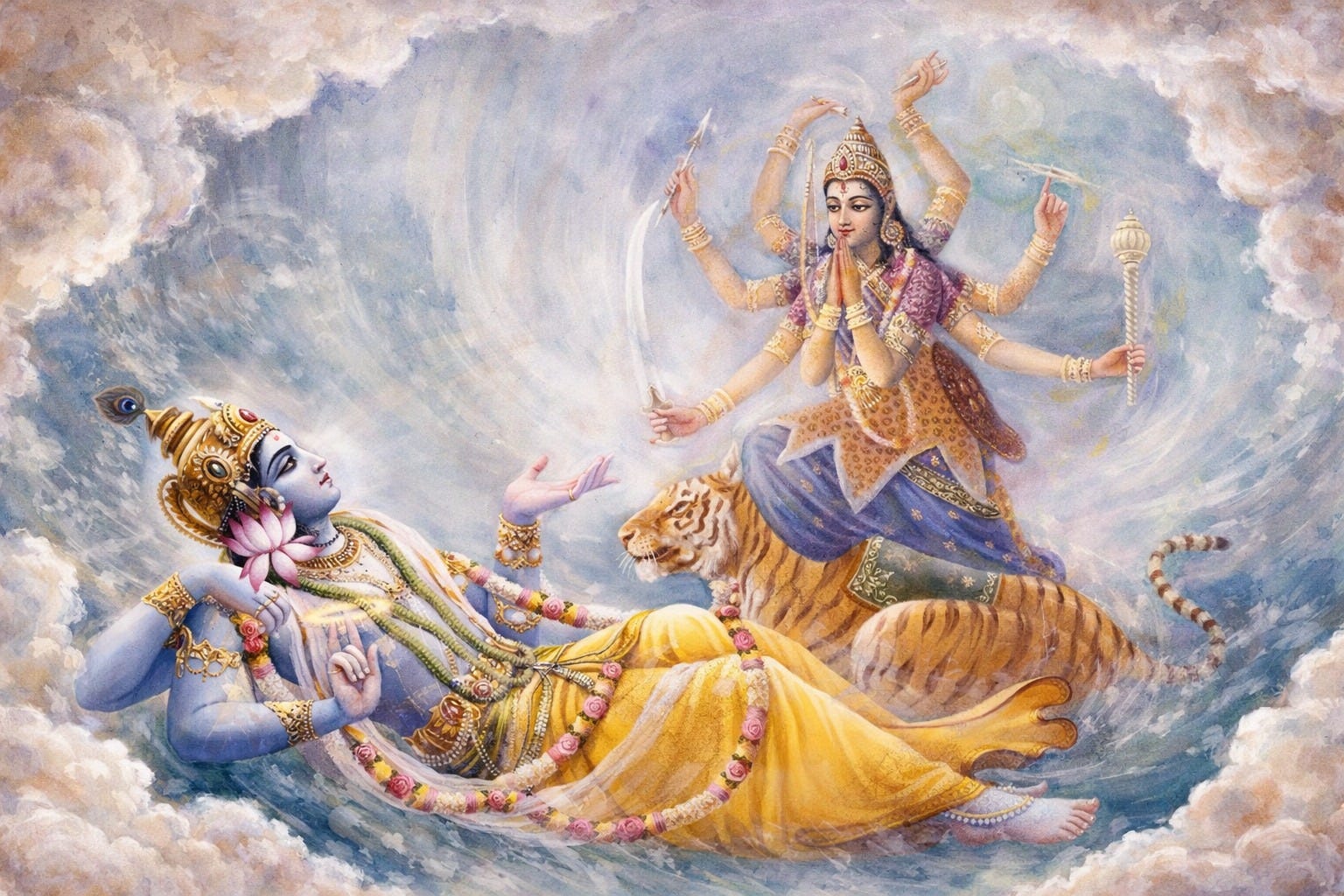
A crucial stage of this process is the creation of the material elements, the building blocks of the material creation. When we hear the expression “material elements”, we think about tangible things we can touch, like a bar of iron or a mound of earth, but here we are speaking about subtle manifestations that appeared before the universes were even formed. The elements are thus less about physical matter and more about energy or properties. These same elements are later converted into many different grades of matter, which are used to build the different levels of planetary systems. Both a table here on earth and a table in Svargaloka are composed of the same earth element, but they are of very different natures.
The material energy is first manifested as pradhāna, the gigantic mass of unmanifested material energy that appears like a cloud above the causal ocean. After being impregnated with the time energy, the three material modes become apparent. From this point on, pradhāna is converted into the mahat-tattva, and the chain of transformations that leads to the creation of the material manifestation starts.
This initial process of creation of the material elements is described in the third canto of Śrīmad-Bhāgavatam, starting with the creation of the false ego, mind, and intelligence, followed by the senses and the material elements (ether or sky, fire, air, water, and earth):
“Mahat-tattva, or the great causal truth, transforms into false ego, which is manifested in three phases — cause, effect and the doer. All such activities are on the mental plane and are based on the material elements, gross senses and mental speculation. The false ego is represented in three different modes — goodness, passion and ignorance.
The false ego is transformed into mind by interaction with the mode of goodness. All the demigods who control the phenomenal world are also products of the same principle, namely the interaction of false ego and the mode of goodness. The senses are certainly products of the mode of passion in false ego, and therefore philosophical speculative knowledge and fruitive activities are predominantly products of the mode of passion. The sky is a product of sound, and sound is the transformation of egoistic ignorance. In other words, the sky is the symbolic representation of the Supreme Soul.
Thereafter the Personality of Godhead glanced over the sky, partly mixed with eternal time and external energy, and thus developed the touch sensation, from which the air in the sky was produced. Thereafter the extremely powerful air, interacting with the sky, generated the form of sense perception, and the perception of form transformed into electricity, the light to see the world. When electricity was surcharged in the air and was glanced over by the Supreme, at that time, by a mixture of eternal time and external energy, there occurred the creation of water and taste.
Thereafter the water produced from electricity was glanced over by the Supreme Personality of Godhead and mixed with eternal time and external energy. Thus it was transformed into the earth, which is qualified primarily by smell. O gentle one, of all the physical elements, beginning from the sky down to the earth, all the inferior and superior qualities are due only to the final touch of the glance of the Supreme Personality of Godhead.” (SB 3.5.29-37)
The creation of the false ego
From the combination of the mahat-tattva (the total aggregate of the material elements), and the mode of ignorance, the false ego is generated. This false ego is the basic force that binds the souls into the material universe, making them accept different material identities one after the other.
In his purport to text 3.5.28, Prabhupāda explains, “The mahat-tattva is the medium between pure spirit and material existence. It is the junction of matter and spirit wherefrom the false ego of the living entity is generated. All living entities are differentiated parts and parcels of the Personality of Godhead. Under the pressure of false ego, the conditioned souls, although parts and parcels of the Supreme Personality of Godhead, claim to be the enjoyers of material nature. This false ego is the binding force of material existence.”
False ego means the concept of identity that makes us think we are something other than our original spiritual nature. My original nature is to be a servant of Kṛṣṇa, but under the influence of the false ego, I think I’m a man, a woman, a demigod, a tree, or a horse. Under the influence of the false ego, we are prepared to accept any identity, any at all, except our original spiritual identities as servants of Kṛṣṇa.
False ego leads us to perform material activities, manipulating the material energy in the form of gross matter, and also in dealing with other people. These material activities have three phases: cause, effect, and doer. The cause is material desire, the effect (or consequence) is the different karmic reactions we get, and under the illusion, we see ourselves as the doers, the ones doing all these different activities.
The false ego is not a physical, tangible element, but it is counted as part of the material creation because it is the binding force that keeps us bound to this material world, considering ourselves part of it. Without the influence of the false ego, the material experience is not possible. Therefore, it has to be created right at the beginning stages of the material creation.
The appearance of the mind and senses
Originally, there were only five energies present: the mahat-tattva (the sum of all material elements), the three modes of nature, and material time. By the interaction of the five, everything else was created, just as many preparations can be made from the same ingredients. First, the false ego was created by the combination of mahat-tattva and the mode of ignorance, and next, the mind is created by the further interaction of the false ego and the mode of goodness. The mind is the center of our material experience because it is through the mind that we can feel, desire, and experience the world.
The creation of the mind is explained in SB 3.5.30:
“The false ego is transformed into mind by interaction with the mode of goodness. All the demigods who control the phenomenal world are also products of the same principle, namely the interaction of false ego and the mode of goodness.”
The interaction of the false ego and the mode of goodness also creates the different demigods who govern the cosmos. The demigods created at this stage, however, are not the same demigods we have in our universe. Everything that is described at this stage happened in the very initial stages of creation, before the creation of the material universes. These demigods mentioned here are archetypal demigods that are the source of all the different demigods that later appear inside the different material universes, just like Lord Sadāśiva, who appears from the look of Mahā-Viṣnu, is the origin of all the Śivas who appear in the different universes.
Next, by the interaction of the false ego and the mode of passion, the senses are created, allowing us to experience the world. Again, the senses created at this stage are archetypal senses that will later give origin to the senses of every individual living being. One example that can be given in this sense is that someone may invent a thing called “car” as an idea, and later a factory may be built to produce cars for everyone interested in buying them.
The other material elements manifest
In this way, from the interaction of false ego and goodness, the mind and the demigods are generated. From false ego and passion, the senses and material intelligence are created. The next stage is the creation of the material elements, which starts with the creation of the element ether, from which other elements are created. This process is first described in chapter five of the Third Canto, and later deepened in further chapters.
Ether, or sky, is created from the interaction of the false ego and the mode of ignorance. False ego already appears from the interaction of the mahat-tattva and ignorance, and when the combination again mixes with ignorance, ether is created. These successive combinations are similar to an artist creating new colors by mixing different colors present in his palette and then mixing the new colors again with the previous colors to create yet newer colors.
The element ether is the fabric of the material manifestation and also the source of all other elements. It also serves as the foundation where the whole cosmic manifestation rests. The property of ether is to transmit sound; therefore, ether and sound are created at the same stage. The idea of ether transmitting sound may sound strange at first, since we learn in school that the propagation of sound depends on atoms that can conduct the vibration. There are, however, subtle forms of sound that can travel on ether. Even in our gross reality, radio signals can travel through the vacuum of space.
Together with sound, the sense of hearing is created, which allows us to experience it. The ears of a human and a cat may be different, but the concept of hearing is valid for both. This concept is created long before the physical forms.
The next stage is the creation of the element air, together with the touch sensation. We can’t see air, but we can feel it, and the Vedas explain that we can feel different material objects due to a layer of subtle air that covers the skin. Ether is created from mixing mahat-tattva with ignorance and then again ignorance. Touch is created from the mixture of ether with eternal time, and the element air comes immediately after the creation of touch. This all happens due to the glance of the Lord.
The next stage is the creation of the element fire. In this description, fire is mentioned as “jyoti” (light), which Prabhupāda translates as “electricity”. Both light and electricity are considered subtle manifestations of the element fire; therefore, the three are manifestations of the same material element. However, it seems that at the time of creation, there was no gross manifestation of fire (nothing was burning), but just subtle energy. Therefore, the element fire existed in a very subtle form, and that’s probably why Prabhupāda chose to use the word “electricity”.
Electricity, or fire, comes after the appearance of form, which comes from a combination of ether (or sky) and air. It’s thanks to the creation of the element fire and its subtle forms—light and electricity—that we can see the world. It’s described that this light or electricity surcharged the air, and, by the glance of the Lord, this air surcharged with electricity was again combined with time and mahat-tattva, which led to the creation of water, together with taste. This water was again glanced at by the Lord and once more combined with time and mahat-tattva, leading to the creation of the element earth, together with smell. With this, all the basic building elements of the cosmos were manifested.
Read the whole book:
« Making Sense of the Vedic Universe, a Higher-Dimensional Reality
This is a publication for thoughtful readers who want to go deeper into Kṛṣṇa consciousness. I publish daily, trying to offer high-quality spiritual content, and all posts are available to free subscribers. If you wish, you can also choose a paid subscription to support this work.
You can also receive the updates on WhatsApp or Telegram.
If you would like to contribute further, you can find the donation links here.