

« Making Sense of the Vedic Universe, a Higher-Dimensional Reality
The inconceivable material creation
“The great ṛṣi Śukadeva Gosvāmī said: My dear King, there is no limit to the expansion of the Supreme Personality of Godhead’s material energy. This material world is a transformation of the material qualities [sattva-guṇa, rajo-guṇa and tamo-guṇa], yet no one could possibly explain it perfectly, even in a lifetime as long as that of Brahmā. No one in the material world is perfect, and an imperfect person could not describe this material universe accurately, even after continued speculation. O King, I shall nevertheless try to explain to you the principal regions, such as Bhūloka, with their names, forms, measurements and various symptoms.” (SB 5.16.4)
Prabhupāda mentions that the material world is just one-fourth of Kṛṣṇa’s creation. This comes from a passage of the Chāndogya Upaniṣad (3.12.6):
tāvān asya mahimā, tato jyāyāṁś ca pūruṣaḥ
pādo ’sya sarvā bhūtāni, tri-pād asyāmṛtaṁ divīti“Such is His greatness, but the Lord (Puruṣa) is greater still. He is greater than everything that has been described. All material universes and all living beings are just His one quarter. The other three quarters form the immortal and eternal spiritual world.”
However, even though comparatively smaller and less complex, the material creation is still impossible to fully understand. Even Brahmā, who is the creator of this particular universe, can’t fully understand it, and this is just one in millions of other universes.
Modern astronomers conclude that each star is like a separate sun, and one could, based on this, conclude that each star must have its own solar system, and each of these solar systems forms a separate universe, each one with its own Brahmā. Prabhupāda, however, disagrees with this conclusion. All the stars and other structures we see in the sky are all part of this particular universe. Outside of it (and not observable to us), there are millions of other complete universes.
According to the description of the Śrīmad-Bhāgavatam, the size of Bhū-mandala appears to be on the scale of our solar system (as far as the light of the sun can be seen). The size of Svargaloka appears to be on the scale of our local neighborhood of stars, up to the Polestar, since it is described that Śiśumāra (the divine dolphin, based on the path of the Milky Way we see in the sky at night) goes all the way to Dhruvaloka (the Polestar).
After Dhruvaloka, in increasing distances, there are the higher planetary systems of Maharloka, Janaloka, Tapoloka, and Satyaloka, followed by the coverings of the universe, which, in this line of thought, would include everything else that is observable (distant galaxies, etc.). This fits the description that we cannot see anything outside our own universe. Inconceivable as it may seem, it appears thus that the scale increases exponentially as we move from one planetary system to the next, reaching mind-blowing proportions when we think about the seven coverings of the universe, each ten times larger than the previous.
In any case, even if you disagree, we both have to admit that the universe is more complex than we can conceive. How could we fully understand it? We can’t even fully understand our own bodies; what to say about the complete material creation? As Prabhupāda explains, “Śrīla Śukadeva Gosvāmī admitted that to give full details of this expansive material universe would be impossible, but nevertheless he wanted to give the King as much knowledge as he had received through the paramparā system.”
As in other topics, it is not possible to fully understand the material creation; the main point in the model described in the Śrīmad-Bhāgavatam is to teach us how to see it in connection with Kṛṣṇa.
Bhū-mandala as a lotus flower
“The planetary system known as Bhū-mandala resembles a lotus flower, and its seven islands resemble the whorl of that flower. The length and breadth of the island known as Jambūdvīpa, which is situated in the middle of the whorl, are one million yojanas [eight million miles]. Jambūdvīpa is round like the leaf of a lotus flower.” (SB 5.16.5)
To understand the description of Bhū-mandala given by Śukadeva Goswami, it is essential to keep in mind the image of a lotus flower. The center of the lotus flower, the pericarp, is a golden, cone-like structure that stands above the surrounding parts. Immediately outside this central pod is a dense ring of fine, filament-like elements (stamens) that appear to support it. We then have the petals, which do not form a single rim. They are disposed into multiple layers, with each layer overlapping the next.
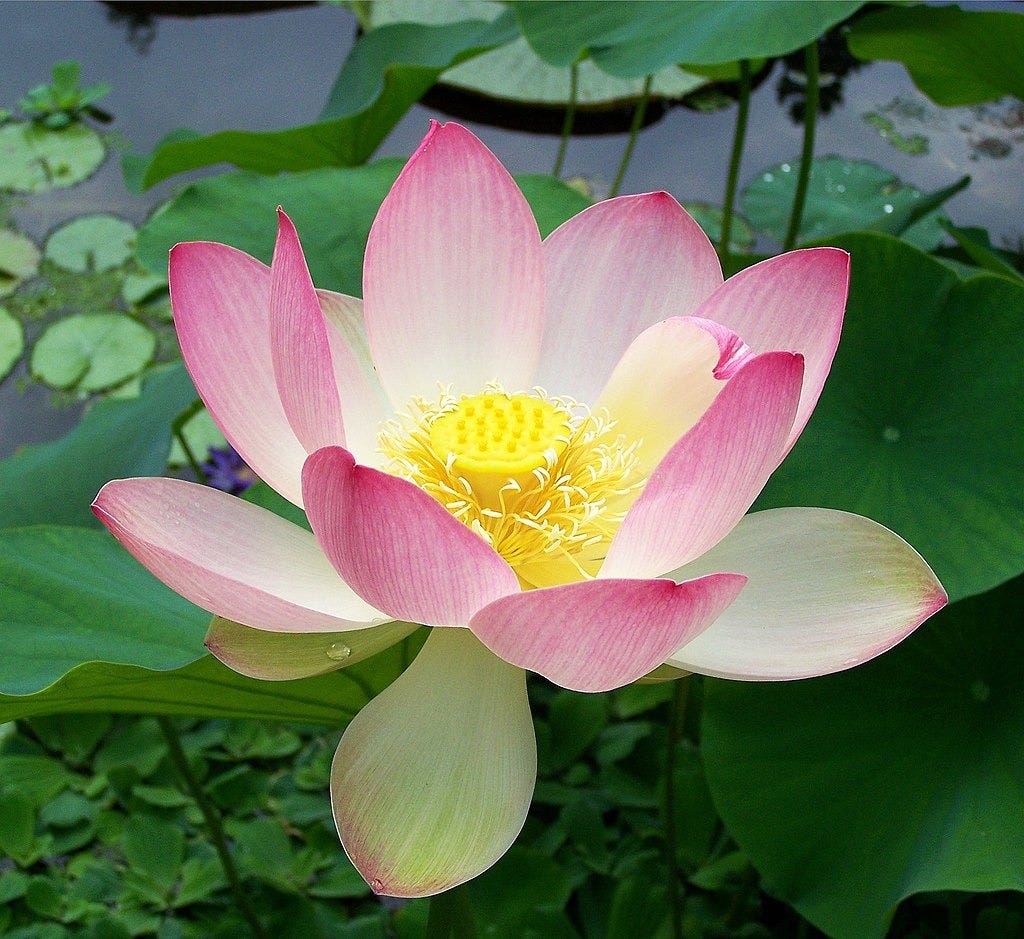
Each of the seven islands of Bhū-mandala is divided into different varṣas, or tracts of land, separated by great mountains, just as the central island of Jambūdvīpa is separated into nine varṣas. Each of these varṣas corresponds to one of the lotus petals in the analogy.
How is it possible that Bhū-mandala, a planetary system, can look like a lotus? In the Bhagavad-gītā, Kṛṣṇa compares the material world with a reflected tree on the waters of a lake. The original tree is the spiritual world, while the material creation is a reflection of it. Just as Goloka Vṛndāvana has the form of a lotus flower, Bhū-mandala, which is the central feature of the material universe, also has the form of a lotus flower, with the pericarp represented by Mount Sumeru, the gigantic golden mountain in the form of an inverted cone in the center of Jambūdvīpa. This is just another display of Kṛṣṇa’s inconceivable potencies.
Read the whole book:
« Making Sense of the Vedic Universe, a Higher-Dimensional Reality
This is a publication for thoughtful readers who want to go deeper into Kṛṣṇa consciousness. I publish daily, trying to offer high-quality spiritual content, and all posts are available to free subscribers. If you wish, you can also choose a paid subscription to support this work.
You can also receive the updates on WhatsApp or Telegram.
If you would like to contribute further, you can find the donation links here.