

« Making Sense of the Vedic Universe, a Higher-Dimensional Reality
The annual orbit of the sun
“Śukadeva Gosvāmī said: My dear King, I have thus far described the diameter of the universe [fifty crores of yojanas, or four billion miles] and its general characteristics, according to the estimations of learned scholars.
As a grain of wheat is divided into two parts and one can estimate the size of the upper part by knowing that of the lower, so, expert geographers instruct, one can understand the measurements of the upper part of the universe by knowing those of the lower part. The sky between the earthly sphere and heavenly sphere is called antarikṣa, or outer space. It adjoins the top of the sphere of earth and the bottom of that of heaven.
In the midst of that region of outer space [antarikṣa] is the most opulent sun, the king of all the planets that emanate heat, such as the moon. By the influence of its radiation, the sun heats the universe and maintains its proper order. It also gives light to help all living entities see. While passing toward the north, toward the south or through the equator, in accordance with the order of the Supreme Personality of Godhead, it is said to move slowly, swiftly or moderately. According to its movements in rising above, going beneath or passing through the equator — and correspondingly coming in touch with various signs of the zodiac, headed by Makara [Capricorn] — days and nights are short, long or equal to one another.” (SB 5.21.1-3)
In the previous chapter, Śukadeva Goswami described Bhū-mandala, which is situated approximately in the vertical middle of the universe. Bhū-mandala forms the earthly sphere, or earthly realm, being composed of all intermediate planets. Below Bhū-mandala, are the seven planetary systems of the asuras, and below these are the hellish planets. Sustaining the whole structure is Lord Ananta, who rests on the Garbhodaka Ocean, maintaining all planets floating in their proper orbits. What we call “gravity” is nothing more than His divine potency.
All of these together form the lower half of the universe. What about the upper half? Śukadeva Gosvāmī compares the universe with a grain of wheat. Just as a grain of wheat is divided into two symmetrical parts, the universe is also divided into two halves. The dimensions of the upper region may be inferred from the lower.
Just as the two parts of a grain of wheat are not directly glued together, but joined by a tiny layer of air, similarly, the universe is divided into a lower hemisphere and an upper hemisphere, joined by outer space, the antarikṣa. This is defined as the space where the sun and planets have their orbits.
When we hear the word “space” we think in terms of the concept of empty space in modern cosmology, but the concept of the antarikṣa is different. First of all, there is no concept of empty space in Vedic cosmology. What seems to be a vacuum is just another material element, ether, which is subtler than the others. Floating on this cosmic ether, the planets move in precise paths, governed not by blind mechanical laws, but by demigods who perform their functions in accordance to the will of the Lord.
The antarikṣa is thus the space where the sun, moon, and the planets of our solar system move, movements that will be explained in the following passages, starting with the movements of the sun.
This space also includes Bhuvarloka, the abode of the lower demigods (upa-devas), such as the Siddhas, Cāraṇas, and Vidyādharas, as well as the Yakṣas and Rākṣasas, the servants of Kuvera. Their abode starts from the upper atmosphere. We can’t see it, because all structures are subtle, but from their perspective, their abodes are formed by lakes, gardens, and so on. In the model of Bhū-mandala, their abode fits the area around Mount Sumeru. In the Mahābhārata, it is described that Bhima invaded this abode searching for the saugandhika lotus flower desired by Draupadī, fighting an army of Rākṣasas on the way.
North, south, or through the equator
We then have the main topic of the three verses previously mentioned, which is the annual orbit of the sun.
It is described that the sun sometimes passes through the north, south or the equator. This refers to the sūrya-mārga, or the ecliptic circle, which is not identical with the celestial equator. This is also studied in regular astronomy.
The Vedic model is a little different, because the earth is not tilted, but the general concept is the same, with the orbit of the sun staying part of the year above the equator, part under it, and with the two lines crossing in two points of the year. You can see how this works in this diagram:
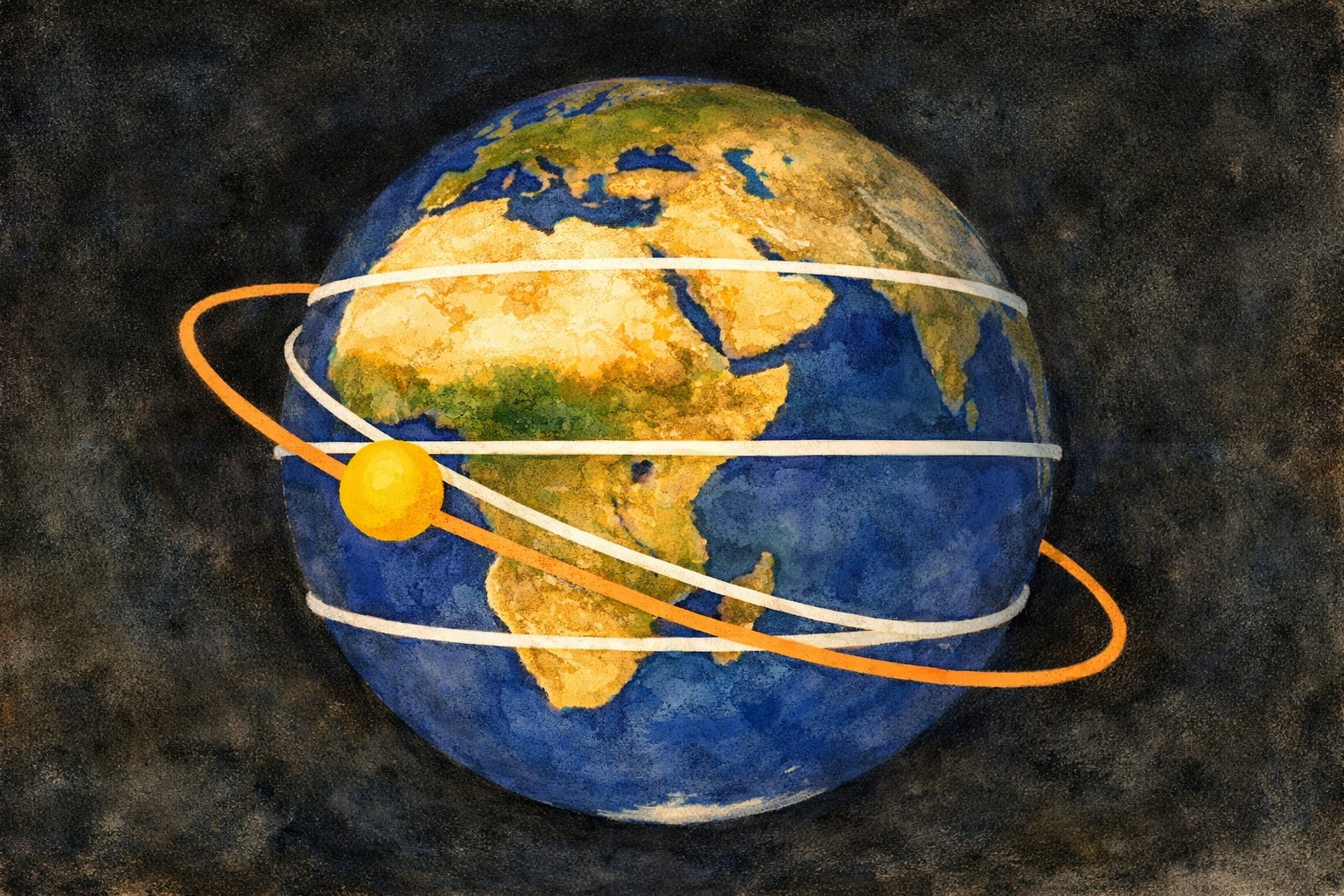
The path of the ecliptic in the Vedic model
The central horizontal line is the equator, which divides our planet in two exact halves. In the model of the Bhāgavatam, this is also the equator of Bhū-mandala.
The upper horizontal line is the Tropic of Cancer, which marks the upper limit of the path of the sun, while the lower horizontal line is the Tropic of Capricorn, which marks the lower limit of its path.
Imagine someone standing exactly at the line of the equator, facing east. In this position, the line of the equator appears as the middle of the sky. However, the sun will rarely pass directly overhead. Half of the year the sun will pass to the left of the sky (north, in the direction of the Tropic of Cancer), and the other half to the right (south, on the side of the Tropic of Capricorn). Only two days per year the sun will pass exactly directly overhead. This north–south shifting of the passage of the sun is caused by the sun’s annual motion along the ecliptic, the path of the sun shown in the picture. That’s what Śukadeva Goswami describes in these verses as the sun traveling through the constellations (rāśis), sometimes to the north and sometimes to the south.
This is how he explains it: As the sun goes through its annual path, it sometimes moves northward (udagayana), sometimes southward (dakṣiṇa-ayana), and sometimes (twice a year), it passes exactly through the middle line (vaiṣuvata). Just as in our example, all these movements of the sun are described from the perspective of someone standing on earth in the line of the equator and facing east.
This is one of the points that make Vedic astronomy attractive: it can be explained in a very simple and practical way, that perfectly matches what we see when we look into the sky. Here, in this book, the explanation may appear complicated, because I’m trying to reconcile it with modern observations to satisfy the scientifically minded among us. However, the Vedic system can also be explained in a simpler way, especially when one can visually see the model working.
The word yathā-savanam in text three is very significant for understanding this passage. The orbit of the sun is conducted according to the order of the Supreme Personality of Godhead. This understanding is the missing element in modern cosmology. The description of the orbit of the sun and the planets, thus, is not just a lesson in cosmology, but ultimately an aid to see the Lord behind all these functions, observing how the universe works in an ordered way, as a universal machine, and understanding that just as each of the demigods has their particular functions, we also have certain functions that we should perform as an offering to the Lord. The description of the universe found in the Śrīmad-Bhāgavatam helps us to reinforce both our devotional meditation and our concept of performing our prescribed duties.
Read the whole book:
« Making Sense of the Vedic Universe, a Higher-Dimensional Reality
This is a publication for thoughtful readers who want to go deeper into Kṛṣṇa consciousness. I publish daily, trying to offer high-quality spiritual content, and all posts are available to free subscribers. If you wish, you can also choose a paid subscription to support this work.
You can also receive the updates on WhatsApp or Telegram.
If you would like to contribute further, you can find the donation links here.