


You can receive new articles directly in your inbox. Subscription is free; donations are welcome.
This is a summary of the first chapter of the Gītā, with the verses divided into the sections, as I use for the new book, and a short description of each section, giving you a bird’s-eye view of the structure of the chapter. Gradually, we will have similar guides for the other chapters.
The first chapter of the Bhagavad-gītā is often misunderstood as merely the background to Kṛṣṇa’s teachings, but it is itself an essential part of the message. Before Kṛṣṇa speaks, we first see the condition that makes spiritual instruction necessary. Kṛṣṇa does not start speaking out of the blue. Arjuna plays the role of a sincere soul, overwhelmed by attachment, fear, moral uncertainty, and grief, who reaches the limits of his reasoning.
Arjuna is not confused because he lacks intelligence, morality, or other material qualifications. On the opposite: his arguments are thoughtful, compassionate, and religious. Still, they cannot resolve his dilemma because they remain incomplete without a direct connection with the desire of Kṛṣṇa.
In this way, the first chapter prepares the ground for the whole Gītā: when material reasoning reaches a dead end, the real solution begins by hearing the perfect transcendental message from Kṛṣṇa or His representative.
Setting the scene of the Gītā (Bg 1.1)
The Bhagavad-gītā begins with the conversation of Kṛṣṇa and Arjuna being grounded in a real historical setting: dharma-kṣetre kuru-kṣetre, the sacred field of Kurukṣetra. These words are important because they make it clear that the Gītā is not an allegory or metaphor, but a dialogue spoken on an actual battlefield, at a sacred place known since ancient times. Kṛṣṇa was there, and Arjuna was there, and they spoke in front of both armies.
Dhṛtarāṣṭra said: O Sañjaya, after my sons and the sons of Pāṇḍu assembled in the place of pilgrimage at Kurukṣetra, desiring to fight, what did they do?
Duryodhana speaks to Droṇācārya (Bg 1.2 to 1.9)
Sañjaya begins to answer Dhṛtarāṣṭra’s question by describing Duryodhana’s reaction on the battlefield. Concerned about the powerful army assembled by the Pāndavas, he approaches his guru, Droṇācārya. His attitude, however, is falsely confident and arrogant. This will be later contrasted with the attitude of Arjuna approaching Kṛṣṇa. This is one of the first lessons of the Gītā.
Sañjaya said: O King, after looking over the army arranged in military formation by the sons of Pāṇḍu, King Duryodhana went to his teacher and spoke the following words.
O my teacher, behold the great army of the sons of Pāṇḍu, so expertly arranged by your intelligent disciple the son of Drupada.
Here in this army are many heroic bowmen equal in fighting to Bhīma and Arjuna: great fighters like Yuyudhāna, Virāṭa and Drupada.
There are also great heroic, powerful fighters like Dhṛṣṭaketu, Cekitāna, Kāśirāja, Purujit, Kuntibhoja and Śaibya.
There are the mighty Yudhāmanyu, the very powerful Uttamaujā, the son of Subhadrā and the sons of Draupadī. All these warriors are great chariot fighters.
But for your information, O best of the brāhmaṇas, let me tell you about the captains who are especially qualified to lead my military force.
There are personalities like you, Bhīṣma, Karṇa, Kṛpa, Aśvatthāmā, Vikarṇa and the son of Somadatta called Bhūriśravā, who are always victorious in battle.
There are many other heroes who are prepared to lay down their lives for my sake. All of them are well equipped with different kinds of weapons, and all are experienced in military science.
The political game before the battle (Bg 1.10 and 1.11)
Even in front of his guru, Duryodhana continues to manage the situation politically. He first tries to influence Drona, securing his full commitment. Then, he must also praise Bhīṣma, without minimizing his teacher. In doing so, however, he creates a third problem: now he must also praise the other generals, without offending either Bhīṣma or Drona. His words reveal his political skill, but also his insecurity: even surrounded by powerful generals and a vast army, he knows that victory is not certain.
Our strength is immeasurable, and we are perfectly protected by Grandfather Bhīṣma, whereas the strength of the Pāṇḍavas, carefully protected by Bhīma, is limited.
All of you must now give full support to Grandfather Bhīṣma, as you stand at your respective strategic points of entrance into the phalanx of the army.
Signs of victory: the sounding of the conchshells (Bg 1.12 to 1.19)
Bhīṣma can clearly see Duryodhana’s attempt to politically manage his generals. However, seeing Duryodhana as his nephew, he doesn’t respond negatively. Instead, he tries to encourage him by blowing his conchshell, and is followed by the whole Kaurava army. Externally, this appears to display their strength, but the real situation becomes clear when Kṛṣṇa and Arjuna answer, followed by the other Pāndavas and their whole army. Their vibration reveals the reality Duryodhana’s diplomacy could not change: victory belongs to the side protected by Kṛṣṇa.
Then Bhīṣma, the great valiant grandsire of the Kuru dynasty, the grandfather of the fighters, blew his conchshell very loudly, making a sound like the roar of a lion, giving Duryodhana joy.
After that, the conchshells, drums, bugles, trumpets and horns were all suddenly sounded, and the combined sound was tumultuous.
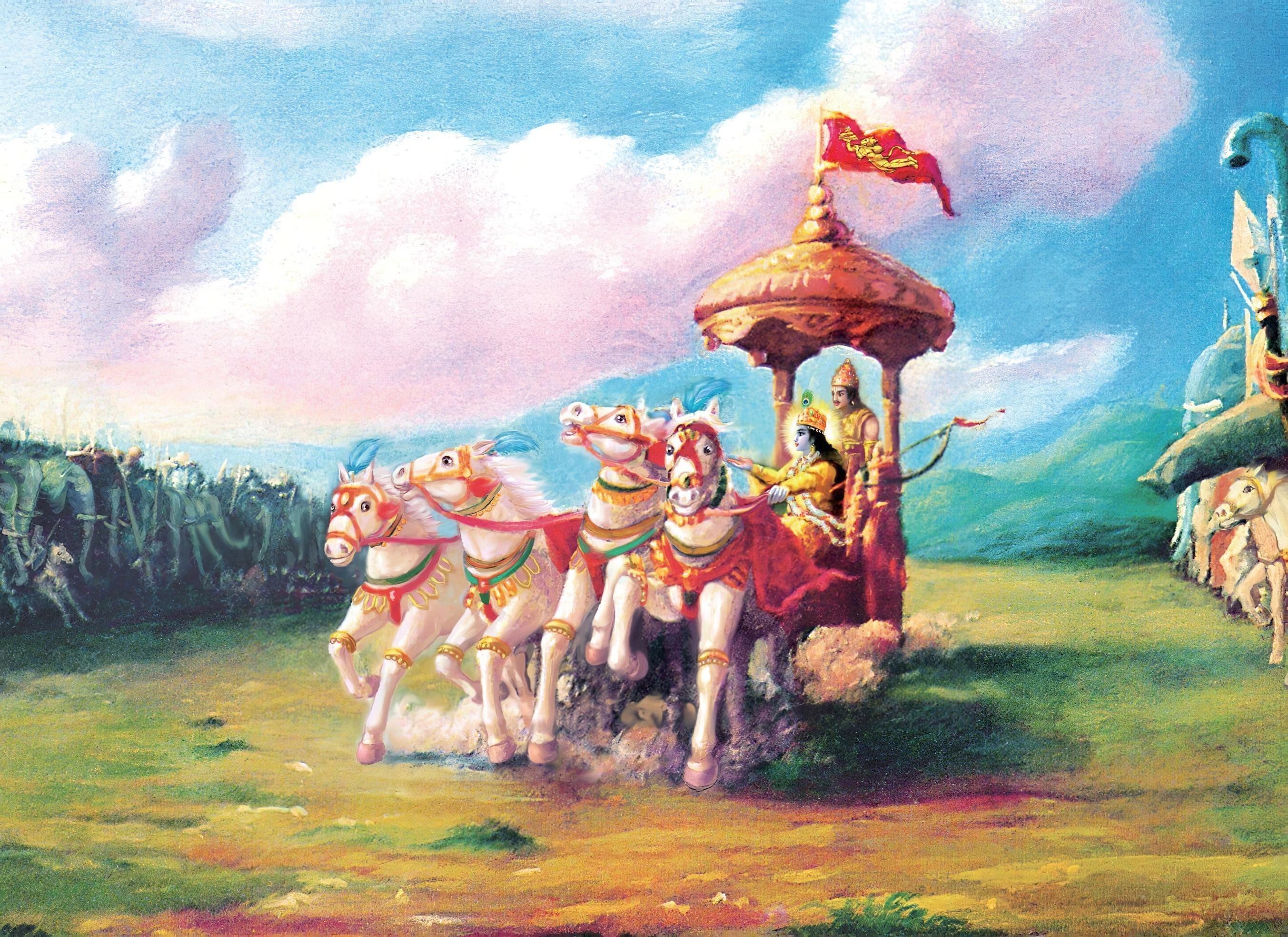
On the other side, both Lord Kṛṣṇa and Arjuna, stationed on a great chariot drawn by white horses, sounded their transcendental conchshells.
Lord Kṛṣṇa blew His conchshell, called Pāñcajanya; Arjuna blew his, the Devadatta; and Bhīma, the voracious eater and performer of herculean tasks, blew his terrific conchshell, called Pauṇḍra.
King Yudhiṣṭhira, the son of Kuntī, blew his conchshell, the Ananta-vijaya, and Nakula and Sahadeva blew the Sughoṣa and Maṇipuṣpaka. That great archer the King of Kāśī, the great fighter Śikhaṇḍī, Dhṛṣṭadyumna, Virāṭa, the unconquerable Sātyaki, Drupada, the sons of Draupadī, and others, O King, such as the mighty-armed son of Subhadrā, all blew their respective conchshells.
The blowing of these different conchshells became uproarious. Vibrating both in the sky and on the earth, it shattered the hearts of the sons of Dhṛtarāṣṭra.
Arjuna orders Kṛṣṇa (Bg 1.20 to 1.23)
After the sounding of the conchshells, the description shifts to Arjuna, who takes up his bow and prepares for battle. Confident and ready to fight, he asks Kṛṣṇa to place his chariot between the two armies so he can see those who have come to fight on the side of Duryodhana.
At that time Arjuna, the son of Pāṇḍu, seated in the chariot bearing the flag marked with Hanumān, took up his bow and prepared to shoot his arrows. O King, after looking at the sons of Dhṛtarāṣṭra drawn in military array, Arjuna then spoke to Lord Kṛṣṇa these words.
Arjuna said: O infallible one, please draw my chariot between the two armies so that I may see those present here, who desire to fight, and with whom I must contend in this great trial of arms.
Let me see those who have come here to fight, wishing to please the evil-minded son of Dhṛtarāṣṭra.
Arjuna sees the armies, and his heart shatters (Bg 1.24 to 1.27)
After Arjuna asks to see the warriors assembled for battle, Kṛṣṇa brings the chariot directly before Bhīṣma, Droṇa, and the other leading members of the Kuru dynasty. This marks the turning point in the first chapter. Up to this point, Arjuna has been ready to fight, but when he sees not merely soldiers, but relatives, teachers, friends, and well-wishers standing on both sides, his determination begins to falter. By Kṛṣṇa’s arrangement, Arjuna is brought into the state of confusion that will serve as the background for His instructions.
Sañjaya said: O descendant of Bharata, having thus been addressed by Arjuna, Lord Kṛṣṇa drew up the fine chariot in the midst of the armies of both parties.
In the presence of Bhīṣma, Droṇa and all the other chieftains of the world, the Lord said, “Just behold, Pārtha, all the Kurus assembled here.”
There Arjuna could see, within the midst of the armies of both parties, his fathers, grandfathers, teachers, maternal uncles, brothers, sons, grandsons, friends, and also his fathers-in-law and well-wishers.
When the son of Kuntī, Arjuna, saw all these different grades of friends and relatives, he became overwhelmed with compassion and spoke thus.
Arjuna feels compassion and fear (Bg 1.28 to 1.29)
Kṛṣṇa brought Arjuna to the middle of the armies so he could see with his own eyes the real cost of the battle. Seeing his relatives, teachers, friends, and well-wishers assembled on both sides, Arjuna’s confidence vanishes. His internal conflict is so acute that it appears as visible symptoms in his body.
Arjuna said: My dear Kṛṣṇa, seeing my friends and relatives present before me in such a fighting spirit, I feel the limbs of my body quivering and my mouth drying up.
My whole body is trembling, my hair is standing on end, my bow Gāṇḍīva is slipping from my hand, and my skin is burning.
The result of material attachment (Bg 1.30)
Arjuna begins to see the whole situation through the lens of attachment and fear of misfortune. Under this mistaken conception, he starts considering what to do in terms of personal gain and loss, and thus becomes disturbed and confused about what to do. This connects with our situation in this world, where we live immersed in material attachment and anxiety, unable to find our way out.
I am now unable to stand here any longer. I am forgetting myself, and my mind is reeling. I see only causes of misfortune, O Kṛṣṇa, killer of the Keśī demon.
Arjuna’s reasons for not fighting (Bg 1.31 to 1.39)
The two previous sections described Arjuna’s reaction after seeing his friends and relatives arranged on the battlefield. Now his bewilderment takes the form of arguments. He tries to justify his unwillingness to fight using arguments based on compassion, family affection, morality, non-violence, and so on. These are reasonable arguments from a material perspective, but we can observe that they are not sufficient to solve his dilemma.
I do not see how any good can come from killing my own kinsmen in this battle, nor can I, my dear Kṛṣṇa, desire any subsequent victory, kingdom or happiness.
O Govinda, of what avail to us are a kingdom, happiness or even life itself when all those for whom we may desire them are now arrayed on this battlefield? O Madhusūdana, when teachers, fathers, sons, grandfathers, maternal uncles, fathers-in-law, grandsons, brothers-in-law and other relatives are ready to give up their lives and properties and are standing before me, why should I wish to kill them, even though they might otherwise kill me? O maintainer of all living entities, I am not prepared to fight with them even in exchange for the three worlds, let alone this earth. What pleasure will we derive from killing the sons of Dhṛtarāṣṭra?
Sin will overcome us if we slay such aggressors. Therefore it is not proper for us to kill the sons of Dhṛtarāṣṭra and our friends. What should we gain, O Kṛṣṇa, husband of the goddess of fortune, and how could we be happy by killing our own kinsmen?
O Janārdana, although these men, their hearts overtaken by greed, see no fault in killing one’s family or quarreling with friends, why should we, who can see the crime in destroying a family, engage in these acts of sin?
With the destruction of the dynasty, the eternal family tradition is vanquished, and thus the rest of the family becomes involved in irreligion.
How unwanted progeny destroys society (Bg 1.40 to 1.43)
After presenting arguments based on non-violence and fear of sinful reactions, Arjuna now expands his argument beyond the immediate consequences, analyzing the long-term effects on the whole society. If the senior members are killed, the family traditions will be broken, spiritual culture will decline, and both ancestors and future generations will suffer. How could this be positive?
When irreligion is prominent in the family, O Kṛṣṇa, the women of the family become polluted, and from the degradation of womanhood, O descendant of Vṛṣṇi, comes unwanted progeny.
An increase of unwanted population certainly causes hellish life both for the family and for those who destroy the family tradition. The ancestors of such corrupt families fall down, because the performances for offering them food and water are entirely stopped.
By the evil deeds of those who destroy the family tradition and thus give rise to unwanted children, all kinds of community projects and family welfare activities are devastated.
O Kṛṣṇa, maintainer of the people, I have heard by disciplic succession that those whose family traditions are destroyed dwell always in hell.
Arjuna decides not to fight (Bg 1.44 and 1.45)
In 1.31-39, Arjuna argued from a personal and moral perspective. Then, in 1.40-43, he argued from a social and religious perspective, considering the danger of the destruction of family traditions and the suffering that would follow. Now, Arjuna’s reasoning comes to a conclusion: it is better not to fight. Even if the Kauravas decide to kill him unarmed and unresisting, he calculates, this would be better than enjoying a kingdom smeared in blood.
Alas, how strange it is that we are preparing to commit greatly sinful acts. Driven by the desire to enjoy royal happiness, we are intent on killing our own kinsmen.
Better for me if the sons of Dhṛtarāṣṭra, weapons in hand, were to kill me unarmed and unresisting on the battlefield.
The perfect opportunity (Bg 1.46)
Externally, Arjuna appears to be defeated. He even puts aside his bow. Spiritually, however, this becomes the perfect opportunity. Having reached the limits of his own reasoning, Arjuna is now ready to hear from Kṛṣṇa.
Sañjaya said: Arjuna, having thus spoken on the battlefield, cast aside his bow and arrows and sat down on the chariot, his mind overwhelmed with grief.
Read also:

This is a publication for thoughtful readers who want to go deeper into Kṛṣṇa consciousness. I publish daily, trying to offer high-quality spiritual content, and all posts are available to free subscribers. If you wish, you can also choose a paid subscription to support this work.
You can also receive the updates on WhatsApp or Telegram.
If you would like to contribute further, you can find the donation links here.