

« The Song of God—Volume 1, chapters 1-6
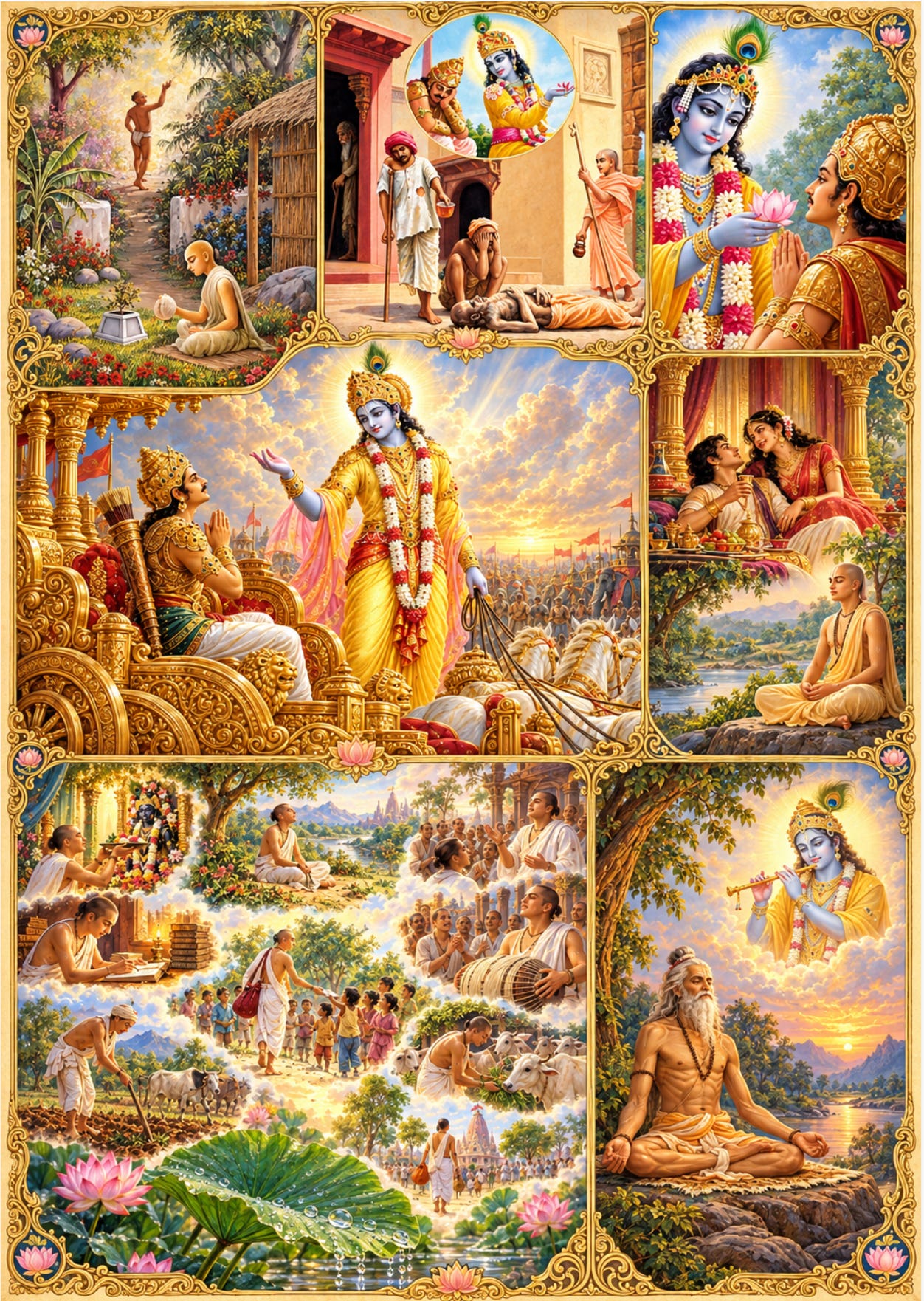
A map of the fifth chapter
This is the chapter where the topic of action in Kṛṣṇa consciousness is concluded. What happens when karma-yoga (chapter three) is combined with transcendental knowledge (chapter four)? We come back to buddhi-yoga, which is karma-yoga in its perfect form. Work performed for Kṛṣṇa without attachment and in full knowledge is the perfect form of renunciation. That’s the process Kṛṣṇa summarized in the second chapter and has been explaining in detail since chapter three. This chapter also emphasizes the difference between this practical process of Kṛṣṇa consciousness and the path of jñāna, which nowadays often degenerates into mere mental speculation.
The keys are:
Action - Freedom - Doer - Vision - Liberation - Peace
Action: Devotional action is better than dry renunciation (Bg 5.1 to 5.6)
Arjuna again asks whether renunciation or work in devotion is better. Kṛṣṇa replies that while both may lead to liberation, devotional service (karma-yoga) is superior, safer, and more direct than the artificial renunciation of the jñāna path. True renunciation means doing everything for Him, the Supreme Lord.
Freedom: Niṣkāma-karma-yoga (Bg 5.7 to 5.12)
A person who works in full Kṛṣṇa consciousness is never entangled by his actions. When we dedicate all our physical and mental activities entirely to Kṛṣṇa, we remain untouched by sin and free from karmic bondage, just as a lotus leaf remains untouched by water, even while living directly on it. This platform becomes possible through transcendental knowledge, the understanding of our eternal relationship with Him.
Doer: The liberated soul does not create activities (Bg 5.13 to 5.16)
Who is actually performing the action? The materialist, bewildered by false ego, thinks he is the doer and he is the enjoyer of the results. However, the liberated soul understands that the soul does not act. The soul desires, but the actions themselves are carried out by the material nature under the sanction of the Supersoul. Since everything is performed by Kṛṣṇa’s energies, He is the proprietor of the fruits. The self-realized devotee does not work in the sense that he does not claim proprietorship. By working in this consciousness, we remain free, even while living in the body.
Vision: The vision of the self-realized (Bg 5.17 to 5.21)
Because self-realized souls see with the eyes of transcendental knowledge, they do not distinguish between the outer material coverings of different beings. They see the soul, and not the body, and thus they see everyone with equal spiritual vision (sama-darśinaḥ). They are not even affected by pleasant and unpleasant situations. Such a sage finds happiness within and is not attracted to external sense gratification.
Liberation: Resisting the urges of the senses (Bg 5.22 to 5.26)
The material senses are actually sources of misery. Real happiness is possible only on the spiritual platform. Understanding this, an intelligent person tolerates the urges of the senses and resists the forces of lust and anger, and thus becomes situated in transcendence. He works for the benefit of all and remains happy and free from sin, even while still living in this world. At the end, he attains the Supreme.
Peace: Introducing dhyāna-yoga (Bg 5.27 to 5.29)
Kṛṣṇa concludes the chapter by briefly introducing the next process He wants to discuss, dhyāna-yoga, and giving its goal, the ultimate peace formula. One can attain complete peace and the ultimate goal only by understanding three things: Kṛṣṇa is the supreme enjoyer of all sacrifices, the Supreme Lord of all planets and their controllers, and the greatest well-wisher of all living entities. With these words, Kṛṣṇa declares that devotional service is the ultimate goal of all processes of yoga.
Through Action offered without claim,
Freedom breaks the binding chain.
When knowledge clears the false Doer from sight,
In true Vision, we see all beings in equal light.
Resisting desire leads us to Liberation,
beyond the waves of material agitation.
Knowing Kṛṣṇa as the enjoyer, Lord, and friend,
we attain Peace, on which all happiness depends.
Read the entire book:
« The Song of God—Volume 1, chapters 1-6

This is a publication for thoughtful readers who want to go deeper into Kṛṣṇa consciousness. I publish daily, trying to offer high-quality spiritual content, and all posts are available to free subscribers. If you wish, you can also choose a paid subscription to support this work.
You can also receive the updates on WhatsApp or Telegram.
If you would like to contribute further, you can find the donation links here.