

« The Song of God—Volume 1, chapters 1-6
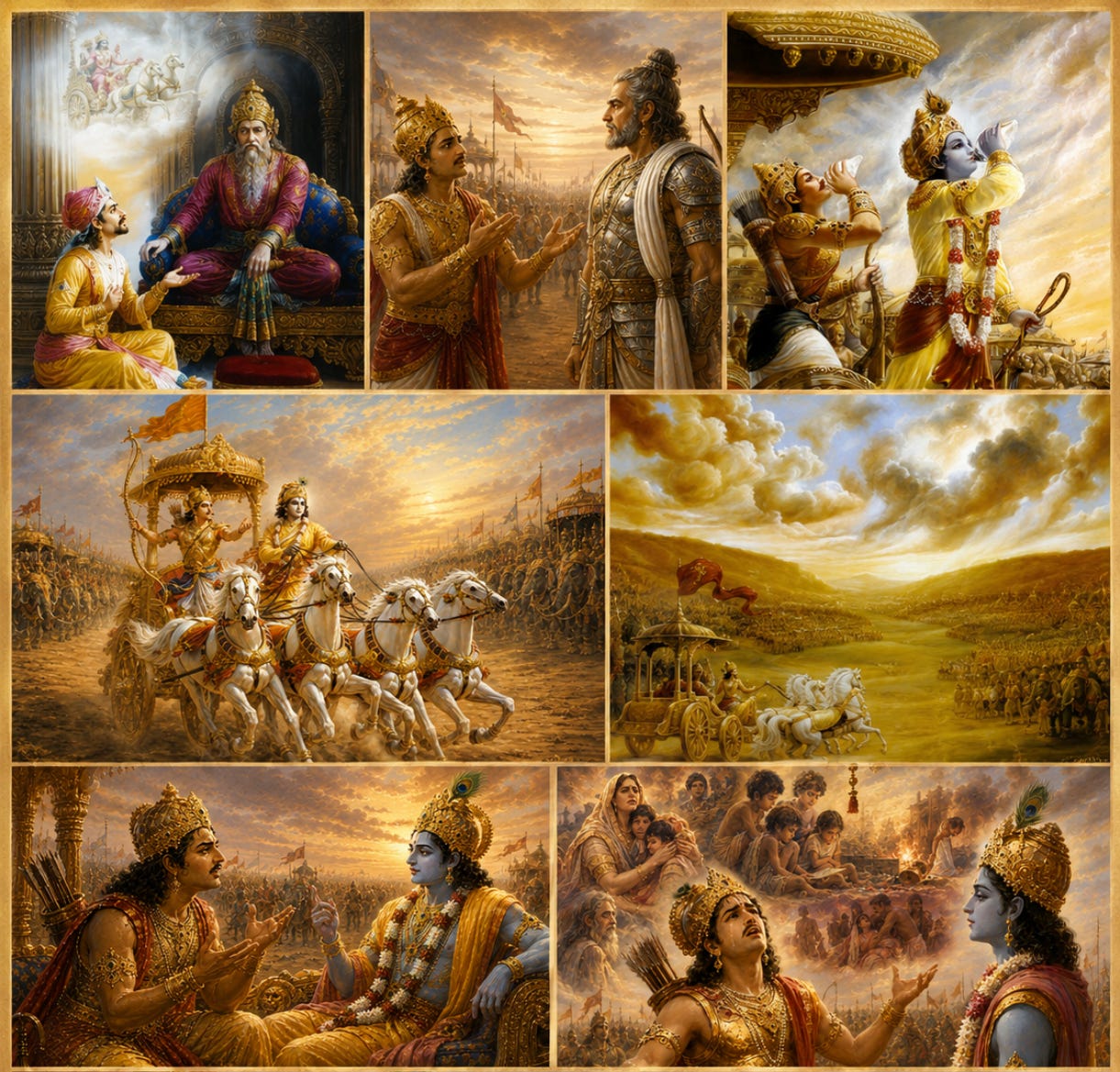
A map of the first chapter of the Gītā
This is a short summary of the topics that compose the first chapter, meant to help us to remember what we studied. You can imagine these short descriptions as hooks on which to anchor everything we studied, gaining a structured view of the entire chapter. We will have similar outlines for all subsequent chapters.
Scene: Sañjaya and Dhṛtarāṣṭra (Bg 1.1)
Sañjaya and Dhṛtarāṣṭra are in the palace. The armies are already assembled on the battlefield. The blind king is unsure about the outcome, fearing that the holy influence of Kurukṣetra may favor the virtuous Pāṇḍavas.
Diplomacy: Duryodhana talks to Dronacārya (Bg 1.2 to 1.11)
Duryodhana addresses his guru in a calculated monologue. He tries to manipulate the situation, using carefully crafted sentences, trying to satisfy both Bhīṣma and Droṇācārya, as well as the other generals. He speaks as one who already knows everything and feels no need to inquire.
Sound: The sounding of the conchshells (Bg 1.12 to 1.19)
The soldiers on the side of the Pāṇḍavas are not affected by the sounds of the Kaurava army, but the hearts of the Kauravas are shattered when Kṛṣṇa and the Pāṇḍavas answer. Kṛṣṇa is on the other side, and the goddess of fortune is with Him.
Request: Arjuna asks to see the opposing side (Bg 1.20 to 1.23)
Arjuna wants to see who has come to fight and estimate the strength of the opposing forces. The chariot positioned in the middle of both armies will give Kṛṣṇa the opportunity to benefit the soldiers in both armies by speaking the Bhagavad-gītā.
Vision: Arjuna’s heart shatters (Bg 1.24 to 1.27)
This is the defining moment of the first chapter. Seeing the friends and family members who have come to fight against him, Arjuna has a change of heart. Now he faces the choice of fighting and killing his own kinsmen, or neglecting his duty as a kṣatriya.
Collapse: Arjuna’s compassion and fear (Bg 1.28 to 1.29)
Arjuna shows a mixture of symptoms. The quivering of the limbs and his mouth drying up are symptoms of compassion, while the trembling, the hair standing on end, the skin burning, and the bow slipping from his hand are symptoms of material fear.
Attachment: Arjuna falls into the bodily concept of life (Bg 1.30)
Because of material attachment to his friends and relatives, Arjuna falls into the bodily conception of life, characterized by lamentation. He considers that both victory and defeat will bring him grief, and as a result, his mind reels in confusion.
Arguments: Reasons for not fighting (Bg 1.31 to 1.43)
Arjuna gives five reasons not to fight: 1) compassion, 2) fear of personal loss, 3) destruction of family traditions, 4) fear of karmic reactions, and 5) indecision. He then concludes by arguing that wholesale killing in the battle would leave the women unprotected, leading to the destruction of family traditions.
Impasse: Arjuna casts his bow aside and sits (Bg 1.44 to 1.46)
Arjuna gives strong arguments from the moral standpoint, based on what he has heard from authorities, but his knowledge of ordinary dharma is not sufficient to solve his problem. His confusion gives Kṛṣṇa the opportunity to speak the Bhagavad-gītā for our benefit.
In this way, the keys for remembering the topics of this chapter are:
Scene - Diplomacy - Sound - Request
Vision - Collapse - Attachment - Arguments - Impasse
Each word corresponds to one section of the map. By memorizing these keys in sequence, we can remember the flow of the whole chapter: first the setting, then Duryodhana’s political maneuvering, the sounding of the conchshells, Arjuna’s request to see the opposing side, his vision of his relatives, his emotional collapse, the result of his attachment, his arguments against fighting, and finally the impasse that gives Kṛṣṇa the opportunity to speak.
The Scene is set as armies gather for the fight;
through cautious Diplomacy, Duryodhana measures might.
The conches resonate with a thunderous Sound;
then Arjuna makes his Request to survey the ground.
His Vision falls upon his teachers, friends, and kin;
his courage gives way to Collapse before the war can begin.
Through Attachment, compassion loses proper aim;
and grief disguises weakness beneath a righteous name.
His Arguments condemn the battle, duty, and throne;
yet all arise from thinking the body is the self alone.
Unable to fight or from the conflict depart, Arjuna reaches an Impasse,
defeated within his heart.
Next: CHAPTER TWO: Contents of the Gītā Summarized (Sānkhya-yoga)
Read the entire book:
« The Song of God—Volume 1, chapters 1-6

This is a publication for thoughtful readers who want to go deeper into Kṛṣṇa consciousness. I publish daily, trying to offer high-quality spiritual content, and all posts are available to free subscribers. If you wish, you can also choose a paid subscription to support this work.
You can also receive the updates on WhatsApp or Telegram.
If you would like to contribute further, you can find the donation links here.