

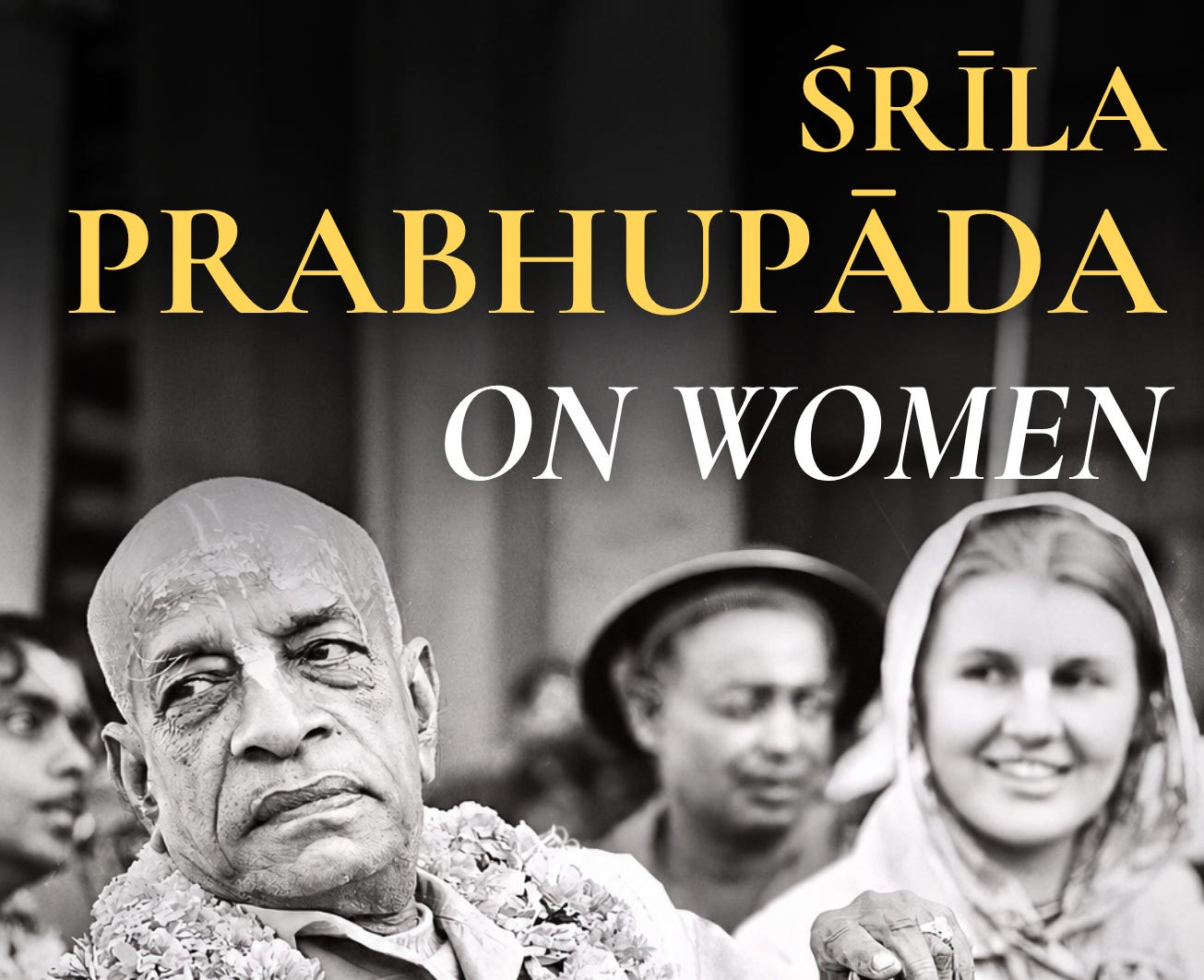
A woman should follow a husband who is not fallen
An important passage that balances all the many other passages that speak about the duties of a woman inside a family is SB 7.11.28:
“A chaste woman should not be greedy, but satisfied in all circumstances. She must be very expert in handling household affairs and should be fully conversant with religious principles. She should speak pleasingly and truthfully and should be very careful and always clean and pure. Thus a chaste woman should engage with affection in the service of a husband who is not fallen.”
In his purport, Prabhupāda explains the dynamic:
“Anyone who is a devotee is sinless. One who is not a devotee, however, is the most fallen and condemned. It is recommended, therefore, that a chaste wife not associate with a fallen husband. A fallen husband is one who is addicted to the four principles of sinful activity — namely illicit sex, meat-eating, gambling and intoxication. Specifically, if one is not a soul surrendered to the Supreme Personality of Godhead, he is understood to be contaminated. Thus a chaste woman is advised not to agree to serve such a husband. It is not that a chaste woman should be like a slave while her husband is narādhama, the lowest of men. Although the duties of a woman are different from those of a man, a chaste woman is not meant to serve a fallen husband. If her husband is fallen, it is recommended that she give up his association. Giving up the association of her husband does not mean, however, that a woman should marry again and thus indulge in prostitution. If a chaste woman unfortunately marries a husband who is fallen, she should live separately from him. Similarly, a husband can separate himself from a woman who is not chaste according to the description of the śāstra. The conclusion is that a husband should be a pure Vaiṣṇava and that a woman should be a chaste wife with all the symptoms described in this regard. Then both of them will be happy and make spiritual progress in Kṛṣṇa consciousness.”
One problem we often create is interpreting the word “devotee” out of the intended meaning. Prabhupāda uses the term “devotee” consistently in his writings in the sense of a pure Vaiṣnava. Not necessarily in the sense of a uttama-adhikārī, but in the sense of a genuine Vaiṣnava, who acts without ulterior motives, gives proper example, and shows the necessary qualities, and not just someone who adopted external symbols.
Śrīla Bhaktivinoda Thākura divides human beings into four categories: the impious atheists who don’t respect the laws of God, the pious atheists, who follow general moral principles, the pious theists who follow moral rules under some religious system, and the devotee, who, on top of following moral principles, develops true Vaiṣnava qualities. There is no mention of an impious devotee. Under his definition, an impious “devotee” who does not follow basic moral principles is classified together with the impious atheist. He is an atheist who adopted external symbols and rituals, not a real Vaiṣnava.
A sincere husband may sometimes commit mistakes due to weakness as part of his process of purification. He may repent, accept correction, and continue his practice. This is part of the learning process we all go through in family life. There is, however, a limit to it. If one is repeatedly abusive, dishonest, violent, etc., this places him within the narādhama category, and he should be considered as fallen. If he cannot be corrected, the wife is advised to abandon him. This is a difficult step that should not be taken lightly, but this is the general recommendation.
The instruction for a wife to be chaste implies cooperating with a husband who follows spiritual and moral principles, following the path of dharma together with him. It cannot be used as an excuse for abuse, violence, cruelty, threats, and other adharmic behavior.
This point is essential in balancing the roles of men and women inside a marriage in the context of the teachings of Prabhupāda. It is true that Prabhupāda prescribes duties for a woman that go much beyond what is considered reasonable for a wife in the modern context, but it is also true that the obligations for a man are equally high, starting with the prerequisite of being a pure Vaiṣnava, with all the corresponding qualities.
A woman should not be proud and independent within a marriage and risk undermining it, but at the same time, she should not follow a fallen or abusive husband. This again brings up the idea that chaste wives cannot exist separated from qualified husbands. The Vedic model requires both. If men are unqualified, the system collapses, for women have to protect themselves against abuse.
In short, the Vedic system does not force women to follow unqualified men. It is based on men becoming qualified protectors. Once qualified men are available, it is not difficult to find women willing to follow them.
Read the whole book:
« Śrīla Prabhupāda on Women
This is a publication for thoughtful readers who want to go deeper into Kṛṣṇa consciousness. I publish daily, trying to offer high-quality spiritual content, and all posts are available to free subscribers. If you wish, you can also choose a paid subscription to support this work.
You can also receive the updates on WhatsApp or Telegram.
If you would like to contribute further, you can find the donation links here.