


You can receive new articles directly in your inbox. Subscription is free; donations are welcome.
One topic studied in bhakti-śāstrī courses is the yoga ladder of the Bhagavad-gītā. In the course, it is normally studied as a simplified diagram. This is an updated version of it, showing the different processes mentioned in the Gītā and the different paths of progression between them.
Prabhupāda introduces the concept of the different processes of self-realization described in the Gītā as a ladder leading to Kṛṣṇa in his purports to texts 6.3 and 6.4 and emphasizes the essential role of Kṛṣṇa consciousness in this progression:
“The process of linking oneself with the Supreme is called yoga. It may be compared to a ladder for attaining the topmost spiritual realization. This ladder begins from the lowest material condition of the living entity and rises up to perfect self-realization in pure spiritual life. According to various elevations, different parts of the ladder are known by different names. But all in all, the complete ladder is called yoga and may be divided into three parts, namely jñāna-yoga, dhyāna-yoga and bhakti-yoga. The beginning of the ladder is called the yogārurukṣu stage, and the highest rung is called yogārūḍha.”
“Without Kṛṣṇa consciousness, one must be always seeking self-centered or extended selfish activities. But a Kṛṣṇa conscious person can do everything for the satisfaction of Kṛṣṇa and thereby be perfectly detached from sense gratification. One who has no such realization must mechanically try to escape material desires before being elevated to the top rung of the yoga ladder.”
He explains the ladder in more detail in text 6.47. This is a partial explanation, because many other details are given in other purports, but this is the central text for the explanation:
“The culmination of all kinds of yoga practices lies in bhakti yoga. All other yogas are but means to come to the point of bhakti in bhakti-yoga. Yoga actually means bhakti-yoga; all other yogas are progressions toward the destination of bhakti-yoga. From the beginning of karma-yoga to the end of bhakti-yoga is a long way to self-realization. Karma-yoga, without fruitive results, is the beginning of this path. When karma-yoga increases in knowledge and renunciation, the stage is called jñāna-yoga. When jñāna-yoga increases in meditation on the Supersoul by different physical processes, and the mind is on Him, it is called aṣṭāṅga-yoga. And when one surpasses the aṣṭāṅga-yoga and comes to the point of the Supreme Personality of Godhead Kṛṣṇa, it is called bhakti-yoga, the culmination. Factually, bhakti-yoga is the ultimate goal, but to analyze bhakti-yoga minutely one has to understand these other yogas. The yogī who is progressive is therefore on the true path of eternal good fortune. One who sticks to a particular point and does not make further progress is called by that particular name: karma-yogī, jñāna-yogī or dhyāna-yogī, rāja-yogī, haṭha-yogī, etc. If one is fortunate enough to come to the point of bhakti-yoga, it is to be understood that he has surpassed all other yogas. Therefore, to become Kṛṣṇa conscious is the highest stage of yoga, just as, when we speak of Himālayan, we refer to the world’s highest mountains, of which the highest peak, Mount Everest, is considered to be the culmination.”
This is the diagram with the ladder combining this central explanation with other details he gives in other parts of the Gītā:
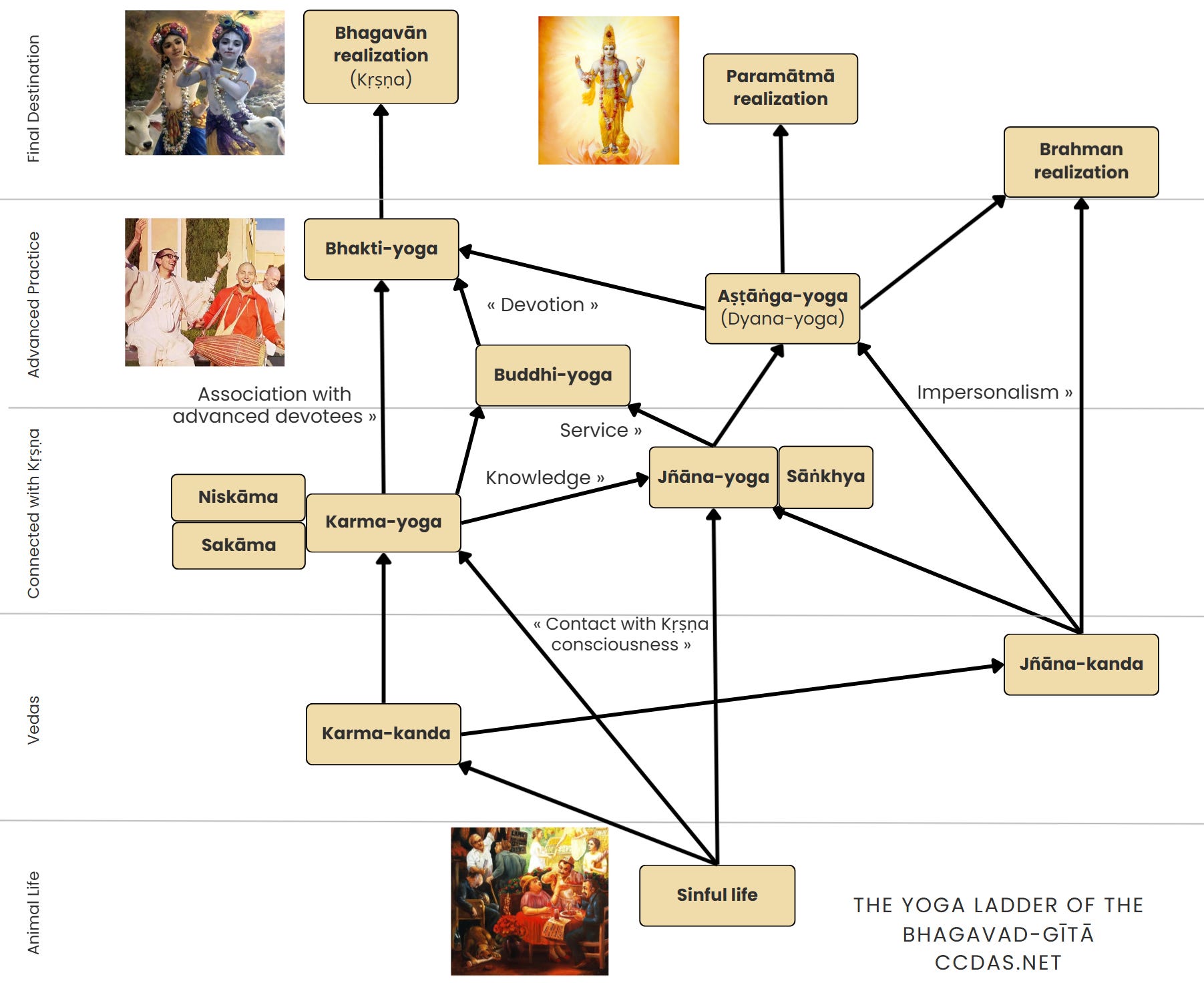
The lowest level is a sinful, materialistic life, where one performs all kinds of questionable activities, or vikarma. This stage is compared to animal life, because one just works to satisfy his senses, eating, sleeping, mating, and defending, without any higher goal. A person who lives like that lives in vain, and risks returning to the animal species.
From this sinful life of sense gratification, one may come into contact with the Vedas, and start the general path of fruitive actions aspiring for material recompenses (karma-kanda), or come into contact with Kṛṣṇa consciousness and come directly to the path of karma-yoga, working for Kṛṣṇa.
Karma-yoga has two levels: when one works for Kṛṣṇa but is still attached to the fruits (sakāma), and the niṣkama level, where one works without attachment. Generally, one will start the process while still attached, and will gradually become detached as the heart is cleansed. We can imagine sakāma-karma-yoga as tending to the side of fruitive activity, and niṣkāma-karma-yoga as tending to the side of pure bhakti-yoga. As we can see, the level of karma-yoga is quite vast, going from little more than fruitive activity, all the way to a level approaching pure devotion. Prabhupāda tends to speak positively of karma-yoga, referring to the higher levels, where Kṛṣṇa consciousness is predominant, while some passages from other ācāryas speak of it more negatively, referring to the lower levels. This should not be taken as a contradiction.
The next two stages are jñāna-yoga and buddhi-yoga. The main characteristic of these two steps of the ladder is the predominance of knowledge. Different from the dry, vague, and mostly impersonal knowledge of the ordinary jñāna path, in jñāna-yoga there is understanding of Kṛṣṇa consciousness. One generally gets there only through association with devotees, and, as his understanding matures, one progresses into the realm of buddhi-yoga, the mature form of jñāna-yoga, where one understands himself as an eternal servant of Kṛṣṇa, the Supreme Personality of Godhead, and decides to serve Him. This is also the point on the ladder where the paths of jñāna-yoga and karma-yoga join into one. As it matures further, it leads to pure bhakti-yoga.
Karma-yoga is already directly connected with bhakti-yoga. Prabhupāda even translates karma-yoga as “devotional service” in chapter three. The difference is that at the karma-yoga level, one is still going through the process of purification, while pure bhakti-yoga is the stage of maturity where devotion fully manifests. Simultaneously, as one’s knowledge matures, one progresses to jñāna-yoga or buddhi-yoga. Devotional service, however, is so powerful that one may also progress directly to mature devotional service directly through association with advanced devotees, even without one formally studying philosophy.
In this way, when the karma-yogi advances in knowledge, he progresses into jñāna-yoga or buddhi-yoga, and when the jñana-yogi progresses in service, he progresses into buddhi-yoga. In both cases, the final progression is pure bhakti-yoga.
What about Sānkhya, the process of analytical knowledge described by Kṛṣṇa in chapter two? Sānkhya-yoga is a form of jñāna-yoga; therefore it is put together with it in the diagram. In the context of the Bhagavad-gītā, Sānkhya is analytical knowledge about spirit and matter that brings us to devotional service, while in the context of Śrīmad-Bhāgavatam, Sānkhya is a complete philosophical system that guides one to bhakti through jñāna-yoga and aṣṭānga-yoga.
Another point is that in many passages, Prabhupāda equates jñāna-yoga and buddhi-yoga, just as he equates karma-yoga and bhakti-yoga. Here I take it as indicating a direct progression between the two paths, and not directly as meaning they are exactly the same, since other passages describe distinctions between them.
What about aṣṭānga-yoga? Many devotees in previous ages would practice aṣṭānga-yoga as a way to fix their mind in meditation on Kṛṣṇa. This was the path chosen by Pṛthu Maharaja, for example. Aṣṭānga-yoga is generally connected with Paramātmā realization, but devotees may use it to increase their meditation on Kṛṣṇa, and thus also reach pure bhakti-yoga from this path. In this case, one may not perform physical service, but one serves Kṛṣṇa in one’s meditation. This is connected with the yogārūḍha stage Kṛṣṇa describes in text 6.3. However, as described in the Gītā, the path of aṣṭānga-yoga is not recommended for our age. One does better by associating with devotees and going directly to the path of bhakti-yoga from karma-yoga.
One can also reach aṣṭānga-yoga from the jñāna-yoga path, and from there progress to devotional service. This is the general path Kṛṣṇa explains in the 6th chapter of the Gītā. There is, however, another path that is less commendable. An ordinary follower of the Vedas may come to the path of jñāna after becoming frustrated with the fruitive path, and from there eventually start practicing aṣṭānga-yoga. However, without contact with devotional service, this practice will simply lead to Brahman realization, like in the case of Dhṛtarāṣṭra, described in the First Canto of Śrīmad-Bhāgavatam. One may also go directly from jñāna to impersonalism, coming to the conclusion of being one with Brahman.
However, this path can be avoided if the jñāni comes into contact with devotees and hears about devotional service. In this case, one can progress to the path of jñāna-yoga, which, when matured, can lead to buddhi-yoga, and from there to bhakti-yoga, maturing his devotion to Kṛṣṇa.
We can see that all these paths are connected with transcendental knowledge from the Vedas, or with direct contact with devotional service. One may also, from sinful life, simply go on the path of mental speculation, studying different paths without really practicing any of them. In this case, one ends up becoming some form of cheap, New Age impersonalist, but this is not real spiritual realization. From there, one may just become a stone or a tree. This helps us to understand why Śrīla Prabhupāda emphasized so much the distribution of his books, seeing them as a vehicle to put people in contact with Kṛṣṇa consciousness and thus avoid both the danger of sinful life and mental speculation.
It is also important to note that the progression on this ladder typically takes many lives. This is the central point in the discussion about the destination of the unsuccessful yogī at the end of the 6th chapter of the Gītā. This is a point that is made clear in the Jaiva-dharma of Śrīla Bhaktivinoda Thākura. Different characters in the book exemplify different levels of spiritual advancement in this multi-life progression. Vaiṣnava dāsa, for example, went very high on the path of jñāna after a life of practice, endowed with learning and renunciation, but still tending to impersonalism. From there, he was quickly promoted to pure bhakti-yoga by association with Prema-dāsa bābājī. Conversely, Digambara Cattopādhyāya exemplifies the proud materialist, who, although qualified by material standards, is not able to appreciate Vaiṣnavas. He, however, gained some ajñāta-sukṛti (involuntary piety) from meeting a devotee, and this type of meeting can be decisive in changing a soul's path, bringing one to the path of devotional service in future lives.
Another example is Vrajanātha, a sharp young scholar. He already had some devotion from association with his grandmother, a devotee of Mahāprabhu, and gradually matures through association with saintly Vaiṣnavas throughout the book. He is instructed to progress through the path by marrying and performing his duties, while at the same time remaining fixed in Kṛṣṇa consciousness.
The central point is that every saint has a past, and every sinner has a future. Every conditioned soul passes through the stage of sinful life, but we should not remain there. We should progress through the path, and the Gītā assures us that once we come to the point of trying to serve Kṛṣṇa, He helps us to continue progressing, even if our path takes many lives. When we come to the stage of practicing Kṛṣṇa consciousness, we are already at the door; we just need to take the last step and cross it.
Read also:

This is a publication for thoughtful readers who want to go deeper into Kṛṣṇa consciousness. I publish daily, trying to offer high-quality spiritual content, and all posts are available to free subscribers. If you wish, you can also choose a paid subscription to support this work.
You can also receive the updates on WhatsApp or Telegram.
If you would like to contribute further, you can find the donation links here.
🕉️✨🕊️