

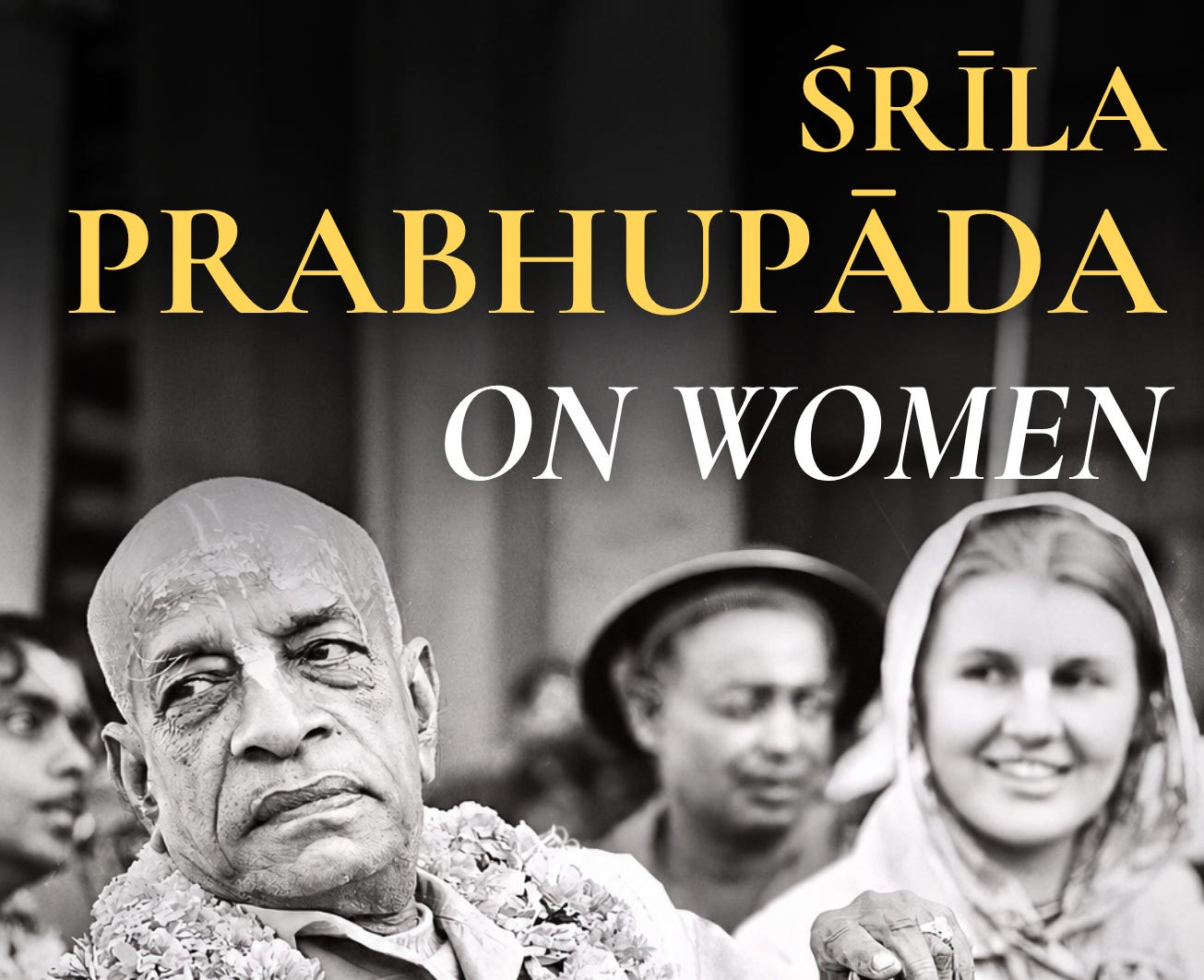
In what sense are women nine times more lusty?
Another point many may disagree with at first is the idea that women are more sexually inclined than men (not merely by some percentage, but precisely nine times). Śrīla Prabhupāda makes this point in a few passages. Take this purport from the passage on the allegory of King Purañjana, for example:
“Women in general are very much sexually inclined. Indeed, it is said that a woman’s sex desire is nine times stronger than a man’s. It is therefore a man’s duty to keep a woman under his control by satisfying her, giving her ornaments, nice food and clothes, and engaging her in religious activities.” (SB 4.27.1)
At first, this appears to be the opposite of what we see in practice. We don’t see women harassing men in the streets, as many men do, and in cases of sexual violence, almost always a man is the perpetrator and a woman is the victim. In many historical accounts, including passages from the Vedas, men are described as having many wives, while the opposite is rare. Based on all of this, it seems unfair, to say the least, to imply that women are more sexually inclined than men.
There are, however, a few nuances. Prabhupāda uses the term “sexually inclined” as he uses the word “lustier” in other passages, as an interpretation of the word kāma, a term that is much wider in usage than mere biological sexuality.
The word kāma is ordinarily translated as “lust” or “sexual desire”, but the meaning is nuanced, just as in English. Sometimes the word lust is used in the sense of sexual desire (lasciviousness), but it also has the connotation of an intense desire (eagerness, enthusiasm). It can also be used to describe intense longing (craving). One can thus have lust for wealth, lust for prestige, lust for enjoyment, lust for honor, lust for comfort, and so on. When we adopt this broader definition for the word “lust”, it becomes closer in significance to the word “kāma”.
When it is said that women are nine times more lustful than men, this does not mean they are nine times more prone to casual sexual intercourse (men are usually more into that), but simply that their impulse to enjoy matter and romantic relationships is stronger. The nine times stronger lust is manifested in the form of a general propensity for romantic relationships, including all the interactions that it entails, as well as in things like eating, dressing, decorating oneself, attracting attention, and so on.
We can observe that in his purport, Prabhupāda mentions that “Women in general are very much sexually inclined. Indeed, it is said that a woman’s sex desire is nine times stronger than a man’s. It is therefore a man’s duty to keep a woman under his control by satisfying her, giving her ornaments, nice food and clothes.” The part “giving her ornaments, nice food and clothes” makes it clear that he is not referring just to sexual intercourse but to the whole spectrum of material enjoyment connected to relationships with the opposite sex.
When this broader meaning for the word “lust” or “sexual desire” is applied, it becomes understandable why women can be considered more lustful than men. Women, in general, spend more on clothes and beauty treatments, spend more time taking care of their appearance, are more attached to domestic comfort, and so on. Women also have a more intrinsic necessity for attracting attention and care, which is also a form of lust when the broader meaning is applied. The idea of being beautiful, being desired, becoming the center of attention, and being cared for is the very foundation of what being a woman means for most. Giving up these aspirations is so hard that the scriptures don’t even recommend it in most cases, advising that instead of suppressing it, a woman should embrace this identity and just use it positively inside family life.
There is nothing wrong with a married woman trying to be beautiful for her husband, keeping him attracted, and being the center of his attention. If a woman is satisfied in this position and can be peaceful to keep her spiritual practice and take care of the family, this is a win-win for everyone. Ultimately, of course, all kinds of material attachment are bad in the sense that this is not our place, but, if properly directed, this lust can be purified and ultimately help one to become free. The only problem is when this propensity is applied outside of family life.
Another point to consider is that although, in general, women can be considered less sexually prone than men, when a woman finds a man whom she is really attracted to, the sexual impulse can be much stronger than in a man. In this case, not only can the desire be stronger, but the capacity of a woman to enjoy the sexual act can be many times greater. A man has to physically stop after having an orgasm, but a woman, in ideal circumstances, can have many in succession. We can see this described in the pastime of Kardama Muni, when he divided himself into nine forms to fully satisfy Devahūti. We can thus see that even when applied directly, the idea is not incorrect; it just manifests in more specific circumstances than in the case of men. Therefore, the passage from SB 3.23.44 where Prabhupāda mentions that “It is understood that the sexual appetite of a woman is nine times greater than that of a man” is also valid in ideal circumstances.
The bottom line is that every conditioned soul is prone to enjoy matter. In the case of man, this lust is usually concentrated in the direction of gross domination over matter, including power, prestige, control, conquest, and recognition. This all culminates in sexual desire, and, therefore, when a man acquires a very strong philosophical and introspective foundation, he may be able to avoid it and concentrate on spiritual life. Because the attraction for matter is focused on a single direction, an introspective man can learn to avoid it.
In the case of a woman, this desire for material enjoyment is more intrinsic and has many different focal points. Therefore, it is comparatively much harder to become free from it. Men are usually attracted to one aspect of human relationships, and from this focal point (becoming attracted to a woman), everything else ramifies, leading them to accept all the responsibilities of family life. A woman, on the other hand, is usually attracted to the whole spectrum of relationships and material enjoyment, and this leads her to search for a man who can help her attain all the enjoyment she hankers for. Everything else serves this purpose. The sexual act (which is often the focal point of attraction for a man) serves as a mere conclusion in the case of a woman. Therefore, the attraction is not smaller; it just becomes diluted in the middle of all the other hankering and comparatively less noticeable.
For a woman to renounce all propensity to enjoy relationships and matter in general, including looking beautiful, being comfortable, receiving attention, being loved, etc., means to renounce the very essence of her material identity. Considering it from this perspective, the idea that it is nine times harder for a woman to renounce material lust does not seem too unreasonable.
The good news is that a woman does not have to renounce this propensity. She just has to learn to use it properly within family life. A lady who uses her natural propensity for looking beautiful, attracting attention, etc. to attract a man and, after being married, uses the same propensity to take good care of him and reinforce their relationship, working together with him in the direction of spiritual advancement, is called a chaste wife, which in the scriptures is also referred to by the term “sādhvī” (the feminine of sādhu). In other words, a woman does not have to renounce her femininity to become saintly; she just has to learn to use it appropriately.
Of course, finding a good man in current times can be challenging, as we discuss in other topics, but here we are speaking about general principles and propensities that can be noted in all times and societies, although sometimes manifested in different ways according to the specific circumstances. It remains valid as a principle even in modern times, although arguably more challenging to apply in practice.
Read the whole book:
« Śrīla Prabhupāda on Women
This is a publication for thoughtful readers who want to go deeper into Kṛṣṇa consciousness. I publish daily, trying to offer high-quality spiritual content, and all posts are available to free subscribers. If you wish, you can also choose a paid subscription to support this work.
You can also receive the updates on WhatsApp or Telegram.
If you would like to contribute further, you can find the donation links here.
Hedonism is greater than General lust. It rises to prevail over peace. Man or Woman both will get engaged with the act. But I think it's really a truth. That a Woman definitely has more desires, mental state or bodily relation desires.. Many woman speaks up about the same, but most of them are unable to express their bodily desires to their boyfriend or husband nowadays. There has been a global survey conducted on the same matter. Orgasm reach for male is easier, than mostly in female body, it takes more time for a female to reach orgasm.
Thank you for your article sir.