

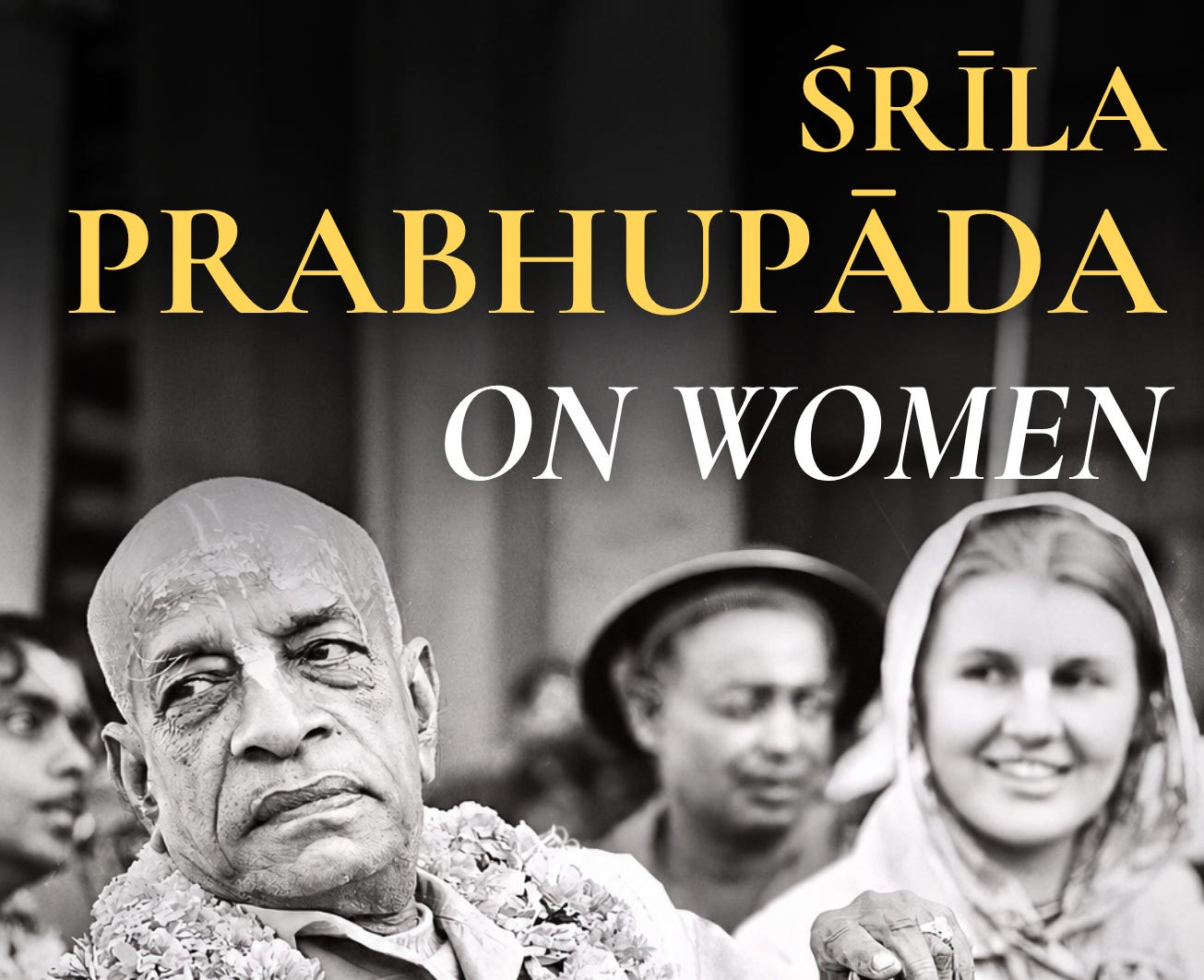
Are women untrustworthy?
A similar dynamic of criticism of both materialistic men and women is found in Prabhupāda’s purport to Bg 1.40. The context of this passage is Arjuna’s hesitation to fight in the battle of Kurukṣetra, calculating that the death of the men would leave the wives without guidance and without means of subsistence, creating chaos in society:
“O Janārdana, although these men, their hearts overtaken by greed, see no fault in killing one’s family or quarreling with friends, why should we, who can see the crime in destroying a family, engage in these acts of sin? With the destruction of the dynasty, the eternal family tradition is vanquished, and thus the rest of the family becomes involved in irreligion. When irreligion is prominent in the family, O Kṛṣṇa, the women of the family become polluted, and from the degradation of womanhood, O descendant of Vṛṣṇi, comes unwanted progeny. An increase of unwanted population certainly causes hellish life both for the family and for those who destroy the family tradition. The ancestors of such corrupt families fall down, because the performances for offering them food and water are entirely stopped.” (Bg 1.37-41)
In his purport, Prabhupāda emphasizes the Vedic concept that good children come from stable families, where husband and wife follow the path of dharma together. When a couple conceives a child, their consciousness combines into a new body, which attracts a similarly inclined soul. Pious couples would thus have pious children, who, being properly educated, would maintain family traditions and bring society forward. Arjuna, however, fears that if the men die in battle, the whole system will be disturbed, and, left unprotected, the women will break their vows, have affairs, and conceive children outside of marriage.
This brings us to the passage in the purport to which some may object:
“According to Cāṇakya Paṇḍita, women are generally not very intelligent and therefore not trustworthy. So the different family traditions of religious activities should always engage them, and thus their chastity and devotion will give birth to a good population eligible for participating in the varṇāśrama system. On the failure of such varṇāśrama-dharma, naturally the women become free to act and mix with men, and thus adultery is indulged in at the risk of unwanted population. Irresponsible men also provoke adultery in society, and thus unwanted children flood the human race at the risk of war and pestilence.”
There are two points to consider here. The first is that this passage speaks from a material perspective, describing bodily conditioning, and social disruption. In other words, this passage describes the behavior of conditioned souls. It is not directly a description of spiritual topics like later passages of the Gītā. So, by “women” and “men”, Prabhupāda refers to souls who, due to material conditioning, see themselves as men and women and act as such under the three material modes.
Prabhupāda mentions that according to Cāṇakya Paṇḍita, women are “generally not very intelligent and therefore not trustworthy” and then says that “irresponsible men also provoke adultery.” The blame is thus not placed only on women; the main point is that when the protective restrictions of the path of dharma are removed, both men and women act in ways that undermine the very foundations of a progressive society, which reinforces Arjuna’s concern.
We can observe an example of this in the women’s liberation movement, which was repeatedly criticized by Śrīla Prabhupāda. Men were responsible for it in two ways. The first is that men had abused women for many centuries, keeping them in a subordinate position without properly protecting them, making many women, understandably, repudiate the system. The second is the push for women to join the workforce during the Second World War, which continued in the following decades. The problem was that from this, other social disruptions followed, including the sexual revolution, which led to a massive weakening of the family bonds and the conception of children outside of marriage, children who would more often than not grow up without a father, mother, or both, culminating in the hippie movement. All of this illustrates the process of degradation described by Arjuna.
Is it the fault of the women, or is it the fault of the men? Both, as indicated by Prabhupāda in his purport. Materialistic men fail to properly nourish, protect, and engage the women, and the women, due to weakness or other factors, take part in the system. Unscrupulous men then use the opportunity for fully exploiting women. One may call it liberation, but we understand that real liberation is in becoming free from material contamination, and not in increasing it.
With this, we can understand the basic point raised in the passage. What about the specific point of women not being very intelligent and therefore not trustworthy?
We already discussed that real intelligence means understanding one’s position as a soul. A person who comes to the spiritual platform, man or woman, is considered intelligent. Everyone else, even if materially educated, is considered foolish. Therefore, when Prabhupāda speaks about unintelligent women, it is clear that he is speaking about materialistic women, who are under the control of their senses, as well as lust, anger, and so on, and are thus considered untrustworthy, put in the same category as the irresponsible men. As souls, we should elevate ourselves above both positions.
Other similar passages reinforce this point. On SB 6.18.41, Prabhupāda mentions:
“Cāṇakya Paṇḍita has also advised, viśvāso naiva kartavyaḥ strīṣu rāja-kuleṣu ca: “There are two persons one should not trust — a politician and a woman.” These, of course, are authoritative śāstric injunctions, and we should therefore be very careful in our dealings with women.”
This appears in the context of Diti serving Kaśyapa Muni perfectly for a long time, not out of love, but with the intention of manipulating him into using his power to give her a son who could kill Indra. When he understood the trap, Kaśyapa was appalled and lamented, mentioning that the heart of a materialistic woman is sharp like a razor, and due to that, she can even come to the point of killing her husband, brother or son, or cause them to be killed by others.
Kaśyapa had other wives who were very religious, and became the mothers of the demigods and other pious races who populated the universe. These are all examples of exalted women who showed saintly qualities. Diti, however, played the role of the materially engrossed woman under the control of her senses, performing unholy activities. The pastime itself indicates that this does not apply to all women, but it is a tendency that, when not checked, can create havoc. The other wives of Kaśyapa Muni were able to check it by following the path of dharma, but Diti surrendered to this lower nature.
This type of woman is put in the same category as a dishonest politician. Neither can be trusted. Just as a man should not become a dishonest politician, a woman should stay on the pious path and not fall into the same trap as Diti. Again, when the passage is taken out of context, it may appear as unfair criticism, but when we take the whole passage, the real meaning can be understood. Everyone carries these lower tendencies inside, but we should not identify with them.
Another passage in which the same idea is invoked is in the pastime of Kamsa wanting to kill his sister Devakī during her marriage ceremony because of a voice from the sky proclaiming that her eighth son would kill him. Kamsa was a demon, and was acting like that following his selfish, low nature. In 10.1.35 Prabhupāda mentions:
“Kaṁsa was driving the chariot and controlling the reins with his left hand, but as soon as he heard the omen that his sister’s eighth child would kill him, he gave up the reins, caught hold of his sister’s hair, and with his right hand took up a sword to kill her. Before, he had been so affectionate that he was acting as his sister’s chariot driver, but as soon as he heard that his self-interest or his life was at risk, he forgot all affection for her and immediately became a great enemy. This is the nature of demons. No one should trust a demon, despite any amount of affection. Aside from this, a king, a politician or a woman cannot be trusted, since they can do anything abominable for their personal interest. Cāṇakya Paṇḍita therefore says, viśvāso naiva kartavyaḥ strīṣu rāja-kuleṣu ca.”
Just as a man should not become a demon like Kamsa, a woman should not surrender to the same lower nature. When the senses are uncontrolled, no one can be trustworthy, because the uncontrolled senses will force him or her to act in his or her own interests. A materialistic person is thus untrustworthy by definition, for the senses will never be fully under one’s control. To have controlled senses, one has to follow the path of dharma. The whole point is to break with this tendency by controlling our senses, and eventually connecting with our spiritual nature, beyond all feminine and masculine flaws.
Yet another dimension to this consideration is that a woman who succumbs to her lower nature becomes dangerous only when she is given the opportunity of doing so. What is the situation that makes a man vulnerable to being manipulated by a woman who is acting under the control of her mind and senses? That’s sexual attraction.
We can see that in the passage, Diti is not the only problem. She acted wrongly by manipulating her husband, but the main problem was that Kasyapa Muni allowed himself to be manipulated because of her beauty. This is the male weakness that makes the whole situation possible.
Kṛṣṇa Himself used this weakness to take away the nectar from the demons without a fight in His advent as Mohinī-mūrti. Infatuated by her beauty, the demons were easily manipulated into giving away the nectar, which was then distributed to the demigods.
Female weakness thus manifests in the form of a woman falling under the control of lust and anger and using her beauty and other attractive features to exploit or manipulate, while male weakness comes in the form of a man becoming infatuated with this beauty and losing his proper judgement. Again, some passages emphasize one side or the other, but ultimately they work together. Controversial passages from Prabhupāda sound controversial only until we properly understand the whole context.
Read the whole book:
« Śrīla Prabhupāda on Women
This is a publication for thoughtful readers who want to go deeper into Kṛṣṇa consciousness. I publish daily, trying to offer high-quality spiritual content, and all posts are available to free subscribers. If you wish, you can also choose a paid subscription to support this work.
You can also receive the updates on WhatsApp or Telegram.
If you would like to contribute further, you can find the donation links here.