

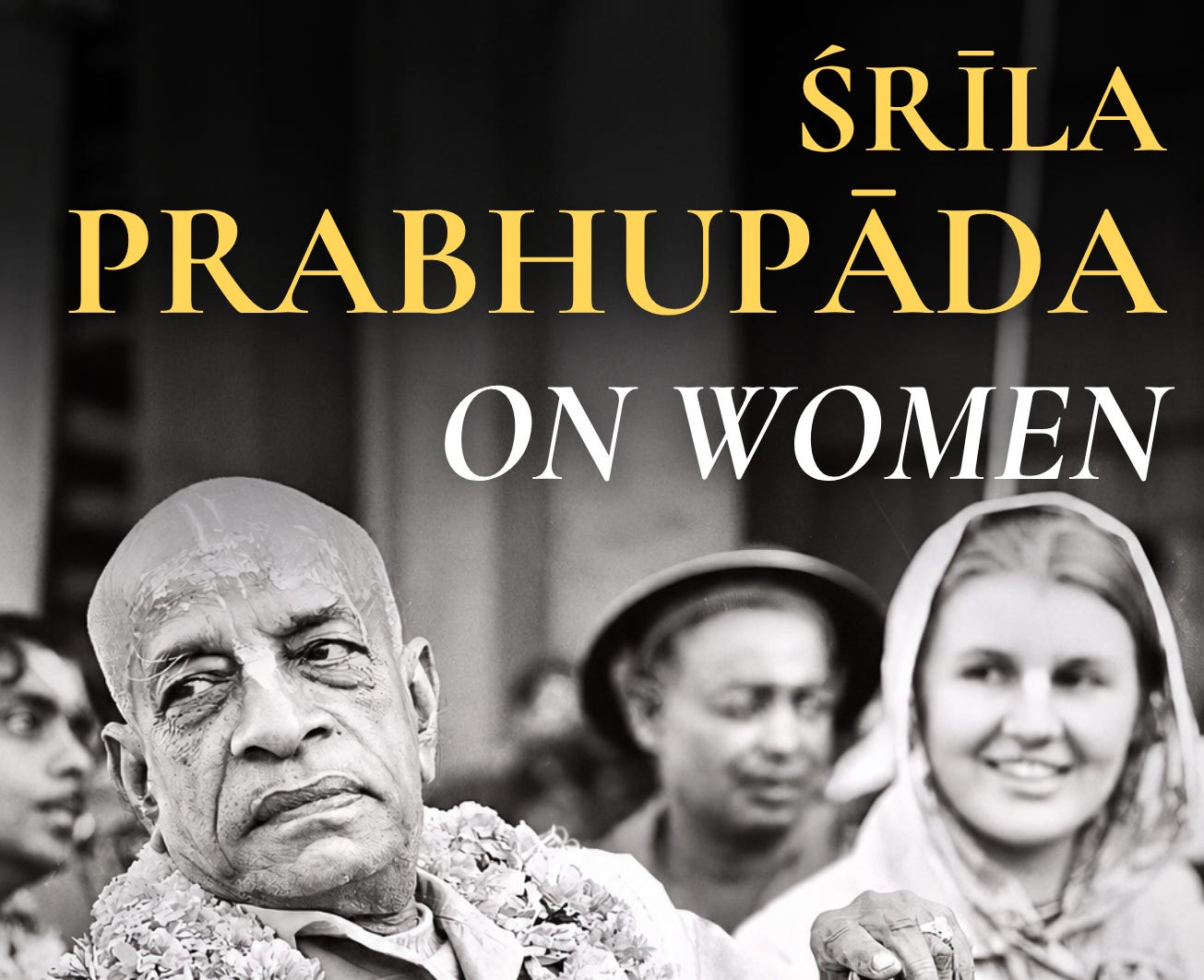
Are women, vaiśyas, and śūdras of lower birth?
In the Bhagavad-gītā, 9.32, Kṛṣṇa mentions:
māṁ hi pārtha vyapāśritya, ye ’pi syuḥ pāpa-yonayaḥ
striyo vaiśyās tathā śūdrās, te ’pi yānti parāṁ gatim
Prabhupāda translates this verse as:
“O son of Pṛthā, those who take shelter in Me, though they be of lower birth – women, vaiśyas [merchants] and śūdras [workers] – can attain the supreme destination.”
This verse is another controversial point, for it appears to imply that women are of lower birth, included among the pāpa-yonayaḥ, the sinful. At first, this verse appears to discriminate against women, but only when we fail to consider the context.
The verdict of the scriptures is kalau śūdra-sambhavaḥ: In this age of Kali, everyone is born a śūdra. We thus have a greater category, called “śūdra,” in which both men and women are included. Because in the current age the Vedic purificatory system is not followed, people are born without the qualifications traditionally required for higher Vedic culture. Kṛṣṇa also mentions vaiśyas, who have slightly higher qualities, such as entrepreneurship, honesty, and charity, but even those are added to the same broader category of sinful birth.
In this age, therefore, almost everyone is born as a sinful, low-class person, and we have to progress from there. The problem we often face is that men put themselves in the wrong category, imagining themselves as brāhmanas and kṣatriyas, and using this to accuse the women of being low. This is the opposite of what the verse implies. The point is thus not about gender; we are all in the same boat.
If everyone is a śūdra, why is it that Kṛṣṇa explicitly adds “women” to the list? Kṛṣṇa names groups that traditional societies might consider less qualified. Without this, one could argue that śūdras and vaiśyas can attain the supreme destination, but not women. The point is thus not to degrade them, but to reassure that they are not excluded from the devotional process. Even a person with no education, no status, no wealth, and no social support can become perfect by taking shelter of Kṛṣṇa. This point is emphasized in the purport. The verse is about inclusion, not discrimination:
“According to the different modes of material nature, men are classified in the mode of goodness (brāhmaṇas), the mode of passion (kṣatriyas, or administrators), the mixed modes of passion and ignorance (vaiśyas, or merchants), and the mode of ignorance (śūdras, or workers). Those lower than them are called caṇḍālas, and they are born in sinful families. Generally, the association of those born in sinful families is not accepted by the higher classes. But the process of devotional service is so strong that the pure devotee of the Supreme Lord can enable people of all the lower classes to attain the highest perfection of life. This is possible only when one takes shelter of Kṛṣṇa. As indicated here by the word vyapāśritya, one has to take shelter completely of Kṛṣṇa. Then one can become much greater than great jñānīs and yogīs.”
We can also add that just before, in text 9.29, Kṛṣṇa mentions:
“I envy no one, nor am I partial to anyone. I am equal to all. But whoever renders service unto Me in devotion is a friend, is in Me, and I am also a friend to him.”
Still earlier, in 5.18, Kṛṣṇa also mentions:
“The humble sage, by virtue of true knowledge, sees with equal vision a learned and gentle brāhmaṇa, a cow, an elephant, a dog and a dog-eater [outcaste].”
This gives the framework through which 9.32 should be interpreted. Everyone is equal on the spiritual platform. Kṛṣṇa is equal to all, and therefore He gives an equal chance to everyone to come to Him; women are explicitly included.
It is not even just about women. SB 2.4.18 further expands it to all people and communities that one could classify as low:
“Kirāta, Hūṇa, Āndhra, Pulinda, Pulkaśa, Ābhīra, Śumbha, Yavana, members of the Khasa races and even others addicted to sinful acts can be purified by taking shelter of the devotees of the Lord, due to His being the supreme power. I beg to offer my respectful obeisances unto Him.”
All these different references are thus part of a larger Vaiṣṇava doctrine, the conclusion that bhakti can purify anyone, regardless of birth, nation, social class, or previous condition, and that, once one is purified, all divisions introduced by birth, caste, social status, and so on become irrelevant. A sincere millionaire devotee will offer his obeisances to a taxi driver who happens to be more advanced in the devotional process.
The main point in text 9.32, thus, is to indicate that the process of devotional service is so powerful that even we, the unqualified people of the age of Kali, can attain the supreme destination. The door is open; we just need to walk through it.
This is further emphasized in the next verse, where Kṛṣṇa mentions:
“How much more this is so of the righteous brāhmaṇas, the devotees and the saintly kings. Therefore, having come to this temporary, miserable world, engage in loving service unto Me.”
Here, three categories are added: the righteous brāhmanas, the devotees, and the saintly kings. If even the śūdras can attain perfection by adopting the process of devotional service, what to say about these three categories, who are already advanced on the path?
This clarifies the previous verse. It is not about women being inferior, but about the people of our age being contrasted with highly qualified classes that existed in previous ages: the highly intelligent brāhmaṇas, who were capable of guiding society, and the powerful kṣatriyas, who were capable of protecting it. Arjuna was a kṣatriya, just as Yudhiṣṭhira Maharaja and Parīkṣit. We will not find leaders like these nowadays.
There is a third category, however: the devotees. We may not be able to attain the qualifications of a Vedic brāhmana or kṣatriya, but we can become devotees and thus gradually develop spiritual qualities due to contact with Kṛṣṇa. A pure devotee is considered to be higher than a brāhmaṇa or a kṣatriya because his qualification is spiritual, while even though very high, the qualification of a brāhmaṇa or kṣatriya is still material.
It is not possible for us to directly attain the high qualities of a brāhmaṇa or kṣatriya, but we can become devotees and purify ourselves by following the path of devotional service to Kṛṣṇa. The fact that these two verses appear in the 9th chapter of the Gītā is thus not a coincidence; these are precisely the chapters where Kṛṣṇa directly tries to elevate us to the platform of devotional service.
When we come to the transcendental platform, things become different. On the material platform, there are differences based on social or educational level, gender, marital status, country, color of the skin, and so on. However, when we transcend these bodily distinctions, we come to a platform where we are all the same, where we are all eternal souls, full of bliss and knowledge, and eternally related to Kṛṣṇa. That’s where Kṛṣṇa is trying to bring us, and He reassures us that that’s our place, no matter what other people may say to us, or discriminate us against.
Read the whole book:
« Śrīla Prabhupāda on Women
This is a publication for thoughtful readers who want to go deeper into Kṛṣṇa consciousness. I publish daily, trying to offer high-quality spiritual content, and all posts are available to free subscribers. If you wish, you can also choose a paid subscription to support this work.
You can also receive the updates on WhatsApp or Telegram.
If you would like to contribute further, you can find the donation links here.
Prabhuji actually this verse has editorial mistake. This was pointed by Srila Bhaktivedanta narayana goswami maharaj himself. There, after the translation of the word pāpa-yonayaḥ(of lower birth), comma was to come insted of hyphen, but because of editorial mistake in today's version hypen is there.
In the orignal version of Bhagwat Gita, i.e Bg asitis 1968, there is the following translation given:
"O son of Pritha, anyone who will take shelter in Me, whether a woman, or a merchant, or born in a low family, can yet approach the Supreme Destination."