

« The Song of God—Volume 1, chapters 1-6
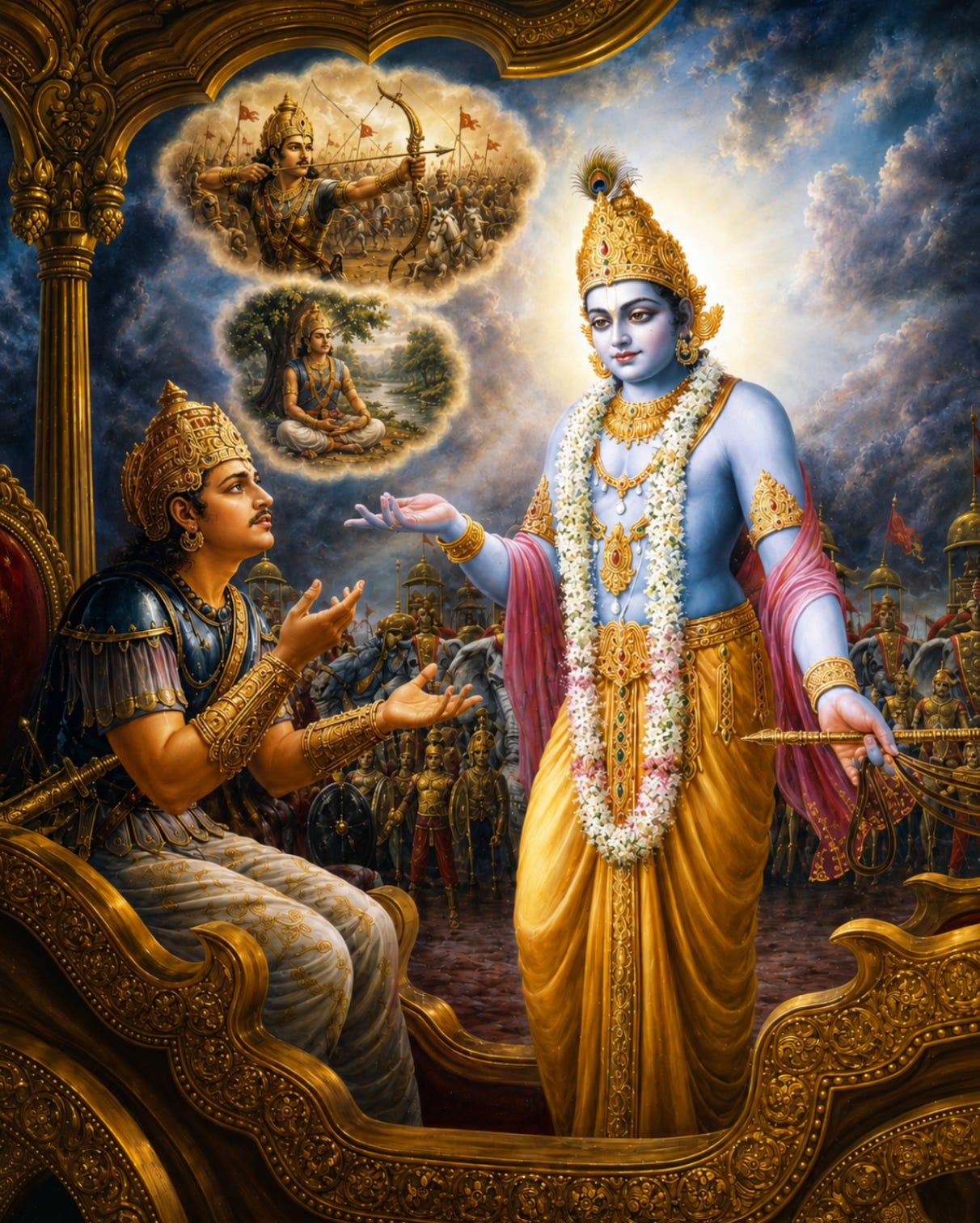
Arjuna becomes confused after Kṛṣṇa’s instructions (Bg 3.1 and 3.2)
Having heard Kṛṣṇa praise transcendental intelligence and detachment from fruitive work, Arjuna now asks how this instruction can be reconciled with Kṛṣṇa’s repeated order to fight. If intelligence is superior to action, why should Arjuna engage in such a terrible activity as war? This question opens the third chapter, where Kṛṣṇa explains that real detachment is not inactivity, but action in Kṛṣṇa consciousness.
Text 1: arjuna uvāca
jyāyasī cet karmaṇas te, matā buddhir janārdana
tat kiṁ karmaṇi ghore māṁ, niyojayasi keśava
Arjuna said: O Janārdana, O Keśava, why do You want to engage me in this ghastly warfare, if You think that intelligence is better than fruitive work?
Text 2: vyāmiśreṇeva vākyena, buddhiṁ mohayasīva me
tad ekaṁ vada niścitya, yena śreyo ’ham āpnuyām
My intelligence is bewildered by Your equivocal instructions. Therefore, please tell me decisively which will be most beneficial for me.
In the first chapter, Arjuna revealed that one of the reasons for his hesitancy in fighting was his fear of sinful reactions for killing. In the second chapter, Kṛṣṇa encouraged Arjuna to fight, and recommended that he perform buddhi-yoga to become free from all sinful reactions. Kṛṣṇa uses the term buddhi-yoga in the sense of linking our intelligence with Him, keeping ourselves on the transcendental platform even while acting in this world. In other words, Kṛṣṇa recommends Arjuna to fight, but to do so in full Kṛṣṇa consciousness, which is the main conclusion of the Bhagavad-gītā.
As Śrīla Prabhupāda comments:
“The Supreme Personality of Godhead Śrī Kṛṣṇa has very elaborately described the constitution of the soul in the previous chapter, with a view to delivering His intimate friend Arjuna from the ocean of material grief. And the path of realization has been recommended: buddhi-yoga, or Kṛṣṇa consciousness.”
The difficulty is that the word “buddhi” means “intelligence,” and the term “buddhi-yoga” can thus be understood as the process of using our intelligence. If we take it in this way, the meaning of the verses of the whole second half of the second chapter changes, and the instructions become unclear.
Let’s take 2.49, for example:
dūreṇa hy avaraṁ karma, buddhi-yogād dhanañ-jaya
buddhau śaraṇam anviccha, kṛpaṇāḥ phala-hetavaḥ
Prabhupāda follows the conclusions of the text, and translates buddhi-yoga as devotional service. Thus, the translation for the verse is given as:
“O Dhanañjaya, keep all abominable activities far distant by devotional service, and in that consciousness surrender unto the Lord. Those who want to enjoy the fruits of their work are misers.”
If, however, we take buddhi-yoga as simply the process of using our intelligence, the meaning of the verse changes completely. It becomes:
“O Dhanañjaya, using your intelligence, keep all abominable activities far distant. Take refuge in this intelligence. Those who want to enjoy the fruits of their work are misers.”
The term buddhi-yoga is central to the meaning of the verse, and thus, by misunderstanding this term, the entire meaning of the verse changes. Now, instead of fighting in devotional consciousness, the conclusion appears to be that he should use his deliberation to avoid the fight. This misunderstanding then cascades into the following verses, creating even more misunderstandings.
In 2.51, for example, when Kṛṣṇa mentions karma-jaṁ buddhi-yuktā hi, phalaṁ tyaktvā manīṣiṇaḥ, the correct meaning is “By thus engaging in devotional service to the Lord, great sages or devotees free themselves from the results of work in the material world.” However, understanding buddhi as simply “intelligence,” the meaning becomes “By thus using their intelligence, great sages free themselves from the results of work in the material world.”
Kṛṣṇa uses the term buddhi-yoga eight times more until the end of the second chapter; therefore, if the term is misinterpreted every time, the misunderstandings multiply. One can thus end with the idea that instead of working for Kṛṣṇa, one should use his intelligence to avoid fruitive work, and thus become free from the sinful reactions. That’s how Arjuna understood it. However, remembering that in the first half of the second chapter, Kṛṣṇa insisted that he should fight, Arjuna becomes confused, not understanding how to reconcile these two apparently contradictory instructions. He starts the third chapter thus, asking why he should engage in karma (fighting in the battle) if buddhi (using his intelligence to avoid abominable activities) is described as superior.
Because we have the translations and purports from Śrīla Prabhupāda, we come to the end of the second chapter understanding that we should fight in Kṛṣṇa consciousness instead of abandoning our duty, but for one who hears just the Sanskrit, this conclusion is not so clear.
Another reason for Arjuna’s confusion is that this was Kṛṣṇa’s plan, because He wants to explain the topic of action in Kṛṣṇa consciousness in more detail in chapters three, four, and five, and thus He allows Arjuna to remain bewildered so He can explain these points in more detail for our benefit. Arjuna is thus guided to ask the right questions, so the Lord can deepen His explanations.
In his purport to Bg 3.1, Prabhupāda brings the doubt of Arjuna to our practical reality, revealing that this is a common misconception. We often think that Kṛṣṇa consciousness means inertia, to just be peaceful and chant the whole day. However, until one rises to an elevated spiritual platform, this process is not really possible. A neophyte, or even an intermediate devotee, can’t properly concentrate for long periods of time. Sooner or later, the mind will force us to perform material actions. Instead of becoming impostors, the recommended process combines chanting with practical action in Kṛṣṇa consciousness. Kṛṣṇa explained this process in the second chapter, and will explain it again in more detail now in the third chapter, deepening it further in the fourth and fifth chapters.
Main points in the purports of Śrīla Prabhupāda:
“Arjuna said: O Janārdana, O Keśava, why do You want to engage me in this ghastly warfare, if You think that intelligence is better than fruitive work?”
a) Arjuna starts the second chapter immersed in material grief. To rescue him, Kṛṣṇa describes the transcendental position of the soul, and then recommends the path of buddhi-yoga (devotional service) as the path out of material entanglement.
b) Kṛṣṇa consciousness means primarily to dovetail our activities with Kṛṣṇa. That’s the message of the Gītā: stand and fight, but do so in proper consciousness and understanding. When the process is misunderstood, however, we transform it into a process of escapism, abandoning material duties prematurely to just chant in seclusion. Kṛṣṇa consciousness is then used as an excuse for irresponsibility.
c) The questions of Arjuna also illustrate how we should question the spiritual master about our doubts and misunderstandings, so he can clarify these different points to us.
“My intelligence is bewildered by Your equivocal instructions. Therefore, please tell me decisively which will be most beneficial for me.”
a) The second chapter is considered a summary of the contents of the Gītā because it describes the main topics and brings us to the conclusion of the book, acting for Kṛṣṇa in devotional service. All these different topics are, however, presented unsystematically.
b) Arjuna’s questions give Kṛṣṇa the opportunity of detailing and deepening His explanations, opening the path for all of us to go deeper in the teachings of the Bhagavad-gītā.
Next: Karma-yoga in its perfect form (3.3 to 3.9)
Read the entire book:
« The Song of God—Volume 1, chapters 1-6

This is a publication for thoughtful readers who want to go deeper into Kṛṣṇa consciousness. I publish daily, trying to offer high-quality spiritual content, and all posts are available to free subscribers. If you wish, you can also choose a paid subscription to support this work.
You can also receive the updates on WhatsApp or Telegram.
If you would like to contribute further, you can find the donation links here.