

« The Song of God—Volume 1, chapters 1-6
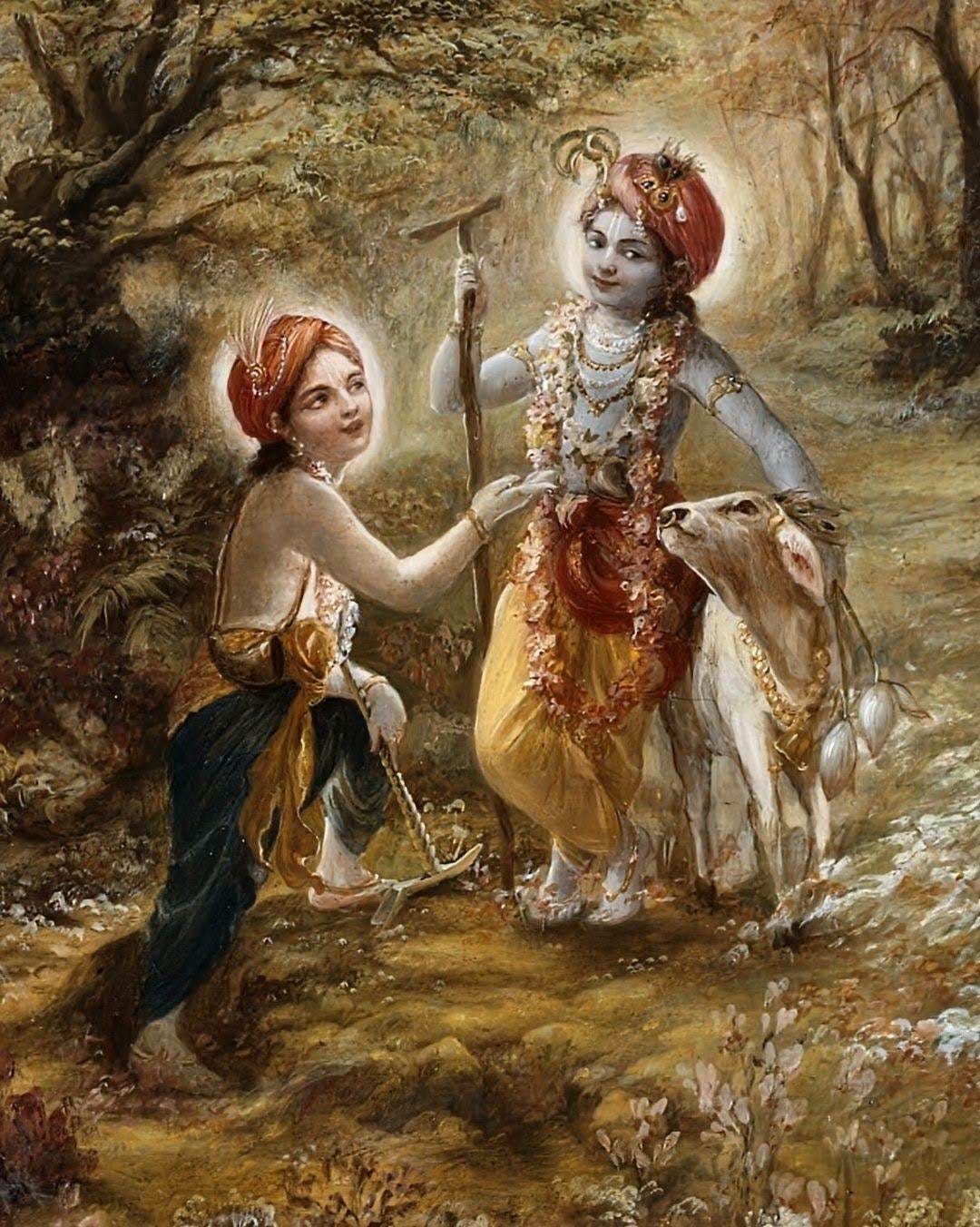
As all surrender unto Me, I reward them accordingly (Bg 4.11 to 4.15)
In the previous section, Kṛṣṇa described how we can attain perfection by understanding the transcendental nature of His appearance and activities. Now, He broadens the discussion by showing how He reciprocates with different classes of people. Everything that exists is part of Kṛṣṇa’s energy, and therefore, in a sense, everything is Kṛṣṇa. Consequently, no one can be independent from Him. Depending on how different people relate to Him or His potencies, Kṛṣṇa reciprocates accordingly; they thus follow different paths according to their nature and attain different results, but they are all under His control. Kṛṣṇa, however, remains transcendental and unaffected by material work.
Text 11: ye yathā māṁ prapadyante, tāṁs tathaiva bhajāmy aham
mama vartmānuvartante, manuṣyāḥ pārtha sarvaśaḥ
As all surrender unto Me, I reward them accordingly. Everyone follows My path in all respects, O son of Pṛthā.
Text 12: kāṅkṣantaḥ karmaṇāṁ siddhiṁ, yajanta iha devatāḥ
kṣipraṁ hi mānuṣe loke, siddhir bhavati karma-jā
Men in this world desire success in fruitive activities, and therefore they worship the demigods. Quickly, of course, men get results from fruitive work in this world.
Text 13: cātur-varṇyaṁ mayā sṛṣṭaṁ, guṇa-karma-vibhāgaśaḥ
tasya kartāram api māṁ, viddhy akartāram avyayam
According to the three modes of material nature and the work associated with them, the four divisions of human society are created by Me. And although I am the creator of this system, you should know that I am yet the nondoer, being unchangeable.
Text 14: na māṁ karmāṇi limpanti, na me karma-phale spṛhā
iti māṁ yo ’bhijānāti, karmabhir na sa badhyate
There is no work that affects Me; nor do I aspire for the fruits of action. One who understands this truth about Me also does not become entangled in the fruitive reactions of work.
Text 15: evaṁ jñātvā kṛtaṁ karma, pūrvair api mumukṣubhiḥ
kuru karmaiva tasmāt tvaṁ, pūrvaiḥ pūrva-taraṁ kṛtam
All the liberated souls in ancient times acted with this understanding of My transcendental nature. Therefore you should perform your duty, following in their footsteps.
In the previous section, Kṛṣṇa spoke about the transcendental nature of His transcendental form, appearance, and pastimes. This perfect knowledge leads to the realization of the soul’s eternal relationship with Kṛṣṇa, which in turn leads to complete surrender. This surrender, in turn, gradually leads one to the platform of pure love, a path that was explained by Śrīla Prabhupāda in his purport to text 4.10. When Kṛṣṇa says that “One who knows the transcendental nature of My appearance and activities does not, upon leaving the body, take his birth again in this material world, but attains My eternal abode, O Arjuna,” He is hinting at this entire process, which starts with transcendental knowledge and ends with pure love of Godhead. We may still be in the first step, but as long as we continue practicing the process, our success is guaranteed; it is merely a question of time. Anywhere we go in this material world, we have to eventually come back, but as soon as we reach Kṛṣṇa’s transcendental abode, we can remain there with Him eternally.
Now, Kṛṣṇa describes the path of those who take shelter of Him to some degree, but who have other goals. What is their destination?
Kṛṣṇa doesn’t reject them. On the contrary, He rewards them according to the degree of their surrender. He mentions that everyone follows His path, because everyone has to live according to the rules created by Him. Even atheists who completely reject the existence of God have to live under the restraints of the law of karma. Because there is nothing apart from Kṛṣṇa, there is no possibility of anyone living independently from Him. Just as in ordinary law, however, those who are lawful citizens receive different results than those who are criminals.
Ultimately, everything that exists is Kṛṣṇa; therefore, everyone is attracted to Kṛṣṇa. When we are in our healthy state, we are attracted to Kṛṣṇa in His personal form, and in conditioned life we envy Kṛṣṇa and become attracted to His energy in the form of different material manifestations. Everything that is material, however, comes together with suffering. One may be happy for some time after finding a wife or husband, but later has to face suffering in the form of marital disagreements, divorce, or death of the spouse. One may desire to act sinfully, and thus enjoy promiscuous sex and intoxication, but this illusory pleasure also leads to suffering in the form of many sinful reactions. Only when we turn our face back to Kṛṣṇa, who smiles so enchantingly, can we find true happiness.
One may question why Kṛṣṇa allows this at all. Why doesn’t He prevent us from doing all these things that will bring us suffering later? Knowing everything, how can He allow the living entities to obtain things that will ultimately bring them suffering? The point is free will. Love can’t be forced or imposed. Love must be the result of a conscious choice. To allow the souls to develop love for Him, Kṛṣṇa must allow them to make their choices, until they themselves come to the point of desiring to develop love for Him. When we finally come to this point, He helps us to go back home, back to Godhead, just as He helps us at every stage.
Kṛṣṇa mentions that “Men in this world desire success in fruitive activities, and therefore they worship the demigods.” This is also a path created by Kṛṣṇa, designed to attract ordinary people to the path of piety. The demigods are also connected with Kṛṣṇa, being considered parts of His universal body. As Kṛṣṇa will explain later, those who worship demigods indirectly worship Him, but they do so without proper knowledge, just like one pouring water on the leaves of a tree instead of the root. They desire material results, and the result is that they obtain the blessings they desire rather quickly, but these are just temporary material benefits.
Devotees who worship Kṛṣṇa for material benefits also obtain what they desire. The difference is that when Kṛṣṇa gives, He gives material blessings together with the necessary purification, so when a devotee receives it, he loses the attraction and becomes instead more firmly situated in devotional service. Dhruva Mahārāja, for example, worshipped Lord Viṣṇu asking for a kingdom greater than his father’s, but when he finally obtained the grace he desired, he was already so purified that he just desired to serve the Lord.
Here we can see Kṛṣṇa’s reciprocation at play: worshippers of demigods have very meager knowledge, and thus they receive shallow material blessings according to that. Even if not completely pure, devotees understand Kṛṣṇa as the Supreme and approach Him, and thus they eventually attain Him. Similarly, jñānis desire knowledge or promotion to the impersonal brahmajyoti, the dazzling effulgence of Kṛṣṇa’s form, and they also attain that. However, because this is not the eternal position of the soul, they also eventually have to come back.
What impels people in the direction of these different indirect paths? Why can’t all of them directly surrender to Kṛṣṇa? That’s answered in text 4.13: people are influenced by different combinations of the three material modes, and thus follow different paths according to them. Kṛṣṇa thus created different paths for these different classes of people, so they can satisfy their material desires, and gradually come to worship Him. Everything starts with the path of varṇāśrama, where people worship Kṛṣṇa indirectly by performing their prescribed duties, and thus gradually become purified. Those who exhaust this path may eventually become jñānis and aim for liberation, and those who are more advanced may eventually reach the path of bhakti.
One could, however, argue that since Kṛṣṇa created this system, and He acts inside of it, performing duties as a family man and kṣatriya, and telling Arjuna and others to also perform their duties, He must be involved in the system, and thus also be affected by the material modes. Kṛṣṇa counters this by explaining that although He is the creator of this system, He doesn’t act materially, remaining on the transcendental platform. He is the nondoer, being unchangeable.
Ordinary people have to work according to their prescribed duties because these are the types of work that match their nature, and allow them to satisfy their material desires, while at the same time advancing. Kṛṣṇa, however, has no desires to satisfy, nor does He need to achieve anything. He is already fully complete, and He is fully independent. As He says, “There is no work that affects Me; nor do I aspire for the fruits of action.”
By understanding the truth of the transcendental position of Kṛṣṇa, a devotee also ascends to the transcendental platform, and by acting on this platform, in full Kṛṣṇa consciousness, a devotee can remain free from all karmic results. This is confirmed in the next verse: “All the liberated souls in ancient times acted with this understanding of My transcendental nature. Therefore you should perform your duty, following in their footsteps.”
Kṛṣṇa again repeats that Arjuna should fight, but He does so after revealing a new layer of transcendental knowledge: His transcendental position and the concept of pure devotional service to Him. In the beginning, Kṛṣṇa argued that Arjuna should fight based on his duty as a kṣatriya and other factors. Now, He tells Arjuna to fight in this attitude of transcendental service to Him.
Main points in the purports of Śrīla Prabhupāda:
“As all surrender unto Me, I reward them accordingly. Everyone follows My path in all respects, O son of Pṛthā.”
a) Everyone is directly or indirectly searching for Kṛṣṇa. Transcendentalists look for Him as the impersonal Brahman or Paramātmā, while materialists look for Him in the material energy. All of these are aspects of Kṛṣṇa. Devotees, however, fully realize Kṛṣṇa in His personal aspect.
b) Pious fruitive workers perform their duties following the Vedic injunctions and are rewarded with the material results they desire, while yogīs who desire mystical powers eventually obtain them. In any case, everyone is dependent on Kṛṣṇa’s mercy.
c) Just as Kṛṣṇa reciprocates with everyone in the material world according to the way they approach Him, He reciprocates with His devotees in the spiritual world in five transcendental relationships, according to the intensity of their love for Him. Regardless of their particular rasa, devotees render transcendental service to Kṛṣṇa and derive transcendental bliss from their relationship.
d) Impersonalists, however, refuse this position of service, and desire to merge instead into Kṛṣṇa’s powerful effulgence. This is considered a form of spiritual suicide, because there the soul extinguishes his individuality. This position is not even fully stable, for latent desires can bring the soul back to the material world.
e) All different spiritual processes are like different steps in the same path. They are not the same, however. They all have imperfections and limitations. The complete perfection of the soul is reached only when we reach the highest level of Kṛṣṇa consciousness.
“Men in this world desire success in fruitive activities, and therefore they worship the demigods. Quickly, of course, men get results from fruitive work in this world.”
a) Many take the different demigods as different forms of God, but in reality, they are just His parts and parcels, souls who are empowered by Kṛṣṇa to perform their functions. Nityo nityānām: God is one; He is the master of many individual souls, including demigods. In fact, even great demigods like Brahmā and Śiva worship Kṛṣṇa, proving this point.
b) Some consider that God and demigods are on the same level. This thinking ultimately leads to the conclusion that everyone is God. Such people are considered atheists. If everyone is God, then there is no God.
c) Foolish people worship demigods, or even human leaders, because they desire immediate results. They think that just because someone became powerful by material standards, this means he has become God. This is a form of anthropomorphism. Any material advantage they may receive through such worship is, however, temporary and ultimately insignificant, just like bubbles in the ocean. Only Kṛṣṇa consciousness is a permanent solution for all miseries.
“According to the three modes of material nature and the work associated with them, the four divisions of human society are created by Me. And although I am the creator of this system, you should know that I am yet the nondoer, being unchangeable.”
a) Kṛṣṇa is the creator of everything, including the varṇāśrama system. All the four classes, brāhmaṇas, kṣatriyas, vaiśyas, and śūdras, have different duties and activities according to the influence of the three material modes. Kṛṣṇa, however, is not part of these divisions. He is not one of the conditioned souls. Even when He comes to this world, He remains transcendental.
b) As long as people are materialistic, human society is not different in essence from animal society. Kṛṣṇa creates the varṇāśrama system to gradually elevate society to the standard of Kṛṣṇa consciousness.
c) Brāḥmanas are considered the highest among the four classes, because they are situated in goodness, but a person situated in Kṛṣṇa consciousness is superior. The reason is that although brāḥmanas are supposed to know about Brahman, they mostly approach the impersonal aspect, while a person in Kṛṣṇa consciousness reaches Kṛṣṇa in His personal aspect. Such a devotee transcends the mode of goodness and reaches the transcendental platform.
“There is no work that affects Me; nor do I aspire for the fruits of action. One who understands this truth about Me also does not become entangled in the fruitive reactions of work.”
a) Even in this world, a king, or dictator, is often considered above state laws. It is thus not difficult to accept Kṛṣṇa’s transcendental position. He remains aloof even while creating and maintaining the universe, while the living entities become attached to this world and thus entangled in the results of activities for sense gratification that are not ordained by the Lord.
b) Ordinary people aspire to be promoted to heavenly planets for a superior standard of material sense gratification, but Kṛṣṇa has no interest in that. His position is much higher. Even the demigods who rule these planets are just His humble servants.
c) Even though the Lord is the creator and maintainer, He is not responsible for the activities of the living beings, who reap the fruits of their choices. Kṛṣṇa just gives them facilities. An example is that rain is not responsible for the different types of vegetation that appear on earth, even though without rain there is no vegetation.
d) A person who understands Kṛṣṇa’s transcendental nature becomes transcendental, just as He is. Such a devotee becomes a liberated soul, free from the laws of karma. One who fails to do so, thinking that Kṛṣṇa has a material body and performs material activities, however, remains under the material pangs.
“All the liberated souls in ancient times acted with this understanding of My transcendental nature. Therefore you should perform your duty, following in their footsteps.”
a) Those who are under the influence of lust and have many material desires can benefit from the process of Kṛṣṇa consciousness to gradually cleanse these contaminations, while those who are already free can continue to act exemplarily for the benefit of others following their example.
b) To retire from all activities without knowledge of Kṛṣṇa consciousness is not recommended or approved by the Lord. The problem is not action in itself, but knowing how to act. To make a show of Kṛṣṇa consciousness in a solitary place is not as valuable as directly working for Kṛṣṇa, who remembers the activities of all previous great devotees, and recommends that Arjuna follow their example.
Read the entire book:
« The Song of God—Volume 1, chapters 1-6

This is a publication for thoughtful readers who want to go deeper into Kṛṣṇa consciousness. I publish daily, trying to offer high-quality spiritual content, and all posts are available to free subscribers. If you wish, you can also choose a paid subscription to support this work.
You can also receive the updates on WhatsApp or Telegram.
If you would like to contribute further, you can find the donation links here.