

« Making Sense of the Vedic Universe, a Higher-Dimensional Reality
Bhārata-varṣa: the door out of material existence
Bhārata-varṣa is different from the other varṣas of Jambūdvīpa, which are celestial places where pious souls reap the results of their piety. It is the place where those who have exhausted their past karma, coming either from the other varṣas or animal species, take birth to perform a new set of work that will decide where they will go next.
Because Bhārata-varṣa is a crossroads in which all kinds of souls take birth, it’s possible to encounter people influenced by all the three modes of nature: some taking birth as exalted persons, ordinary men or women, or degraded personalities. These births are not by chance, but according to their past work. Lord Kapila mentions in the 3rd canto that when a human being acts sinfully and goes to hell, one takes his next human birth (after passing through the animal species) in a similar situation to that of his previous human birth, and thus has a new opportunity. Similarly, souls coming back from the celestial planets take birth according to their natures.
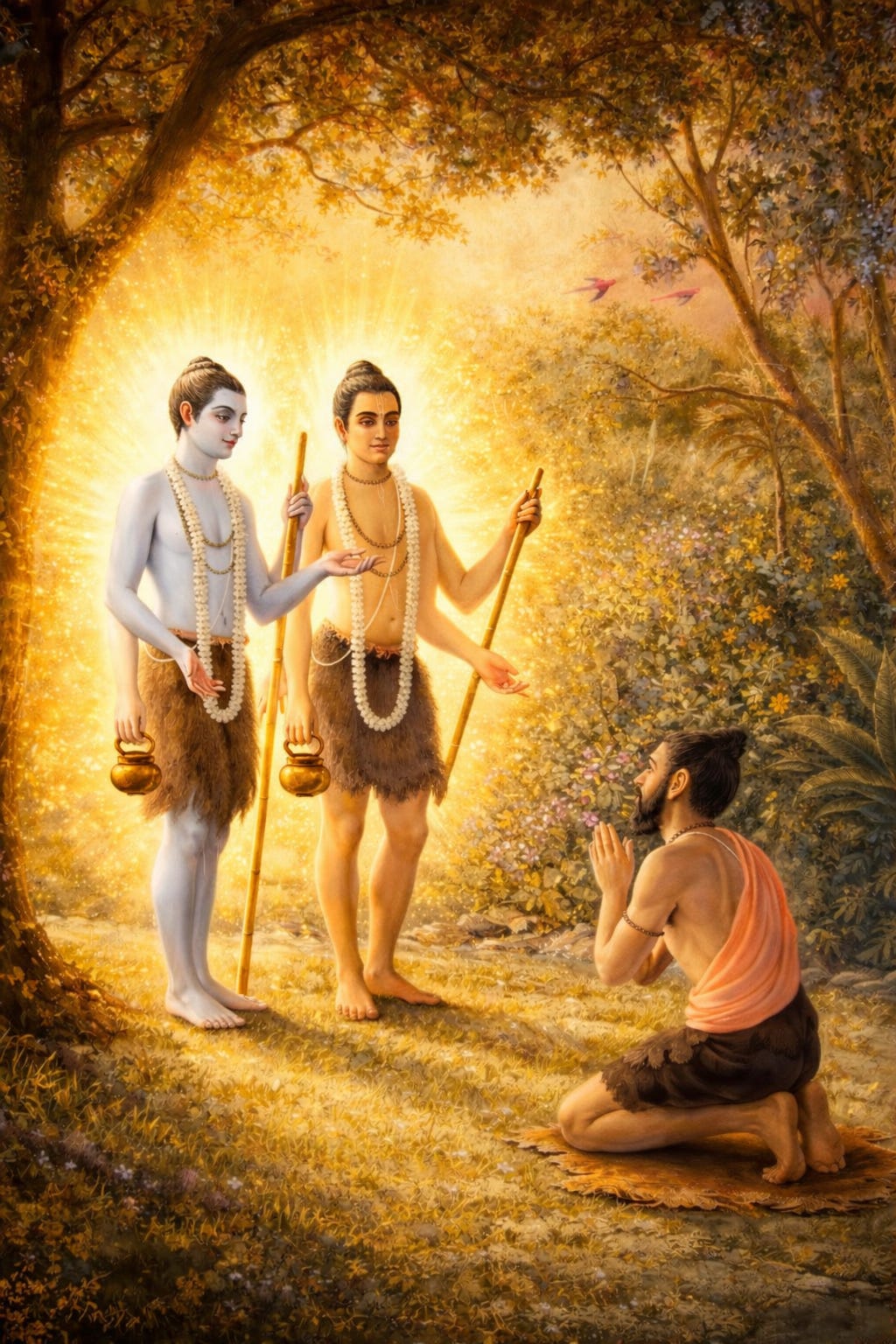
The predominating deities in Bhārata-varṣa are Nara-Nārāyaṇa, Kṛṣṇa and Arjuna, appearing as the twin sages who perform austerities in Badarīkāśrama to give example to all human beings of how to attain the perfection of life.
Once, Indra became envious, thinking that Nara-Nārāyaṇa would exceed his austerities and take his position, and sent a group of Apsarās and Gandharvas, led by Cupid himself (the demigod, not the incarnation of the Lord), to tempt the great sages. The Lord, however, showed a number of celestial girls emanating from His own potency, each of them much more beautiful than any of the Apsarās sent by Indra, and, instead of being angry, asked the demigods to choose one to become the ornament of the heavenly planets. This led to Ūrvaśī being selected and becoming the leader of the Apsarās in the heavenly abode.
Later, in the 12th canto (chapter eight), it is described how Mārkaṇḍeya Ṛṣi met Nara-Nārāyaṇa Ṛṣi and, after offering prayers, asked for the benediction of seeing the Lord’s illusory energy. This led to the pastime of him struggling for a whole night of Brahmā in the waters of devastation.
Nara-Nārāyaṇa Ṛṣi live accompanied by many other great sages, including Vyāsadeva himself, in the high-dimensional Himalayas, in an āśrama that is accessible only to highly qualified persons. The verse mentions the word ākalpāntam, which indicates that they will continue to be present there until the end of the current kalpa, or in other words, until the end of the day of Brahmā. From there, they instructed many great sages over the ages, including Nārada Muni, who worships them by the prayers described in the Śrīmad-Bhāgavatam.
In his purport, Śrīla Prabhupāda connects this to the ancient Śrī Badarinātha (Badrinath) temple in the Himalayas, where the deities of Nara-Nārāyaṇa Ṛṣi are worshiped. In this way, he shows how the contents of the verse remain true even in our current reality.
He then connects the teachings of Nara-Nārāyaṇa Ṛṣi with Śrī Caitanya Mahāprabhu, mentioning that people of our age have no capacity to perform austerities as taught by the sages; therefore, the Lord appeared as Mahāprabhu to offer us an easy method of self-realization, by simply chanting the holy names. He thus equates the two processes, revealing that Śrī Caitanya Mahāprabhu is none other than Nārāyaṇa Ṛṣi (Kṛṣṇa) Himself.
It is described that when Kṛṣṇa appears as an incarnation, all the other forms of Viṣnu and different incarnations merge into His body, just like many rays of light. The body of Kṛṣṇa thus includes all the other forms. In Kali-yuga, Kṛṣṇa appears personally as Śrī Caitanya Mahāprabhu. In other words, Mahāprabhu includes all the other forms, and the process of saṅkīrtana includes all other teachings. All the prayers of the inhabitants of Jambūdvīpa, thus, ultimately bring us to Him.
In the 11th canto (11.29.41-44), it is also described that Kṛṣṇa sent Uddhava to Badarīkāśrama to give instructions to the many great sages living there. These sages had no opportunity to personally associate with Him, and thus Kṛṣṇa sent His representative to meet with them.
Nārada Muni instructs the inhabitants of Bhārata-varṣa to worship the Lord by performing their prescribed duties according to the varnāśrama system. We often think of varnāśrama as a stereotyped caste system, but that’s not what it is about. As mentioned in the verses, everyone who takes birth in Bhārata-varṣa assumes a certain nature according to one’s previous activities. To achieve perfection, one has to learn to engage this particular nature in the service of Kṛṣṇa, and varnāśrama is the institution that trains us to do so. When we are properly trained to develop our natural propensities and taught how to engage these talents in the service of Kṛṣṇa, we can become easily fixed in our service and thus advance. If, however, we put a person with a nature fit for manual labor to study books all day long, and someone with a brāhminical nature to break bricks, both will face great difficulties, and will tend to abandon the devotional process.
Without varnāśrama, no one is properly trained, and as a result, unqualified people assume posts of leadership, creating chaos. As Prabhupāda states:
“In the name of secular government, unqualified people are taking the supreme governmental posts. No one is being trained to act according to the principles of varṇāśrama-dharma, and thus people are becoming increasingly degraded and are heading in the direction of animal life.”
He then concludes, restating the mission of our movement:
“The Kṛṣṇa consciousness movement, however, is being propagated all over the world to reestablish the varṇāśrama-dharma system and thus save human society from gliding down to hellish life.”
Reestablishing varṇāśrama-dharma means training people, starting with a class of qualified brāhmanas, who can form the head of society, and then competent kṣatriyas, honest vaiśyas and hard-working śūdras.
We may think that śūdras are low, but see what is mentioned in SB 7.11.8-12:
These are the general principles to be followed by all human beings: truthfulness, mercy, austerity (observing fasts on certain days of the month), bathing twice a day, tolerance, discrimination between right and wrong, control of the mind, control of the senses, nonviolence, celibacy, charity, reading of scripture, simplicity, satisfaction, rendering service to saintly persons, gradually taking leave of unnecessary engagements, observing the futility of the unnecessary activities of human society, remaining silent and grave and avoiding unnecessary talk, considering whether one is the body or the soul, distributing food equally to all living entities (both men and animals), seeing every soul (especially in the human form) as a part of the Supreme Lord, hearing about the activities and instructions given by the Supreme Personality of Godhead (who is the shelter of the saintly persons), chanting about these activities and instructions, always remembering these activities and instructions, trying to render service, performing worship, offering obeisances, becoming a servant, becoming a friend, and surrendering one’s whole self. O King Yudhiṣṭhira, these thirty qualifications must be acquired in the human form of life. Simply by acquiring these qualifications, one can satisfy the Supreme Personality of Godhead.”
These are general qualities that apply to all followers of the varnāśrama system, including the śūdras. On top of these common qualities, there are sets of special qualities exhibited by each of the four classes, described in texts 7.11.13 to 29. Śūdras, for example, exhibit (on top of the above-mentioned general qualifications) qualities such as offering respect to superior persons, always being clean and free from duplicity, always speaking the truth, and offering protection to the cows and brāhmanas.
We will nowadays find it very difficult to find a person who has even all the basic common qualities, even among the most cultured sectors of current society. This means that even the most educated individuals in our age are below even the level of śūdras in the varnāśrama system. We can imagine, thus, the positive changes in society if people would be properly trained to attain one of the three higher classes.
In fact, we will be pressed to find this level of qualification even inside our own movement, but Śrīla Prabhupāda gave us the seeds to evolve in this direction through the practice of Kṛṣṇa consciousness. It is practically impossible to develop this level of qualification through mere academic study, but if one becomes a perfect Vaiṣnava, all these qualities automatically manifest. Once we develop these qualities, we can train others in the same process.
Read the whole book:
« Making Sense of the Vedic Universe, a Higher-Dimensional Reality
This is a publication for thoughtful readers who want to go deeper into Kṛṣṇa consciousness. I publish daily, trying to offer high-quality spiritual content, and all posts are available to free subscribers. If you wish, you can also choose a paid subscription to support this work.
You can also receive the updates on WhatsApp or Telegram.
If you would like to contribute further, you can find the donation links here.
Really appreciated the passage about being well situated in our Varna.