

« Making Sense of the Vedic Universe, a Higher-Dimensional Reality
Chapter 7: Bila-svarga, the subterranean heavens
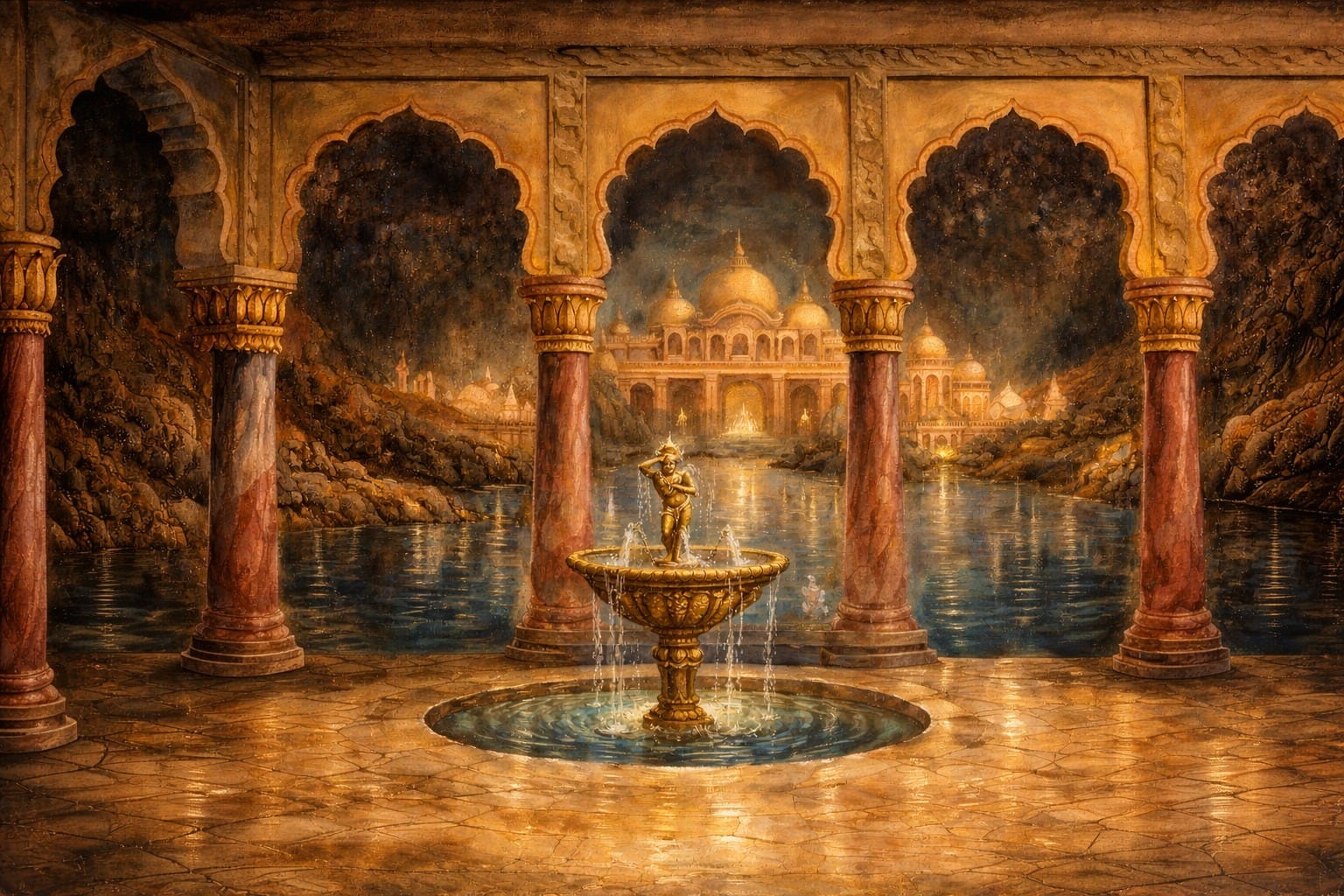
“My dear King, beneath this earth are seven other planets, known as Atala, Vitala, Sutala, Talātala, Mahātala, Rasātala and Pātāla. I have already explained the situation of the planetary systems of earth. The width and length of the seven lower planetary systems are calculated to be exactly the same as those of earth.
In these seven planetary systems, which are also known as the subterranean heavens [bila-svarga], there are very beautiful houses, gardens and places of sense enjoyment, which are even more opulent than those in the higher planets because the demons have a very high standard of sensual pleasure, wealth and influence. Most of the residents of these planets, who are known as Daityas, Dānavas and Nāgas, live as householders. Their wives, children, friends and society are all fully engaged in illusory material happiness. The sense enjoyment of the demigods is sometimes disturbed, but the residents of these planets enjoy life without disturbances. Thus they are understood to be very attached to illusory happiness.” (SB 5.24.7-8)
Below the surface of Bhū-mandala lie seven other planetary systems, described as the abodes of the asuras. Just as Svargaloka is a disk of the same diameter as Bhū-mandala itself, each of these abodes is again of approximately the same diameter, positioned one below the other. This explanation suggests that they are also planetary systems composed of thousands of planets each. In our dimension, however, they appear as planets scattered over the cosmos.
In other words, “subterranean” means that these planets are situated below the high-dimensional plane of Bhū-mandala (just as Svargaloka is situated above it), and not that they are literally caves inside the earth.
Unlike human beings and demigods, inhabitants of the lower planetary systems have no access to the light of the sun. Their abodes are thus very opulent and materially beautiful, but artificially illuminated.
Because they can’t see the sun, they don’t notice the passage of the days and nights. They live in a continuous night, both literally and figuratively, not only living under artificial lights but also completely blind to self-realization. The kāla-cakra continues to rotate, diminishing their life expectancy, but they fail to notice it, being continuously involved in sense gratification.
In the Gītā, Kṛṣṇa mentions that, “Those who are envious and mischievous, who are the lowest among men, I perpetually cast into the ocean of material existence, into various demoniac species of life. Attaining repeated birth amongst the species of demoniac life, O son of Kuntī, such persons can never approach Me. Gradually they sink down to the most abominable type of existence.” These two verses describe precisely the existence in the lower planetary systems. Atheists who are somehow pious usually have the opportunity of taking birth there and enjoying sense gratification in the company of other atheists. Because they want to turn their backs to Him, Kṛṣṇa organizes a situation in which they can enjoy without being disturbed, and even arranges for some of His pure devotees, such as Prahlāda and Bali, to take birth there and give them the opportunity of getting their association.
As the text mentions, even the demigods are sometimes disturbed in their sense enjoyment by the attacks of the demons and other occurrences, and this helps them to return to their proper consciousness and take shelter of the Lord. The demons, however, are never disturbed (there is no one to attack them). In this way, they are free to enjoy until their pious merits are completely exhausted. After that, they usually go to the lower species of life and have to go through the evolutionary cycle. After millions of births, they eventually take birth as human beings in Kali-yuga, and because of their previous habits, they usually engage again in sinful activities and thus glide back down into the lower heavens or animal life. Kṛṣṇa uses the word “ajasram” (perpetually, forever), giving the idea of a practically eternal cycle. In this way, such atheists remain in darkness for an incalculably long time. Since they want to enjoy material life without being disturbed by thoughts of a God, Kṛṣṇa gives them the opportunity of doing so.
In his purport to text 5.24.8, Prabhupāda brings our attention to our role in this cosmic system: we are not supposed just to sit and wait, observing as such souls remain perpetually in darkness. Devotees are the way out of this system. If an atheist meets with devotees during the rare opportunity of taking a human birth on our planet and can be, somehow or other, induced to perform any devotional act, however small as it may be, he or she can start on the devotional path and be eventually saved. For us, it may appear as a small act, such as giving someone a book, a sweet ball, or inducing one to chant Hare Kṛṣṇa and so on, but for them, it can be the moment that turns their existence.
“According to the statements of Prahlāda Mahārāja, material enjoyment is māyā-sukha, illusory enjoyment. A Vaiṣṇava is full of anxieties for the deliverance of all living entities from such false enjoyment. Prahlāda Mahārāja says, māyā-sukhāya bharam udvahato vimūḍhān: these fools (vimūḍhas) are engaged in material happiness, which is surely temporary. Whether in the heavenly planets, the lower planets or the earthly planets, people are engrossed in temporary, material happiness, forgetting that in due course of time they have to change their bodies according to the material laws and suffer the repetition of birth, death, old age and disease. Not caring what will happen in the next birth, gross materialists are simply busy enjoying during the present short span of life. A Vaiṣṇava is always anxious to give all such bewildered materialists the real happiness of spiritual bliss.” (SB 5.24.8 purport)
The planetary systems of the demons
A personality very connected with the subterranean heavens is Maya Dānava, the great architect of the demons. He is an atheist, but he had the good fortune of meeting Arjuna during the pastime of the burning of the Khāṇḍava forest. Being threatened by the fire on one side and the Sudarśana cakra of the Lord on the other, he surrendered to Arjuna and was saved by him. Out of gratitude, he built the assembly hall of Maharaja Yudhiṣṭhira in Indraprastha. This is yet another instance of a demon being saved by a Vaiṣnava and being engaged in devotional service.
The Śrīmad-Bhāgavatam describes that this same Maya Dānava builds many opulent cities in the lower planetary systems. All these cities contain gardens, parks, roads, and so on, as well as different types of birds and other animals. Demons travel from one city to another and stay in specially constructed hotels and guest houses. Apart from demons, many nāgas (celestial serpents) live in these cities, and the mystical gems on their heads emit light that illuminates them, replacing the light of the sun. It’s also described that their cities contain temples, but these are not temples of Viṣnu. Demons usually worship Lord Śiva or Durgā.
Their cities are described as more opulent than even the cities of the demigods. Just as the inhabitants of the earthly heavens in Bhū-mandala have access to rivers of different substances that grant them health, beauty, and vitality, the demons also have access to medicinal juices and elixirs that keep them free from old age and other bodily inconveniences. They can thus enjoy unrestrictedly for a long time, but eventually the Sudarśana cakra of the Lord (in the form of time) catches them. Like all materialists, they are terrified of that.
“My dear King, in the imitation heavens known as bila-svarga there is a great demon named Maya Dānava, who is an expert artist and architect. He has constructed many brilliantly decorated cities. There are many wonderful houses, walls, gates, assembly houses, temples, yards and temple compounds, as well as many hotels serving as residential quarters for foreigners. The houses for the leaders of these planets are constructed with the most valuable jewels, and they are always crowded with living entities known as Nāgas and Asuras, as well as many pigeons, parrots and similar birds. All in all, these imitation heavenly cities are most beautifully situated and attractively decorated.
The parks and gardens in the artificial heavens surpass in beauty those of the upper heavenly planets. The trees in those gardens, embraced by creepers, bend with a heavy burden of twigs with fruits and flowers, and therefore they appear extraordinarily beautiful. That beauty could attract anyone and make his mind fully blossom in the pleasure of sense gratification. There are many lakes and reservoirs with clear, transparent water, agitated by jumping fish and decorated with many flowers such as lilies, kuvalayas, kahlāras and blue and red lotuses. Pairs of cakravākas and many other water birds nest in the lakes and always enjoy in a happy mood, making sweet, pleasing vibrations that are very satisfying and conducive to enjoyment of the senses.
Since there is no sunshine in those subterranean planets, time is not divided into days and nights, and consequently fear produced by time does not exist.
Many great serpents reside there with gems on their hoods, and the effulgence of these gems dissipates the darkness in all directions.
Since the residents of these planets drink and bathe in juices and elixirs made from wonderful herbs, they are freed from all anxieties and physical diseases. They have no experience of grey hair, wrinkles or invalidity, their bodily lusters do not fade, their perspiration does not cause a bad smell, and they are not troubled by fatigue or by lack of energy or enthusiasm due to old age. They live very auspiciously and do not fear death from anything but death’s established time, which is the effulgence of the Sudarśana cakra of the Supreme Personality of Godhead. When the Sudarśana disc enters those provinces, the pregnant wives of the demons all have miscarriages due to fear of its effulgence.” (SB 5.24.9-15)
Just as our planet is connected to the higher abodes through subtle passages in the Himalayas, we are connected to these lower abodes through caves and subterranean passages. There are many stories in the folklore of different cultures of men going through these passages and finding very opulent places with beautiful women, etc. Based on these old folk stories, many believe these subterranean heavens exist under the surface of our planet, but that’s not exactly true. These planetary systems are composed of many planets that exist below the plane of Bhū-mandala, and not literally inside the earth. They are simply connected to our planet through these subtle subterranean passages.
In his purport to text 14, Prabhupāda connects these lower heavens with the shortcomings of a materialistic civilization. That’s something important to reflect upon: “This is the defect of material existence. Everything in the subterranean heavens is very nicely arranged. There are well situated residential quarters, there is a pleasing atmosphere, and there are no bodily inconveniences or mental anxieties, but nevertheless those who live there have to take another birth according to karma. Persons whose minds are dull cannot understand this defect of a materialistic civilization aiming at material comforts. One may make his living conditions very pleasing for the senses, but despite all favorable conditions, one must in due course of time meet death. The members of a demoniac civilization endeavor to make their living conditions very comfortable, but they cannot check death. The influence of the Sudarśana cakra will not allow their so-called material happiness to endure.”
Modern civilization is based on the same principles as the lifestyle of the asuras. We can see that most people in the cities imitate even the patterns of being more active during the night. Modern cities are thus replicas of the cities of the demons in the lower planets, with the same basic lifestyle. Trying to practice devotional service and develop the mode of goodness in such environments is surely challenging. Prabhupāda envisioned an alternative, based on small communities, where devotees could live in a more natural setting and practice spiritual life while keeping contact with the land and cows, two factors that strongly push us in the direction of the mode of goodness. Technically, one can practice devotional service in any circumstance, but as long as we are not situated on a pure platform, the environment we live in surely plays an important role.
For someone trying to develop love of Godhead, living in a materialistic city, like the demons in the lower planets, may not be the most favorable environment.
Read the whole book:
« Making Sense of the Vedic Universe, a Higher-Dimensional Reality
This is a publication for thoughtful readers who want to go deeper into Kṛṣṇa consciousness. I publish daily, trying to offer high-quality spiritual content, and all posts are available to free subscribers. If you wish, you can also choose a paid subscription to support this work.
You can also receive the updates on WhatsApp or Telegram.
If you would like to contribute further, you can find the donation links here.