

« Things I Wish Someone Had Taught Me When I Started Krishna Consciousness
Depression is also a problem amongst devotees
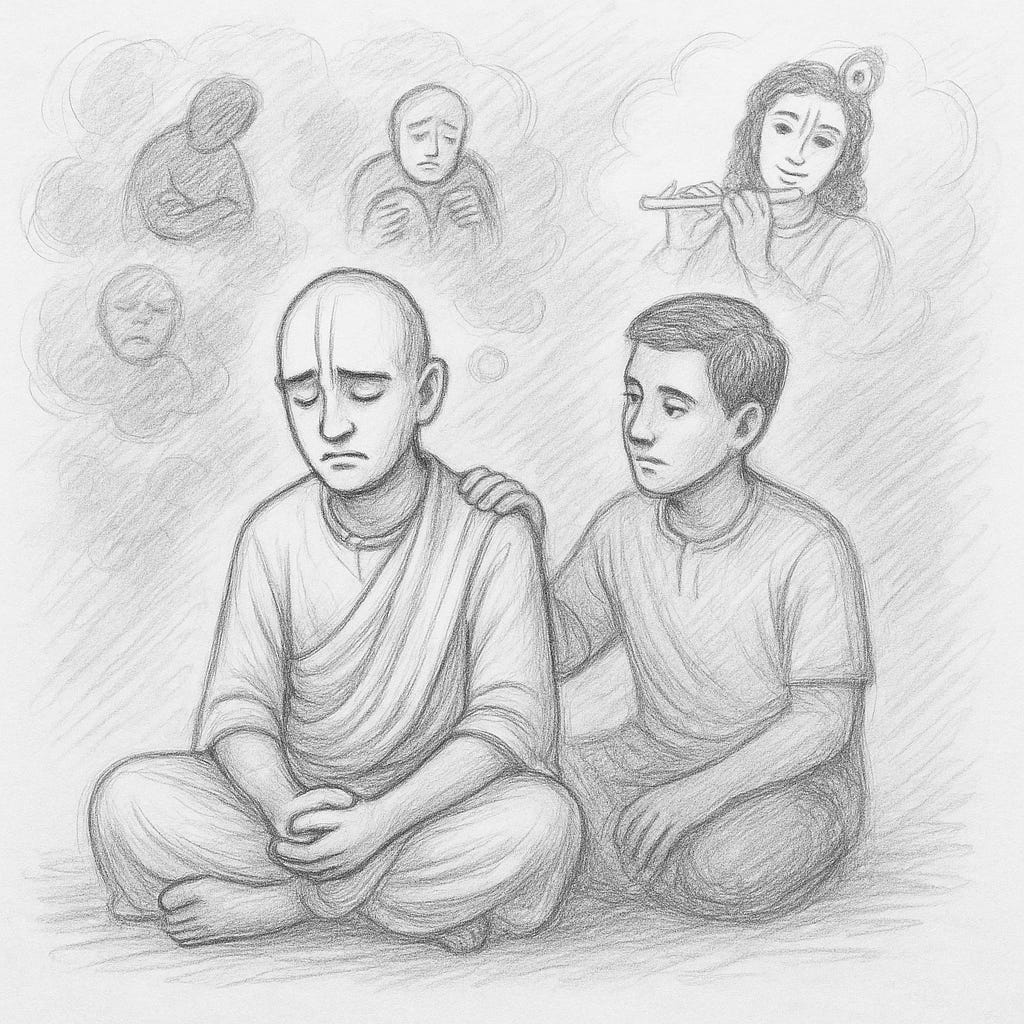
When we join Kṛṣṇa Consciousness, we may have the impression that all devotees are happy and fulfilled in their relationship with Kṛṣṇa. Unfortunately, that’s often not the case.
Depression and even suicide are also problems amongst devotees, just as it is in general society. The causes are fundamentally the same: Modern life creates an artificial and unhealthy lifestyle, which separates us from the deep social interactions that are supposed to be the foundations of our mental health. Some are more susceptible than others, but it can definitely take a serious toll. When we combine it with the other issues we have been discussing, the mixture can become explosive.
Although we have the opportunity of practicing Kṛṣṇa Consciousness and having relationships with self-realized souls, we don’t become completely free from material conditioning overnight. On the contrary, it can often beat us even stronger, since spiritual practice forces us to face our internal issues in our process of growth, rather than numbing them with alcohol and nicotine, as most people do.
In general, practicing the spiritual process makes us purer and happier than we would be otherwise, but this doesn’t necessarily mean we will become completely pure and happy overnight. There are many traps on the way.
One may have difficulties in his or her marriage, difficulties with other family members, traumas from the past that are difficult to heal, difficulties in the spiritual practice, challenges in dealing with other devotees who may act in hostile or envious ways, and so on. The list can quickly become extensive.
What can we do in this situation? What to do if someone is so pained that it can affect his or her mental health, or even lead him to take his own life? What to do if we find ourselves in this situation at some point?
True friends are our first line of defense. Is there anyone whom we really consider a well-wisher? Someone with whom we can open our hearts without fear? Someone who can hear us without being judgmental? If such a person exists, he or she is the best candidate to ask for help during difficult times. If not, it may be just the case of looking around: we have some very amazing people in our movement, but we need to learn how to find them. Often, the best devotees are the last ones we notice. Often, we are too distracted by the flashy neophytes to notice the true gems amongst us.
A second line of defense is our spiritual practice. It may sound cliché, but the holy names do have power, and often difficulties can give us the power to chant sincerely and connect with the Lord. In the 4th canto of Srimad Bhagavatam, we hear the story of Vaidarbhī, who was able to directly hear the Lord in a moment of crisis. Feelings of grief and loss often trigger a feeling of helplessness and renunciation that can make one eligible to contact the Lord in ways that would not be normally possible. Kṛṣṇa is the source of all transcendental bliss, and thus, if we can establish this connection with Kṛṣṇa, even if partially, our problems will look much smaller. This will be the support we always looked for.
General association with devotees, like going to festivals, can also be good, but it may be treated with more caution, because it can be a double-edged sword. The key is quality: quality association with like-minded devotees is always positive, and it can help us enormously in all situations. The problem is that this type of association is often rare, and if we are facing serious difficulties in our spiritual practice, it is usually a symptom that we are not getting it.
Often, superficial association with devotees who don’t really care about us is one of the sources of our problems, and if that’s the case, more of it will just make the problem worse. In this case, part of the solution may be to reduce this type of association and instead try to associate more personally with any individual devotees we may have affinity with and who we see care about us.
If the previous steps don’t help, seeking professional help may be the next step. Depression is also a form of disease, and therefore, there is no dishonor in seeking a doctor when we battle it, just as we would do in any other disease. Although doctors can’t solve the original problem, which is our material conditioning and forgetfulness of Kṛṣṇa, they can often help us to deal with the symptoms and imbalances that may be causing or exacerbating it. Although light cases of depression can be treated with just some philosophical introspection, serious cases may demand professional help or even medication.
One factor to avoid, on the other hand, is simply negation. To think that depression is just māyā, that we are just being mental, etc., and continue trying to do everything with a fake smile, pretending that nothing is happening, can make things a lot worse. Some time ago, in Māyāpur, the case of the suicide of a brahmacārī who was living in the āśrama shocked the community. No one could imagine he was so desperate that he could take his own life. He seemed okay, performing his services, until the day he wasn’t. When dealing with depression and other similar issues, the first step to a solution is to admit that there is a problem. This allows us to consider the question and find solutions.
While spiritual practice is the ultimate solution for all problems, bringing us closer to our eternal self, there are risks in seeing spiritual practice in itself as an immediate solution in this case. The point is that if we are practicing and we still develop depression, it means that more of the same practice may not solve the problem. Help is needed to find the points that are limiting my progress and work on them. Unresolved trauma, social isolation, sleep deprivation, unrealistic expectations, loss and grief, burnout, etc., are immediate issues that need practical responses. Just trying to chant more, without addressing the underlying cause in such situations, can lead to double-suffering, compounding the initial problem with self-blame for not being able to chant attentively, and so on.
Chanting more in these cases may be a lifeline, but chanting in such situations can feel dry and distant, despite all our efforts. In such cases, we need to clear the obstacles first, so we can again properly connect.
That is why seeking counseling, improving sleep and diet, creating balanced routines, and cultivating healthy friendships are not just material distractions, but actually important parts of our sādhana, because they give us the foundations for approaching Kṛṣṇa with attention and sincerity.
The local culture of devotees can either help or harm someone who is struggling. A community that dismisses mental struggles and the need to take additional rest, changing diet, or getting professional help as “māyā” or weakness can make things much worse, by pushing devotees into isolation and stigma. Such situations can increase the problem, up to suicide, by forcing the devotees to repress the problem to avoid being labeled as weak or unreliable.
A supportive community, on the other hand, can act as a safety net. If the local culture makes it normal to ask for help and share one’s challenges, with practical help being offered and struggles being treated with compassion instead of judgment, the outcome will be much better. In general, these are symptoms of mature communities.
Groups and communities that create a culture of care going in parallel with service are much safer environments. When we receive proper support, moments of crisis can end up being beneficial in the long term, helping us to form bonds with devotees who stand by our side, get rid of superficial attachments, and understand that this movement is our true home. If instead, we are left alone, labeled as weak or problematic in the moment of need, this can have very negative and long-lasting repercussions in the way we relate to others and to ourselves.
When we see a devotee with a lack of energy and motivation, even for basic tasks, who is having difficulty to chant and read, who shows hopelessness or self-critical thoughts, withdrawn, etc., we should be attentive, since these are precisely the symptoms of someone in need of help. Often, a shoulder to cry on, someone who listens without judging or trying to give philosophical solutions, is all that is needed.
In my experience, if everything else fails, there is something that can be tried as a last resort: A few days of fasting can often lead to miraculous healing. On the other hand, food (especially sugar and starches) can exacerbate symptoms of depression. When we feel depressed frequently, our first reaction is to eat sweets, but in most cases, this just makes us feel worse. Fasting, on the other hand, can lead to physical and mental healing. It can help one to find his own answers with the help of the Supersoul, especially when combined with sincere chanting. Many doctors nowadays are familiar with the therapeutic usage of fasting and can help to do it in the right way.
Depression can also lead to deep philosophical introspection. Even books and classes that we have already heard before can bring much deeper realization when we hear them during a process of healing. Often devotees describe how reading the same verses and purports from Prabhupāda’s books would bring them much deeper realizations when read again in a difficult time.
Being able to find the way out of such challenges, be it with the help of others or with the help of the Supersoul, can also make us more qualified in helping others. One who has never faced challenges may not understand the suffering of others and may not show much compassion to them, taking all difficulties as mere weakness. However, someone who faced challenges, who felt the bite, can understand the suffering of others and be more prepared to help. Surpassing our personal challenges is thus important not only for our personal well-being, but to the well-being of others we may be able to help in the future.
« Things I Wish Someone Had Taught Me When I Started Krishna Consciousness
You can also donate using Buy Me a Coffee, PayPal, Wise, Revolut, or bank transfers. There is a separate page with all the links. This helps me enormously to have time to write instead of doing other things to make a living. Thanks!
Beautifully clear and so important. Thank you Sir 🙏🏼
Thank you very much, Prabhuji, I really needed this article at this moment. Could you please write about living spiritual life with OCD? I am an unsure neophyte facing a lot of mental difficulties.