


You can receive new articles directly in your inbox. Subscription is free; donations are welcome.
In the ninth chapter of the Gītā, Kṛṣṇa mentions that:
“Fools deride Me when I descend in the human form. They do not know My transcendental nature as the Supreme Lord of all that be.
Those who are thus bewildered are attracted by demonic and atheistic views. In that deluded condition, their hopes for liberation, their fruitive activities, and their culture of knowledge are all defeated.”
In his purport to the first verse, Prabhupāda bashes the Māyāvādīs, who conclude that Kṛṣṇa has a material body.
Māyāvādīs study the scriptures, especially the Vedānta-sūtra and Upaniṣads, and accept Brahman as the ultimate reality. However, they understand this Supreme Brahman as impersonal, formless, and without qualities. The problem with this conclusion is that many passages in the scriptures, starting from the Gītā itself, describe the Lord as having a form, qualities, desires, and activities. To counteract that, they create another misguided theory on top of the first, arguing that there are two manifestations of Brahman: nirguṇa Brahman and saguṇa Brahman.
According to them, nirguṇa Brahman is the original formless and qualityless Brahman, while saguṇa Brahman is a lower manifestation associated with māyā. From this idea, they conclude that when Kṛṣṇa appears in this world, He not only accepts a material form and qualities, but performs material activities under the influence of the material modes. When we consider this conclusion, however, the logical problem becomes evident: if Kṛṣṇa, the Supreme Brahman, becomes covered by māyā when He appears, this means that māyā can overpower Kṛṣṇa. In other words, their conclusion is that the subordinate energy becomes greater than its controller. Māyāvādīs also study the Bhagavad-gītā, but we can see that their philosophy directly contradicts what Kṛṣṇa just explained in text 9.10.
Kṛṣṇa explains that the material nature works under His direction, but the Māyāvādī concludes that the same subordinate energy becomes the cause of Kṛṣṇa’s body and places Him under its laws. That’s why we call them Māyāvādīs: their philosophy concludes that māyā is greater than God.
In his purport to 9.12, however, Prabhupāda mentions something else:
“There are many devotees who assume themselves to be in Kṛṣṇa consciousness and devotional service but at heart do not accept the Supreme Personality of Godhead, Kṛṣṇa, as the Absolute Truth. For them, the fruit of devotional service – going back to Godhead – will never be tasted. Similarly, those who are engaged in fruitive pious activities and who are ultimately hoping to be liberated from this material entanglement will never be successful either, because they deride the Supreme Personality of Godhead, Kṛṣṇa.”
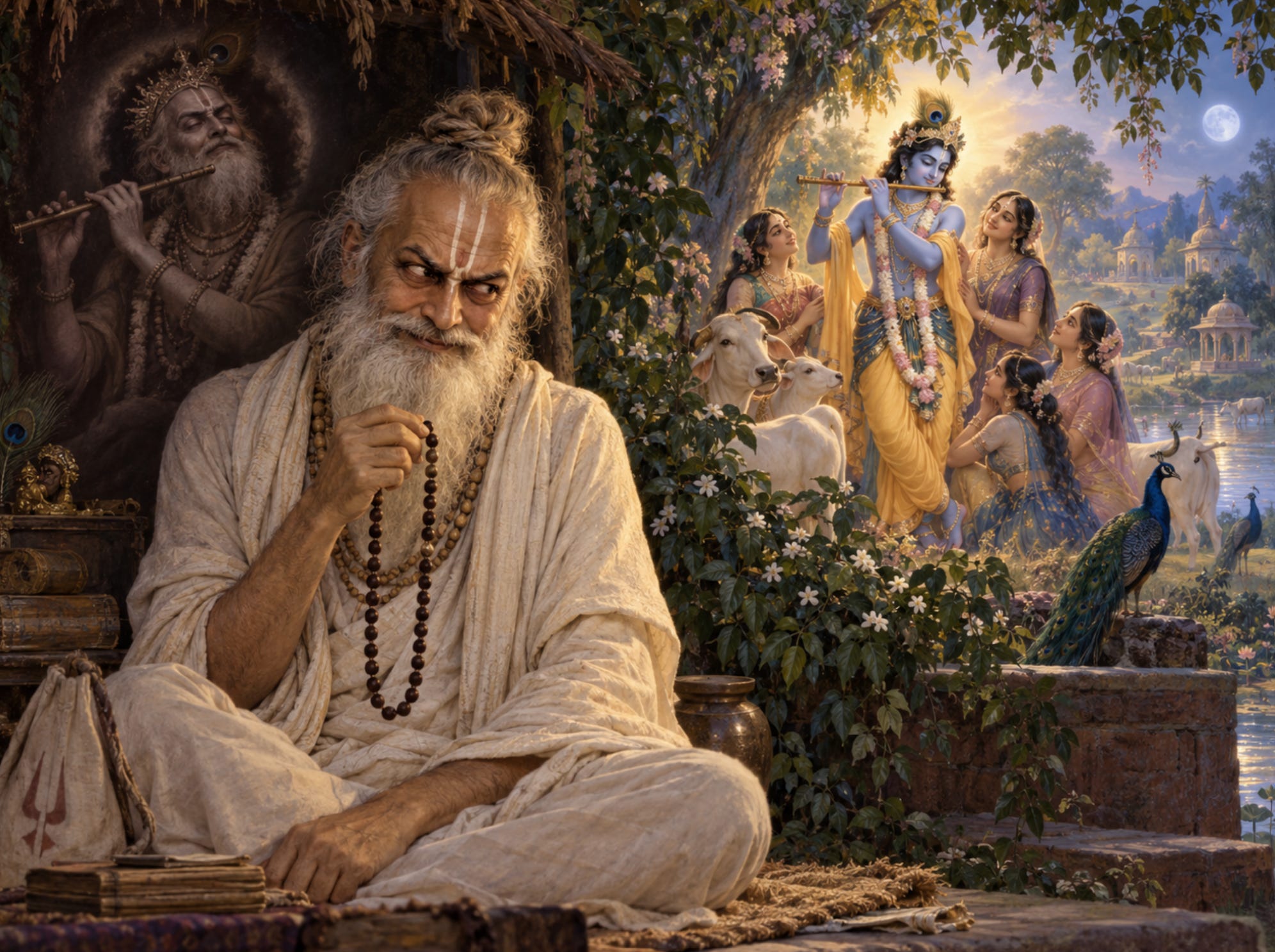
Who are these devotees who do not accept Kṛṣṇa as the Absolute Truth? One particularly dangerous example is a certain class of sahajiyās. While worshipping Kṛṣṇa, they adhere to the Māyāvādī conclusion that behind Kṛṣṇa there is the impersonal Brahman. This may sound surprising, but it appears as a natural consequence.
The Māyāvāda philosophy offers some semblance of transcendence by speaking of the Absolute Truth, emphasizing detachment and austerity and so on. The problem is that all of this is very dry. How much pleasure can a person obtain by endlessly speculating on the meaning of the words of the Vedānta-sūtra while fasting and sleeping on the ground? Some may remain satisfied with this, but others start hankering for some taste. They then face a problem: the pastimes of Kṛṣṇa (whom they call the “saguṇa Brahman”) are extraordinarily attractive. What happens then when we combine attraction to Kṛṣṇa’s pastimes with the idea of being ultimately one with Him? This combination produces the essential sahajiyā mentality: instead of serving Kṛṣṇa’s pastimes, one tries to imitate them.
When a devotee who understands the purity of Kṛṣṇa and accepts His supremacy hears about His pastimes, the consequence is spiritual attraction. One does not envy Kṛṣṇa, but comes to love Him. One then develops the desire to perform some form of service to facilitate these pastimes. That’s how a devotee eventually comes to the position of joining Kṛṣṇa in His eternal pastimes to serve Him eternally.
A Māyāvādi, however, does nothing to treat the root of the problem, which is his envy of Kṛṣṇa. On the contrary, he fuels it by considering Him an ordinary man, while simultaneously believing himself to be one with Him. The consequence then is:
“Kṛṣṇa’s pastimes are attractive. Ultimately, I’m Kṛṣṇa; therefore, these are my own pastimes. I can thus enjoy them by speaking about them and imitating them, and by doing so I will realize my own divine nature, and eventually merge into the Supreme Brahman, which is behind Kṛṣṇa.”
Putting oneself in the position of an enjoyer, one gradually becomes some form of bogus guru, who pretends to be transcendental while at the same time taking advantage of women who accept him as spiritually advanced, performing so-called pastimes with them.
A pure devotee does not desire to enjoy materially, because he is absorbed in the understanding of Kṛṣṇa as the supreme enjoyer. Such a devotee simply wants to bring everything enjoyable to Him. When he cooks, he cooks for Kṛṣṇa. When he chants, he chants to give Kṛṣṇa pleasure. If he accepts disciples, it is with the goal of bringing these souls to Kṛṣṇa. In this way, his existence is based on genuinely giving, not taking.
A sahajiyā, on the contrary, sees himself as the enjoyer. Externally, he may imitate devotional practices, but internally he sees himself as the center, the enjoyer, which leads to the development of an exploitative mentality, that culminates in unscrupulous or even predatory relationships with followers. This also explains why such imitators often appear more saintly to the uneducated than genuine pure devotees: they deliberately try to fit into the stereotype of a sādhu to attract followers, while a genuine pure devotee has no such concern.
Prabhupāda mentions this point in chapter 33 of the Kṛṣṇa Book:
“There is a distinction between Lord Kṛṣṇa’s dancing with the gopīs and the ordinary dancing of living entities within the material world. In order to clear up further misconceptions about the rāsa dance and the affairs of Kṛṣṇa and the gopīs, Mahārāja Parīkṣit, the hearer of Śrīmad-Bhāgavatam, told Śukadeva Gosvāmī, “Kṛṣṇa appeared on the earth to establish the regulative principles of religion and to curb the predominance of irreligion. But the behavior of Kṛṣṇa and the gopīs might encourage irreligious principles in the material world. I am simply surprised that He would act in such a way, enjoying the company of others’ wives in the dead of night.” This statement of Mahārāja Parīkṣit’s was very much appreciated by Śukadeva Gosvāmī. The answer anticipates the abominable acts of the Māyāvādī impersonalists who place themselves in the position of Kṛṣṇa and enjoy the company of young girls and women.”
The word “sahajiyā” is used in different senses, starting with more or less innocent people who just take the devotional process cheaply, but here we are speaking about this particularly dangerous type.
This brings us again to the point of sambandha. When the philosophical foundation is incorrect, the practice is misguided, and the supreme goal is not attained. A devotee understands that he is the eternal servant of Kṛṣṇa, who is completely pure and transcendental. Based on this foundation, one hears Kṛṣṇa’s pastimes and understands His supreme position. Gradually, one becomes disinterested in material enjoyment and becomes fixed on the spiritual platform. The Māyāvādī, on the other hand, believes that he is one with Kṛṣṇa. Thus, as long as he hears Kṛṣṇa’s pastimes through this Māyāvādī conception, his envy of Kṛṣṇa is reinforced rather than cured, and he desires to become Him. His practice then becomes some form of sensual imitation of Kṛṣṇa’s pastimes. The goal is then never reached.
As Prabhupāda warns in his purport to text 3.24:
“Lord Śiva drank poison to the extent of swallowing an ocean, but if any common man tries to drink even a fragment of such poison, he will be killed. There are many pseudo devotees of Lord Śiva who want to indulge in smoking gañjā (marijuana) and similar intoxicating drugs, forgetting that by so imitating the acts of Lord Śiva they are calling death very near. Similarly, there are some pseudo devotees of Lord Kṛṣṇa who prefer to imitate the Lord in His rāsa-līlā, or dance of love, forgetting their inability to lift Govardhana Hill.”
Read more:


This is a publication for thoughtful readers who want to go deeper into Kṛṣṇa consciousness. I publish daily, trying to offer high-quality spiritual content, and all posts are available to free subscribers. If you wish, you can support this work with a monthly contribution. When you subscribe, you can choose between a free subscription and a monthly contribution, and you can switch from a free subscriber to a supporter at any time.
You can also receive updates on WhatsApp or Telegram.
If you would like to contribute further, you can find the donation links here.
Srila Prabhupada’s Appearance Day!🙏🏽🙏🏽🙏🏽
🕉️🤍🤍🤍🪽