

Subscribe to receive new articles by e-mail. It’s free, but if you like, you can pledge a donation:
When Dhruva Maharaja was offended by Suruci, his stepmother, he was advised by his mother to go to the forest and look for Lord Viṣnu, for only he could help him in this situation. On the way, he was approached by Nārada Muni, who was inspired by the Lord from inside the heart to help him.
After being instructed by Nārada, Dhruva Mahārāja went to Madhuvana, one of the forests around Vṛndāvana, and started his austerities:
“Elsewhere, Dhruva Mahārāja, having arrived at Madhuvana, took his bath in the river Yamunā and observed fasting in the night with great care and attention. After that, as advised by the great sage Nārada, he engaged himself in worshiping the Supreme Personality of Godhead.
For the first month Dhruva Mahārāja ate only fruits and berries on every third day, only to keep his body and soul together, and in this way he progressed in his worship of the Supreme Personality of Godhead.
In the second month Dhruva Mahārāja ate only every six days, and for his eatables he took dry grass and leaves. Thus he continued his worship.
In the third month he drank water only every nine days. Thus he remained completely in trance and worshiped the Supreme Personality of Godhead, who is adored by selected verses.
In the fourth month Dhruva Mahārāja became a complete master of the breathing exercise, and thus he inhaled air only every twelfth day. In this way he became completely fixed in his position and worshiped the Supreme Personality of Godhead.
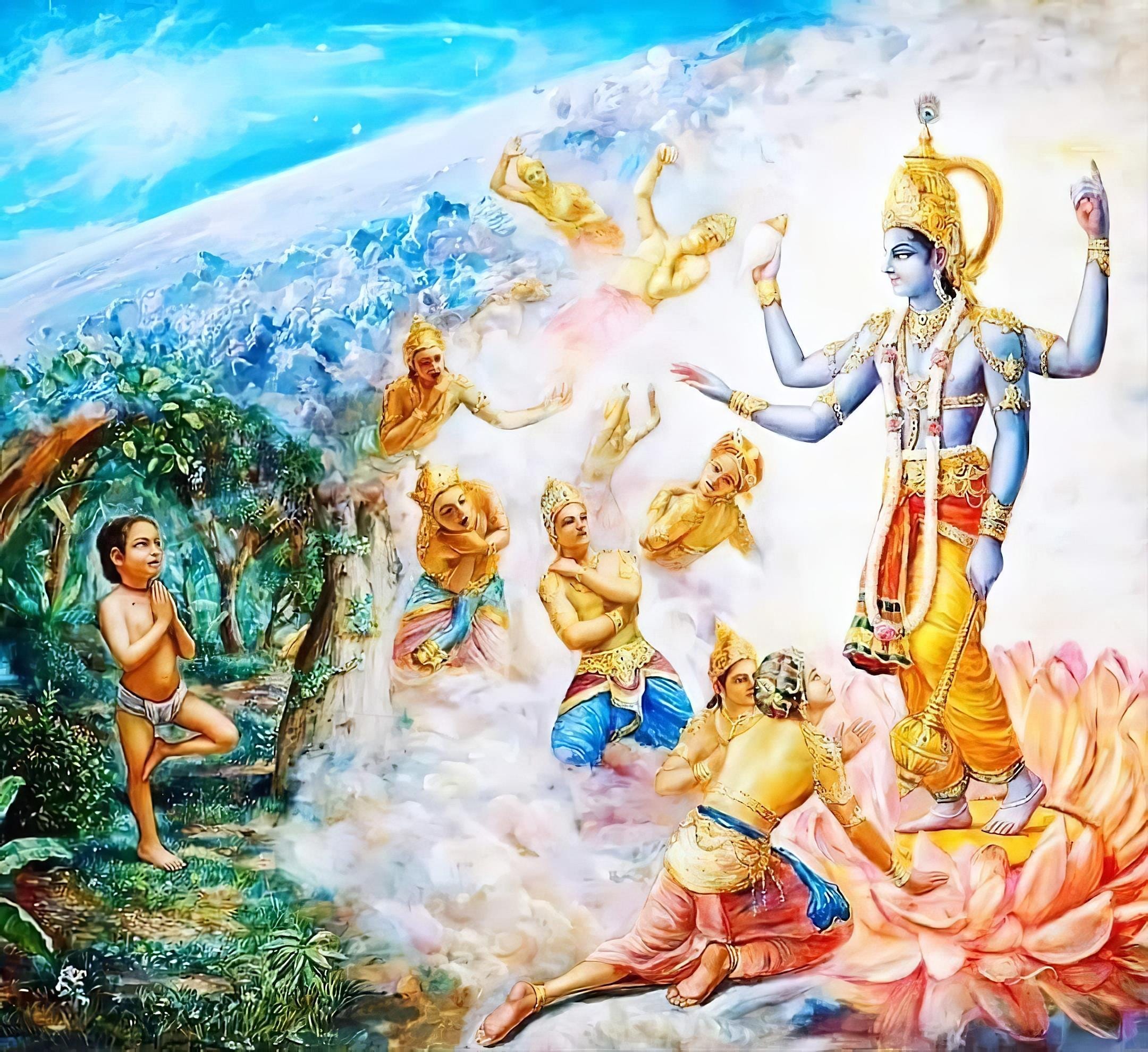
By the fifth month, Mahārāja Dhruva, the son of the King, had controlled his breathing so perfectly that he was able to stand on only one leg, just as a column stands, without motion, and concentrate his mind fully on the Parabrahman. He completely controlled his senses and their objects, and in this way he fixed his mind, without diversion to anything else, upon the form of the Supreme Personality of Godhead.” (SB 4.8.71-77)
By following the process given by his spiritual master, Dhruva was able to attain perfection in just five months. One can question how this can be possible, but there are examples of devotees who were able to fix their minds on the Lord even faster, as in the case of Mahārāja Khaṭvāṅga, who had just a muhūrta (48 minutes) to live. The success of Dhruva serves as a testimony to the power of the spiritual process. We may have difficulty progressing in the beginning, when we are not properly practicing the spiritual process, but as we become fixed, our advancement becomes faster. If we don’t know how to reach the airport, our journey to a distant country can be very long and arduous, but as soon as we take the plane, everything goes quickly.
In the first month, Dhruva followed the regulative principles, worshiped the deity, and practiced mantra meditation and remembrance of the pastimes of the Lord as instructed by Nārada. He ate only fruits and berries that were naturally available in the forest every third day, minimizing his bodily needs and engaging himself fully in worshiping the Lord.
In the second month, he reduced his eating to just dry grass and leaves every six days. By practicing sense control in this way, he became fixed in his meditation and gradually completely stopped eating, starting to just drink a little water every nine days, starting from the third month.
In the fourth month, he became perfectly situated in his meditation and was able to cease all external activities. Completely absorbed in meditation, he worshiped the form of the Lord within, as instructed by Nārada. By practicing prāṇāyāma, yogis are capable of restricting their breath and thus extending their lifespans. Dhruva fully mastered this process. Not only did he completely stop eating or drinking, but he was able to restrict his breath (jita-śvāsaḥ) and breathe only once every twelve days.
By the fifth month, he was able to stand immobile in one leg, completely fixed in his meditation on the Lord. Because he was able to fully capture the Lord in his meditation, he became extremely heavy and was able to make the three words tremble. Prabhupāda explains this point, also making a parallel with our practical activities in spreading Krsna consciousness:
“By associating constantly with the Supreme Personality in his heart, Dhruva Mahārāja naturally became equal to the greatest, Brahman, by His association, and thus became the heaviest, and the entire universe trembled. In conclusion, a person who always concentrates on the transcendental form of Kṛṣṇa within his heart can very easily strike the whole world with wonder at his activities. This is the perfection of yoga performance, as confirmed in Bhagavad-gītā (6.47). Yoginām api sarveṣām: of all yogīs, the bhakti-yogī, who thinks of Kṛṣṇa always within his heart and engages in His loving transcendental service, is the topmost. Ordinary yogīs can exhibit wonderful material activities, known as aṣṭa-siddhi, eight kinds of yogic perfection, but a pure devotee of the Lord can surpass these perfections by performing activities which can make the whole universe tremble.”
Yogis are capable of manifesting mystic perfections due to their contact with specific potencies of the Lord. Dhruva, however, was capable of fully capturing the Lord in his meditation, and thus he became more powerful than anyone. Before, Dhruva was just a defenseless child who was not able to even sit on the lap of his father, but now, due to his connection with the Lord, he became so powerful that he was able to make the whole universe tremble. Similarly, a devotee who never showed any particular talent in mundane life can become enormously successful in spreading Krsna consciousness due to his faith in the Lord.
Finally, due to his full concentration, he was able to close all the holes of his body and completely stop his process of breathing. At this point, the breath of all inhabitants of the universe became choked. This affected even the great demigods, who felt suffocated. As in other situations of danger, they approached Lord Kṣīrodakaśāyī Vishnu in Śvetadvīpa and begged Him to save them from the danger.
The Lord replied that all was due to Dhruva’s meditation, but his purpose was not destructive. It was more or less an accident since he was fully absorbed in samādhi and was not aware of how his meditation was affecting others. The Lord reassured the demigods and went to see Dhruva and stop his meditation. One reason was to relieve the demigods, as they pleaded, but an even more pressing reason is that the Lord became compassionate to Dhruva and wanted to stop him from performing such severe austerities.
No one can force the Lord to come to him, but by the power of the devotional service of Dhruva, the Lord Himself desired to visit him to relieve him of his severe penances and award everything he desired.
After reassuring the demigods that He would protect them, the Lord went to the Madhuvana Forest to see Dhruva, mounted on Garuḍa.
In his Laghu-Bhāgavatāmṛta, Śrīla Rūpa Gosvāmī explains that Kṣīrodakaśāyī Vishnu expanded into the Pṛśnigarbha incarnation to meet Dhruva. Being a Vaikuṇṭha planet, Dhruvaloka is an eternal abode, but it is described as being “created” in the same sense as Lakṣmī Devī and the Kaustubha jewel appear from the churning of the milk ocean, or that Lord Śiva appears from Brahma. They are all eternal, but when they manifest inside of this particular universe, sometimes it is said they are created. Pṛśnigarbha is also the same incarnation who appears as the son of Pṛśni and Sutapā.
At this moment, Dhruva was absorbed in his meditation, seeing the Lord inside his heart, when the form suddenly disappeared. This broke his meditation. When he opened his eyes, he saw the Lord personally present before him. Seeing the Lord, Dhruva developed all symptoms of ecstasy, looking at the Lord, embracing Him, kissing his feet, etc. He wanted to offer beautiful prayers to the Lord, but being just a boy, he couldn’t speak very eloquently. The Lord, however, touched Dhruva with his conch, and in this way, he was blessed with all transcendental knowledge. He could thus glorify the Lord with beautiful prayers, as he wanted. This shows us how the potency to perform any kind of service or to glorify the Lord in any capacity can be bestowed upon us by the Lord if we are eager to serve Him.
Another important point is that a pure devotee is empowered to speak directly by the Lord, and this inspiration is called brahma-maya, because a devotee so inspired speaks words that exactly represent Vedic knowledge in its pure form. As Śrila Madhvācārya mentions in his commentary on the Mundaka Upaniṣad, Vedic knowledge can be understood in two levels: pāra-vidya (transcendental knowledge) and apāra-vidya (mundane, superficial knowledge). Mundane persons, as well as neophyte devotees still under the three modes, are not capable of understanding the real meaning of the Vedas just by studying the text. The proper understanding can be revealed only by pure devotees. The words of a pure devotee such as Śrila Prabhupāda have thus much more weight than the words of a mundane scholar, who will probably not be able to reach the proper conclusions of the text, despite his grammatical knowledge. Literal translation of Vedic texts has very little value; the knowledge has always to be interpreted in some way. It all depends on the qualification of the person explaining it, and their connection with the proper Paramparā.
“At that time Dhruva Mahārāja became perfectly aware of the Vedic conclusion and understood the Absolute Truth and His relationship with all living entities. In accordance with the line of devotional service to the Supreme Lord, whose fame is widespread, Dhruva, who in the future would receive a planet which would never be annihilated, even during the time of dissolution, offered his deliberate and conclusive prayers.” (SB 4.9.5)
Having received all Vedic knowledge from the Lord, Dhruva offered eloquent prayers to the Lord, which are registered in the pages of the Śrīmad Bhāgavatam.
You can also donate using Buy Me a Coffee, PayPal, Wise, Revolut, or bank transfers. There is a separate page with all the links. This helps me enormously to have time to write instead of doing other things to make a living. Thanks! You can also receive the updates on Telegram.