

« Making Sense of the Vedic Universe, a Higher-Dimensional Reality
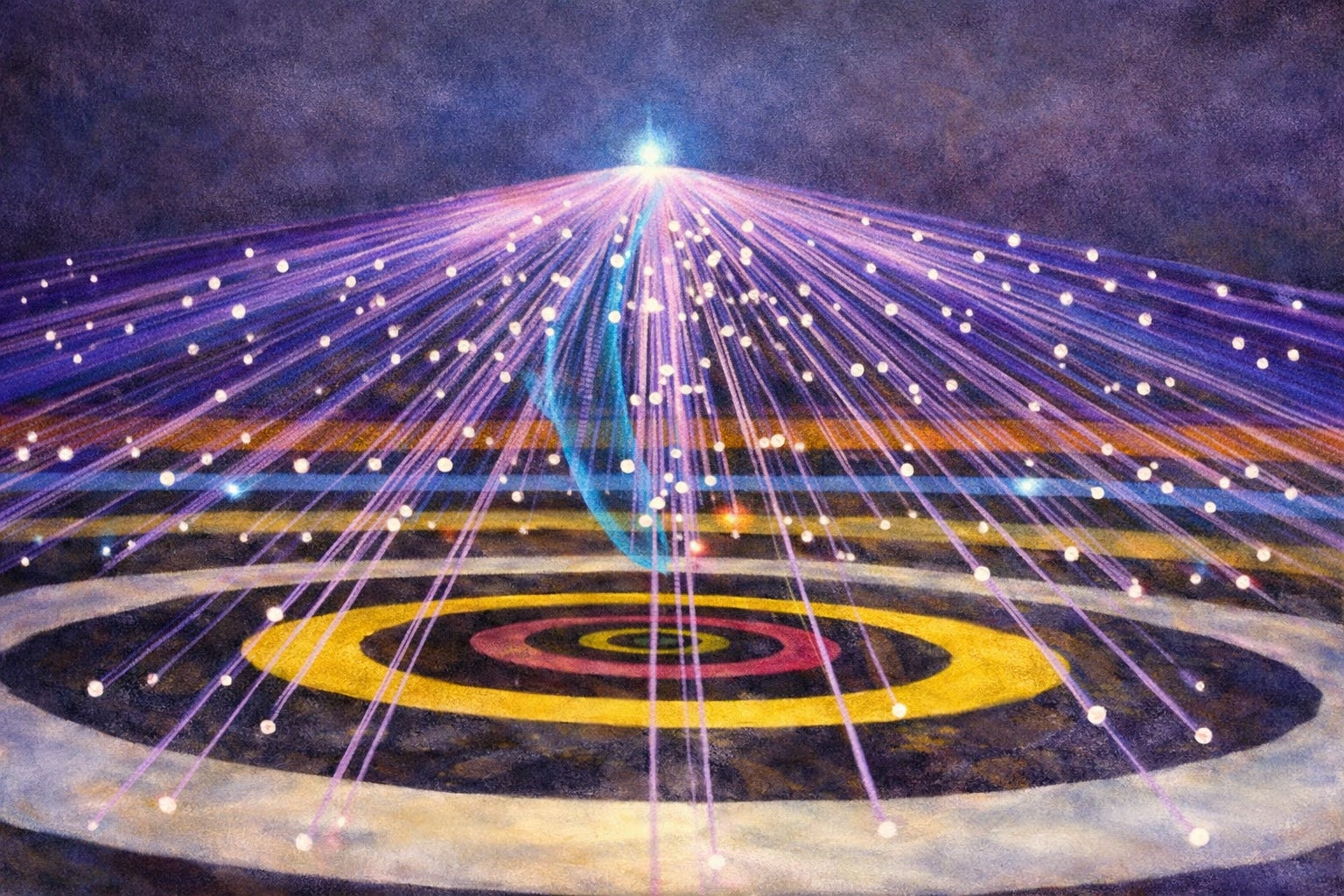
Dhruvaloka, the universal pivot
“Śukadeva Gosvāmī continued: My dear King, 1,300,000 yojanas [10,400,000 miles] above the planets of the seven sages is the place that learned scholars describe as the abode of Lord Viṣṇu. There the son of Mahārāja Uttānapāda, the great devotee Mahārāja Dhruva, still resides as the life source of all the living entities who live until the end of the creation. Agni, Indra, Prajāpati, Kaśyapa, and Dharma all assemble there to offer him honor and respectful obeisances. They circumambulate him with their right sides toward him. I have already described the glorious activities of Mahārāja Dhruva [in the Fourth Canto of Śrīmad-Bhāgavatam].
Established by the supreme will of the Supreme Personality of Godhead, the polestar, which is the planet of Mahārāja Dhruva, constantly shines as the central pivot for all the stars and planets. The unsleeping, invisible, most powerful time factor causes these luminaries to revolve around the polestar without cessation.” (SB 5.23.1-2)
The pastime of Dhruva Maharaja is described in the Fourth Canto. He is such a great devotee that He was given a Vaikuṇṭha planet that manifests inside the universe, and is the central pivot of the rotation of the whole sky. The analogy is that all luminaries are yoked to this central pivot, just like bulls in an oil pressing machine, where they are yoked to a central pivot and made to walk in circles.
The glories of Dhruvaloka are the best explanation of how the whole sky can rotate around a central axis. Dhruvaloka is different in essence from all other planets and stars. It is not a material planet, but an eternal Vaikuṇṭha planet that appears inside the universe, just as the abode of the Lord is manifested in Vṛndāvana. These places are transcendental, but they become manifest inside the material universe. Dhruvaloka is also the abode of Kṣīrodakaśāyī Viṣnu, who is present in Śvetadvīpa, the divine island in the middle of the ocean of milk present there. When the demigods need assistance, they go there and pray for the Lord’s divine intervention from the shore.
When the material universe is destroyed, Dhruvaloka remains invisible (or unmanifested), but it is not destroyed. It continues to exist eternally as a spiritual planet, and is later revealed again inside another material universe in the course of another pastime.
“When bulls are yoked together and tied to a central post to thresh rice, they tread around that pivot without deviating from their proper positions — one bull being closest to the post, another in the middle, and a third on the outside. Similarly, all the planets and all the hundreds and thousands of stars revolve around the polestar, the planet of Mahārāja Dhruva, in their respective orbits, some higher and some lower. Fastened by the Supreme Personality of Godhead to the machine of material nature according to the results of their fruitive acts, they are driven around the polestar by the wind and will continue to be so until the end of creation. These planets float in the air within the vast sky, just as clouds with hundreds of tons of water float in the air or as the great śyena eagles, due to the results of past activities, fly high in the sky and have no chance of falling to the ground.” (SB 5.23.3)
In the description of the process of creation given in the Śrīmad-Bhāgavatam, it is described that kāla (time) is the mixing element, the energy that puts the material energy in motion, creating the material manifestation. This same time energy, operating under the will of the Lord, controls the movements of all stars and planets around Dhruvaloka. Each star and planet has a precise path to follow. This is the main point behind Vedic cosmology: it is not about mechanics, but about the will of the Lord. Even though the universe operates under certain forces and rules, these are not blind, impersonal laws, but potencies of the Lord acting under His order.
As Prabhupāda explains in his purport, “Material scientists want to avoid the ruling government of the Supreme Personality of Godhead, and therefore they imagine different conditions under which they suppose the planets move. The only condition, however, is the order of the Supreme Personality of Godhead. All the various predominating deities of the planets are persons, and the Supreme Personality of Godhead is also a person. The Supreme Personality orders the subordinate persons, the demigods of various names, to carry out His supreme will.”
Modern researchers observe the movements of the planets and call the law supposedly behind it “gravity”. However, “gravity” is just a name for an observable phenomenon. They see an orderly universe, and create a “law” to explain it, but it does not answer the question of why there is an orderly universe in the first place. By focusing on the phenomenon, they fail to understand the cause behind it.
An aborigine observing planes flying at regular times over his island, could conclude there is a force called ‘air-drive’ that makes these objects fly at specific times. However, even if the aborigine were to perfectly understand the flight schedule, his explanation would remain flawed. The flights follow a certain schedule and happen through consistent physical principles, but the reason they fly at those times is the desire and coordination of different people.
Similarly, what we call ‘gravity’ describes the regularity of motion, but the Śrīmad-Bhāgavatam points to an ultimate governance behind that regularity, including the different demigods, kāla, the results of karma, and so on, all operating under the will of the Lord.
In general, scientists prefer impersonal explanations that allow them to avoid acknowledging a supreme controller. They focus thus in explaining the mechanics, but they fail to find the cause behind it. The Bhāgavatam goes in the opposite direction: it explains how Kṛṣṇa controls the cosmic manifestation through His different energies (such as kāla, karma, and so on) and servants (such as the demigods).
This is the main point of Vedic cosmology: it offers an explanation of the cosmos that properly acknowledges the true causes behind the cosmic manifestation and its goals, instead of merely describing physical phenomena.
Read the whole book:
« Making Sense of the Vedic Universe, a Higher-Dimensional Reality
This is a publication for thoughtful readers who want to go deeper into Kṛṣṇa consciousness. I publish daily, trying to offer high-quality spiritual content, and all posts are available to free subscribers. If you wish, you can also choose a paid subscription to support this work.
You can also receive the updates on WhatsApp or Telegram.
If you would like to contribute further, you can find the donation links here.
Dhruva loka is different from vaikunta. Can you site vedic reference to goloka and vaikunta from vedas? Vaikunta is the final loka that is laways there and above that there is no other loka as per vedas.