

« The Song of God—Volume 1, chapters 1-6
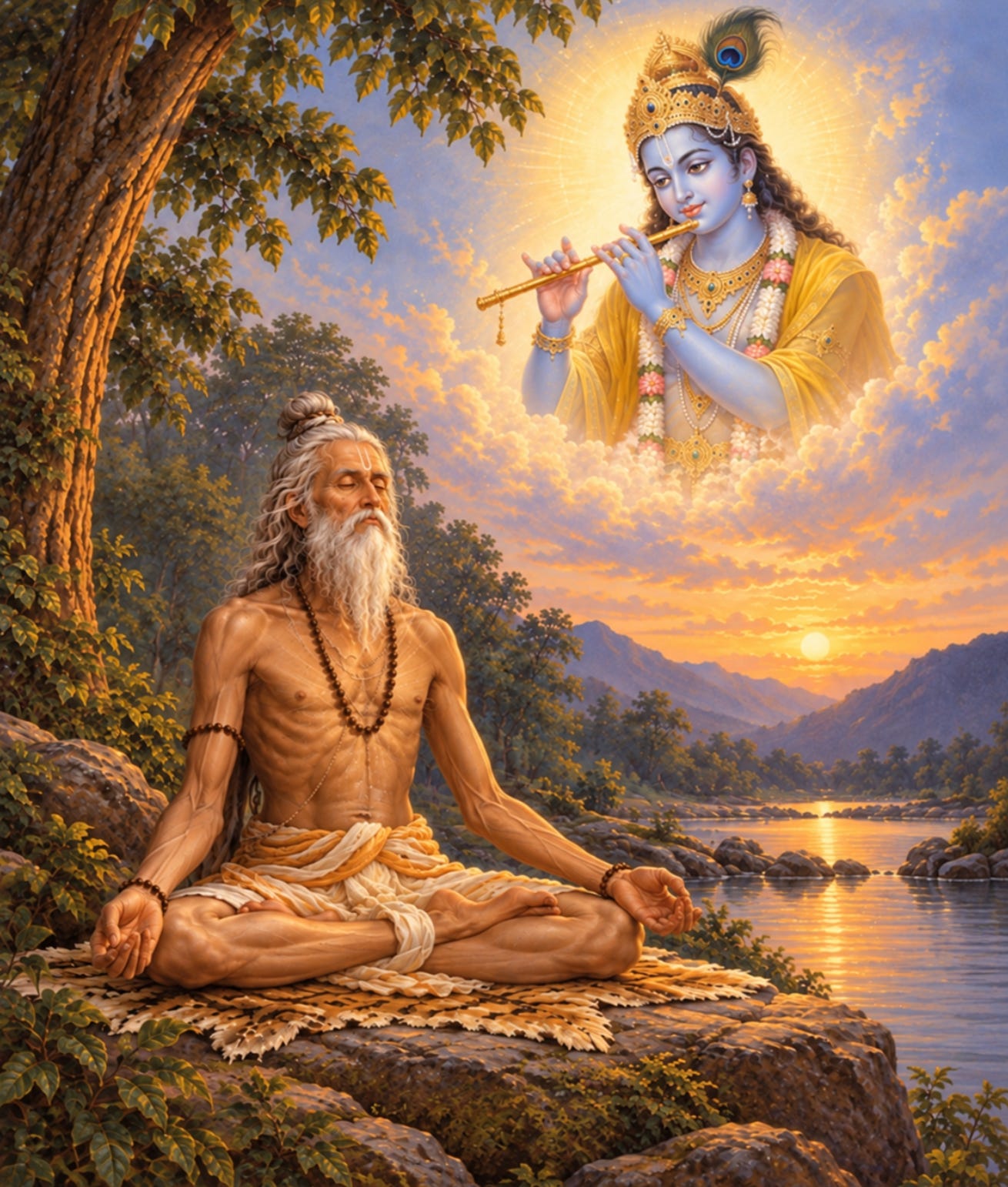
Introducing dhyāna-yoga and its goal (Bg 5.27 to 5.29)
This section connects the description of perfection in devotional service given in chapter five with the process of dhyāna-yoga, explained in detail in chapter six. At first, the change may seem abrupt. Kṛṣṇa has just emphasized the superiority of devotional work over mere renunciation, and now He appears to go in the opposite direction, telling us to sit and meditate. Meditation, however, is also a part of the yoga ladder, and many great sages attained perfection in the past through this process. By explaining this system, Kṛṣṇa shows how the different yoga paths ultimately aim at the same perfection: fixing the consciousness on Him. It also gives Arjuna the opportunity to reject the process, opening the door for Kṛṣṇa to explain the direct path of bhakti-yoga starting from chapter seven.
Texts 27-28: sparśān kṛtvā bahir bāhyāṁś, cakṣuś caivāntare bhruvoḥ
prāṇāpānau samau kṛtvā, nāsābhyantara-cāriṇau
yatendriya-mano-buddhir, munir mokṣa-parāyaṇaḥ
vigatecchā-bhaya-krodho, yaḥ sadā mukta eva saḥ
Shutting out all external sense objects, keeping the eyes and vision concentrated between the two eyebrows, suspending the inward and outward breaths within the nostrils, and thus controlling the mind, senses and intelligence, the transcendentalist aiming at liberation becomes free from desire, fear and anger. One who is always in this state is certainly liberated.
Text 29: bhoktāraṁ yajña-tapasāṁ, sarva-loka-maheśvaram
suhṛdaṁ sarva-bhūtānāṁ, jñātvā māṁ śāntim ṛcchati
A person in full consciousness of Me, knowing Me to be the ultimate beneficiary of all sacrifices and austerities, the Supreme Lord of all planets and demigods, and the benefactor and well-wisher of all living entities, attains peace from the pangs of material miseries.
Kṛṣṇa started the fifth chapter speaking about action in Kṛṣṇa consciousness and how this is the natural result of transcendental knowledge and the perfect way for becoming free from material entanglement. Now, suddenly, it appears that He changes topics and starts speaking about aṣṭāṅga-yoga, a process He continues to explain in the sixth chapter. This can create a few questions, since it appears that He is presenting aṣṭāṅga-yoga as a progression of the path of niṣkāma-karma-yoga, which is the advanced form of the path of action in devotional service He has been explaining since chapter two.
The main point is that Kṛṣṇa offers different processes of self-realization in the Bhagavad-gītā. All of them, if properly practiced, can lead to the perfection of devotional service He described in the previous sections. For example, in text 5.5, He declared that “One who knows that the position reached by means of analytical study can also be attained by devotional service, and who therefore sees analytical study and devotional service to be on the same level, sees things as they are.”
Ordinarily, the path of jñāna is considered superior to karma. However, when they are practiced in Kṛṣṇa consciousness, they both purify and lead us to the transcendental platform. Technically, there is a difference in reaching the top floor of a building by going through the stairs, the elevator, or flying through the window, but once we reach the destination, these practicalities are not relevant.
The ultimate goal of all the different yoga processes described in the Bhagavad-gītā is to bring us to the stage of complete absorption in Kṛṣṇa in full realization of our constitutional position of service to Him. Karma-yoga, jñāna-yoga, buddhi-yoga, and the other processes described in the Gītā are different paths that lead us to this ultimate goal. Inside these processes, however, there are natural paths of progression. Just like sakāma-karma-yoga, when perfected, leads to niṣkāma-karma-yoga, the path of jñāna-yoga, or the path of understanding the self through philosophical inquiry, often leads to the practice of aṣṭāṅga-yoga. Therefore, after explaining the path of niṣkāma-karma-yoga, Kṛṣṇa also explains the path of mystic yoga as a progression for those coming from the path of jñāna-yoga.
Aṣṭāṅga-yoga is very difficult to practice in modern times, but still, many are attracted to it, just as Arjuna was inclined to abandon his prescribed duties and practice meditation. By explaining the process, Kṛṣṇa shows how difficult it is, leading Arjuna himself to reject it. This will open the doors for Him to describe the direct process of bhakti-yoga in chapters seven to twelve, teaching us how to achieve perfection by always remembering Him, and never forgetting Him. This is the ultimate stage of the yoga ladder, the answer to all other processes. No matter which path we are following, the direct path of hearing about Kṛṣṇa and always remembering Him is the final progression.
As Prabhupāda explains:
“After explaining the above principles of liberation in the Supreme, the Lord gives instruction to Arjuna as to how one can come to that position by the practice of the mysticism or yoga known as aṣṭāṅga-yoga, which is divisible into an eightfold procedure called yama, niyama, āsana, prāṇāyāma, pratyāhāra, dhāraṇā, dhyāna and samādhi. In the Sixth Chapter the subject of yoga is explicitly detailed, and at the end of the Fifth it is only preliminarily explained. One has to drive out the sense objects such as sound, touch, form, taste and smell by the pratyāhāra process in yoga, and then keep the vision of the eyes between the two eyebrows and concentrate on the tip of the nose with half-closed lids. There is no benefit in closing the eyes altogether, because then there is every chance of falling asleep. Nor is there benefit in opening the eyes completely, because then there is the hazard of being attracted by sense objects. The breathing movement is restrained within the nostrils by neutralizing the up-moving and down-moving air within the body. By practice of such yoga one is able to gain control over the senses, refrain from outward sense objects, and thus prepare oneself for liberation in the Supreme.”
Aṣṭāṅga-yoga is also recommended in several places of the scriptures as a process to allow people who are not ready to practice the path of devotional service to gradually achieve transcendental realization. In the First Canto of Śrīmad-Bhāgavatam, for example, we see the story of Vidura guiding Dhṛtarāṣṭra in practicing meditation after he retired from the palace, understanding that after committing so many offenses to the Pāṇḍavas during his life, he would not be able to directly adopt the process of bhakti.
Nowadays, there is a great interest in yoga, but with so many fashionable styles and the almost universal goals of controlling stress and toning the body, the essence of the yoga process is lost, to the point that most simply relate the word “yoga” to physical exercises.
The original process of transcendental meditation is called aṣṭāṅga-yoga, or the eightfold yoga system (aṣṭa means “eight” and aṅga means “limbs” in Sanskrit). It consists of eight levels of practice: yama, niyama, āsana, prāṇāyāma, pratyāhāra, dhāraṇā, dhyāna, and samādhi. This is the process mentioned in the Bhagavad-gītā and other scriptures, which was practiced by yogīs and transcendentalists through the ages. All the modern processes of yoga derive from this original eightfold system, but in most cases, important parts of the process are lost, discarded, or modified.
The aṣṭāṅga-yoga process starts with yama and niyama. Yama means “restraint,” and niyama means “observance.” In other words, these are rules and regulations, or prescriptions and prohibitions, that yogīs are supposed to follow as part of their practice.
Yama means avoiding what is unfavorable to spiritual practice; niyama means practicing what is favorable. Together they lead to a regulated life. For example, in the Gītā (6.16) Kṛṣṇa mentions that “There is no possibility of one’s becoming a yogī, O Arjuna, if one eats too much or eats too little, sleeps too much or does not sleep enough.” This is an example of yama and niyama.
Similarly, other prescriptions include waking up early in the morning, not going to sleep too late, following a vegetarian diet, being non-violent, maintaining a good standard of cleanliness and sense control, etc. Most rules and prohibitions of yama and niyama are useful for all spiritual seekers, not only for aṣṭāṅga-yogīs.
The third component is āsana, which consists of bodily exercises and sitting postures. The āsanas help one to ascend from a gross material platform to a more subtle platform, calming the mind and helping to develop concentration, which are prerequisites for the more advanced stages of the process. The āsanas are thus a preparation, just like runners warm up and execute other routines as a preparation for their training.
In other words, āsanas mean to use the material body to perform activities that can elevate one’s consciousness. In this sense, there are similarities with the process of karma-yoga described in the Bhagavad-gītā. In the case of the aṣṭāṅga-yoga process, the āsanas also help to prepare the body for sitting in the same position for the long times required in the practice of meditation.
More advanced than bodily postures is the process of prāṇāyāma, which consists of breathing exercises: inhaling, exhaling, and holding the breath. It’s a more subtle form of the process of employing the gross body in actions that help to elevate one’s consciousness. The prāṇāyāma process is summarily explained in text 4.29: “Still others, who are inclined to the process of breath restraint to remain in trance, practice by offering the movement of the outgoing breath into the incoming, and the incoming breath into the outgoing, and thus at last remain in trance, stopping all breathing. Others, curtailing the eating process, offer the outgoing breath into itself as a sacrifice.”
Just like the āsanas, the purpose of the prāṇāyāma process is to stop the mind and senses from engaging in materialistic activities. In both cases, the goal is not to make the body and mind stronger in order to be able to work more, or simply to manage stress, but to advance in spiritual practice. The problem with the way most people practice yoga nowadays is exactly that, because of a lack of a broader understanding of the process and its goals, most people practice isolated parts of the process with the goal of simply improving their physical endurance or mental alertness, and thus they are just like someone who licks the external part of a pot of honey instead of tasting what is inside.
The next step is the process of pratyāhāra, which means to control the mind and senses. In the Gītā, the material body is compared with a chariot, where the senses are the horses, the mind is the reins, intelligence is the coachman, and the soul is the passenger. When one starts the meditation process, the mind will wander everywhere, bringing to consciousness a series of remembrances, desires, plans, feelings, etc. Pratyāhāra means to withdraw the mind and focus it on the practice of yoga, or, in other words, to withdraw the senses from matter and engage them in transcendence, just like in the example of the tortoise, which can withdraw its limbs when necessary, and again expand them when desired.
Without mastering the process of pratyāhāra, it’s not possible for a yogī to successfully practice the next level (dhāraṇā, or meditation). Nowadays, many try to meditate, but without pratyāhāra, it’s not possible to successfully do that. This leads to many concocted processes of guided meditation that just make one meditate on different aspects of daily life instead of proper dhāraṇā. In this way, the practice becomes a dead end.
The next stage is called dhāraṇā, or fixed meditation. Nowadays, many have the idea that to meditate means to empty the mind of all thoughts. However, not only is this not recommended, but it is actually not even possible, since thoughts will always come to one’s mind. Instead, the aṣṭāṅga-yoga process prescribes meditation on the form of the Lord. A yogī takes shelter (āśraya) in a particular form of the Lord and fixes his mind on all the details of this particular form. This fixed meditation is thus a form of worship.
The object of the meditation (dhāraṇā-āśraya) can be the universal form (virāṭ-rūpa) or the form of Paramātmā inside the heart, according to the yogī’s level of advancement. Some yogīs meditate on the impersonal Brahman, which is an intermediate stage between the two, but ultimately the goal of the aṣṭāṅga-yoga process is to meditate on the personal form of the Lord, not to get stuck in impersonal meditation.
What is this process of meditation on the virāṭ-rūpa? One who has material desires or is at a gross level of consciousness is recommended to meditate on the universal form of the Lord (as described in the Second Canto of Śrīmad-Bhāgavatam). In this process, one meditates on the different levels of planetary systems situated inside the universal form, and thus gradually elevates his consciousness, from the gross planetary systems to the subtle planetary systems, up to Brahmaloka, and then to the subtle coverings of the universe, including ego, and mahat-tattva, up to the point of pure consciousness, or Brahman realization (the stage of liberation). This is a process that can take several lives and involve taking birth in progressively higher planetary systems, where the yogī gradually improves in practice and consciousness until achieving perfection. The upper planetary systems are full of souls who are following this gradual ascending process.
This universal form is essentially an imaginary form, where different levels of planetary systems and different personalities and elements of the cosmic creation are taken as different parts and limbs of the universal form. In one sense, this is so, since the universe is the energy of the Lord, but in the other sense, it’s imaginary since the Lord doesn’t have a material form. To meditate on the universal form of the Lord is thus an indirect form of meditation that can help yogīs who are too much absorbed in material consciousness, and thus can’t conceive anything beyond it. Such yogīs can’t conceive the existence of the transcendental forms of the Lord, and thus meditation on the universal form is the only feasible process.
A yogī who is already free from material desire, situated in a more advanced stage, can skip meditation on the universal form and go straight to meditation on the Supersoul, the form of the Lord situated in one’s heart, fixing his mind on all the details of the transcendental form of the Lord. This is a direct process that allows one to achieve perfection in this same life.
For a bhakti-yogī, the process of dhāraṇā is achieved through the chanting of the mahā-mantra and absorption in the form of the deity, which provides a shelter for one’s meditation, allowing a devotee to ascend to the transcendental platform with much less effort.
The next stage is dhyāna, achieved as the meditation intensifies and deepens. Although both dhāraṇā and dhyāna involve essentially the same practice of meditation, dhāraṇā is the beginning stage, whereas dhyāna is the advanced stage, in which the yogī masters the process and begins to approach the final goal.
Finally, we have the stage of samādhi, a deep trance that is attained when the yogī attains perfection in the meditation process. In samādhi, the yogī is capable of fully situating his consciousness on the spiritual platform, attaining the level of brahma-bhūta, or liberation.
Samādhi is also attained in the process of bhakti-yoga, where it’s also attained through fixed meditation. The main difference is that in the process of aṣṭāṅga-yoga, one has to execute a very difficult process, and usually he will be, at best, capable of achieving Paramātmā realization, while a bhakta can achieve complete Bhagavān realization, the final and ultimate level of transcendental realization, by just becoming absorbed in Kṛṣṇa’s name, form, pastimes, etc.
The stage of brahma-bhūta is described in the last chapter of the Gītā (18.54): “One who is thus transcendentally situated at once realizes the Supreme Brahman and becomes fully joyful. He never laments or desires to have anything. He is equally disposed toward every living entity. In that state, he attains pure devotional service unto Me.”
The very word “yoga” means “to connect” or, in other words, to bring one’s consciousness from matter to spirit, allowing one to connect with the divine. This connection is firmly established in this stage of brahma-bhūta.
The stage of brahma-bhūta also marks the stage where one can start to practice a personal relationship with the Lord, in one of the five rasas cultivated in the spiritual realm. Some souls prefer the stage of neutrality, others prefer to serve the Lord, others cultivate a personal relationship on an equal level (friendship), others a paternal relationship, and others a conjugal relationship. Any of these rasas, or relationships, is possible for sincere souls, but they start from the stage of brahma-bhūta, where one becomes free from material entanglement and thus is firmly situated on a pure, transcendental platform.
In this way, aṣṭāṅga-yoga is a valid process of self-realization that was practiced by many great sages in bygone ages. The conclusion, however, is that constant engagement in the service of Kṛṣṇa is a better way to control the senses than the process of aṣṭāṅga-yoga, especially in the age we live in.
The process of aṣṭāṅga-yoga in the devotional context is described in more detail in the Third Canto of Śrīmad-Bhāgavatam in the teachings of Lord Kapila, and Prabhupāda explains its relation to the practical process of devotional service we practice in our age in his purports.
While a yogī performs āsanas as a way to use his body to focus the mind, we can achieve the same by doing different practical services. While a yogī controls his breath using prāṇāyāma, we simply sit and silently recite the holy names (japa). While a yogī fixes his meditation on the form of Paramātmā inside the heart, a devotee simply fixes his attention on the form of the deity, and so on. In this way, all the limbs of aṣṭāṅga-yoga have their equivalents inside the process of bhakti, but the process of Kṛṣṇa consciousness is much simpler and easier, allowing us to direct our natural propensities, instead of trying to focus our attention mechanically for very long periods of time. This is the same conclusion that Arjuna will come to in the next chapter.
Prabhupāda also makes the point that the process of Kṛṣṇa consciousness includes the practice of aṣṭāṅga-yoga in the sense that the ultimate purpose is achieved. The purpose of the process of meditation is to fix our mind on Kṛṣṇa, and that’s precisely what the process of Kṛṣṇa consciousness offers. As he explains:
“The eightfold yoga mysticism is automatically practiced in Kṛṣṇa consciousness because the ultimate purpose is served. There is a gradual process of elevation in the practice of yama, niyama, āsana, prāṇāyāma, pratyāhāra, dhāraṇā, dhyāna and samādhi. But these only preface perfection by devotional service, which alone can award peace to the human being. It is the highest perfection of life.”
The peace formula
After giving this introduction to the aṣṭāṅga-yoga process, Kṛṣṇa concludes the fifth chapter with a verse that summarizes much of what He has described up to this point in the Gītā:
bhoktāraṁ yajña-tapasāṁ, sarva-loka-maheśvaram
suhṛdaṁ sarva-bhūtānāṁ, jñātvā māṁ śāntim ṛcchati
This is the true peace formula, at all levels. In the material world, people want peace, but they have no idea of how to achieve that. On the contrary, we see conflict at all levels. Even in the celestial planets, there is enmity, war, and the misery caused by them. Kṛṣṇa reveals three realizations that solve the problem.
a) bhoktāraṁ yajña-tapasām: Kṛṣṇa is the real beneficiary and enjoyer of all sacrifices and austerities. He is the root of all existence. We should not perform sacrifices or austerities for our own prestige or gain. Instead, all activities should be performed for the satisfaction of Kṛṣṇa. This eliminates artificial competition based on ego.
Since Kṛṣṇa is the ultimate beneficiary, everyone should work together for Him, instead of against each other. More than that, by working in this spirit, all our sacrifices will culminate in transcendental knowledge, as Kṛṣṇa declared in chapter four.
b) sarva-loka-maheśvaram: Kṛṣṇa is the supreme proprietor. He is the master of all planets and their controllers, greater than anyone. This realization defeats the illusory sense of ownership that is the root cause of all conflicts. A materialist thinks he is the lord of everything he sees, but in reality he is just a slave of his senses. When the proper conclusion is restored, we can finally see everything properly, just like when the sun appears to dispel the darkness of night. Conversely, when we refuse the service of Kṛṣṇa, we end up being enslaved by material nature.
c) suhṛdaṁ sarva-bhūtānām: Kṛṣṇa is the closest friend of all living entities, the well-wisher of all. Therefore, surrendering to Him is not our loss, but our welfare. This also explains how a pure devotee can be friendly to all living entities. Kṛṣṇa is the supreme friend, and a pure devotee is His representative.
These three realizations work together. If Kṛṣṇa were simply the proprietor, we would fear, or maybe envy, Him. If He were only the enjoyer, one could feel exploited. But because He is the supreme friend, surrendering to Him becomes natural.
We can see that other religious scriptures emphasize God as the ruler, master, or recipient of worship, but they neglect His aspect as the supreme friend. This leads to unbalanced philosophies that modern people tend to resist. People are told that they must obey God, but they are not given a sufficiently deep understanding of why surrender is their highest welfare. God is presented as an authority demanding obedience, not as the dearmost friend inviting the soul back into an eternal loving relationship.
When this incomplete presentation collides with modern education and individual freedom, people tend to reject it, but without encountering the complete philosophy of Kṛṣṇa consciousness, they often fall into crude materialism or atheism. Only the Bhagavad-gītā presents a deep and balanced view of the Absolute Truth, and has the potential of being a universal scripture. This is further elaborated in the Śrīmad-Bhāgavatam, which brings details about Kṛṣṇa’s qualities and activities, and the process of developing a personal relationship with Him.
Once Kṛṣṇa is accepted as the dearmost friend, the fact that He is the supreme proprietor and enjoyer becomes a distant secondary detail. That’s how Kṛṣṇa’s cowherd associates in Goloka Vṛndāvana see it. They understand that Kṛṣṇa is the Supreme Controller, the Supreme Personality of Godhead, but this knowledge is eclipsed by their love for Kṛṣṇa as a friend, son, or lover. At this stage, a devotee does not think that Kṛṣṇa owns everything; he simply thinks that “Kṛṣṇa is mine, and I am His.” Kṛṣṇa’s supremacy remains eternally true, but it is eclipsed by their pure love. They love Kṛṣṇa because of who He is, not because He is a powerful person or celebrity.
Kṛṣṇa then concludes the verse with jñātvā māṁ śāntim ṛcchati. One who fully understands these three facts becomes situated in full Kṛṣṇa consciousness and attains peace from the pangs of material miseries. This is a summary of the process of Kṛṣṇa consciousness that Kṛṣṇa has been explaining since chapter two, and that will be deepened in the following chapters.
Main points in the purports of Śrīla Prabhupāda:
“Shutting out all external sense objects, keeping the eyes and vision concentrated between the two eyebrows, suspending the inward and outward breaths within the nostrils, and thus controlling the mind, senses and intelligence, the transcendentalist aiming at liberation becomes free from desire, fear and anger. One who is always in this state is certainly liberated.”
a) By practicing Kṛṣṇa consciousness, we can quickly become situated on the platform of liberation, and from there gradually come to understand Kṛṣṇa as our devotional service blossoms. When we finally become fixed in this platform, we can directly experience Kṛṣṇa everywhere. This position of a direct relationship with the Lord is higher than ordinary liberation.
b) During the fifth chapter, Kṛṣṇa explained the general principles of liberation. Now, Kṛṣṇa explains how one can come to this platform by practicing the process of aṣṭāṅga-yoga. The system is explained preliminarily in these two verses and explained in more detail in chapter six.
c) Aṣṭāṅga means the eightfold process of yoga, composed of yama, niyama, āsana, prāṇāyāma, pratyāhāra, dhāraṇā, dhyāna and samādhi. After practicing the four preliminary processes, one comes to the stage of restricting the senses in the pratyāhāra stage. From there, one enters into a state of meditation by keeping the vision of the half-closed eyes between the two eyebrows and concentrating on the tip of the nose, while neutralizing the movement of the air inside the body.
d) This process of yoga can make one free from fear and anger, bringing him to a transcendental platform, where one can feel the presence of the Supersoul.
e) A yogī has to carefully control his senses to not fall, but a devotee fully engaged in Kṛṣṇa consciousness faces no such risk. Kṛṣṇa consciousness is thus a better process for controlling the senses.
“A person in full consciousness of Me, knowing Me to be the ultimate beneficiary of all sacrifices and austerities, the Supreme Lord of all planets and demigods, and the benefactor and well-wisher of all living entities, attains peace from the pangs of material miseries.”
a) Everyone wants peace, but people do not know the formula. Here it is given: Kṛṣṇa is the beneficiary of all activities. We should thus connect all our activities with Him in devotional service. He is the proprietor of everything, the greatest. Nothing belongs to us; everything should be used in His service. A materialist thinks he owns everything around, but he is controlled by the material energy, the inferior potency of the Lord. We can attain peace only in complete Kṛṣṇa consciousness.
b) Karma-yoga, the practical process of Kṛṣṇa consciousness, is the main topic of chapter five. Working for Kṛṣṇa means to understand Kṛṣṇa’s special position as the supreme predominator. It can’t thus be separated from transcendental knowledge.
c) Bhakti-yoga is direct Kṛṣṇa consciousness. Jñāna-yoga is a path leading to it, because Kṛṣṇa consciousness means to work in full knowledge of our relationship with Kṛṣṇa. What is this relationship? The soul is the eternal servant of Kṛṣṇa. We come here due to a desire to lord it over Kṛṣṇa’s energy. This is the cause of all our sufferings. Kṛṣṇa consciousness, however, is the process that allows us to return to the spiritual platform even while still living here. As we advance, we become proportionally free from the material clutches.
d) Kṛṣṇa is not partial to anyone; everything depends on our effort and determination in performing our duties in the spiritual process. This is the process that allows us to control desire and anger. Staying firm in Kṛṣṇa consciousness and controlling these forces means remaining in the transcendental stage.
e) The process of aṣṭāṅga-yoga is automatically practiced inside the process of Kṛṣṇa consciousness because the ultimate goal of attaining perfection in devotional service is served.
Read the entire book:
« The Song of God—Volume 1, chapters 1-6

This is a publication for thoughtful readers who want to go deeper into Kṛṣṇa consciousness. I publish daily, trying to offer high-quality spiritual content, and all posts are available to free subscribers. If you wish, you can also choose a paid subscription to support this work.
You can also receive the updates on WhatsApp or Telegram.
If you would like to contribute further, you can find the donation links here.