

« Making Sense of the Vedic Universe, a Higher-Dimensional Reality
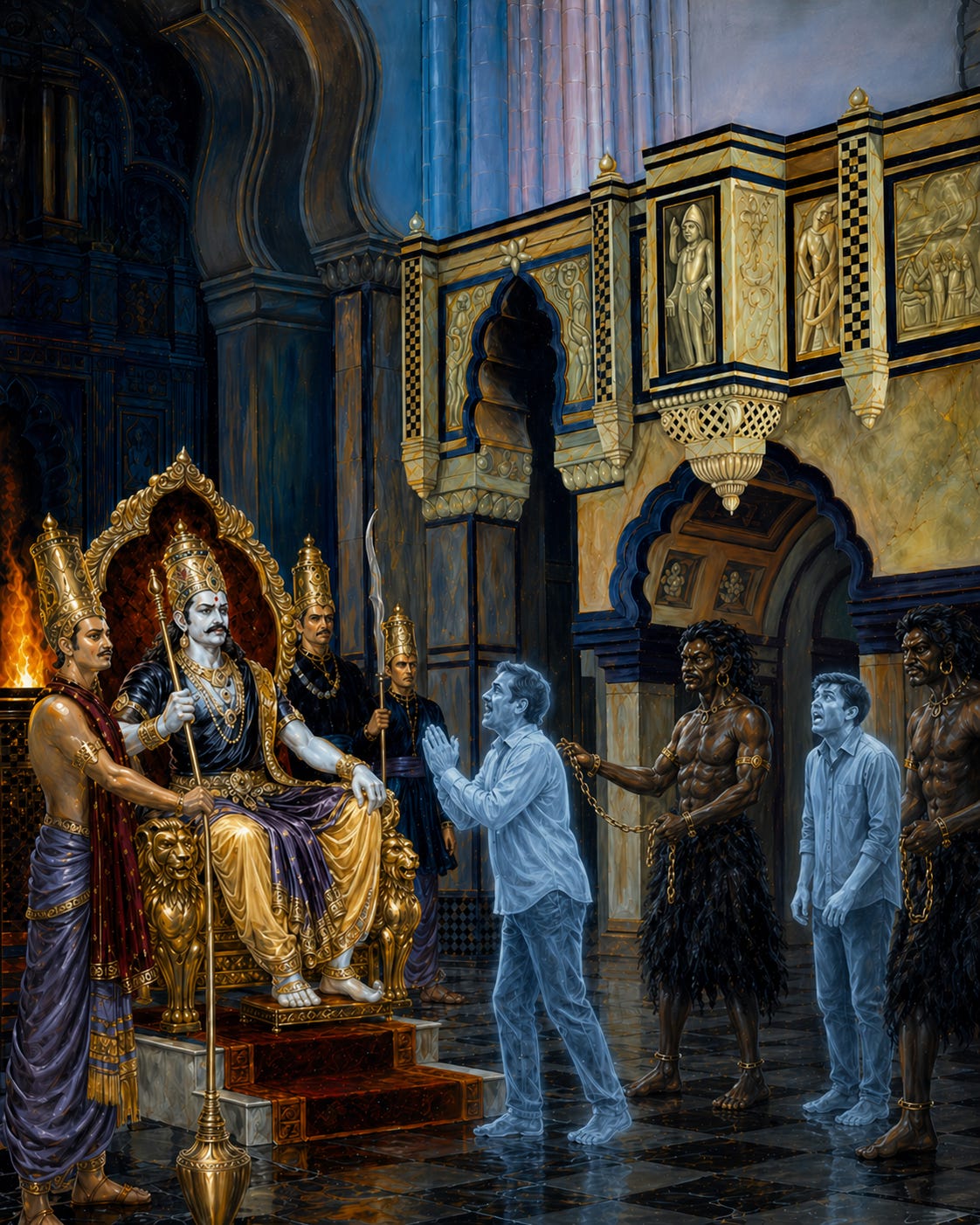
The destiny of others
What about souls who are not so fortunate? How is the severity of the punishment one will receive in hell determined? Śukadeva Gosvāmi explains that it is determined according to one’s individual consciousness. The ones who commit sins due to madness receive the least punishment. The ones who know the difference between right and wrong, but still commit sins due to weakness, receive moderate punishment, but those who are stubborn atheists, consciously willing to commit sins and delude themselves with the idea that there is no God, receive the most severe punishment. This is explained in the next verse:
“Just as by executing various pious activities one achieves different positions in heavenly life, by acting impiously one achieves different positions in hellish life. Those who are activated by the material mode of ignorance engage in impious activities, and according to the extent of their ignorance, they are placed in different grades of hellish life. If one acts in the mode of ignorance because of madness, his resulting misery is the least severe. One who acts impiously but knows the distinction between pious and impious activities is placed in a hell of intermediate severity. And for one who acts impiously and ignorantly because of atheism, the resultant hellish life is the worst. Because of ignorance, every living entity has been carried by various desires into thousands of different hellish planets since time immemorial. I shall try to describe them as far as possible.” (SB 5.26.3)
Why is it that atheists receive harsher punishment? The point is that the main purpose of this punishment is reformation. The system of justice in the universe is designed to correct and purify the soul, not to eternally condemn. If someone acts out of ignorance, usually a small reaction is sufficient for him to learn. If a person acts knowingly, a stronger reaction is usually needed to make him realize his mistake, and if one is obstinate, arrogant, and fully opposed to the very concept of a supreme authority, the punishment must be very strong to break that illusion and bring him to humility. This is similar in principle to modern courts, where an accused who pleads guilty and shows regret usually receives a more lenient punishment, while another who challenges the authority of the court may receive a much harsher sentence.
We can see thus that this topic of hellish punishment is not simple. It is highly nuanced, taking into account the intention, consciousness, knowledge, background, and level of spiritual advancement of each soul. Yamarāja is empowered by the Lord to understand all these factors and thus pass the correct judgment in each case.
Another point is the nature of this punishment. In hell, one does not have a gross body like here; everything happens in a subtle, astral plane. Still, the mind is active, and thus one perceives the experience as painful, even though it is not physical.
“King Parīkṣit inquired from Śukadeva Gosvāmī: My dear lord, are the hellish regions outside the universe, within the covering of the universe, or in different places on this planet?
The great sage Śukadeva Gosvāmī answered: All the hellish planets are situated in the intermediate space between the three worlds and the Garbhodaka Ocean. They lie on the southern side of the universe, beneath Bhū-maṇḍala, and slightly above the water of the Garbhodaka Ocean. Pitṛloka is also located in this region between the Garbhodaka Ocean and the lower planetary systems. All the residents of Pitṛloka, headed by Agniṣvāttā, meditate in great samādhi on the Supreme Personality of Godhead and always wish their families well.” (SB 5.26.4-5)
Geographically, the hellish planets are situated under Pātāla-loka, a little above the waters of the Garbhodaka ocean. That’s the same place where Pitṛloka, the court of Yamarāja, is situated.
It is described that after leaving his body, Vidura was received by the inhabitants of Pitṛloka. Vidura is Yamarāja himself, who took birth from a maidservant due to a curse, and thus had the opportunity of associating with the Pāṇḍavas and being present in many of the personal pastimes of Kṛṣṇa. After leaving his body at Prabhāsa, he was reinstated in his post.
Although situated at the bottom of the universe, Pitṛloka is a celestial place, where pious persons who are attached to their families have the opportunity to meet their ancestors and enjoy with them while at the same time observing their descendants on earth. They can remain there as long as their descendants honor them and offer them food and water (piṇḍa) every year. In other words, Pitṛloka offers pious people the possibility of keeping their current identities in the afterlife and remaining connected with their family members, provided that they perform their family duties properly and leave pious descendants who can continue the family tradition, continuing to follow the scriptures and honoring their ancestors according to the rules and regulations. That’s why in Vedic culture, the offerings to the ancestors are considered so important. When this chain is broken, all the ancestors fall from Pitṛloka and the lineage ends. From this point, each ancestor follows his individual destiny, and they forget each other.
That’s what Arjuna refers to when he mentions that, “An increase of unwanted population certainly causes hellish life both for the family and for those who destroy the family tradition. The ancestors of such corrupt families fall down, because the performances for offering them food and water are entirely stopped.” (Bg 1.41)
We can see that there are many possibilities for one’s destiny after life, according to one’s actions. Devotees who directly worship the Lord and focus their attention on Him go back home, back to Godhead. Transcendentalists engaged in meditation and other advanced spiritual practices can be elevated to Maharloka and upwards, up to the impersonal Brahmājyoti, while those who spend their time performing fruitive activities may reach Svargaloka, or the earthly heavens of Bhū-mandala. Those who perform their duties and are dedicated to family traditions may enjoy in Pitṛloka, while others who don’t do anything special, but have some rudimentary faith in God and are not very sinful may take birth again as human beings in this planet.
There are many different paths. Even if one is an atheist, if one can conduct himself according to the precepts of the scriptures, acting piously and avoiding gross sinful activities, one may have the opportunity of enjoying in one of the subterranean heavens. However, if one doesn’t want to follow any religious principle at all, and just enjoys at the cost of the suffering of others, then he may see himself surrounded by the Yamadūtas at the time of death. As Prabhupāda explains in his purport to text 15:
“It doesn’t matter which set of religious principles one follows: the only injunction is that he must follow them strictly. An atheist, or nāstika, is one who does not believe in the Vedas. However, even if one takes up a different system of religion, according to this verse he must follow the religious principles he has accepted. Whether one is a Hindu, or a Mohammedan or a Christian, he should follow his own religious principles. However, if one concocts his own religious path within his mind, or if one follows no religious principles at all, he is punished in the hell known as Asi-patravana. In other words, a human being must follow some religious principles. If he does not follow any religious principles, he is no better than an animal. As Kali-yuga advances, people are becoming godless and taking up so-called secularism. They do not know the punishment awaiting them in Asi-patravana, as described in this verse.”
Different paths to the court of Yamarāja
The path that a sinful person is forced to take is described earlier in the Śrīmad-Bhāgavatam by Lord Kapila. There, it is described that:
“At death, he sees the messengers of the lord of death come before him, their eyes full of wrath, and in great fear he passes stool and urine. As a criminal is arrested for punishment by the constables of the state, a person engaged in criminal sense gratification is similarly arrested by the Yamadūtas, who bind him by the neck with strong rope and cover his subtle body so that he may undergo severe punishment.
While carried by the constables of Yamarāja, he is overwhelmed and trembles in their hands. While passing on the road he is bitten by dogs, and he can remember the sinful activities of his life. He is thus terribly distressed.Under the scorching sun, the criminal has to pass through roads of hot sand with forest fires on both sides. He is whipped on the back by the constables because of his inability to walk, and he is afflicted by hunger and thirst, but unfortunately there is no drinking water, no shelter and no place for rest on the road. While passing on that road to the abode of Yamarāja, he falls down in fatigue, and sometimes he becomes unconscious, but he is forced to rise again. In this way he is very quickly brought to the presence of Yamarāja. Thus he has to pass ninety-nine thousand yojanas within two or three moments, and then he is at once engaged in the torturous punishment which he is destined to suffer.” (SB 3.30.19-24)
This path corresponds to a subtle path from our planet all the way to the bottom of the universe, where one is first judged and then sent to the appropriate hellish planets according to his crimes.
The Sāroddhāra recension of the Garuḍa Purāṇa describes that there are a total of four paths that one can take after death to the castle of Yamarāja. They are taken by different classes of people according to their actions:
dharmarājapure yānti tribhir dvārais tu dhārmikāḥ
pāpās tu dakṣiṇa-dvāra-mārgeṇaiva vrajanti tat
“In the city of Dharmarāja, the righteous pass through three gates; but sinners reach it only by the route of the southern gate.”
The description of the Śrīmad-Bhāgavatam matches the description of the path to the southern gate, which is the path taken by sinful persons, who are meant to be punished in hell. On this path they face the scorching sun, are beaten by the Yamadūtas, and so on. This is already part of the hellish punishment they are entitled to. The other three paths (to the east, north, and west) are reserved for pious persons who follow the principles of the scriptures: great kings, brāhmanas, renounced sages, and others practicing advanced pious or spiritual activities. They are decorated with many trees and gardens, refreshments, and so on. The pious go through these paths escorted by pleasant companions who help them on the journey. Reaching the city of Yamarāja, they are received personally by him, who appears in a pleasant form, describing their pious actions before awarding them the results. This, however, is rare for people of our age.
Devotees who sincerely chant the holy names, even at the time of death, are rescued by the Viṣṇudūtas, but most of the others, who are involved in meat eating, intoxication, etc., have to meet Yamarāja and receive his judgment, according to their actions.
“The King of the pitās is Yamarāja, the very powerful son of the sun-god. He resides in Pitṛloka with his personal assistants and, while abiding by the rules and regulations set down by the Supreme Lord, has his agents, the Yamadūtas, bring all the sinful men to him immediately upon their death. After bringing them within his jurisdiction, he properly judges them according to their specific sinful activities and sends them to one of the many hellish planets for suitable punishments.
Some authorities say that there is a total of twenty-one hellish planets, and some say twenty-eight. My dear King, I shall outline all of them according to their names, forms and symptoms. The names of the different hells are as follows: Tāmisra, Andhatāmisra, Raurava, Mahāraurava, Kumbhīpāka, Kālasūtra, Asipatravana, Sūkaramukha, Andhakūpa, Kṛmibhojana, Sandaṁśa, Taptasūrmi, Vajrakaṇṭaka-śālmalī, Vaitaraṇī, Pūyoda, Prāṇarodha, Viśasana, Lālābhakṣa, Sārameyādana, Avīci, Ayaḥpāna, Kṣārakardama, Rakṣogaṇa-bhojana, Śūlaprota, Dandaśūka, Avaṭa-nirodhana, Paryāvartana and Sūcīmukha. All these planets are meant for punishing the living entities.” (SB 5.26.6-7)
Yamarāja is an empowered living entity who receives the power of observing all activities of all human beings to reward or punish them according to their actions. Not all living beings are judged by him. As Prabhupāda explains in his purport to 6.3.12, “Yamarāja is in charge of some of the moving living entities, namely the human beings, but the animals, who also move, are not under his control. Only human beings have consciousness of right and wrong, and among them only those who perform sinful activities come under the control of Yamarāja. Therefore although Yamarāja is a controller, he is only a departmental controller of a few living entities. There are other demigods who control many other departments, but above them all is one supreme controller, Kṛṣṇa.”
Even though so powerful, Yamarāja does not work alone. He is in charge of a large police force, composed of millions of Yamadūtas. They are very strong and ruthless and, in general, can’t be challenged even by demigods. In the Ramayana, it is described that once Rāvana attacked hell, and fought with the Yamadūtas with the intention of challenging Yamarāja to a fight. He took a beating, and could defeat them only by invoking the pāśupata-astra he had previously received from Lord Śiva.
Who are they? In the Garuḍa Purāṇa (2.18.34), it is mentioned that “Those who have passed several years in the dreadful hell and have no descendants to offer oblations in their favor become messengers of Yama.”
What are these oblations? In his purport to Bg 1.14, Prabhupāda mentions that “According to the rules and regulations of fruitive activities, there is a need to offer periodical food and water to the forefathers of the family. This offering is performed by worship of Viṣṇu, because eating the remnants of food offered to Viṣṇu can deliver one from all kinds of sinful reactions. Sometimes the forefathers may be suffering from various types of sinful reactions, and sometimes some of them cannot even acquire a gross material body and are forced to remain in subtle bodies as ghosts. Thus, when remnants of prasādam food are offered to forefathers by descendants, the forefathers are released from ghostly or other kinds of miserable life. Such help rendered to forefathers is a family tradition, and those who are not in devotional life are required to perform such rituals. One who is engaged in the devotional life is not required to perform such actions. Simply by performing devotional service, one can deliver hundreds and thousands of forefathers from all kinds of misery.”
We can thus see that a person who falls into hell under a heavy load of sins can still be saved if he has living descendants who can offer him prasādam, or save him by becoming devotees. If, however, one has no living descendants, one falls into a very dangerous position, having a very long sentence ahead, without any hope of being rescued. In such cases, Yamarāja can show compassion and convert their sentences into work as Yamadūtas, just as sometimes prisoners are engaged in guarding and punishing other prisoners.
Yamadūtas act carefully under the orders of Yamarāja and are very devoted to him. We can see that the Yamadūtas that went to take Ajāmila in the Sixth Canto, saw Yamarāja as the Supreme Lord and became deeply surprised in seeing that there was someone above him.
Read the whole book:
« Making Sense of the Vedic Universe, a Higher-Dimensional Reality
This is a publication for thoughtful readers who want to go deeper into Kṛṣṇa consciousness. I publish daily, trying to offer high-quality spiritual content, and all posts are available to free subscribers. If you wish, you can also choose a paid subscription to support this work.
You can also receive the updates on WhatsApp or Telegram.
If you would like to contribute further, you can find the donation links here.