


You can receive new articles directly in your inbox. Subscription is free; donations are welcome.
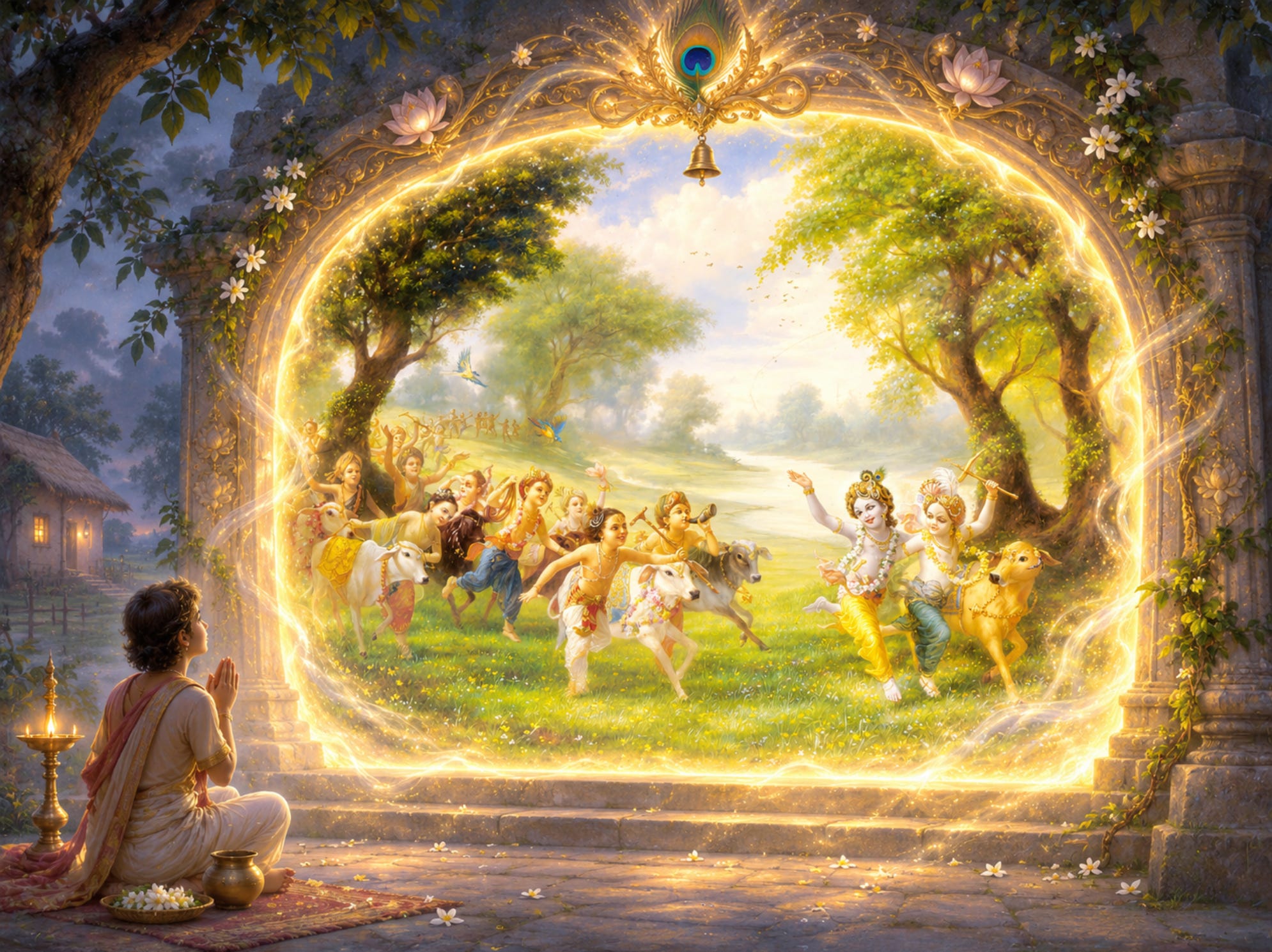
Holy places such as Vṛndāvana and Māyāpur are not simply geographical places on our planet, but extraordinary places where the eternal, unlimited spiritual nature of Kṛṣṇa’s abode and material reality appear to overlap.
We can see this distinction present even in the works of our previous ācāryas. In one place, Vṛndāvana is described as extending for 16 krośas (32 miles), roughly covering the area from present-day Vṛndāvana toward Nandagrāma. In another, however, attempting to measure the area of the holy dhāma is described as one of the six dhāma-aparādhas.
This apparent contradiction is explained in CC Madhya 21.29 by Śrī Caitanya Mahāprabhu Himself:
ṣola-krośa vṛndāvana, — śāstrera prakāśe
tāra eka-deśe vaikuṇṭhājāṇḍa-gaṇa bhāse“According to the revelations of revealed scripture, Vṛndāvana extends only sixteen krośas [thirty-two miles]. Nonetheless, all the Vaikuṇṭha planets and innumerable universes are located in one corner of this tract.”
From one side, Vṛndāvana is measurable. If one takes a surveyor’s chain and measures the distance from Vṛndāvana to Nandagrāma, he will find that the distance is about 32 miles, or 51 km. This measurement can then be used as practical information to build a road, or to describe a path people should walk to go from one place to another.
In the Śrī Navadvīpa-dhāma-māhātmya, for example, Śrīla Bhaktivinoda Ṭhākura gives many concrete measurements for the purpose of mapping the holy dhāma for pilgrimage. At the same time, however, Vṛndāvana is the whole spiritual world, including not only Goloka Vṛndāvana itself, but also all the Vaikuṇṭha planets and even the material universes. We can see an example of this at play in descriptions of the lila. From someone looking from the outside, Vṛndāvana appeared to be a village with a measurable circumference, but once one would gain access to it, one would see that Kṛṣṇa was living there with billions of associates. Similarly, to an ordinary person, Dvaraka appeared to be just a fort built on the ocean, but inside one would find an unlimited area, with millions and millions of palaces, gardens, roads, and so on. Each of Kṛṣṇa’s 16,108 wives had a huge palace complex, and each of their millions of children and grandchildren had similar ones, apart from the housing arrangements for their billions of servants, without even considering all the other inhabitants of the city.
We can imagine holy places as a kind of portal. From the outside, a portal is measurable, just like a door or opening. However, once one enters the portal, one gains access to an unlimited space. This explains how the same scriptures that give measurements to Vṛndāvana also tell us that trying to measure the holy place blocks our entrance to it. The measurements simply describe the geography of our planet to help us to find the entrances for the holy place. Once the locations are found, however, we have to get rid of such geographical distinctions and focus our attention on the spiritual reality if we want to have any hopes of gaining access to it.
As long as one continues to think that Vṛndāvana is just a geographical place on our planet, he or she will not see anything beyond streets, buildings, monkeys, pigs, traffic, and open sewage. Simply buying a ticket or paying for a rickshaw does not give us entry to the holy place. This demands a change in consciousness.
This is a point that is also made in the descriptions of the universe given in the Vedas. The moon, for example, is described as a celestial planet. This is the abode of Soma, where the inhabitants live in great opulence, enjoying the palaces, gardens, etc. However, when an astronaut visits it, he sees only rocks and dust. The main difference is that the inhabitants of the celestial planets have a demigod’s consciousness, which grants them demigod bodies and senses that give them access to the celestial abode. The astronaut is an ordinary human being, with an ordinary human body and senses, that give him only access to a gross dimension where he sees only rocks and dust.
Similarly, a pure devotee gains entrance to Vṛndāvana by developing a spiritual body by which he can gain access to Kṛṣṇa’s transcendental pastimes, while a materialist who simply uses his material senses cannot see past the gross reality of monkeys and traffic.
Initially, a devotee lives in Vṛndāvana while practicing regulated devotional service, and mentally seeing that this is Kṛṣṇa’s abode. His eyes may see the rickshaws and monkeys, but philosophically one understands that this is the spiritual world.
Gradually, by becoming purified, a devotee develops a spiritualized body. At this stage, one still has a material body, but it becomes purified by the practice of devotional service. Just like prasādam is still composed of molecules and can be perceived by an ordinary person, while simultaneously gaining spiritual characteristics, the body of such a devotee is still technically material and can interact with regular people, but simultaneously it develops spiritual qualities due to one’s devotional service. At this stage, a devotee can start having glimpses of the spiritual reality, especially while associating with pure devotees.
Eventually, a devotee may really develop a spiritual body through one’s fixed meditation in Kṛṣṇa’s pastimes. At this stage, one can practically experience the spiritual reality, while at the same time remaining connected with the material reality through the physical body. Devotees at this stage are especially valuable for us, because they serve as bridges between the two realities. Just like Kṛṣṇa’s eternal associates, they experience the spiritual reality, but they can also interact with us and explain it in ways we may understand.
Many disciples of Śrīla Prabhupāda describe that they had the impression that he could close their eyes and see the spiritual world, and then open his eyes again and explain it to them. This gives us some insight into how this works.
This illustrates another point, that is our position as the taṭasthā-śakti, the marginal energy of Kṛṣṇa. As individual souls, we can associate with either Kṛṣṇa’s spiritual potency or with the external potency, the material energy. This choice exists everywhere, but it becomes especially evident in the holy dhāma. The same Vṛndāvana that is for pure devotees a place where they can fully concentrate on Kṛṣṇa’s pastimes and connect with the spiritual reality, is for materialists just another place for eating, shopping, and making money. When we approach the holy place with an enjoying mentality, we automatically become absorbed in the material covering, and the spiritual reality remains hidden.
Śrīla Bhaktivinoda Ṭhākura explains this principle in his Jaiva-dharma:
“Kṛṣṇa’s abode of Vraja is called Brahmapura in Chāndogya Upaniṣad. It is purely spiritual in nature. It has spiritual variety, spiritual creation, spiritual places, spiritual animals, spiritual rivers and trees, spiritual sky, spiritual sun, moon and stars. There is not even a drop of material faults there at all. It is full of spiritual joy. You are in Māyāpura in Navadvīpa which is also the spiritual dhāma. But sitting upon the net of matter made of māyā, you do not touch its spiritual nature. If your spiritual nature arises by the mercy of a devotee, you will see the spiritual place. Your residence in Vraja will be accomplished.”
One phrase that is commonly used in book distribution is “consciousness creates reality”. It may sound like some flashy mantra to attract people’s attention, but it is actually the encapsulation of this universal truth. Ultimately, there is nothing that is not spiritual, since Kṛṣṇa is spiritual and everything comes from him. However, part of the spiritual creation is misused by the conditioned jīvas who try to steal Kṛṣṇa’s energy and use it in their own ways. The stolen energy thus becomes material, just like Sitā immediately exhibited a material form when she was kidnapped by Rāvana.
Kṛṣṇa has three energies, called jīva-śakti, cit-śakti, and māyā-śakti. All three of them are spiritual. However, being inert, the material energy can be misused by the jīvas, who are superior to it. When the energy is separated from Kṛṣṇa, it becomes illusory. Kṛṣṇa explains this point in the Bhagavad-gītā when He defines His material energy as daiva, or divine, in text 7.14:
daivī hy eṣā guṇa-mayī, mama māyā duratyayā
mām eva ye prapadyante, māyām etāṁ taranti te“This divine energy of Mine, consisting of the three modes of material nature, is difficult to overcome. But those who have surrendered unto Me can easily cross beyond it.”
As long as we have an enjoying mentality, everything around us will be material. Even the holy dhāma will look just like a polluted mundane city. However, as soon as this propensity is abandoned and the pure attitude of service to Kṛṣṇa is established in the heart, the curtain of māyā is removed, and one gradually starts seeing the holy dhāma as it is.
Read more:


This is a publication for thoughtful readers who want to go deeper into Kṛṣṇa consciousness. I publish daily, trying to offer high-quality spiritual content, and all posts are available to free subscribers. If you wish, you can support this work with a monthly contribution. When you subscribe, you can choose between a free subscription and a monthly contribution, and you can switch from a free subscriber to a supporter at any time.
You can also receive updates on WhatsApp or Telegram.
If you would like to contribute further, you can find the donation links here.