


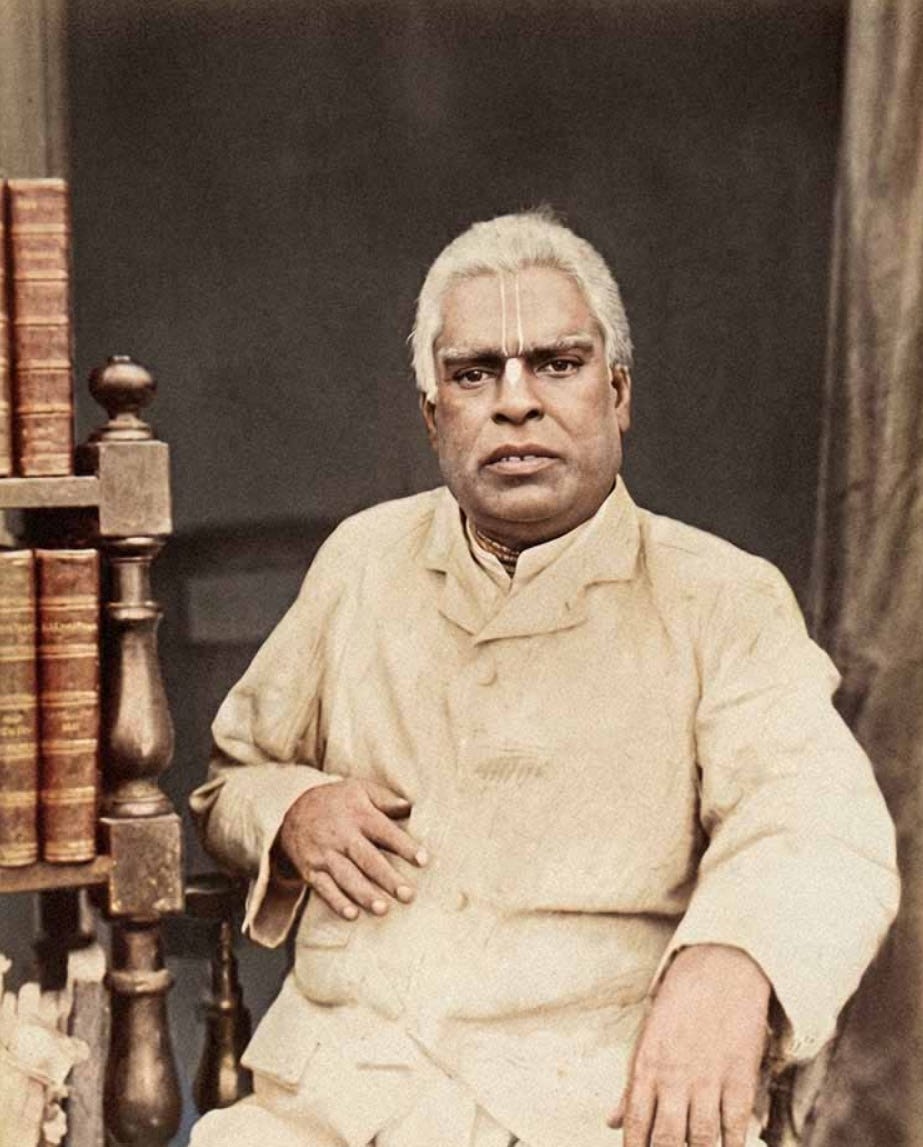
Śrīla Bhaktivinoda Thākura described how many holy places are present in Navadvipa in his Navadvipa Mahatmya. He was also the first of our acaryas to not only write about the presence of different thirtas in Navadvipa but also to locate the precise places. He did so with a combination of research in historical documents and spiritual insight.
Once, when searching for the birthplace of Śrī Caitanya Mahāprabhu, he famously saw an unusual light on the opposite side of the Ganges. Researching about the area, he came across historical documents that confirmed that the historical place of the birth of Mahaprabhu is on the opposite side of what is nowadays Navadvīpa. As he found, a change in the course of the river left the historical Navadvipa underwater for centuries, leading the inhabitants to move to the other side of the river and reconstruct their city there, the present-day Navadvipa. Four hundred years later, the original place had been forgotten, and caste gosvāmis were claiming the birthplace of Mahaprabhu was on the wrong side of the river.
To confirm his discoveries, he brought Śrīla Jagannātha Dāsa Bābājī to the place. At that time, he was already incredibly old and had to be carried in a basket. However, when they arrived at the place, he became surcharged with spiritual ecstasy and began jumping and dancing like a young man, confirming that this was indeed the birthplace of Mahāprabhu.
Perfect devotees can make such discoveries due to their spiritual vision. An ordinary person can only see ordinary places and objects, but devotees of such caliber can get in contact with the spiritual reality and describe it to us. Their accounts are thus the most reliable source of information, just as the description of a person who can directly see an object is the most authoritative.
Once a year, devotees congregate in Mayapur to visit many of these holy places during the Navadvipa Mandala Parikrama. During the parikrama, we visit many holy places, like Naimisharanya, Kurukshetra, Puskara Thirta, and even the Radha-Kunda, which can make many devotees doubtful. To anyone with basic geographical knowledge, this may seem absurd. Everyone knows that Kuruksetra is in north India, that Radha-Kunda is in Vrindavana, and so on. How are we supposed to believe that all these holy places are present in Navadvipa? There is even the Nrishinhapali, where Lord Nrshinhadeva came to rest and washed His hands after killing Hiranyakashipu, a place that is not even supposed to be on this planet! How are we supposed to accept that certain places are simultaneously present in distinct geographical locations throughout the universe?
The first point to understand is that Navadvipa is not merely a geographical location on this planet, but actually part of the spiritual world, just as Vrindavana is not part of the district of Uttar Pradesh, but actually the center of the spiritual world. All the holy places are originally situated in the spiritual world, being part of Kṛṣṇa’s pastimes. When Kṛṣṇa comes to this planet, it is not that He leaves Vrindavana; rather, it is His abode, with all its inhabitants, that becomes visible on this planet. The Vrindavana that we see on this planet is thus a kind of multidimensional space, that is simultaneously a region of this planet, and the core of the spiritual world. It’s a place where the material dimension is in touch with the spiritual dimension. In the material dimension we can see sand, bricks, monkeys, etc., but in the spiritual dimension one can see kalpa-vriksa trees and cintamani stones. Which of the two realities one will see depends solely on his consciousness, but in any case, just by visiting one derives benefit.
There is a story of when a king came to visit Sanatana Goswami. Being satisfied with him, the king offered to donate any amount of money to repair the temples and holy places of Vrindavana. Noticing that the king was proud, Sanatana Goswami pointed to a broken brick and asked if he could fix it. Being so rich, his request almost offended the king. However, before he could voice his dissatisfaction, Sanatana Goswami revealed to him the spiritual form of the brick. The king could see that the brick was actually made out of gold and cinthamani stones. There was nothing he could improve: this simple brick was actually much more valuable than anything he had in his treasure. Baffled, the king could understand that there was nothing he could offer.
Similarly, when Lord Caitanya manifests His pastimes, His abode manifests in Navadvipa. This is what is called prakāśa; the eternal abode of the Lord becomes manifest in the material world. What does it mean? We can say that just like Vṛndāvana, Navadvipa is a multidimensional space, a place where the material and spiritual dimensions are in touch. All the different thirtas, or holy places, that are present in different parts of this universe are actually expansions of the original holy places present in the spiritual world. Both Vṛndāvana and Navadvipa are manifestations of the spiritual world; therefore, it is natural that all the original holy places are present there. Just as Navadvipa is like a portal, a place where we can access the spiritual realm, specific places in Navadvipa are portals to these specific places in the spiritual world.
Holy places situated in other parts of the world, like Kurukshetra in Haryana, or the Puskara Tirtha in Rajasthan, are actually just expansions of the original holy places that are situated in Navadvipa. Therefore, by doing parikrama in Navadvipa, one gets even more benefit than one who does a pilgrimage through the whole of India. One that has time and money to spare may take the long road and travel all over India, but one that is eager to make advancement can just stay in Navadvipa and visit all these places in just one week during the Navadvipa Mandala Parikrama.
Finally, Navadvipa is non-different from Vṛndāvana. Prabhupāda explains that in his purport to SB 10.1.28 and in other places:
“Vrajabhūmi” refers to Mathurā-Vṛndāvana, and Gauḍa-maṇḍala-bhūmi includes Navadvīpa. These two places are nondifferent. Therefore, anyone living in Navadvīpa-dhāma, knowing Kṛṣṇa and Śrī Caitanya Mahāprabhu to be the same personality, lives in Vrajabhūmi, Mathurā-Vṛndāvana. The Lord has made it convenient for the conditioned soul to live in Mathurā, Vṛndāvana and Navadvīpa and thus be directly connected with the Supreme Personality of Godhead. Simply by living in these places, one can immediately come in contact with the Lord. There are many devotees who vow never to leave Vṛndāvana and Mathurā. This is undoubtedly a good vow, but if one leaves Vṛndāvana, Mathurā or Navadvīpa-dhāma for the service of the Lord, he is not disconnected from the Supreme Personality of Godhead. At any rate, we must understand the transcendental importance of Mathurā-Vṛndāvana and Navadvīpa-dhāma. Anyone who executes devotional service in these places certainly goes back home, back to Godhead, after giving up his body.”
This explains why even places like the Radha-Kunda are manifested there. One who bathes in the Radha-Kunda in Navadvipa achieves the same result as one who bathes in Vṛndāvana, and one who visits one of them gains the benefit of visiting both.
In chapter twelve of the Navadvīpa-dhāma Māhātmya, we have a moving description of Lord Nityananda visiting Ṛtudvīpa and becoming absorbed in the ecstasy of Vrindāvana.
“Eventually, they came to Rātupura. Upon seeing the beauty of the town, Nityānanda Prabhu said, “We have come to Ṛtudvīpa, which is extremely enchanting.
”The trees bow their heads, the breeze blows gently, and the flowers bloom in all directions. The humming of the bees and the fragrant nectar of the flowers intoxicate the hearts of travellers.” As He spoke, Nityānanda Rāya became almost mad and said, “Quickly bring My horn! The calves have run off, and Kānāi is asleep. Like a child, He does not come now.
“Where are Subala and Śrīdāma? I, Balarāma, cannot go out to tend the cows alone.” With great power, Nityānanda called out, “Kānāi! Kānāi!” and jumped a couple of metres.
Seeing His ecstasy, the devotees quickly submitted at His feet, “O Nityānanda Prabhu! Your brother Gaura-candra is not here now. “The Lord has taken sannyāsa and gone to Nīlācala, leaving us destitute.” Hearing this, Nityānanda became dismayed. He fell to the ground and wept. “What sorrow! Brother Kānāi! You left us and became a sannyāsī in Nīlācala! I cannot continue this life; I will dive into the Yamunā.” Saying this, Nityānanda lost consciousness.
Everyone saw the intense ecstasy of Nityānanda and chanted the Lord’s Name. An hour and a half passed, but Nityānanda did not get up. Finally, the devotees sang songs about Gaurāṅga. Hearing the Name of Gaurāṅga, Nitāi immediately arose and said, “This is the place of Rādhā Kuṇḍa. Here, Gaurahari would perform kīrtana with the devotees in the afternoon.
“Here, the six seasons meet and enhance the beauty of Gaurāṅga’s kīrtana Pastimes. Rādhā Kuṇḍa in Vraja is present here in Ṛtudvīpa, where devotees drink and relish divine love.
“See also the beauty of Śyāma Kuṇḍa, which enchants the mind of every soul in this world, and the groves of the sakhīs nearby. Gorā would become immersed in saṅkīrtana here in the afternoon and satisfy everyone with the gift of divine love.
“Brother! We find no place like this in the three worlds. Know it to be a place for the devotees to serve. Souls who reside here attain the wealth of divine love, and their hearts become serene.”
Remaining there for the day, calling the Name of Śrī Gaurāṅga, all the devotees became immersed in divine love. They spent the day and night in Ṛtudvīpa and worshipped the moon-like Śrī Caitanya. Then, dancing as He went, Nityānanda Prabhu arrived in Śrī Vidyā Nagara. The beauty of the town attracts the minds of sages, and upon seeing it, the devotees were jubilant.”
Read more:


This is a publication for thoughtful readers who want to go deeper into Kṛṣṇa consciousness. I publish daily, trying to offer high-quality spiritual content, and all posts are available to free subscribers. If you wish, you can support this work with a monthly contribution. When you subscribe, you can choose between a free subscription and a monthly contribution, and you can switch from a free subscriber to a supporter at any time.
You can also receive updates on WhatsApp or Telegram.
If you would like to contribute further, you can find the donation links here.