

« Making Sense of the Vedic Universe, a Higher-Dimensional Reality
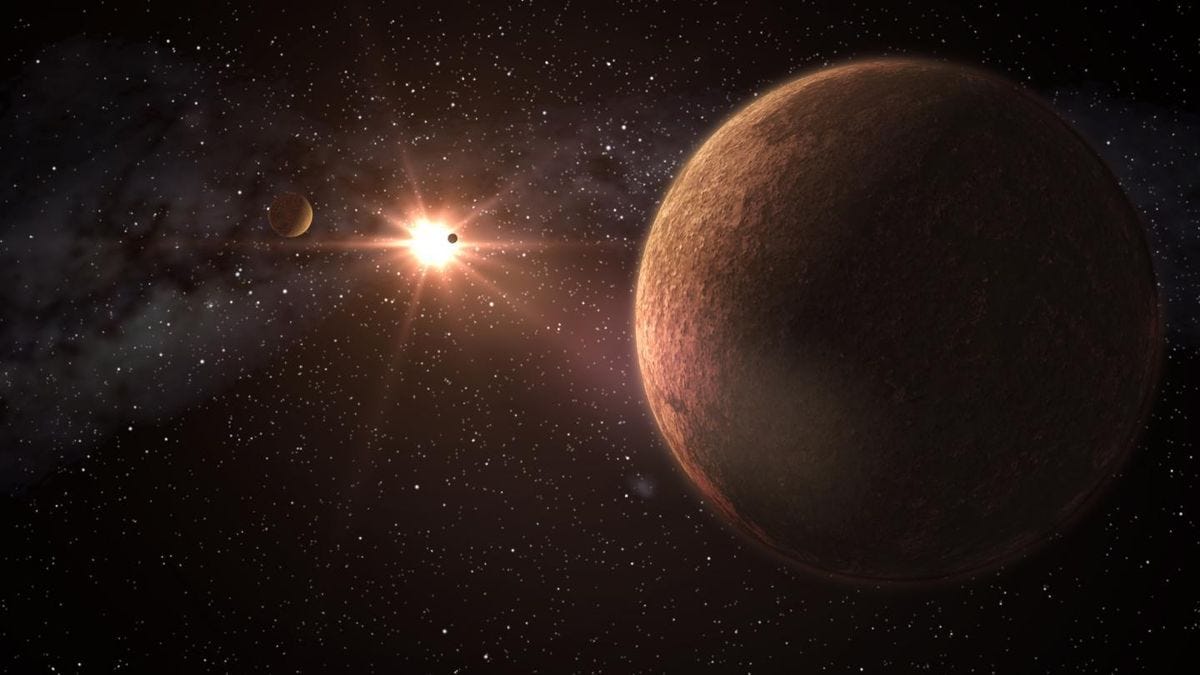
Exoplanets from the Vedic perspective
One of the most obvious and expected objections to the idea of Bhū-mandala as a planetary system is the simple fact that we cannot see the other planets that form it. As we have already studied, the other planets of our solar system, such as Mars and Saturn, are considered celestial planets and not part of Bhū-mandala, just as the sun, the moon and the nearby stars. Apart from earth itself, all the other visible celestial bodies we can observe using the naked-eye are part of Svargaloka. The rest of Bhū-mandala is nowhere to be seen.
Prabhupāda concluded that Bhū-mandala is composed of different planets, spread through the cosmos. Still, one could argue, where exactly are they? We can observe the stars that compose Svargaloka, described as the śiśumāra, every night in the sky, and the other distant stars and galaxies can be mapped to the planetary systems of Maharloka, Janaloka, Tapoloka, and Satyaloka, as well as, possibly, structures that are part of the coverings of the universe. Why is it that the only part of the universe we cannot see consists precisely of the intermediate planets?
The existence of the other planets that form the intermediate planetary systems may be another feature of the Vedic universe to be confirmed by recent scientific discoveries: exoplanets (planets orbiting stars other than the sun). Recent discoveries suggest that there may indeed be planets all over the cosmos. This discovery, however, also raises another point that calls for reconciliation.
First of all, how are exoplanets detected, and how reliable are the methods? The first methods consisted of inferring the existence of a planet orbiting a star by observing small changes in the light detected from earth. The most productive of these early methods was the transit method. When a planet passes in front of its star from our point of view, it blocks a tiny fraction of the light. The star, therefore, appears to dim at regular intervals, and astronomers conclude that a planet is orbiting it. From the depth of the dimming, they can estimate the size of the planet, and from the interval between transits, they can estimate its orbital period. Another method is radial velocity, in which astronomers detect the slight back-and-forth motion of a star, which is attributed to the gravitational pull of an orbiting planet. This allows researchers to calculate the planet’s mass and orbital period.
Over time, the reliability of these methods improved, with new methods surfacing, and being used to complement and confirm one another. This culminated in direct imaging, allowing the direct capture of images of these exoplanets. The most successful of these methods are based on blocking the light of the main star, creating a dark region around which the light of the faint planet can be observed:
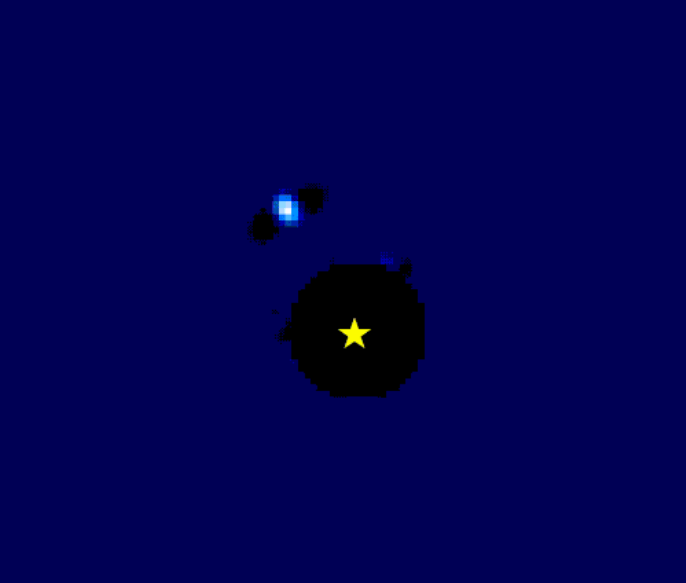
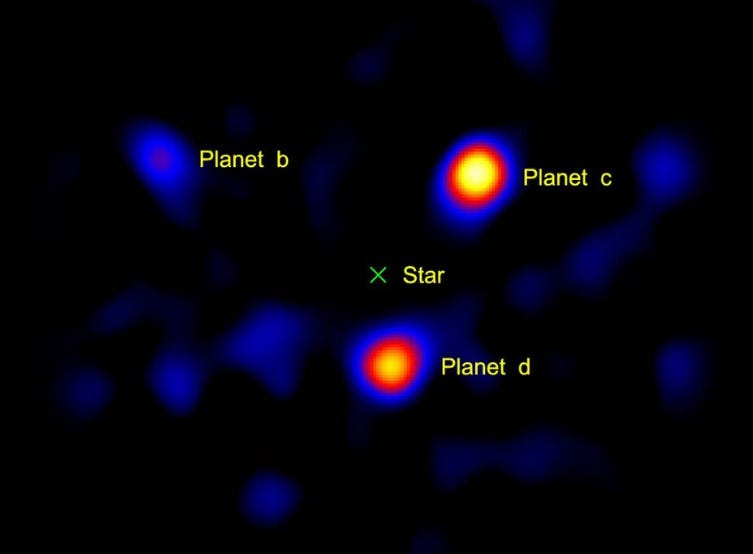
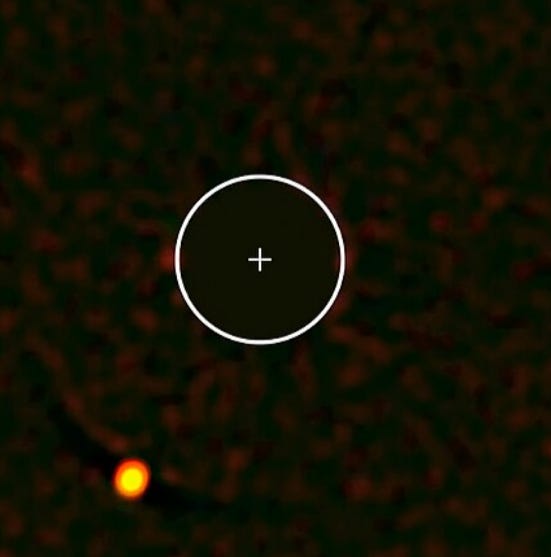
Images of faint objects orbiting distant stars are not absolute proof that these are planets, but they are part of a growing body of evidence.
There are always reasons for skepticism, but if we accept this evidence as valid, does it invalidate the model of the universe we have been discussing up to this point? The answer is no; it simply adds a new layer to it.
Modern astronomy is not directly entering these planetary systems, nor is it perceiving them in the way an inhabitant of these realms would. It is simply detecting disturbances in light and motion within our gross material plane. In other words, it describes a certain level of reality, but not necessarily the same level of reality described in the Śrīmad-Bhāgavatam. It belongs to the same general category as the Sūrya-siddhānta: it is an observational and computational method based on what can be measured from the human platform. It tells us something real, but only within the limits of our restricted observational framework. In other words, it describes things as they are seen on our gross plane; what they are in higher levels of reality, we can only infer.
We have already been discussing that the moon, sun and close planets we see in the sky are not directly the higher-dimensional celestial bodies discussed in the Śrīmad-Bhāgavatam, but gross representations of them. The idea of exoplanets around distant stars simply adds another layer to this concept of multidimensional objects.
The universe exists simultaneously on gross and subtle levels; what is visible to us is just the gross side of a much richer reality. Just as the moon described in the Purānas as a celestial planet appears as just rock and dust to us, so too the sun and the planets of our solar system (described as celestial abodes) may present one aspect to our instruments and another to superior beings with access to subtler levels of reality. Both a three-dimensional object and its shadow projected onto a two-dimensional surface are real, but the shadow is only a reduced representation of the original.
The same concept can be applied to exoplanets. From our side, we measure light, orbital periods, mass, distance, etc. From the side of the demigods, however, the same object may be integrated into a higher order of meaning, function, and accessibility. What for us appears to be just another gas giant can appear as a pleasing place to inhabitants who have appropriate bodies to live there. What appears to be many light years away for us, can be easily accessible to beings with the right set of bodies, senses, and knowledge; and so on.
The Vedic conclusion is that there is just one sun and one moon per universe, and that they are essential for life itself. Without the sun and the moon, there could be no life on earth, or in other planets of the intermediate planetary system. This conclusion can be preserved if we understand the visible stars with planetary companions not as independent suns in the empirical sense, but as gross projections of the same solar principle represented in our system by the sun-globe we see in the sky.
It may seem improbable at first, but it is important to note that the sun-globe, as well as the sun-god, are representations of Kṛṣṇa. He is the one who powers both. It is not strange, therefore, to consider that the same sun can appear simultaneously in different parts of the cosmos, sustaining life in many different planets spread throughout the universe, just as Kṣīrodakaśāyī Viṣṇu is just one, present in Dhruvaloka, but at the same time appears everywhere as Paramātma.
At the same time, all these different celestial bodies must be accepted as representations of the same solar potency that governs the whole intermediate system. The sun is one, the Lord is one, and the demigod of the sun is one, but somehow, in our gross dimension, they appear to be present in different places simultaneously.
The same may apply to the moon. Just as in the case of the sun, the scriptures describe a single celestial moon per universe, which is the source of life for all beings. This celestial moon is even subtler than the sun and higher in the vertical dimension. At the same time, it appears as a celestial body in our gross dimension. Considering the possibility that other planets may have their own gross manifestations of the sun, they may also have, similarly, their own gross representations of the moon, similar to our case.
This idea may sound very unusual at first, but it follows the central logic we have been following in this book: The Śrīmad-Bhāgavatam, as well as other Puranas, describes a higher-dimensional reality that is not exactly the same as we can observe with our senses. It would be fair to demand to see Mount Sumeru, the great mountains and celestial varṣas of Jambudvīpa, as well as the other structures of the Vedic universe, if we were demigods, but unfortunately, we are not demigods. We don’t have the consciousness of demigods, we don’t have bodies and senses of demigods, nor do we have the knowledge of demigods. We are what we are, stuck in a very gross level of reality. We can’t thus match the way they see the cosmos, but we can try to understand it.
When we hear the description of the Vedic universe, we tend at first to imagine a flat island with a dome of stars over it. That’s the same primitive conception of people from the Middle Ages. This is, however, not what the model is; it is just our primitive understanding being projected into it. As we study the model more thoroughly, we can deepen our understanding of it and get access to progressively higher levels of understanding.
Apart from Kṛṣṇa, no one can perfectly understand the universe, including Brahmā himself. Brahmā believed he perfectly understood the structure of the universe and the dimensions that compose it, but when he used his power to kidnap Kṛṣṇa’s associates, as described in the 13th chapter of the Tenth Canto, Kṛṣṇa surprised Him by showing an extra dimension he had no idea could exist. In this higher dimension, Kṛṣṇa brought all the Brahmās from all the universes together, without any of them leaving his own universe. Suddenly, all the material universes, including all the forms of Garbhodakaśāyī Viṣṇu, as well as all the Śivas, Brahmās, all planetary systems and all living beings, were contained in the small space in the outskirts of Vṛndāvana where Brahmā and Kṛṣṇa met. If even Brahmā can be confused by certain aspects of creation, we can’t expect to understand the structure of the universe easily.
Back to the central point, we already studied that in the Vedic universe there is one moon, yet that moon performs functions not only for our earth, but for the whole system of Bhū-maṇḍala. We have also seen that the many planets and stars that appear scattered through the sky appear close together in the high-dimensional reality of the demigods, grouped according to levels of existence and organized in a way that is very different from the random and almost empty cosmos imagined in modern theories. If the celestial moon can transcend the narrow, gross object we call “the moon,” then the same may apply in an even more striking way to the sun.
From our gross material perspective, reality appears fragmented. Things that may be close in a higher-dimensional arrangement appear far apart to us. Similarly, things that may be manifestations of one higher principle may appear separate. Just as a three-dimensional object illuminated by different sources of light may cast many different two-dimensional shadows simultaneously, the higher-dimensional structure of Bhū-maṇḍala may project itself into our observational field as many apparently separate stellar systems. Both the original object and the shadows it casts are real, but the shadows are only reduced projections of the original. Similarly, what we see in the sky is real, but it does not represent the same level of reality that is experienced by inhabitants of higher-dimensional realms.
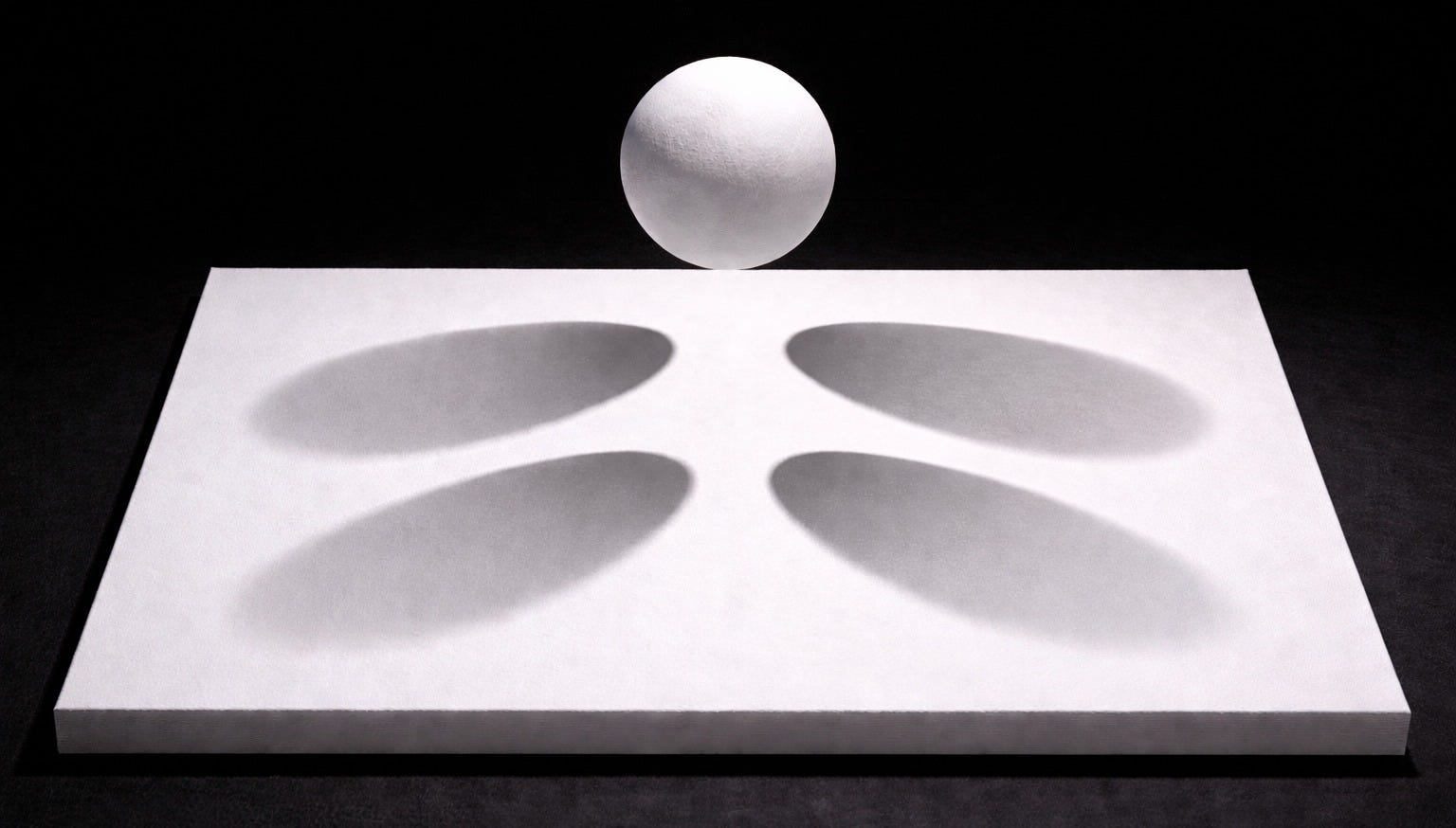
Under this thesis, the exoplanets detected around a number of stars in recent observations could be understood as the other intermediate planets that form Bhū-maṇḍala, or as their gross representations, appearing in our gross dimension as separate stellar systems.
In this case, we could conclude that in the higher-dimensional space of the demigods, these planets appear integrated into a single ordered system, illuminated by one sun and one moon, forming the higher-dimensional structure of Bhū-mandala. In our empirical observations, however, they appear as planets orbiting distant stars because that is how this higher-dimensional arrangement is translated into human sense perception. In other words, exoplanets are not a new challenge to the model, but yet another confirmation of it, answering the question of where the rest of the intermediate planets that form Bhū-mandala are.
Once again, this reveals that the Vedic model is much more complex than it may appear at first glance and that we are still far from fully grasping it, just like Brahmā himself was.
Another idea that this thesis brings into consideration is that just as the sun, as a higher dimensional object, can appear in many different gross representations, illuminating the different sets of intermediate planets, all the stars, galaxies, and other astronomical objects we see in the sky should be nothing more than gross representations of the planets and stars that compose the higher planetary systems of Svargaloka, Maharloka, Janaloka, Tapoloka, and Styaloka. This explains the many discrepancies we find when we try to map the modern cosmological model to the Vedic model, since what we see when we look to the sky is just the reflection of a higher reality, just like stars reflected on a lake.
Imagine that everything we knew about the cosmos was the view of the sky reflected on a lake in front of us. Would it be possible to create perfect models of the cosmos based on this limited set of evidence? Probably we would end-up with more questions than answers. This appears to be precisely our situation when we try to understand the universe based only on telescope observations. Reality is much more complex than what we can theorize.
Concluding, there is yet another type of object identified by modern cosmology that can be connected to the Vedic universe: free-floating planets. These are planets that are not bound to any star. Modern astronomers and astrophysicists speculate that they may be planets ejected from solar systems, or celestial bodies that formed from masses of matter too small to form a star, ending as brown dwarfs. Whatever their origin, they can be seen as corresponding to another description of the Vedic universe: the subterranean realms of the asuras, dark worlds that do not receive the light of the sun. Just as the different planets that form Bhū-mandala, they are also supposed to be scattered throughout our observable universe, but appear close together in organized planetary systems in the high-dimensional universe perceived by the demigods.
In the Vedic model, the lower planetary systems form the lower half of the universe. In other words, lower planets could be as numerous as intermediate and higher planets, if not more. According to current cosmological theories, free floating planets are likely to be far more common than exoplanets attached to stars. This again confirms the Vedic model.
We could then offer, as a preliminary thesis, that:
a) The numerous free-floating planets may correspond to the lower planetary systems of the asuras, where the inhabitants live in darkness, depending on different types of artificial lights.
b) Exoplanets attached to stars may correspond to the other intermediate planets that form the huge structure of Bhū-mandala, each group with their own projection of the sun and moon, just as in our case.
c) Svargaloka may be represented by our local stellar neighborhood, composed of stars relatively close to us in the cosmic scale, up to the Polestar (Dhruvaloka).
d) Distant stars, galaxies, and other cosmic bodies may be representations of abodes that compose the higher planetary systems of Maharloka, Janaloka, Tapoloka, and Satyaloka, and potentially structures from the coverings of the universe, forming the entire observable universe.
e) Beyond the coverings and undetectable to us are innumerable other material universes, and beyond the whole material creation are the Causal Ocean, the impersonal Brahmajyoti, and the Vaikunta planets. Vast and incomprehensible it may appear to us, our entire universe represents thus just a tiny particle of the whole creation.
Read the whole book:
« Making Sense of the Vedic Universe, a Higher-Dimensional Reality
This is a publication for thoughtful readers who want to go deeper into Kṛṣṇa consciousness. I publish daily, trying to offer high-quality spiritual content, and all posts are available to free subscribers. If you wish, you can also choose a paid subscription to support this work.
You can also receive the updates on WhatsApp or Telegram.
If you would like to contribute further, you can find the donation links here.