

« The Song of God—Volume 1, chapters 1-6
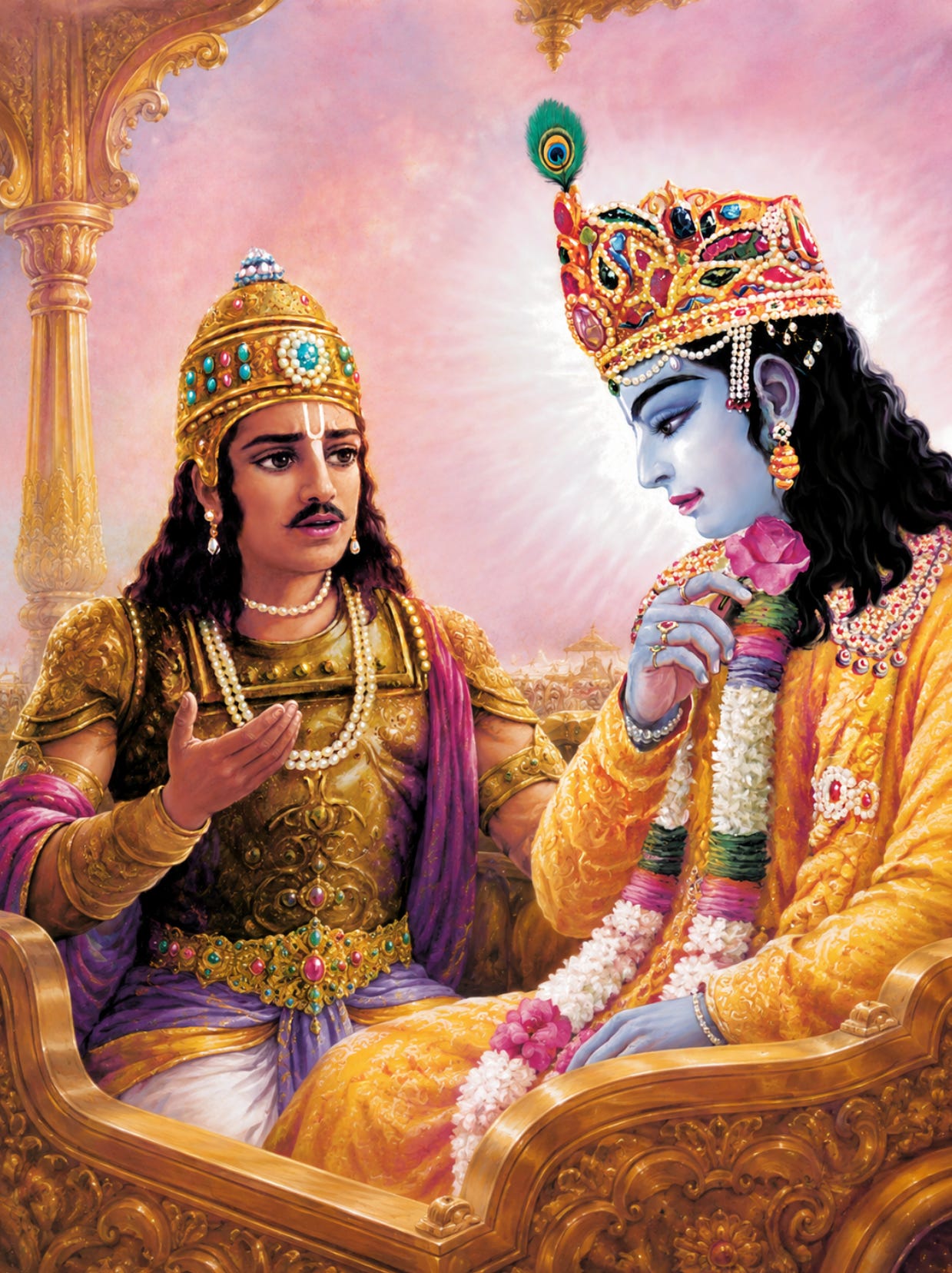
Four questions: The characteristics of the self-realized devotee (Bg 2.54 to 2.72)
After hearing Kṛṣṇa’s description of the path of Kṛṣṇa consciousness, Arjuna inquires about how to recognize a person who has attained the perfection Kṛṣṇa has been describing. What are the qualities one is supposed to develop, and how can we recognize a person who has attained perfection on this path? This is a natural question: Kṛṣṇa is teaching him to become fixed in transcendental consciousness, and Arjuna wants to understand how such realization manifests in practice. Kṛṣṇa answers by describing how such a devotee gives up material desires, remains equipoised in happiness and distress, controls the senses, and acts without attachment. The Bhagavad-gītā starts with Arjuna almost crying in distress, and Kṛṣṇa now describes the characteristics of one who has attained the platform of transcendental peace.
Text 54: arjuna uvāca
sthita-prajñasya kā bhāṣā, samādhi-sthasya keśava
sthita-dhīḥ kim prabhāṣeta, kim āsīta vrajeta kim
Arjuna said: O Kṛṣṇa, what are the symptoms of one whose consciousness is thus merged in transcendence? How does he speak, and what is his language? How does he sit, and how does he walk?
In the previous verse, Kṛṣṇa recommended that Arjuna reject fruitive activities and be situated on the platform of samādhi, in complete Kṛṣṇa consciousness. For this, He recommended buddhi-yoga (work in devotion and cultivation of spiritual knowledge) as the way to become free from material illusion. As we advance on this path, we gradually become equipoised in material happiness and distress, becoming detached from matter. Gradually, we come to the platform of samādhi in Kṛṣṇa consciousness.
Arjuna now asks, very intelligently, what are the symptoms of great devotees who have attained this platform? This has two purposes: he wants to learn how to recognize them, and also to understand the path to attain the same platform.
Arjuna thus asks four questions that Kṛṣṇa answers through the end of the second chapter:
1) What are the symptoms or characteristics of one merged in transcendence?
2) How does he speak? How are his intelligence and words affected by others’ affection, anger, or neutrality? How does he respond to external sources of agitation?
3) How does he sit? In other words, how and when does he restrain his senses?
4) How does he walk? In other words, how does he act, or engage his senses?
The answers Kṛṣṇa gives apply primarily to a pure devotee who has surrendered to Him, but secondarily, they also apply to other types of transcendentalists who have become liberated through impersonal realization. Both the devotee and the impersonalist can reach the stage of liberation, and thus manifest the symptoms described here, but the devotee can go higher, reestablishing his eternal spiritual identity, while impersonalists may become free from material contamination, but remain in orbit in the brahmajyoti, incapable of entering the spiritual planets. Later in the Bhagavad-gītā, Kṛṣṇa mentions that “One who is thus transcendentally situated at once realizes the Supreme Brahman and becomes fully joyful. He never laments or desires to have anything. He is equally disposed toward every living entity. In that state he attains pure devotional service unto Me.” This shows that Brahman realization is preliminary and that pure devotional service is the final perfection.
Main points in the purport of Śrīla Prabhupāda:
“Arjuna said: O Kṛṣṇa, what are the symptoms of one whose consciousness is thus merged in transcendence? How does he speak, and what is his language? How does he sit, and how does he walk?”
a) Like everyone else, a pure devotee has a specific nature that can be identified by his practical actions in talking, walking, thinking, feeling, etc. The most important symptom is how he speaks, because this allows one to easily identify such a pure devotee and set him apart from other categories of people. He speaks only of Kṛṣṇa and of topics relating to Him. Other symptoms then automatically follow.
Next: Q1: What are his symptoms? (Bg 2.55)
Read the entire book:
« The Song of God—Volume 1, chapters 1-6

This is a publication for thoughtful readers who want to go deeper into Kṛṣṇa consciousness. I publish daily, trying to offer high-quality spiritual content, and all posts are available to free subscribers. If you wish, you can also choose a paid subscription to support this work.
You can also receive the updates on WhatsApp or Telegram.
If you would like to contribute further, you can find the donation links here.