


You can receive new articles directly in your inbox. Subscription is free; donations are welcome.
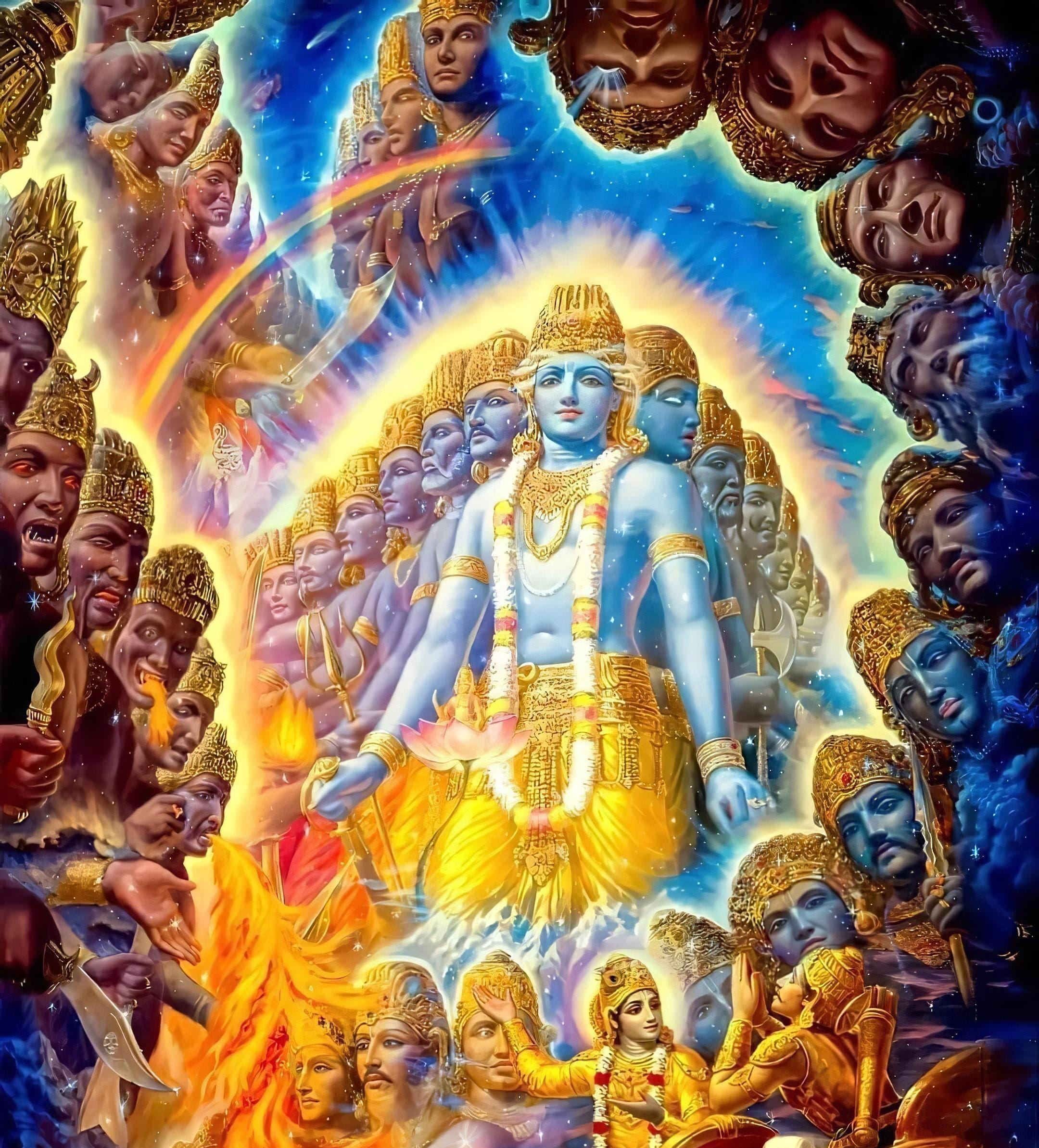
In the Bhagavad-gītā 11.32, we find a passage that can sound bewildering. After showing His powerful universal form to Arjuna, Kṛṣṇa says:
kālo ’smi loka-kṣaya-kṛt pravṛddho
Time I am, the great destroyer of the worlds.
Similarly, in 10.34, He mentions:
mṛtyuḥ sarva-haraś cāham
I am all-devouring death.
We normally see Kṛṣṇa as the most beautiful person, the unlimitedly merciful well-wisher of His devotees, and the supreme object of love for all pure souls. We may then have difficulty in relating this beautiful personal form of God with such destructive aspects of nature.
This, however, is the product of a misunderstanding. When a child discovers that his father is an MMA champion, this doesn’t make him fearful. On the contrary, it makes the boy more confident in the protection of his father. However, when a street thug who is picking on the boy discovers the same truth the hard way, that’s terrifying.
In the same way, Kṛṣṇa appearing as Nṛsiṁhadeva to save Prahlāda was terrifying for Hiraṇyakaśipu, who was threatening Him, but supremely merciful to the devoted Prahlāda. Ultimately, however, Hiraṇyakaśipu was also benefited, attaining liberation after two more lives. Nṛsiṁhadeva was thus merciful to both; His mercy was simply interpreted differently due to the difference in their consciousness.
Kṛṣṇa, as the Supreme Lord, is the possessor of all potencies, and this includes both the beautiful and terrifying aspects. Kṛṣṇa’s potency is one, but it is experienced differently according to our relationship with Him. The same Supreme Lord who is the beloved protector of His devotee appears as all-devouring death to one who rejects His authority to create the possibility of change in one’s next lives.
A good example is Robert G. Ingersoll (1833–1899), an American agnostic, lawyer, and public lecturer. He became famous for giving public speeches attacking Christianity and people’s belief in God.
In one of these lectures, he challenged, “I’ll give God a chance to prove that He exists and is almighty. I challenge Him to strike me dead within 5 minutes!”
As expected, nothing happened. Kṛṣṇa tolerated the 100 offenses of Śiśupāla. Five minutes are not enough to exhaust His patience. Ingersoll, however, misunderstood the situation. Instead of realizing his impotency in manipulating God’s will, he took it as a sign of victory and declared, “See! There is no God. I am still very much alive.”
Ingersoll could keep his audience entertained for five minutes, but he could not dictate a meeting time to God. Eventually, however, his appointed time came, and the Lord appeared in the form no atheist can deny: death.
Time is a manifestation of Kṛṣṇa because it is extremely powerful and inescapable. Everything that is material decays due to the passage of time. People become old, objects become worn-out and rusty. Time forces us to confront the temporality of this world and eventually compels us to move on.
Similarly, death is the force no one can escape. Even though most people prefer to forget about it and imagine death will never come, at least intellectually we understand that everyone must die one day. This even enters our language in the form of expressions such as “as sure as death.”
There is, however, a difference between the way a materialist relates to these two powerful forces and the way a devotee relates to them.
For a materialist, death is terrifying because it comes to take everything he is attached to: his riches, his real estate, relatives, and friends, and even his own body. Everything he worked so hard to build and maintain is taken away at death. Time is no less terrifying. Death may be taken as something abstract that will only come in a distant future, but the effects of time are constant with us, taking away our youth, our vitality, our beauty, our health, and so on.
For a devotee, things are very different. A devotee understands the temporality of this world and its shortcomings. He or she does not hate it. He can appreciate its beauty and accept his role in it. A devotee can thus dutifully maintain a family, be a responsible employer or employee, and so on. There are three essential differences, however.
The first is that a devotee understands the relationship of this world with Kṛṣṇa. He or she does not try, thus, to exploit it. He sees the world as Kṛṣṇa’s energy, which should be used for Him. A devotee plays thus his role in it, while trying to connect the energy and the energetic, offering everything to Kṛṣṇa.
The second point is that a devotee understands that this world is temporary and thus does not become excessively attached to it. We may speak with people on a train, perhaps even make friends, but when our station comes, we do not lament. The fact that the trip will last just a few minutes or hours does not make us insensitive to people around us. It does not prevent us from forming relationships and trying to positively influence them. It just puts everything into perspective.
The third point is that a devotee understands that this is not our original home and thus does not lament when the time to depart comes. On the contrary, a devotee welcomes it, understanding that death is the time for moving to the real home, the start of an eternal existence of spiritual bliss with Kṛṣṇa in the spiritual world.
Prabhupāda gives us an instructive example. A cat carries both mice and her kittens in her mouth, but the situation is vastly different. A mouse sees itself in the jaws of death and becomes terrified, while the kitten feels perfectly safe and comfortable, understanding that mother is just moving it to another place.
Read more:


This is a publication for thoughtful readers who want to go deeper into Kṛṣṇa consciousness. I publish daily, trying to offer high-quality spiritual content, and all posts are available to free subscribers. If you wish, you can support this work with a monthly contribution. When you subscribe, you can choose between a free subscription and a monthly contribution, and you can switch from a free subscriber to a supporter at any time.
You can also receive updates on WhatsApp or Telegram.
If you would like to contribute further, you can find the donation links here.