


You can receive new articles directly in your inbox. Subscription is free; donations are welcome.
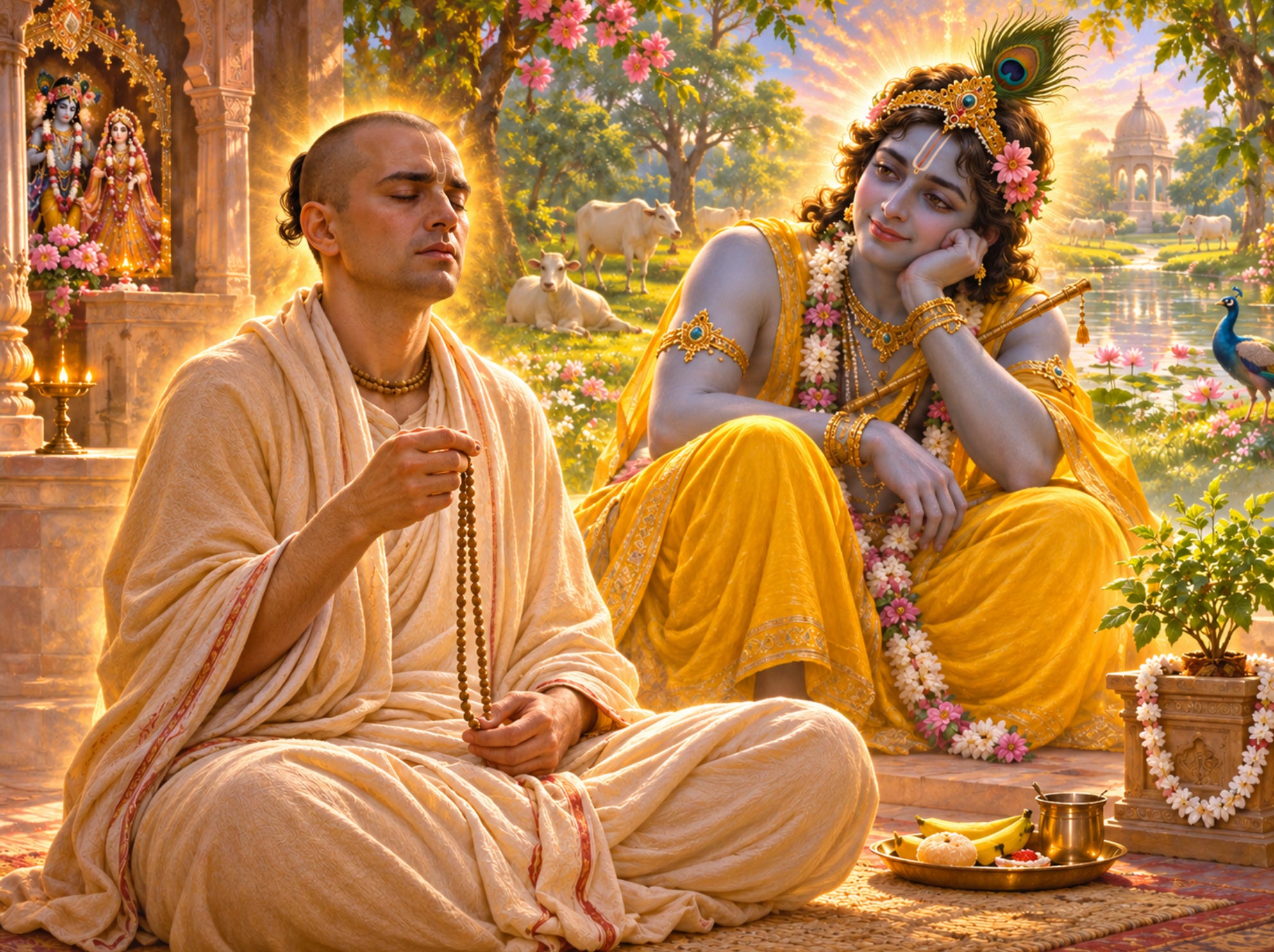
How can we live with Kṛṣṇa? Some may say that we first have to achieve perfection and then wait until death to finally be with Him.
There is, however, a verse in the Gītā that contradicts this version. In 12.8, Kṛṣṇa mentions:
“Just fix your mind upon Me, the Supreme Personality of Godhead, and engage all your intelligence in Me. Thus you will live in Me always, without a doubt.”
Here, Kṛṣṇa states the goal. By fixing our minds upon Him and being completely engaged in Kṛṣṇa consciousness, always, we will always live with Him, even while still living in a material body.
How is this possible? The point is that both material and spiritual are energies of Kṛṣṇa, and He can convert one into the other. Just like food offered to Kṛṣṇa becomes spiritualized prasādam, the material body of a devotee becomes spiritualized. This means that although technically still a material body that can interact with this world, it starts acting like a spiritual body. Prabhupada gives the example of a metal bar becoming red-hot by being put into the fire. Technically, it is still metal, but the proximity makes it start acting like fire.
When we attain this stage, our material existence effectively ends; we are already with Kṛṣṇa.
Material life means to let our minds remain fixed in matter. This is like keeping the metal bar in the water. In the verse, Kṛṣṇa uses the word “eva” (certainly, simply, only) twice to tell us to fully engage our mind and our intelligence in Him instead of matter, or, in other words, put the metal bar into the fire.
mayy eva mana ādhatsva, mayi buddhiṁ niveśaya
nivasiṣyasi mayy eva, ata ūrdhvaṁ na saṁśayaḥ.
Kṛṣṇa’s construction has a flavor of simplicity: just do it, don’t think too much. This is captured by Prabhupāda with the word “just”: Just fix your mind upon Me.
This brings us to the central point of this article: how can we bring this into our lives? How can even a neophyte operate at this stage, even if temporarily?
Prabhupāda gives us a hint in his purport:
“A devotee does not live on the material plane – he lives in Kṛṣṇa. The holy name of the Lord and the Lord are nondifferent; therefore when a devotee chants Hare Kṛṣṇa, Kṛṣṇa and His internal potency are dancing on the tongue of the devotee. When he offers Kṛṣṇa food, Kṛṣṇa directly accepts these eatables, and the devotee becomes Kṛṣṇa-ized by eating the remnants.”
We don’t need to wait until we reach the stage of prema to be with Kṛṣṇa. He is present in all devotional activities, and therefore if we can find a situation where we remain surrounded by devotees who are absorbed in Kṛṣṇa and remain immersed in this environment of hearing, chanting, and serving, we can remain with Kṛṣṇa even in the initial stages of our devotional practice.
How can a neophyte remain immersed like this before even passing through the preliminary stages of regulated practice, anartha-nivṛtti, etc.? This can arise through what is technically known as chāyā-rati-ābhāsa, a shadow of attachment for Kṛṣṇa that appears through the association of pure devotees, before real attachment becomes firmly manifested in the heart.
This shadow allows us to perform devotional service at a much higher level than we would be able to do in ordinary circumstances. We may spontaneously wake up every morning, attend maṅgala-ārati, chant many rounds daily, and spend our time blissfully engaged in different services. If we can keep ourselves absorbed in devotional service in this environment, we can advance to a platform of genuine love for Kṛṣṇa rather quickly. Prabhupāda discusses this point in more detail in the eighteenth chapter of the Nectar of Devotion:
“Such shadow attachment or parā attachment can develop if one associates with a pure devotee or visits holy places like Vṛndāvana or Mathurā, and if an ordinary man develops such attachment for Kṛṣṇa and fortunately performs devotional activities in the association of pure devotees, he can also rise to the platform of pure devotional service. The conclusion is that transcendental attachment is so powerful that if such attachment is seen manifested even in some common man, by the association of a pure devotee it can bring one to the perfectional stage. But such attachment for Kṛṣṇa cannot be invoked in a person without his being sufficiently blessed by the association of pure devotees.”
What if we are not fortunate enough to sustain this complete absorption? How can we strengthen our determination? Kṛṣṇa recommends the process of sādhana-bhakti, performing regulated devotional service under the guidance of the spiritual master—waking up early, chanting sixteen rounds or more daily, following the four principles, studying the Bhagavad-gītā and the Śrīmad-Bhāgavatam, following the process of temple worship, accepting only prasādam, and so on. This is text 12.9:
“My dear Arjuna, O winner of wealth, if you cannot fix your mind upon Me without deviation, then follow the regulative principles of bhakti-yoga. In this way develop a desire to attain Me.”
What should we do if this is also not possible for us? Kṛṣṇa gives us a third option:
“If you cannot practice the regulations of bhakti-yoga, then just try to work for Me, because by working for Me you will come to the perfect stage.”
The soul is active by nature; therefore, if we are not directly active in the service of Kṛṣṇa, it means we will be active on the material platform, performing some practical work in this world. If we can direct this work to Kṛṣṇa, we can remain absorbed in Kṛṣṇa consciousness by working for Him. If one is inclined to have a business, he can do business for Kṛṣṇa; instead of building a building for himself, he can construct a temple for Kṛṣṇa, and so on. The result should be offered to Kṛṣṇa, and one should accept as prasādam the remnants of offerings to Kṛṣṇa.
The direct process of devotional service is thus divided into the process of spontaneous devotion, for those who have attained the stage of spontaneous attraction to Kṛṣṇa’s service, and the path of regulated devotional service. Leading to them is the process of working for Kṛṣṇa, which is the entrance to the process of devotional service.
Read more:


This is a publication for thoughtful readers who want to go deeper into Kṛṣṇa consciousness. I publish daily, trying to offer high-quality spiritual content, and all posts are available to free subscribers. If you wish, you can support this work with a monthly contribution. When you subscribe, you can choose between a free subscription and a monthly contribution, and you can switch from a free subscriber to a supporter at any time.
You can also receive updates on WhatsApp or Telegram.
If you would like to contribute further, you can find the donation links here.