


You can receive new articles directly in your inbox. Subscription is free; donations are welcome.
When we study yogic siddhis, we hear that powerful yogīs can expand themselves into up to eight forms. Kardama Muni, who was an exceptionally powerful yogī, could expand into nine to produce nine children in Devahūti. This is technically called kāya-vyūha (multiplication of the body), a subsection of kāmāvasāyitā, one of the eight mystical perfections, which allows the yogī to obtain anything to the highest possible limit.
However, this mystical perfection has a critical limitation: it manifests additional bodies, but it does not expand one’s consciousness. There is thus still just one consciousness controlling multiple bodies. As a result, the bodies can be used to perform a single activity, like in the case of Kardama Muni. We can imagine it as having more hands. We have two hands, but generally we can’t use both hands to perform two different activities. Not many will be able to play a piano in one hand and a flute using the other simultaneously. Adding more hands would not solve the underlying problem.
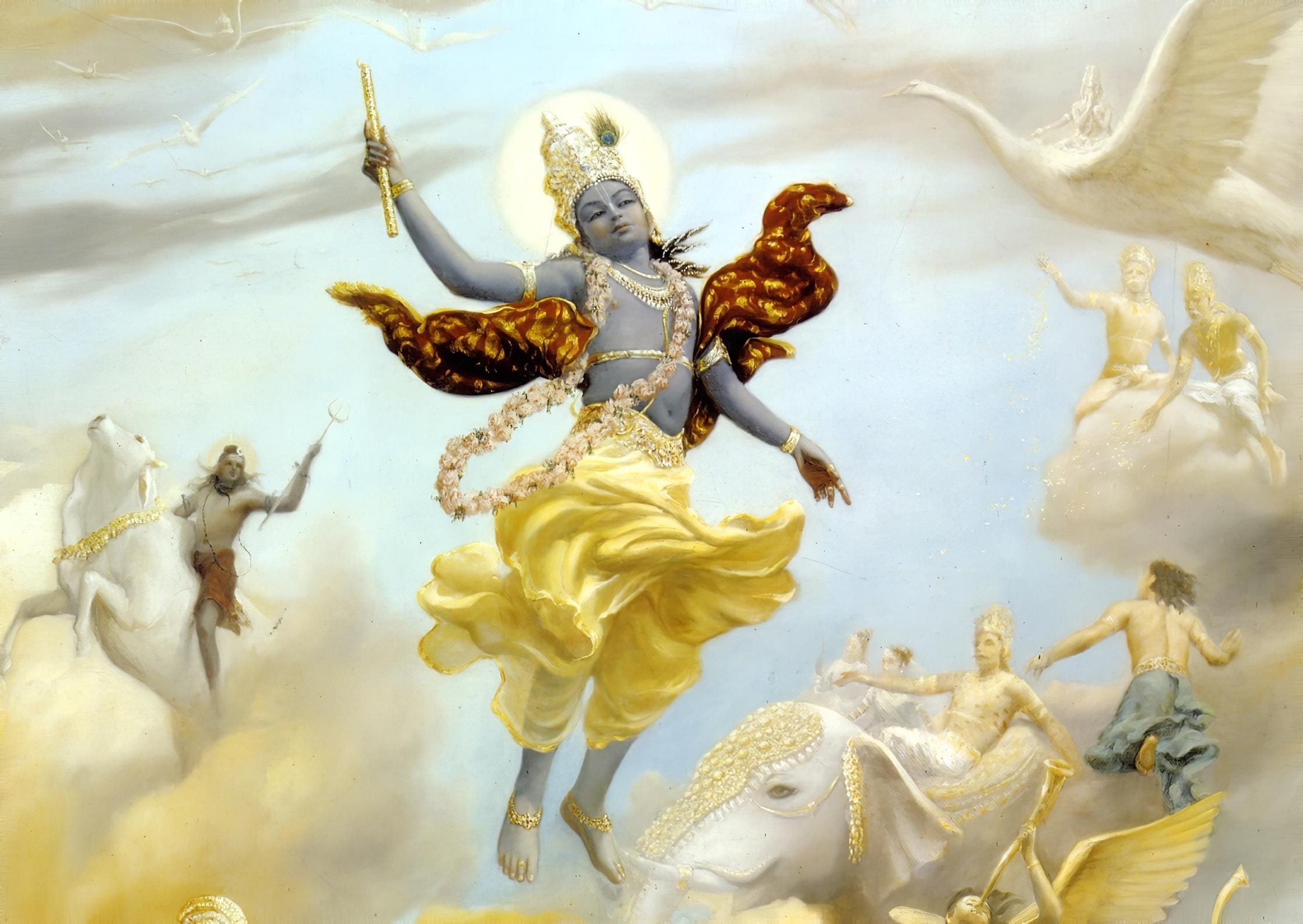
Kṛṣṇa can also expand in many forms, but there are two huge differences:
a) He can expand Himself in an unlimited number of forms, as He did to accept 16,108 wives. This was just a small demonstration in this particular universe. He does the same in millions and billions of other universes, sometimes marrying millions of wives at once.
b) Different from ordinary yogīs, each expansion of Kṛṣṇa is fully complete, just like the original. This is illustrated in the experience of Nārada Muni:
“Nārada then entered the palace of another of Lord Kṛṣṇa’s wives, my dear King. He was eager to witness the spiritual potency possessed by the master of all masters of mystic power. There he saw the Lord playing at dice with His beloved consort and His friend Uddhava. Lord Kṛṣṇa worshiped Nārada by standing up, offering him a seat, and so on, and then, as if He did not know, asked him, “When did you arrive? What can needy persons like Us do for those who are full in themselves? In any case, My dear brāhmaṇa, please make My life auspicious.” Thus addressed, Nārada was astonished. He simply stood up silently and went to another palace. This time Nāradajī saw that Lord Kṛṣṇa was engaged as an affectionate father petting His small children. From there he entered another palace and saw Lord Kṛṣṇa preparing to take His bath. In one place the Lord was offering oblations into the sacrificial fires; in another, worshiping through the five mahā-yajñas; in another, feeding brāhmaṇas; and in yet another, eating the remnants of food left by brāhmaṇas.”
Śukadeva Gosvāmī said: Thus in every palace Nārada saw the Lord in His same personal form, executing the transcendental principles of religion that purify those engaged in household affairs. Having repeatedly seen the vast mystic display of Lord Kṛṣṇa, whose power is unlimited, the sage was amazed and filled with wonder.” (SB 10.69.19-24,41-42)
Such power demonstrated by Kṛṣṇa can sound incredible for someone who hears it for the first time, but devotees get used to it. That’s just who Kṛṣṇa is. He is unlimitedly powerful, and therefore can perform such unbelievable feats.
What can be more surprising is that perfect devotees can also do something similar to a certain extent. They can also become many. See this passage from the Bṛhad-bhāgavatāmṛta describing the experience of Gopa-kumāra visiting Vaikuṇṭha:
“Some were with their families, some with an array of things, and others had left their families and things outside. Some had absorbed all that they had into themselves, and like beggars without possessions they came alone, immersed in the moods of devotional meditation. The Vaikuṇṭha devotees who preferred a more meditative mood of service hid, within their own transcendental bodies, the families and property Lord Nārāyaṇa had awarded them. So the devotees arriving in Vaikuṇṭha were full in all powers and showed the full range of devotional variegatedness in their pastimes of worshiping the Supreme Lord in perfect ecstasy. Some assumed different forms at different times, with all kinds of ornaments, bodily features, and ways of acting, all exceedingly attractive. The Vaikuṇṭha devotees not only acted in many different ways but also assumed many differing forms, including even those of animals, birds, and trees. Some devotees would show one form for some time and then change into another.” (Bb 2.4.34-36)
Later in the book, this is explained more explicitly to Gopa-kumāra by Nārada Muni:
“Just as the one Personality of Godhead Śrī Kṛṣṇa exists in many forms and many places, so also do we, His servants. So it is with all of us — Śrī Garuḍa and other attendants, devotees like Śrīmān Hanumān, and our friend Uddhava, and others too, like these Yādavas. All the Lord’s personal associates are at His hand like playthings. They are always fully dedicated to His service. Each assumes a variety of forms yet stays essentially one, just like the Lord Himself.” (Bb 2.5.52-54)
In his commentary, Śrīla Sanātana Gosvāmi mentions:
“Devotees like Garuḍa and Śeṣa are associates of the Lord of Vaikuṇṭha, whereas Hanumān, Jāmbavān, and others are servants of Lord Rāmacandra. Hanumān sings the glories of Lord Rāma in the Kimpuruṣa-loka of the Bhūloka region and simultaneously in the Ayodhyā of Vaikuṇṭha. And Uddhava, whom Gopa-kumāra can see right before him, is simultaneously one of the principal companions of Kṛṣṇa in Dvārakā on earth, along with the Yādavas, the Pāṇḍavas, and others. Considering the topic too confidential to bring up just now, Nārada chooses not to mention Kṛṣṇa’s devotees in Śrī Goloka. As Śrī Kṛṣṇacandra, the original Supreme Person, expands Himself into innumerable forms of Godhead, when required for service to the Lord His eternal associates can also expand themselves into many forms. Perpetually dedicated to worshiping Him, they are willing instruments in the enactment of His pleasure pastimes. Whatever gives the Lord happiness is also their satisfaction. So when He expands Himself and His abode into all sorts of forms, they accompany Him in suitably corresponding forms. Gopa-kumāra should therefore not be amazed that Nārada appears in many places at once for the service of the Lord.”
This makes the point that perfect devotees show the same opulences as Kṛṣṇa in a minute form, and this includes even the possibility of appearing in different forms simultaneously and performing different activities, both in different abodes of the spiritual world and in different places in the material universes. Just as Kṛṣṇa is one but becomes many, these devotees can also become many while remaining one.
There are also descriptions of great historical personalities being partial incarnations of perfect devotees. This shows how they can also create partial expansions that manifest only part of their transcendental opulences, as well as empower embodied souls with their power or devotion, enabling them to perform extraordinary activities.
This point is also revealed in the Bṛhad-bhāgavatāmṛta:
“Just as the demigods who have entered the material creation are counterparts of the Lord’s Vaikuṇṭha associates, those eternal associates from Vaikuṇṭha are incarnations of the Goloka devotees. Yet like the demigods themselves, those very devotees appear on earth now and again for the pleasure of Lord Viṣṇu when He wants to enjoy various pastimes. And just as the incarnations of Kṛṣṇa, the source of all incarnations, are nondifferent from Him, the incarnations of the Goloka-vāsīs, the residents of Goloka, are nondifferent from them. The Goloka-vāsīs are born sometimes as partial expansions and sometimes as their full selves. Like Kṛṣṇa, they vary their appearance for the time, place, and need.” (Bb 2.6.203-205)
In his commentary, Sanātana Gosvāmi explains that superficially, it may appear that many of the Vraja-vāsīs who appeared on earth during Kṛṣṇa’s pastimes were incarnations of demigods. It is mentioned, for example, that Nanda Maharaja was the incarnation of Droṇa, one of the eight Vasus. This is, however, just how it appears from the material perspective. In reality, it is the precise opposite. These demigods are partial incarnations of these perfect devotees, and when they come personally to join Kṛṣṇa’s pastimes, these partial incarnations merge into them, just like all Viṣnu forms merge into Kṛṣṇa when He personally comes.
The perfect associates from Goloka also expand themselves as Vaikuṇṭha-vāsīs to accompany the Lord in His pastimes there. As Kṛṣṇa expands Himself into Viṣnu, Nanda Maharaja, for example, expands himself as Śrī Nanda to accompany Him. Śrīmatī Rādhārāṇī expands herself as Lakṣmī-devī, and so on.
There is more: these same associates of Lord Nārāyaṇa, many of whom rule their own Vaikuṇṭha planets, expand themselves in the material world, appearing as the different demigods in all the different material universes. In this case, however, we are not speaking about direct personal incarnations, but about empowered living beings. The names of demigods, like Indra, Candra, Vāyu, and so on, are originally names of eternal associates in Vaikuṇṭha. These associates empower different living beings in different universes to act as demigods. These demigods also inherit their names. We have thus the original Indra, the eternal associate of Lord Nārāyaṇa, and the many Indras in different material universes, which are jīvas empowered by him.
There is then another side. Often jīvas who are empowered by eternal associates later join the lila as servants of the same associates. For example, the daughters of the demigods who desired to have Kṛṣṇa as their husband were empowered by the eternal gopīs to manifest pure devotion to Kṛṣṇa, and later took birth in Vraja as servants of the same gopīs and thus joined Kṛṣṇa’s eternal pastimes.
This is explained by Bhaktivinoda Thākura in chapter 32 of the Jaiva-dharma:
“Vijaya, “I can grasp this description of the sādhana-para-gopīs, now kindly explain who are the Devīs?”
Gosvāmī, “When the aṁśa, partial expansion, of Kṛṣṇa incarnates in Svarga as a Deva, the nitya–priyā–gopīs also appear there in their aṁśas as Devīs to please Kṛṣṇa. Similarly, when Kṛṣṇa appears in Vraja-gokula, in His pūrṇa–rūpa, full expansion, then these Devīs also take birth in Gokula as the young gopīs known as the prāṇa–sakhīs. The prāṇa–sakhīs engage as assistants of the nitya-priyā-gopīs who are the aṁśanīs, fountainhead sources, from whom these Devīs originally emanated as aṁśas for service to Kṛṣṇa in His forms as particular Devas in Svarga.”
The nitya–priyā–gopīs are the original, eternally perfect gopīs. They appear as the daughters of the demigods as aṁśas. In this particular case, the word is used in the sense of them empowering jīvas who attain perfection through the practice of sādhana with a small fragment of their potency.
This particular point is confirmed by Jīva Gosvāmi in the Kṛṣṇa-sandarbha (43), where he mentions both possibilities. Sometimes eternal associates can appear as expansions, which merge back into them when they personally come. In other situations, they can empower individual jīvas who later appear as separate associates, joining thus the lila.
Another category is formed by demigods appearing as incarnations, such as Yamarāja appearing as Vidura and Brahmā appearing as Haridāsa Thākura. In this case, it is usually the same soul accepting temporarily a different body to join Kṛṣṇa’s pastimes on earth and later returning to his position as a demigod. In the case of Yamarāja, for example, it is explicitly described that Aryamā temporarily assumed his post while he was present on earth as Vidura. In other cases, no replacement may be necessary. In the case of Brahmā, for example, 100 years on earth equal just 0.001 seconds of his time. Brahmā therefore became absent for just a fraction of a second in Brahmaloka to join Mahāprabhu’s pastimes and then resumed his duties. In these cases, a demigod may attain perfection as an associate of the Lord but still have to return to complete his duties before going back home, back to Godhead, just as a devotee from our planet will not simply drop dead after attaining pure devotion; he will still have to complete his allotted life.
The central point is that there are different mechanisms for the appearances of the eternal associates of the Lord. The essential background is simple: as the Lord expands Himself to perform His different pastimes, His eternal associates also expand themselves to accompany Him. However, they can do that in different ways, and thus when we try to examine it from a technical perspective, the topic quickly becomes confusing. The main point is to understand that in all cases the individuality of the soul is preserved.
No jīva merges into the associates (except in temporary circumstances, when two souls can temporarily share the same body used in service), and an associate does not divide himself into independent souls. When a partial manifestation is described as merging back into an associate, this means that the expansion is being absorbed into the original personality, not that one individual soul is merged into another.
Similarly, when a devotee is described as joining the pastimes as a servant of an eternal associate, it means a distinct jīva who has attained perfection through the mercy and empowerment of that associate, or, in some cases, another eternal associate who is related to the first. In either case, the individuality of the soul is preserved.
Read more:


Understanding the yoga-siddhis (the eight primary, ten secondary and five minor mystic perfections)
This is a publication for thoughtful readers who want to go deeper into Kṛṣṇa consciousness. I publish daily, trying to offer high-quality spiritual content, and all posts are available to free subscribers. If you wish, you can support this work with a monthly contribution. When you subscribe, you can choose between a free subscription and a monthly contribution, and you can switch from a free subscriber to a supporter at any time.
You can also receive updates on WhatsApp or Telegram.
If you would like to contribute further, you can find the donation links here.