

« Making Sense of the Vedic Universe, a Higher-Dimensional Reality
Chapter 8: The Hellish Planets
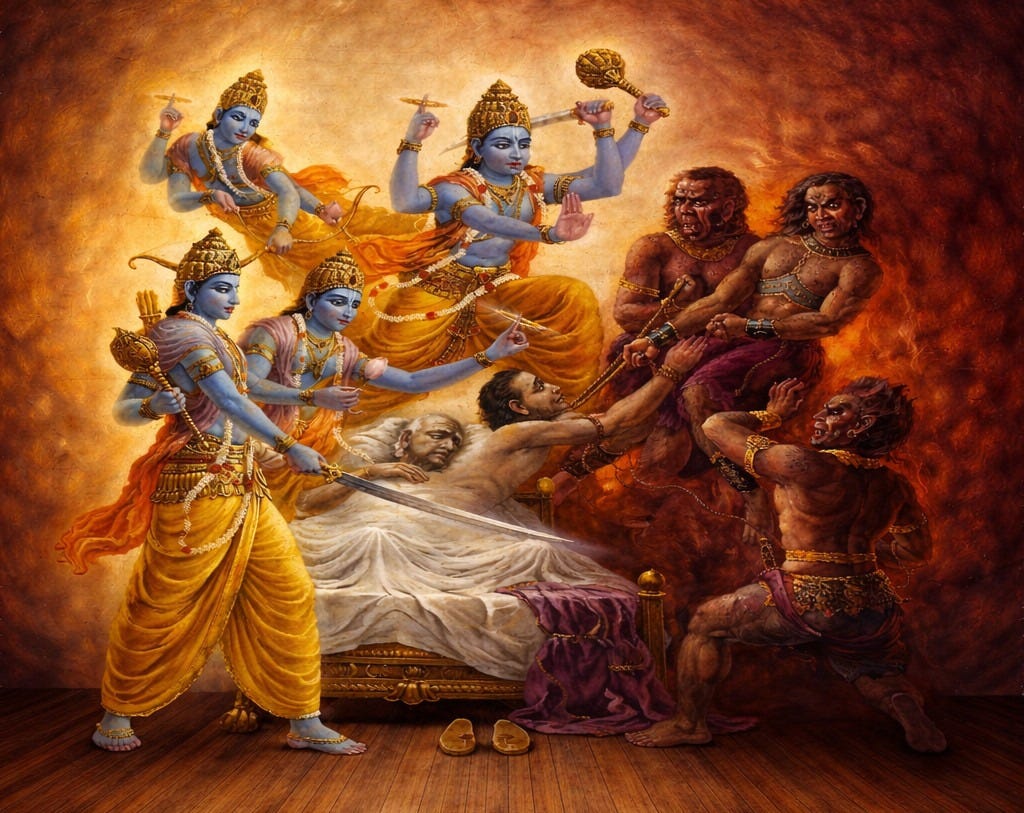
The description of hell in the Fifth Canto is another difficult section of the text. At first, the punishments described may appear barbaric or disproportionate, but it makes more sense when we understand that they are punishments for specific types of sins.
Just as in modern judicial systems, the punishment for a crime has to be significant to discourage people from committing it. If the punishment for stealing were just a small fine, every dishonest person would steal, calculating that if caught, the consequence would be minimal. If instead the punishment for stealing is 10 years in prison, people think twice.
In Vedic culture, people would know their duties and would also hear descriptions of the punishments for performing grossly immoral acts, and thus would learn to avoid them, understanding the consequences. It is not difficult to understand that one who kills animals or seduces the wives of others will have to face consequences for that.
The greatest risk of modern life is exactly this: because atheistic philosophies are so popular, and because even established religions more often than not fail to alert their followers to the dangers of animal cruelty and other activities, people are clueless about the consequences of their habits, and thus risk falling into very painful situations after death.
There is a phenomenon in modern medicine called terminal restlessness, or terminal agitation. People who are about to die commonly become restless, report seeing frightening figures and animals in the corners of the room or floating around the bed, and even being bound by them—visions that provoke great panic. This is not an occasional occurrence, but something very common and well-documented.
From the description of the scriptures, we can understand that these are visions of the Yamadūtas preparing to take the soul. The visions usually start a few days before death, and continue until one falls unconscious. Doctors and nurses are trained to deal with these episodes using sedatives; in this way they just put a person to sleep, trying to create the illusion of a peaceful death. This, however, does nothing to solve the underlying problem. Even if the physical body is put to sleep, one continues to experience the same in the subtle body.
Devotees who have the opportunity of being with relatives and other people in such a situation describe great improvement when they chant the holy names and give the dying person tulasī leaves, garlands from deities, and so on. This all matches the description of the protective power of the holy names, prasādam, and tulasī. Being engaged in hearing and chanting the holy names is the best way to save oneself from the Yamadūtas, even at the last moment, as described in the history of Ajāmila.
Just as in the case of the general cosmological model of the Vedas, hearing these descriptions can help people to escape from the dangerous path of atheism. By understanding the consequences of their acts, people gain the opportunity to take a different direction.
How devotees are protected
“King Parīkṣit inquired from Śukadeva Gosvāmī: My dear sir, why are the living entities put into different material situations? Kindly explain this to me.
The great sage Śukadeva Gosvāmī said: My dear King, in this material world there are three kinds of activities — those in the mode of goodness, the mode of passion and the mode of ignorance. Because all people are influenced by the three modes of material nature, the results of their activities are also divided into three. One who acts in the mode of goodness is religious and happy, one who acts in passion achieves mixed misery and happiness, and one who acts under the influence of ignorance is always unhappy and lives like an animal. Because of the varying degrees to which the living entities are influenced by the different modes of nature, their destinations are also of different varieties.” (SB 5.26.1-2)
In Western culture, people have, in general, an aversion to the idea of hell, perhaps due to Christianity having abused this idea for centuries. Even religious people often prefer to believe that people just go to heaven, or that we immediately reincarnate, without passing through any form of judgment. However, the Śrīmad-Bhāgavatam describes in detail the activities of Yamarāja and his servants, as well as the hellish worlds where they punish the sinful.
Prabhupāda explains the basic rationale in his purport to text five: “The conditioned souls, who have come to this material world for sense gratification, are allowed to enjoy their senses under certain regulative principles. If they violate these regulations, they are judged and punished by Yamarāja. He brings them to the hellish planets and properly chastises them to bring them back to Kṛṣṇa consciousness. By the influence of māyā, however, the conditioned souls remain infatuated with the mode of ignorance. Thus in spite of repeated punishment by Yamarāja, they do not come to their senses, but continue to live within the material condition, committing sinful activities again and again.”
We don’t live alone in the world. When our actions are not properly directed, we can create a lot of pain for others. Just as people who commit crimes are sent to jail, souls who commit serious sins are sent to hell for some time to be punished for them and thus corrected. The mistake in Christianity is the belief of hell as a place of eternal damnation, instead of a correctional facility.
Such hellish planets are part of the universal model described in the Bhāgavatam and part of the experience of conditioned souls in this world. They are thus included by Śukadeva Gosvāmi in his description of the universe, opening the door for Maharaja Parīkṣit to question how people can become free from such torments. This leads, in turn, to the description of the pastime of Ajāmila in the beginning of the Sixty Canto, which emphasizes the potency of the holy names.
Because of their devotional service, devotees are escorted to their next bodies (be they spiritual or material) by the Viṣṇudūtas. This is also described in the Bṛhad-bhāgavatāmṛta (2.3.85-91):
“Śrī Gaṇeśa said: ‘These are associates of the ruler of Vaikuṇṭha, the Supreme Lord Śrī Kṛṣṇa. They have attained bodily forms similar to His and have come here from Vaikuṇṭha itself. Just see these other Vaikuṇṭha companions of the Lord, traveling in this small universe ruled by four-headed Brahmā. And further away those others, moving swiftly in the universe of an eight-headed Brahmā, a world twice as large. And those others in the world of a Brahmā with sixteen heads, a world twice as large again.’
In this way Gaṇeśa showed me many Vaikuṇṭha companions of the Lord traveling with ease in the millions and billions of universes of multitudes of huge Brahmās, who had millions and billions of lotus faces. The Vaikuṇṭha devotees, attractive to the eyes and mind, all had suitable bodies and were suitably equipped for the universes they were visiting.
Śrī Gaṇeśa continued: These persons cherish only devotional service to the Lord. They travel as they please, spreading pure devotion everywhere. They save the Lord’s devotees from all fears, even at the time of death, if those devotees have but once had even a reflection of the Lord’s name on the tip of their tongues or the path to their ears.”
As Śrila Haridāsa Thākura explains, even chanting on the stage of Nāmābhāsa is capable of destroying one’s sins and bringing a person to the liberated platform, where there is no question of meeting the Yamadūtas. The history of Ajāmila, narrated in the Sixth Canto, is a vivid illustration of how one can be saved from hell even by chanting at the last moment.
Because Ajāmila was so sinful, the Yamadūtas were prepared to bring him to hell, but when they started snatching the soul from the body using their subtle ropes, the Viṣṇudūtas appeared carrying weapons and ordered them to release Ajāmila, or else. It happened that Ajāmila destroyed all his karma by desperately chanting the name of Narāyana at the last moment. Even though he chanted to call his son (and not directly addressing Lord Narāyana), because he chanted in full concentration, it was sufficient to free him from all his past sinful activities. By the time the Yamadūtas started taking the soul out of the body, he was indeed an innocent man, and thus the Viṣṇudūtas immediately appeared to protect him.
Read the whole book:
« Making Sense of the Vedic Universe, a Higher-Dimensional Reality
This is a publication for thoughtful readers who want to go deeper into Kṛṣṇa consciousness. I publish daily, trying to offer high-quality spiritual content, and all posts are available to free subscribers. If you wish, you can also choose a paid subscription to support this work.
You can also receive the updates on WhatsApp or Telegram.
If you would like to contribute further, you can find the donation links here.
Dear Caitanya Candra Prabhu: Please accept my respectful obeisances. Thank you very much for your explanations based on Srila Prabhupada's books. It is a great blessing for me to try to understand this transcendental science with expert devotees like you. And just to assist with your excellent service, I would like to mention a detail regarding one of the quotes: "Prabhupāda explains the basic rationale in his purport to text five." The purport you cite is actually found in the following verse, text six. Hare Krishna! All glories to Srila Prabhupada! From Argentina, your fallen servant, Bhakta Gustavo.