

Subscribe to receive new articles by e-mail. It’s free, but if you like, you can pledge a donation:
Even when we understand that we are not the body, we tend to identify with the emotions of the mind. Sometimes, using knowledge and deliberation, we can understand that we are also not the mind, but then we start thinking we are the intelligence. The Srimad Bhāgavatam, however, explains that this is also not our real self.
The material intelligence is something external to the soul, just like the physical body. It is something that we receive and use, and not a part of what we are. This material intelligence covers our real, spiritual intelligence, giving us the tools to act in the material world.
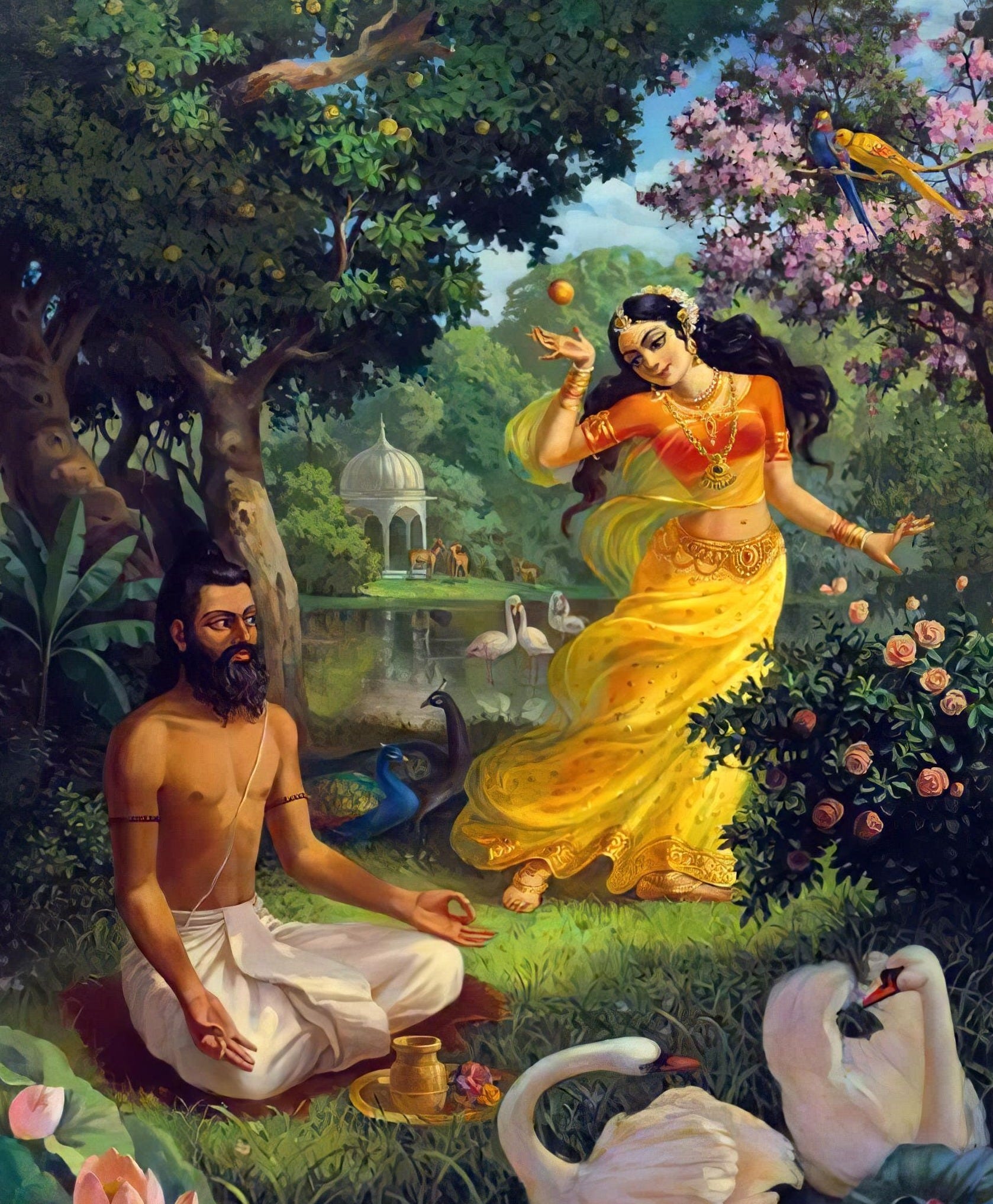
This relation between the soul and the material intelligence is described in the Fourth Canto of Srimad Bhagavatam, as part of the allegory of King Purañjana. After entering the city of the body, the soul meets a beautiful woman, who represents the material intelligence in the allegory.
“While wandering here and there in that wonderful garden, King Purañjana suddenly came in contact with a very beautiful woman who was walking there without any engagement. She had ten servants with her, and each servant had hundreds of wives accompanying him. The woman was protected on all sides by a five-hooded snake. She was very beautiful and young, and she appeared very anxious to find a suitable husband.” (SB 4.25.20-21)
After entering the body, Purañjana meets a beautiful girl, who represents the material intelligence. All the things that are attractive to the conditioned soul, such as the different material desires, plans, and possibilities of material enjoyment, are described as beautiful and attractive in the allegory, and similarly, the material intelligence is described as a young and attractive woman.
Although the mind is the center of material desires, the intelligence is the tool we use to understand the world and make plans to enjoy matter. Without intelligence, material enjoyment is not possible. All species of animals and even plants possess intelligence to a limited degree, but only in human life does this intelligence become developed enough to solve the real problems of life. In its pure state, the soul possesses transcendental intelligence that is used in the service of the Lord. In the material atmosphere, however, this transcendental intelligence becomes dormant, and we receive a substitute intelligence to act in the material world.
Although the soul can’t act materially and satisfy its desires without a material body, the body can’t act without the soul, because the soul brings consciousness to the body. The material intelligence also has no meaning without consciousness; thus, it is said that the beautiful woman was looking for a husband. Just as a man and a woman combine to enjoy the world, the combination of the soul and the material intelligence makes material enjoyment possible. The intelligence, however, is not a separate living entity, but is rather a tool that is given to the soul for its use. This, however, doesn’t prevent us from being captivated by it.
Although the mind can often overpower the intelligence, the natural order is that the intelligence guides the working of the mind. In the allegory of Purañjana, the intelligence is thus given more importance, and the mind is described as just a servant of it.
The ten servants of the woman represent the ten senses, and the hundreds of wives of each servant represent the innumerable sense objects and material desires connected with them. The five-hooded snake that protected the woman from all sides is the five vital airs that move the body.
Some passages of the scriptures are described from the point of view of men, since most sages are of the masculine gender, but in the case of this allegory, it is the same for both men and women. Any conditioned soul is considered masculine and described as puruṣa, because we all share the same propensity to enjoy matter. Therefore, men are puruṣa, and women are also puruṣa; they just try to enjoy in different ways. In both cases, man or woman, the soul is described as Purañjana, the male, entering the material body and enjoying together with the material intelligence and her servants, the senses.
The material intelligence brings us the possibility of enjoying the world using our senses, attaining things, and shaping our environment according to our purposes. The description of the physical characteristics of the woman illustrates our attraction to the power and possibilities granted to us, having a powerful brain that can learn and solve problems, etc.
Material desires often remain dormant until there is some opportunity for one to satisfy them. A boy who never saw a girl may not experience sexual desire, but as soon as a girl is present, the latent desires will awaken. Similarly, Purañjana becomes attracted to the woman, illustrating the attraction of the soul for material enjoyment as soon as the possibility emerges.
The intelligence is thus a double-edged sword. On the one hand, it gives us the possibility of understanding the scriptures, practicing devotional service, and going back to Godhead, but on the other hand gives us the opportunity of repeating the same search for material enjoyment we already went through so many times in the past, in each of the innumerable bodies we already accepted. This is a choice that every human being has.
Seeing the girl, Purañjana asks:
“My dear lotus-eyed, kindly explain to me where you are coming from, who you are, and whose daughter you are. You appear very chaste. What is the purpose of your coming here? What are you trying to do? Please explain all these things to me. My dear lotus-eyed, who are those eleven strong bodyguards with you, and who are those ten specific servants? Who are those women following the ten servants, and who is the snake that is preceding you?” (SB 4.25.25)
Prabhupāda explains that these questions reveal the purpose of human life: inquiring about the absolute truth. In animal life, there is no inquiry about the soul; one is just concentrated on satisfying basic material necessities, but now, after receiving human intelligence, the soul starts the process of inquiring about oneself, the reasons for one’s material condition, one’s origin, etc. Until we start this process of inquiry, it is explained that we haven’t crossed the threshold of human life: our consciousness is still at the animal level, even though in a human body.
The girl, however, has no direct answer for these questions:
“O best of human beings, I do not know who has begotten me. I cannot speak to you perfectly about this. Nor do I know the names or the origin of the associates with me. O great hero, we only know that we are existing in this place. We do not know what will come after. Indeed, we are so foolish that we do not care to understand who has created this beautiful place for our residence. My dear gentleman, all these men and women with me are known as my friends, and the snake, who always remains awake, protects this city even during my sleeping hours. So much I know. I do not know anything beyond this.” (SB 4.25.33-35)
This shows the inherent limitation of material intelligence: although it is the tool we receive to obtain knowledge, it can’t find answers to the important questions of life on its own, because its awareness is limited to the mind, senses, and sense objects. Since the senses are imperfect, and the material intelligence in itself is imperfect, it is impossible to obtain perfect knowledge through them. One will not even be able to find one’s own origin, what to say about understanding God and other spiritual topics? One may speculate for a hundred years and will simply come to the wrong answers.
The method for obtaining perfect knowledge through the imperfect material intelligence is by receiving it from a perfect source: from the scriptures and the association of devotees. As Krsna explains in the Bhagavad-Gītā, the process of obtaining spiritual knowledge starts by approaching a self-realized soul and inquiring.
However, Purañjana becomes overly attracted to his material intelligence. Everyone thinks that his intelligence is perfect, but the material intelligence is covered by ignorance, and by trusting it, one falls into materialistic life, or some kind of pious life, by following some mundane religious process, such as the worship of demigods. Even when one becomes attracted to self-realization, one’s speculative search will end in impersonalism. We can see that in the allegory, Purañjana becomes engaged in sense gratification and ends up going to hell and obtaining a new material body.
When one obtains transcendental knowledge, however, one can properly engage the intelligence in the service of the Lord, which allows us to attain real opulence and real happiness.
You can also donate using Buy Me a Coffee, PayPal, Wise, Revolut, or bank transfers. There is a separate page with all the links. This helps me enormously to have time to write instead of doing other things to make a living. Thanks!
Hare Krishna prabhuji...prabhuji can you also explain more about what is spiritual intelligence? How is it related to soul...
Also prabhuji can you write about where the different mundane roles we see today like physist, inventors, mathematicians etc fit in Varnashram?..I mean where will science fit? Many people have tendencies to go towards these things...where will such people fit?