

« The Song of God—Volume 1, chapters 1-6
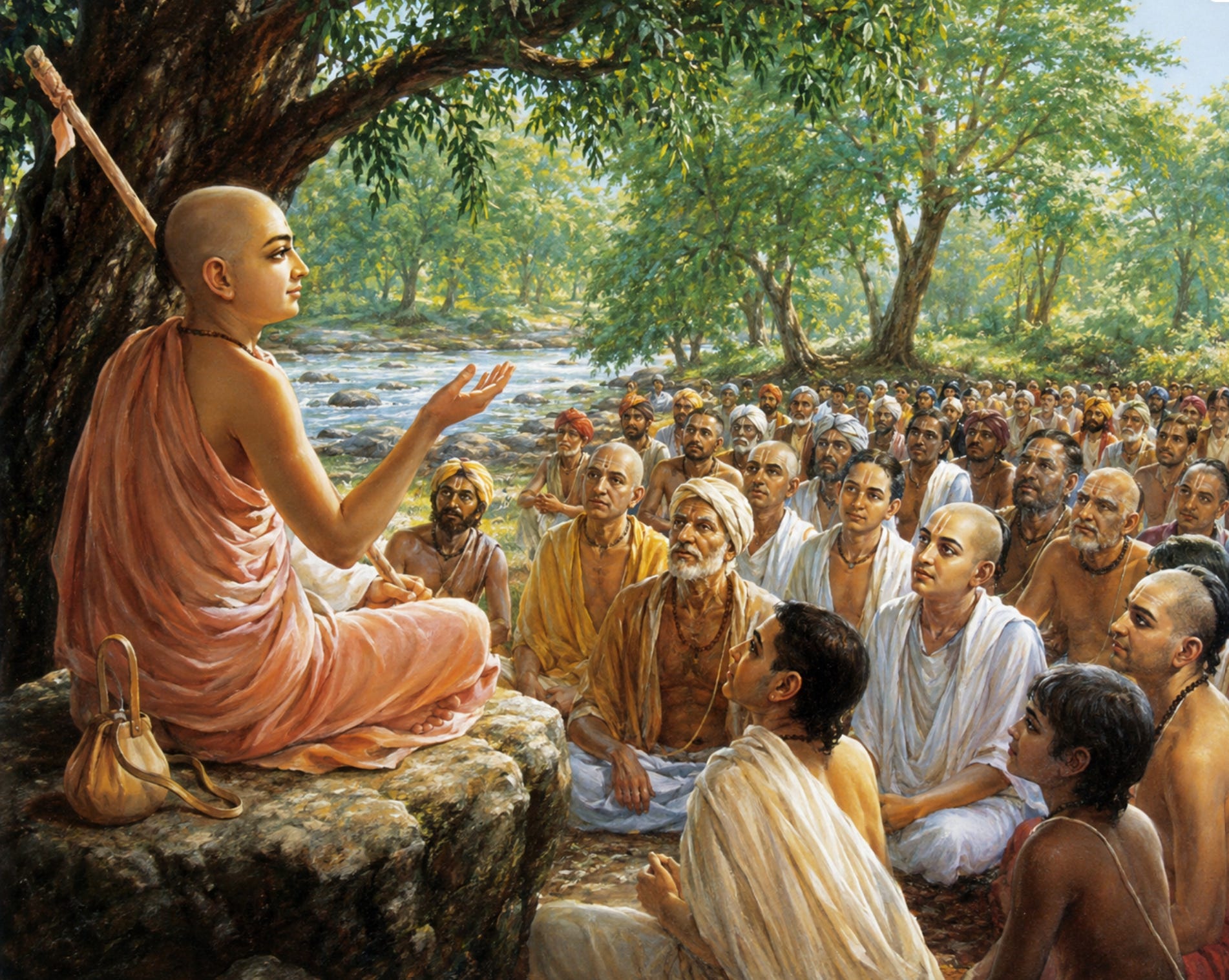
Q2: How does he speak? (Bg 2.56 and 2.57)
Text 56: duḥkheṣv anudvigna-manāḥ, sukheṣu vigata-spṛhaḥ
vīta-rāga-bhaya-krodhaḥ, sthita-dhīr munir ucyate
One who is not disturbed in mind even amidst the threefold miseries or elated when there is happiness, and who is free from attachment, fear and anger, is called a sage of steady mind.
Text 57: yaḥ sarvatrānabhisnehas, tat tat prāpya śubhāśubham
nābhinandati na dveṣṭi, tasya prajñā pratiṣṭhitā
In the material world, one who is unaffected by whatever good or evil he may obtain, neither praising it nor despising it, is firmly fixed in perfect knowledge.
We can see that in verse 2.56, Kṛṣṇa describes the self-realized devotee as “sthita-dhīr muni“. Ordinarily, the word muni is used in the sense of a mental speculator who creates many philosophical theories. Munis typically challenge each other and thus waste their time discussing without reaching any factual conclusion. The sthita-dhīr muni Kṛṣṇa mentions here, however, is a different type of muni, who has exhausted this process of mental speculation and has come to the point of surrendering to Kṛṣṇa, understanding that He is everything. In other words, the sthita-dhīr muni is a devotee who has come to the platform of devotional service from a platform of knowledge and, as a result, has become very firmly fixed on the platform of devotion.
Later in the Bhagavad-gītā, Kṛṣṇa explains that among the four types of persons who surrender to Him, the devotee who is in full knowledge and is therefore always engaged in devotional service is the best.
In texts 2.56 and 2.57, Kṛṣṇa answers Arjuna’s second question (how does he speak?), describing how the pure devotee responds to external circumstances, including the way others behave toward him and how he reacts to different practical situations. He does so by describing several additional characteristics:
a) He is equipoised in changing material conditions. He is not disturbed when there are difficulties, nor overjoyed in pleasant situations.
b) He is free from material attachment, fear, and anger.
c) Because he is fixed in perfect knowledge, he is unaffected by both good and evil, neither praising nor despising either.
All material conditions are felt through the mind. The senses capture information that is interpreted by the mind, creating our view of reality. The mind classifies material objects and situations as pleasant and unpleasant, desirable and undesirable, etc., and forces us to move in the material world, trying to obtain one set and avoid the other. When a person can obtain desirable things and avoid undesirable ones, according to the classifications of the mind, he judges himself to be happy and successful, and when the opposite happens, he considers himself poor and miserable. However, because these material conditions do not affect the soul, they are ultimately illusory, and therefore a pure devotee does not spend much energy on them, preferring to concentrate on his practice of devotional service to the Lord, which he may express both externally, through practical service, and internally, through meditation.
We can see, for example, that Prahlāda Mahārāja had little opportunity to perform practical devotional service since he was constantly watched by the demons, but this never prevented him from being constantly absorbed in the service of the Lord in his meditation. Mahārāja Ambarīṣa, on the other hand, being a king and having all facilities and freedom, was able to engage all his senses in different devotional activities, using his words to describe the glories of the Lord, his hands to clean His temple, his ears to hear about Kṛṣṇa, his eyes to see the Deity of Kṛṣṇa, and so on. From these two examples, we can see that no material situation is capable of preventing a pure devotee from serving the Lord in one way or another. In whatever condition a pure devotee is placed, he will use whatever facilities are available to continue his service to the Lord, even if only mentally.
Fear and anger come from attachment. Fear means anxiety over losing something we have, and anger comes from frustration at not obtaining something we desire. Because a self-realized devotee has no attachment, he becomes free from both fear and anger, as well as all forms of material lamentation. We can remember that in verse 2.16, Kṛṣṇa already defined temporary situations as asat (illusory, nonexistent) with the lines nāsato vidyate bhāvo, nābhāvo vidyate sataḥ. By fully understanding this instruction, a pure devotee becomes concerned with the permanent, not the temporary.
The word “duḥkheṣu” means being in material miseries, in the plural. Duḥkheṣu means literally “in misery” or “in painful situations”, but because there are no miseries on the spiritual platform, it is generally translated as “in material miseries”. Because there are three types of material miseries, Prabhupāda translates it as “in the threefold miseries”. The three types of material miseries are miseries coming from one’s own body and mind (such as different types of diseases), miseries caused by the actions of others, and miseries caused by superior forces, like natural disasters.
Prabhupāda explains that a pure devotee accepts any material miseries that may appear as the mercy of Kṛṣṇa, considering that he is actually eligible for much more trouble due to his past activities, but that Kṛṣṇa is protecting him by minimizing it to a minimum. Similarly, when pleasant situations appear, he is grateful to the Lord, considering himself unworthy of such facilities. In this way, we can see how a pure devotee is grateful in both circumstances, different from a neophyte who sees the Lord as an order supplier and may become angry when his plans are not fulfilled.
The second question of Arjuna was, “How does he speak?” In other words, how are his intelligence and words affected by others’ affection, anger, or neutrality? How does he respond to external sources of agitation?
In short, the answer is that a devotee is unaffected by material happiness or distress because his consciousness is fixed in spirit, not in matter. He does not fear losing what he has, nor does he fear not obtaining what he desires. His mind is thus steady in both good and bad circumstances, and thus he is always grateful. He is satisfied with what comes without effort by the grace of Kṛṣṇa, and he is thus peaceful and happy, with no need to disturb others.
Main points in the purports of Śrīla Prabhupāda:
“One who is not disturbed in mind even amidst the threefold miseries or elated when there is happiness, and who is free from attachment, fear and anger, is called a sage of steady mind.”
a) The word muni ordinarily applies to a mental speculator. The verse, however, refers to a very special type of muni. The sthita-dhīr muni is a sage who is always in Kṛṣṇa consciousness, having exhausted the process of mental speculation.
b) The sthita-dhīr muni has surpassed the stage of mental speculation and reached the conclusion that Vāsudeva, Śrī Kṛṣṇa, is everything. The word sthita-dhīr indicates a person fixed in mind.
c) Another symptom is that he is not disturbed by material miseries, seeing all difficulties as the mercy of the Lord. He sees that he is subjected to difficulties due to the results of his own past karma and that the Lord is minimizing such reactions, blunting the blows. Conversely, he sees that it is due to the mercy of the Lord that he can obtain comfortable material situations and thus remain happy in both.
d) Because he is not influenced by attachment and aversion, he can act daringly in the service of the Lord, perfectly engaging all the tools, talents, and resources at his disposal. Even when his attempts are not successful, he remains steady in his determination.
“In the material world, one who is unaffected by whatever good or evil he may obtain, neither praising it nor despising it, is firmly fixed in perfect knowledge.”
a) Because the material world is a place of duality, there is always the possibility of good and evil. This, however, does not affect a person fixed in Kṛṣṇa consciousness. Kṛṣṇa is all-good and absolute; therefore, a devotee fixed on Him is situated in a perfect transcendental position, in samādhi.
b) The capacity to remain unaffected by material upheavals is thus another symptom of a person in Kṛṣṇa consciousness.
Next: Q3: How does he sit? (Bg 2.58 to 2.63)
Read the entire book:
« The Song of God—Volume 1, chapters 1-6

This is a publication for thoughtful readers who want to go deeper into Kṛṣṇa consciousness. I publish daily, trying to offer high-quality spiritual content, and all posts are available to free subscribers. If you wish, you can also choose a paid subscription to support this work.
You can also receive the updates on WhatsApp or Telegram.
If you would like to contribute further, you can find the donation links here.